quick commerce Holi marketing 2026: Hyperlocal playbooks for Blinkit, Zepto, and Instamart that turn instant gratification color shopping into same-hour festival fulfillment
Estimated reading time: ~11 minutes
Key Takeaways
- Holi 2026 success hinges on hyperlocal personalization, inventory-aware creatives, and credible delivery windows.
- Dark store intelligence powers real-time substitutions and flash sales that prevent stockouts and lift conversion.
- Use platform-exclusive deals for Blinkit, Zepto, and Instamart to win in-app placement and micro-cluster relevance.
- Shift messaging from “10-minute delivery” to same-hour festival fulfillment to stay compliant and build trust.
- Measure ROI with geo-incrementality, holdouts, and through-play metrics tied to dark-store outcomes.
The landscape of Indian retail has undergone a seismic shift as we approach the festive peak of 2026. For enterprise brands, the primary challenge is no longer just visibility; it is the mastery of quick commerce Holi marketing 2026. As consumers move away from planned bulk purchases toward instant gratification color shopping, the ability to provide same-hour festival fulfillment has become the ultimate competitive moat. Brands that fail to synchronize their creative assets with real-time dark store inventory will find themselves sidelined in an era where the “10-minute delivery” promise has evolved into a sophisticated, hyperlocal logistics dance.
1. The 2026 Quick Commerce Landscape: From Speed to Precision
The Indian quick commerce sector has transitioned from an aggressive growth phase into a period of high-precision operational excellence. By March 2026, the dominance of platforms like Blinkit, Zepto, and Swiggy Instamart is absolute, particularly during high-velocity festivals like Holi. Recent data indicates that quick commerce now powers approximately 45% of all festive purchases in India, with Holi serving as the annual apex for categories like organic colors, snacks, and beverages.
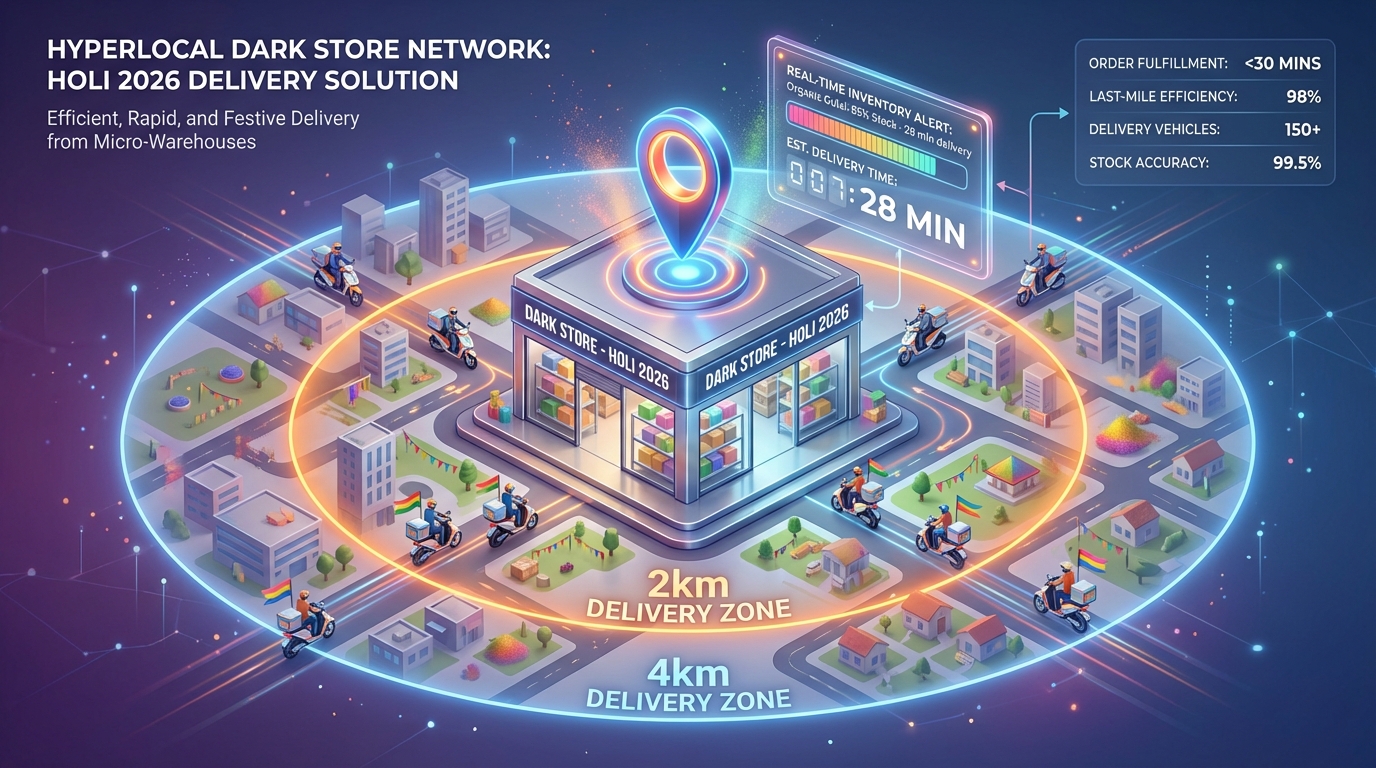
This shift is driven by a denser network of dark stores—closed-to-public micro-warehouses optimized for rapid picking and packing. These facilities serve a limited radius, typically 2–4 kilometers, allowing for the neighborhood Holi flash sales that define modern consumer behavior. However, the regulatory environment has also matured. Following government guidance to move away from rigid “10-minute” claims, the industry has pivoted toward same-hour festival fulfillment, focusing on credible, location-based delivery windows that prioritize safety and reliability over raw speed.
Furthermore, the 2026 market is characterized by aggressive expansion into Tier II and Tier III towns. This regionalization requires a fundamental change in how brands approach their digital presence. It is no longer enough to run a national campaign; success now depends on rapid delivery personalization that speaks the local dialect and reflects the specific inventory levels of the nearest dark store. Platforms like TrueFan AI enable brands to bridge this gap by generating thousands of personalized, inventory-aware video assets that resonate with diverse micro-clusters across the country.
Sources:
- ETBrandEquity research report (Dec 2025) on festive purchase dominance
- Inc42 (Jan 2026) on the competitive phase of quick commerce
- Forbes India (Jan 2026) on the shift from 10-minute delivery claims
2. Hyperlocal Mechanics: Driving instant shopping conversion Holi
To achieve a high instant shopping conversion Holi, brands must deploy a suite of hyperlocal mechanics that trigger immediate action. These are not generic marketing tactics but data-driven interventions that leverage the unique architecture of quick commerce platforms.
Location-Based Urgency Triggers
These are dynamic prompts that tie a user’s specific pin code or micro-cluster to short-lived offers. For example, a user in Andheri West might receive a notification stating, “Only 45 minutes left for 2x cashback on organic gulal at your nearest store.” These triggers are powered by real-time inventory velocity and time-of-day data, ensuring that the urgency is authentic and the product is actually available for immediate dispatch.
Neighborhood Holi Flash Sales
In 2026, the most successful brands are those running 60–120 minute localized price drops. These neighborhood Holi flash sales are targeted specifically to housing societies or colonies within a 2 km radius of a well-stocked dark store. By narrowing the geographic focus, brands can offer deeper discounts or exclusive bundles without the risk of stockouts across the wider city network.
Real-Time Inventory Alerts
Nothing kills conversion faster than an “Out of Stock” message at the final checkout stage. real-time inventory alerts solve this by integrating live stock signals into the creative itself. If a specific dark store is low on “Rose Pink Gulal,” the ad creative automatically switches to promote “Marigold Yellow,” which remains in high supply. This level of dark store festival marketing ensures that every ad impression has a high probability of resulting in a completed transaction.
Rapid Delivery Personalization
This involves merging a user’s pin code, purchase history, and platform preference (e.g., a “Zepto Loyalist”) into a single personalized experience. The creative reflects the exact ETA for that user's specific location—whether it is 28 minutes in Kalyani Nagar or 42 minutes in Indiranagar—creating a seamless path from intent to fulfillment. (rapid fulfillment personalization strategies)
Sources:
- Logistics Insider (Jan 2026) on inventory intelligence and micro-cluster routing
- MediaBrief/Unicommerce (Jan 2026) on evolving e-commerce trends and fulfillment expectations
3. The Creative System: Hyperlocal gulal delivery videos and Personalization
The visual language of Holi marketing in 2026 has moved beyond static banners. The gold standard is now the use of hyperlocal gulal delivery videos. These are short-form, high-impact video assets that are dynamically generated to include regional language, local landmarks, and real-time delivery data.
Scaling Personalization with AI
TrueFan AI's 175+ language support and Personalised Celebrity Videos allow brands to create a sense of trust and intimacy that was previously impossible at scale. Imagine a campaign where a celebrity or a relatable local influencer addresses the user in their native tongue—be it Marathi, Bengali, or Telugu—mentioning their specific neighborhood and the availability of organic color quick delivery. This level of personalization significantly lifts engagement rates and reduces the cost per acquisition.
Virtual Reshoots and Iteration
One of the biggest bottlenecks in festive marketing is the inability to change creative assets once the campaign has launched. In 2026, enterprise brands use virtual reshoots to iterate on offer lines without needing a new production cycle. If a “Buy 1 Get 1” offer is underperforming compared to a “₹120 Cashback” deal in a specific city, the brand can swap the dialogue and text overlays in the video assets across thousands of variants in under 30 seconds.
Shoppable Flows and Accessibility
Every creative asset must serve as a direct gateway to purchase. This includes deep-link CTAs that take the user directly to a pre-filled cart on Blinkit or a specific category page on Instamart. To ensure maximum reach, these videos must also be accessible, featuring high-contrast subtitles and concise on-screen timers that reinforce the same-hour festival fulfillment promise.
Sources:
- YourStory (Jan 2026) on regionalization and consumer spend shifts
- India Digital Advertising (Nov 2025) on linking ad impressions to instant conversion
4. Offer Architecture: Platform-exclusive Holi deals and Compliance
Designing the right offer for Holi 2026 requires a balance between aggressive sales tactics and strict adherence to new consumer protection guidelines. The focus has shifted from “cheapest” to “most convenient and reliable.”
Platform-Exclusive Holi Deals
To maximize visibility on the apps, brands must create platform-exclusive Holi deals. For instance, a “Blinkit-only” bundle might include organic gulal, a white t-shirt, and wet wipes, while a “Zepto-only” deal focuses on a pichkari and snack combo. These exclusives help brands negotiate better placement within the app's ecosystem, such as sponsored tiles and “Holi Special” category headers.
Price Fences by Micro-Cluster
In 2026, pricing is no longer static across a city. Brands employ price fences based on dark store proximity and inventory levels. A society located within 1.5 km of a dark store might receive a “Near-Store Bonus” of an extra 5% discount, incentivizing users who are guaranteed the fastest delivery times. This strategy optimizes the delivery fleet's efficiency while rewarding the most profitable micro-clusters.
Navigating Compliance in 2026
With the government's crackdown on misleading “10-minute” claims, brands must be meticulous with their phrasing. Instead of promising 10-minute delivery festival offers India, the messaging should focus on “same-hour festival fulfillment” with transparent, real-time ranges. For example: “Typically delivered in 25–45 minutes in your area.” This builds long-term trust and avoids the legal pitfalls that many early quick-commerce adopters faced.
Organic Color Quick Delivery
As health consciousness peaks in 2026, the demand for certified organic colors has skyrocketed. Marketing should emphasize the safety and authenticity of these products, using badges and certifications within the creative to reassure parents and skin-conscious Gen Z consumers. Ensuring organic color quick delivery is not just a logistics challenge but a trust-building opportunity.
Sources:
- Forbes India (Jan 2026) on compliance and delivery promises
- ETBrandEquity (Mar 2025) on Blinkit’s successful nostalgia-led Holi creative
5. Platform-Specific Playbooks: Blinkit, Zepto, and Swiggy Instamart
Each quick commerce platform has a distinct user demographic and operational style. A one-size-fits-all approach will lead to wasted ad spend.
The Blinkit Playbook: Nostalgia and Neighborhoods
Blinkit’s strength lies in its ability to tap into the “neighborly” aspect of Indian festivals. Their 2025 campaigns successfully used gujiya-led storytelling to drive basket builds. In 2026, brands should focus on society-specific shout-outs and “Blinkit-only” family bundles. Using TrueFan AI to create videos that mention specific society names can lead to a massive spike in local engagement.
The Zepto Playbook: Speed and Youth Culture
Zepto continues to dominate the younger demographic, particularly in “Campus” and “PG” micro-clusters. The creative here should be fast-paced, using a mix of Hindi-English slang and focusing on late-night “color prep” or last-minute party essentials. Offers should include subscription or loyalty boosters that appeal to high-frequency Gen Z users.
The Swiggy Instamart Playbook: Wit and Pairings
Instamart is known for its witty, context-aware OOH and digital campaigns. Brands should align with this tone by using clever copy in local dialects. A winning strategy on Instamart involves pairing snacks and beverages directly with colors—for example, “Thandai + Gulal” combos that appear as suggested add-ons during the checkout flow.
Solutions like TrueFan AI demonstrate ROI through their ability to deploy these platform-specific creatives at a scale that manual production could never match, ensuring that every micro-segment receives a tailored message that drives action. For a broader overview of Blinkit Zepto festival campaigns, see the enterprise playbook.
Sources:
- Media4Growth (Mar 2025) on Swiggy Instamart’s witty brand-on-brand OOH
- ETBrandEquity (Mar 2025) on Blinkit's creative strategy
6. Measurement and ROI: Tying Creative to the Dark Store
The final piece of the quick commerce Holi marketing 2026 puzzle is a robust quick commerce ROI measurement framework. Traditional e-commerce metrics are insufficient for the high-velocity, hyperlocal nature of quick commerce.
Instrumentation and Tracking
To accurately measure success, brands must implement a sophisticated tracking stack:
- UTMs and Partner Pixels: Every deep link must be tagged to track the journey from a personalized video to a completed purchase.
- MMP Events: Monitor the full funnel—from view and app open to PDP view, add-to-cart, and final transaction.
- Neighborhood Holdouts: To measure true incrementality, brands should withhold flash sales and personalized ads in 10% of randomized pin codes. This allows for a clear comparison of sales lift in targeted vs. non-targeted areas.
KPIs for 2026
Success should be measured through:
- Conversion Rate Uplift: The percentage increase in orders from users who viewed a hyperlocal gulal delivery video vs. a generic banner.
- Geo-Incrementality: The specific sales lift within a 2 km radius of a dark store during a neighborhood Holi flash sale.
- Substitution Acceptance Rate: How often users accept a suggested alternative when their first choice is out of stock, driven by real-time inventory alerts.
- CPTV (Cost Per Through Play): For video variants, measuring how much of the personalized content is actually consumed before the user clicks “Buy Now.”
By tying creative exposures directly to same-day orders and SKU-level outcomes, brands can justify their investment in high-tech personalization and hyperlocal logistics.
7. Holi 2026 Launch Checklist and FAQ
As March 3, 2026, approaches, marketing teams must ensure their operational “war room” is ready for the surge.
The 7-Day Launch Countdown
- T-7 Days: Finalize 10+ creative variants per micro-cluster; verify local slang and dialect accuracy.
- T-5 Days: Test real-time inventory feeds; ensure scarcity triggers (e.g., “Last 50 units”) are active and accurate.
- T-3 Days: Load society-level geo-fences and verify flash sale timers.
- T-1 Day: Activate pre-Holi “prep” campaigns; monitor dark store stock levels for top-selling organic colors.
- Holi Day: Real-time optimization of ad spend based on dark store velocity; deploy “virtual reshoot” offer changes if needed.
Frequently Asked Questions
What has replaced the “10-minute delivery” messaging in 2026?
Due to regulatory shifts, brands now use “same-hour festival fulfillment.” This focuses on providing a realistic delivery range (e.g., 25–55 minutes) based on the user's specific pin code and the live load on the nearest dark store.
How can we ensure the authenticity of organic color quick delivery?
Use certified organic SKUs and prominently display safety badges in your creative. TrueFan AI can incorporate these trust signals into personalized videos, along with clear information on easy returns and skin-safety certifications.
How do we manage stockouts during the peak “Color Hour” on March 3?
Deploy real-time inventory alerts to automatically update ads. If a product goes out of stock, switch creative to a pre-approved substitution and add a small benefit (e.g., next-order discount) to maintain satisfaction.
Is it possible to run different offers for Blinkit, Zepto, and Instamart simultaneously?
Yes. Platform-exclusive Holi deals are recommended. Use a centralized setup to manage distinct creative sets and price fences per app to maximize visibility across the ecosystem.
How does TrueFan AI help in measuring quick commerce ROI?
TrueFan AI provides dashboards that segment performance by language, pin code, and personalization elements. This reveals which hyperlocal triggers drive the highest conversion lift and ROI, tied to dark-store outcomes.