Quick Commerce Festival Marketing 2026: A Holi-Ready Hyperlocal Playbook for Blinkit, Zepto, and Instamart
Estimated reading time: ~9 minutes
Key Takeaways
- Activate a Holi-ready festival flywheel by aligning demand, hyperlocal inventory, and retail media with real-time ETAs to boost trust and conversion.
- Build dark store marketing automation with live inventory data pipes, SLA-based decisioning, and dynamic creative linkage for ROAS lift.
- Scale 10-minute personalization by PIN code using SLA overlays, neighborhood bundles, and multilingual variants powered by TrueFan AI.
- Run hyperlocal flash sales in peak windows and tailor platform playbooks for Blinkit, Zepto, and Instamart.
- Measure incrementality with geo-lift tests and execute a disciplined T-21 rollout plan to win Holi demand.
The landscape of quick commerce festival marketing 2026 has evolved into a high-stakes battle for the “Holi quick commerce campaigns” crown, where winning requires mastering 10-minute delivery personalization and hyperlocal flash sales India. Quick commerce festival marketing 2026 guide. As the festival of colors approaches, the 10-minute economy is no longer just about convenience; it is the primary engine for instant gratification marketing. For enterprise brands, the goal is clear: transform high-intent festival demand into same-hour festival delivery through a sophisticated hyperlocal stack.
In 2026, the Indian quick commerce market is projected to reach a staggering US$6.94 billion in revenue, driven by a hyper-competitive phase where dark store density and AI-led shopping behaviors dictate market share. Brands that fail to synchronize their retail media with real-time inventory videos risk losing the crucial T-3 to T-day window when consumer spending peaks. This playbook outlines the strategic framework for Heads of Growth and Retail Media Leads to execute, measure, and scale instant shopping conversion during Holi and beyond.
The Festival Flywheel: Driving Instant Shopping Conversion
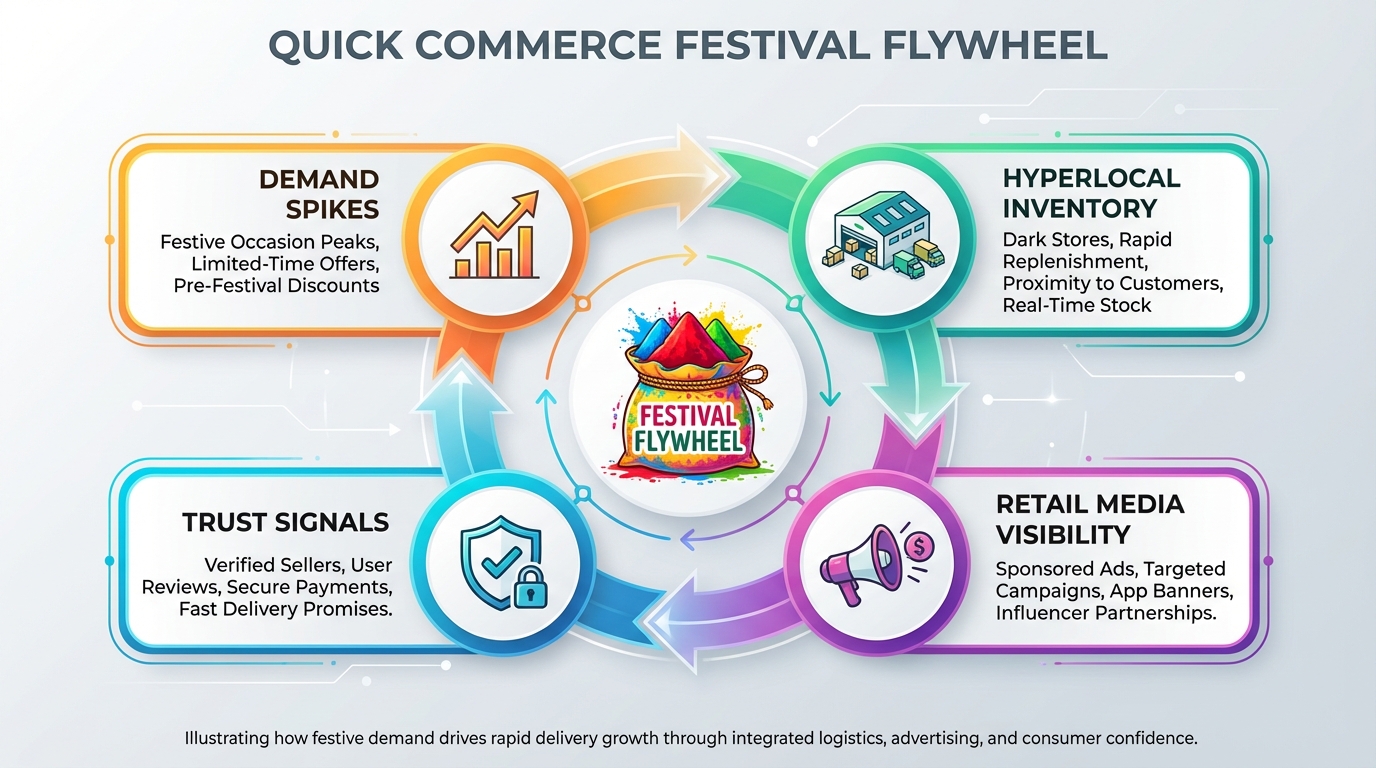
The quick commerce festival flywheel is a self-reinforcing loop where demand, inventory, and creative execution converge to drive rapid conversion. During Holi, this flywheel spins at unprecedented speeds. Shoppers typically seek last-minute essentials—organic gulal, pichkaris, sweets, and even white t-shirts—expecting them to arrive before the first splash of color.
- Demand Spikes: High-intent traffic surges 3x to 5x in the 72 hours leading up to Holi.
- Hyperlocal Inventory: Micro-fulfillment via dark stores ensures that products are physically located within 2-3 kilometers of the consumer.
- Retail Media Visibility: Platform-exclusive deals and search tiles push brand visibility at the point of purchase.
- Trust Signals: Real-time ETAs and stock indicators reduce friction, leading to one-session conversion.
According to industry data, quick commerce platforms like Blinkit and Swiggy Instamart saw record-breaking sales of colors and sweets during previous Holi weekends, with 2026 trends suggesting an even deeper penetration into premium categories. Reliability is the ultimate currency; when a customer sees a “12-minute delivery” promise for a Holi kit, the conversion rate increases by up to 40% compared to standard delivery windows.
Sources:
- Storyboard18: Holi 2024 sales surge for quick commerce
- ET Tech: Record sales of colors and sweets
- Statista: India quick commerce revenue 2026
Infrastructure: Dark Store Marketing Automation and the Hyperlocal Stack
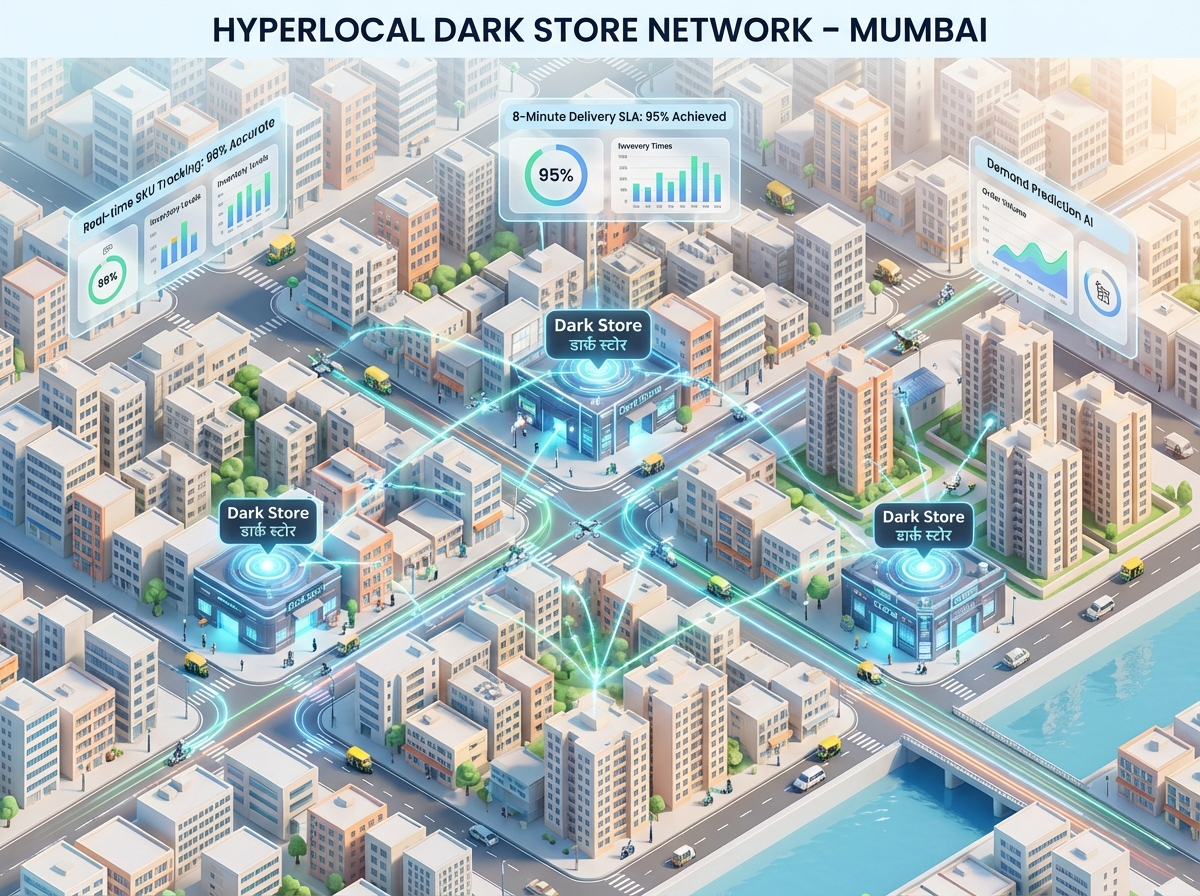
To succeed in quick commerce festival marketing 2026, brands must move beyond national-level campaigns and embrace dark store marketing automation. This involves store-level triggers that adjust budgets and creatives based on real-time variables like rider capacity, SKU availability, and local demand curves.
A robust hyperlocal stack for Holi 2026 requires:
- Inventory Data Pipes: Real-time synchronization between dark store stock levels and ad servers. If a specific brand of thandai mix goes out of stock in Indiranagar, the ad must instantly swap to an available alternative.
- SLA-Based Decisioning: Automated rules that throttle ad spend in PIN codes where delivery times exceed 30 minutes. High ETAs are conversion killers; shifting budget to stores with <15-minute SLAs maximizes ROAS.
- Dynamic Creative Linkage: Using real-time inventory videos that automatically update pricing and “limited stock” badges based on the specific dark store serving the user.
The “dark store revolution” has redefined retail infrastructure in India, moving from nodal fulfillment to a dense network of micro-warehouses. In 2026, the most successful brands are those that treat each dark store as a unique market, tailoring neighborhood-specific offers to match local demographics and stock profiles.
Sources:
- Berkeley CMR: The dark store revolution
- Logistics Insider: Five trends driving quick commerce in 2026
Personalization for 10-Minute Delivery: Beyond the First Name
In the context of Holi, 10-minute delivery personalization goes far beyond simply using a customer's name. It requires rapid fulfillment personalization—customizing the entire shopping experience based on the user's specific PIN code, the current weather (crucial for Holi), and the real-time rider density in their neighborhood. Rapid fulfillment personalization strategies.
Key tactics for Holi 2026 include:
- SLA Overlays: Displaying “Delivering to Sector 56 in 11 minutes” directly on video ads. This builds immediate trust and leverages the “instant” in instant gratification marketing.
- Location-Based Urgency Triggers: Countdown timers tied to store cut-off times. For example, “Order in the next 08:45 to get your Holi colors before the 10 AM party starts.”
- Neighborhood-Specific Bundles: Auto-assembling festive kits based on what is trending in a specific locality. A “Bandra Holi Brunch Kit” might differ significantly from a “Gurgaon Sector 43 Party Pack” in terms of SKU composition and price point.
Platforms like TrueFan AI enable brands to scale this level of personalization by generating thousands of video variants that mention specific neighborhoods and real-time delivery promises. By localizing content into regional dialects—Hindi, Marathi, Bengali, or Tamil—brands can penetrate Tier II clusters where quick commerce is seeing its fastest growth in 2026. Quick commerce video personalization in India.
Sources:
Designing Hyperlocal Flash Sales India: Timing and Mechanics
Hyperlocal flash sales India are the primary tool for managing demand spikes while maintaining high SLAs. Instant shopping video triggers. During Holi, these sales should be scoped to specific neighborhoods and timed to coincide with peak “panic buying” windows.
Effective mechanics for Holi flash sales:
- The “Pre-Party” Window: T-1 day, 5 PM to 8 PM. Target commuters heading home who realized they forgot sweets or gulal.
- The “Morning-Of” Spike: T-day, 8 AM to 11 AM. Focus on last-minute replenishment and “emergency” items like skin-safe wipes or extra snacks.
- Dynamic Pricing Rules: Increase discounts in PIN codes where inventory headroom is high, but throttle promotions in areas where rider capacity is stretched thin to protect the brand's delivery promise.
Successful Holi campaigns often feature co-branded bundles. For instance, a partnership between a skincare brand and a snack brand can create a “Holi Protection & Party Kit,” sold exclusively on platforms like Zepto or Blinkit. These platform-exclusive deals not only drive sales but also improve the brand's organic ranking within the platform's search algorithm.
Sources:
- ImpactOnNet: Havmor x Swiggy Instamart Thandai launch
- Media4Growth: Swiggy Instamart witty OOH campaign
Platform Strategy: Blinkit, Zepto, and Instamart Playbooks
Navigating Blinkit Zepto partnerships requires a nuanced understanding of each platform's unique retail media ecosystem. 10-minute delivery festival personalization. In 2026, retail media has become the fastest-growing advertising channel in India, with platforms offering sophisticated self-serve portals for brand managers.
Blinkit Strategy
Blinkit remains the market leader in efficiency and curated assortments. For Holi, brands should focus on:
- Bistro & Curated Collections: Aligning premium SKUs with Blinkit’s curated festive “stores” within the app.
- SLA Badging: Leveraging Blinkit’s high dark store density to emphasize ultra-fast delivery in Tier I metros.
Zepto Strategy
Zepto’s growth is fueled by its aggressive expansion and robust brand portal. Key plays include:
- Criteo x Zepto Integration: Utilizing advanced retail media performance tools to optimize search and display ads in real-time.
- IPO-Year Aggression: Taking advantage of Zepto’s 2026 scale-up phase to negotiate high-visibility placements and co-branded “Zepto Pass” exclusives.
Swiggy Instamart Strategy
Instamart excels in creative “banter” and high-engagement placements.
- Cart Interstitials: Using the moment of checkout to suggest high-margin Holi add-ons like premium sweets or organic colors.
- OOH Synergy: Aligning digital quick commerce ads with Swiggy’s witty out-of-home campaigns for maximum brand recall.
Sources:
- Zepto Brand Portal
- Criteo and Zepto partner to drive quick commerce
- Exchange4Media: Quick commerce ad monetization
Creative System: Real-Time Inventory Videos and Modular Content
The most effective creative asset for quick commerce festival marketing 2026 is the real-time inventory video. These are short-form, data-driven videos that dynamically overlay live SKU availability, local pricing, and neighborhood tags. Instant shopping video funnels.
TrueFan AI's 175+ language support and Personalised Celebrity Videos allow brands to create these assets at scale. Imagine a Bollywood star addressing a user in Indiranagar, mentioning that their favorite organic gulal is available for delivery in 12 minutes, all in the user's native language. This level of hyper-personalization drives significantly higher watch-through rates and conversion lifts.
Creative modules for a Holi video system should include:
- Geo-Overlays: “Now delivering in Koramangala” or “Sector 56, Gurgaon.”
- SLA Badges: Dynamic timers showing “~10 min delivery.”
- SKU Swap Logic: If the primary Holi kit sells out, the video automatically swaps the visual to the next best available bundle.
- Virtual Reshoots: Iterating on offer percentages (e.g., 10% vs 20% off) without needing a new celebrity shoot.
Solutions like TrueFan AI demonstrate ROI through variant-level analytics, allowing brands to see exactly which neighborhood tag or language variant is driving the highest conversion within the 60-minute festival shopping window.
Sources:
Measurement and Incrementality: The 2026 Standard
In 2026, simply looking at ROAS is insufficient. Enterprise brands must measure the incrementality of their Holi campaigns through sophisticated geo-lift tests. This involves holding out specific PIN codes or store clusters to isolate the true impact of quick commerce marketing. 10-minute delivery festival personalization.
Key KPIs for Holi 2026:
- Instant Shopping Conversion Rate: The percentage of users who complete a purchase within the same session as the ad click.
- Geo-Lift: The percentage increase in sales in exposed PINs versus control PINs, normalized for baseline festive demand.
- ETA Variance Impact: Analyzing how conversion rates drop as delivery times increase from 10 to 30 minutes.
- T+7 Repeat Rate: Measuring how many first-time Holi shoppers return to the platform within a week for replenishment.
By integrating CRM and CDP data, brands can trigger personalized WhatsApp videos for cart abandonment during peak Holi hours. If a user leaves a “Holi Party Bundle” in their cart, an automated nudge featuring a celebrity reminder can be the difference between a lost sale and a completed order. Instant shopping video funnels.
Holi Quick Commerce Campaigns: The T-21 Rollout Plan
A successful Holi campaign requires a disciplined 3-week rollout: Holi quick commerce strategies and Quick commerce Holi marketing 2026.
- T-21 to T-14 (Preparation): Finalize platform Joint Business Plans (JBPs). Lock in platform-exclusive deals and define neighborhood-specific offers. Instrument data feeds for dark store marketing automation.
- T-13 to T-7 (Production): Produce and QA real-time inventory videos. Configure SLA overlays and urgency timers. Set up retail media flights and UTM taxonomy for granular tracking.
- T-6 to T-1 (Ramp-up): Launch hyperlocal flash sales India in high-potential PIN codes. A/B test urgency scripts and simulate stockout swaps.
- T-Day (Execution): Spike push notifications and WhatsApp messages. Prioritize stores with <15-minute SLAs. Use strict budget caps for stores where ETAs exceed 30 minutes.
- T+1 to T+2 (Retention): Retarget with “post-Holi cleanup” kits (skincare, laundry detergents). Analyze geo-lift and repeat purchase data.
Conclusion: The Future of Hyperlocal Engagement
As we look toward quick commerce festival marketing 2026, the integration of AI, real-time data, and micro-fulfillment has created a new standard for brand engagement. Holi is the ultimate testing ground for these technologies. By mastering the festival flywheel and leveraging tools for rapid fulfillment personalization, enterprise brands can capture the massive surge in “same-hour” demand.
The reusable nature of this playbook—from dark store automation to real-time inventory videos—ensures that the strategies developed for Holi can be seamlessly adapted for Eid, Raksha Bandhan, and Diwali. In the 10-minute economy, the winner is not just the fastest delivery, but the most relevant, personalized, and data-driven brand.
Frequently Asked Questions
How do I run hyperlocal flash sales India on Blinkit, Zepto, or Instamart?
Running these sales requires coordinating with platform category managers to set PIN-scoped discounts. You must align your retail media bids with these windows and use real-time inventory data to ensure you aren't promoting out-of-stock items. Learn about instant shopping video triggers.
What are real-time inventory videos and how do they work?
These are AI-generated videos that pull live data from dark store inventory feeds. They automatically update elements like price, stock status, and delivery ETA. TrueFan AI provides the API-driven infrastructure to render these videos in under 30 seconds for distribution via WhatsApp or in-app ads. Explore instant shopping video funnels.
How can I use dark store marketing automation for Holi?
Automation involves setting triggers based on store-level signals. For example, if a dark store has more than 50 units of a Holi kit and rider density is high, the system automatically increases the ad bid for that specific PIN code to drive immediate sales. Read the 10-minute delivery personalization guide.
What is the best way to localize Holi campaigns for Tier II cities?
Localization should include both language and assortment. Use regional dialects in your video creatives and ensure the product bundles reflect local festive traditions. AI-driven localization tools can help scale this across hundreds of cities without manual editing. See the Holi localization guide for quick commerce.
How do I measure the ROI of personalized video in quick commerce?
ROI is measured by comparing the conversion rate and AOV of users who viewed a personalized video versus those who saw a static ad. Most brands see a significant lift in “instant shopping conversion” when the video includes neighborhood-specific details and real-time urgency triggers.