Insurance CLM video automation India: How AI-powered personalized videos will transform policy lifecycle personalization by 2026
Estimated reading time: ~12 minutes
Key Takeaways
- AI-powered personalized videos will orchestrate policyholder communication across onboarding, service, renewals, and claims by 2026.
- Compliance-by-design with IRDAI and DPDP guardrails ensures disclosures, consent, and secure data handling at scale.
- Renewal and upsell journeys see measurable lifts in conversion, call deflection, and NPS when delivered via hyper-relevant video content.
- Enterprise architecture pairs CRM/CDP triggers with GPU rendering and WhatsApp delivery for real-time, event-driven experiences.
- Regional language support and brand faces (including celebrities) deepen trust and comprehension across India’s diverse audiences.
The Indian insurance landscape is undergoing a seismic shift as we approach 2026. With the domestic insurance market projected to reach US$ 222 billion by 2026, according to S&P Global Market Intelligence, the pressure to differentiate through superior customer experience has never been higher. Central to this transformation is insurance CLM video automation India, a strategic framework that leverages artificial intelligence to orchestrate personalized communication across the entire policyholder journey.
Customer Lifecycle Management (CLM) in the insurance context is no longer just about transactional emails or generic SMS alerts. It is the end-to-end orchestration of education, service, and offers from the moment a lead is captured to the final claim settlement or policy renewal. By 2026, policy lifecycle personalization 2026 will be defined by the ability of insurers to deliver hyper-relevant, video-first content that resonates with India’s diverse, mobile-first population.
This automation involves triggering personalized video generation based on specific customer events—such as KYC completion, a missed premium, or a claim filing—and delivering it via preferred channels like WhatsApp Business API. ONDC personalized video onboarding playbook. As Indian insurers navigate the complexities of the Digital Personal Data Protection (DPDP) Act 2023 and evolving IRDAI norms, AI-powered video automation offers a compliant, scalable way to build trust and drive measurable ROI.
Sources:
1. What AI-powered CLM video means for Indian insurers in 2026
In the 2026 paradigm, policy lifecycle personalization 2026 refers to the data-driven tailoring of every creative asset, language nuance, and disclosure to an individual policyholder’s context. This is achieved by integrating CRM and Customer Data Platform (CDP) signals—such as renewal dates, No-Claim Bonus (NCB) status, and family composition—to dynamically assemble video narratives in real-time.
The core components of this ecosystem include sophisticated triggers and sub-30-second rendering pipelines. When a policy is issued, the system automatically pulls the customer’s name, premium amount, and specific rider details into a pre-approved video template. Platforms like TrueFan AI enable this level of hyper-personalization at scale, allowing insurers to transform static data into engaging, celebrity-led or brand-ambassador-driven stories that explain complex policy terms in the customer's native tongue.
Beyond simple engagement, these videos serve as a critical tool for IRDAI compliant video marketing. Every dynamic scene is designed to preserve mandatory risk disclosures while providing a clear, contextual Call to Action (CTA). Whether it is a “Download e-policy” button or a “Set auto-debit” link, the integration of interactive elements within the video ensures that the communication is both informative and actionable.
Analytics play a pivotal role in refining these strategies. Insurers can now track cohort-level benchmarks, watch-through rates, and CTA click-throughs to understand which narratives drive the highest retention. This granular visibility allows marketing teams to iterate on scripts and visual cues without the need for expensive, time-consuming reshoots, ensuring that the CLM strategy remains agile and effective.
Sources:
2. Journey deep-dives: From Onboarding to Claims
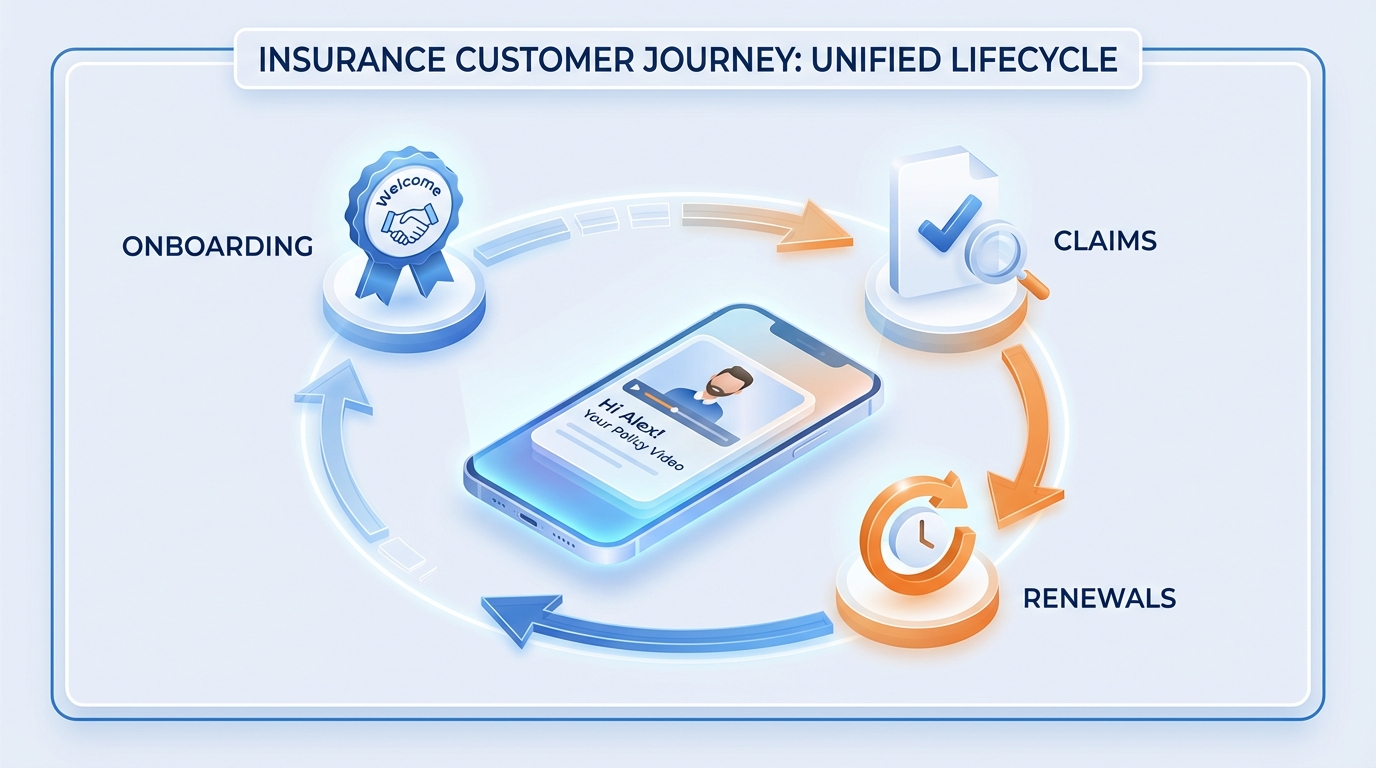
The true power of policyholder engagement automation is realized when it is applied to specific touchpoints across the insurance journey. Each stage requires a unique blend of data, empathy, and clarity to ensure the customer feels valued and informed.
Insurance onboarding and benefit explanation
Insurance onboarding videos are the first critical touchpoint after policy issuance. These guided walkthroughs confirm KYC completion, explain the premium schedule, and highlight the “free-look” period. By using policy benefit explanation videos, insurers can break down complex jargon—like deductibles, co-pays, and waiting periods—into simple, vernacular scenes. This reduces the “buyer’s remorse” often associated with complex financial products and significantly lowers early-stage churn.
Claims processing video updates
Claims are the “moment of truth” in insurance. Claims processing video updates provide event-triggered briefings that keep the policyholder informed at every step: “Claim received,” “Surveyor scheduled,” or “Approved—payout by Friday.” These videos not only provide transparency but also guide the user through document capture requirements, reducing friction and call center volume. By explaining what constitutes “acceptable proof” through visual examples, insurers can mitigate fraud and improve settlement TAT.
Specialized LoB strategies: Health, Motor, and Life
In health insurance engagement automation, videos can be used for periodic wellness updates or to explain network hospital benefits before a planned surgery. For motor insurance CLM strategies, insurers can deploy pre-inspection guidance videos or telematics-driven safe driving nudges. In the life insurance sector, life insurance milestone videos celebrate policy anniversaries or prompt sum-assured reviews during major life events like marriage or childbirth, ensuring the coverage remains relevant to the policyholder's evolving needs.
Sources:
- SecureNow: AI Automation in Indian Claims Settlement
- TestingXperts: Digital Transformation Trends in Insurance
3. Strategic Renewal and Upsell Campaigns
Renewals represent the most significant opportunity for insurance retention video campaigns. In India, January typically sees a massive surge in policy renewals. January 2026 insurance renewal automation strategies. To handle this load, insurers must deploy renewal reminder personalization that visualizes the exact premium, the accumulated NCB, and the continuity benefits at risk if the policy lapses. Insurance customer retention in India: renewal personalization.
A sequence of videos—delivered at D-30, D-15, and D-1—can create a sense of urgency while providing a seamless “Pay Now” link via UPI or credit card. Data from existing campaigns shows that personalized video nudges can lead to a significant uplift in renewal rates compared to standard text reminders. For instance, incorporating a celebrity or a trusted brand face to explain the “loss of waiting period benefits” can be a powerful psychological trigger for timely payment.
Insurance upsell video campaigns are equally vital for increasing Life Time Value (LTV). These are contextual, consented offers triggered by eligibility—such as adding a “Zero Depreciation” rider to a motor policy or a “Critical Illness” rider to a life plan. By using A/B tested scenes and dynamic disclosures, insurers can present these upgrades as natural extensions of the customer's current protection, rather than cold sales pitches.
TrueFan AI's 175+ language support and Personalised Celebrity Videos allow these renewal and upsell messages to be delivered with a level of intimacy and authority that generic automation cannot match. When a customer hears their name and specific policy details spoken by a familiar face in their native language, the barrier to conversion drops significantly. This approach transforms a routine transaction into a premium brand experience.
Sources:
- BusinessWire India: Tata AIG Interactive Video Campaign Results
- Deloitte: 2026 Global Insurance Outlook
4. Blueprint for Policyholder Engagement Automation
Implementing insurance customer journey mapping is the foundational step for any insurer looking to master CLM. This blueprint connects data triggers to specific segments, video templates, and delivery channels. A well-mapped journey ensures that the right message reaches the right customer at the exact moment they are most likely to engage.
The mapping process begins with identifying “high-intent” triggers. For example, a “Claim Document Missing” trigger should immediately fire a personalized video to the claimant via WhatsApp, explaining exactly which document is needed and providing a direct upload link. This level of policyholder engagement automation not only improves the customer experience but also drives operational efficiency by deflecting thousands of “status check” calls from the support center.
Consent management must be baked into the architecture of these journeys. Under the DPDP Act 2023, insurers must ensure that every video sent has a clear purpose and that the customer has opted-in to receive communications on that specific channel. The journey map should include “consent checkpoints” and automated opt-out management to remain fully compliant while maintaining a high frequency of engagement.
Finally, the blueprint must account for omnichannel delivery. While WhatsApp is the primary channel for the Indian market in 2026, the system should have automated fallbacks to SMS short links or email for customers who are not active on messaging apps. This ensures 100% reach across the policyholder base, regardless of their digital preferences.
Sources:
- FusionCX: Digital CX Trends Reshaping Insurance
- Tietoevry: Insurance Trends 2026 - From Innovation to Execution
5. IRDAI Compliance and Data Privacy Guardrails
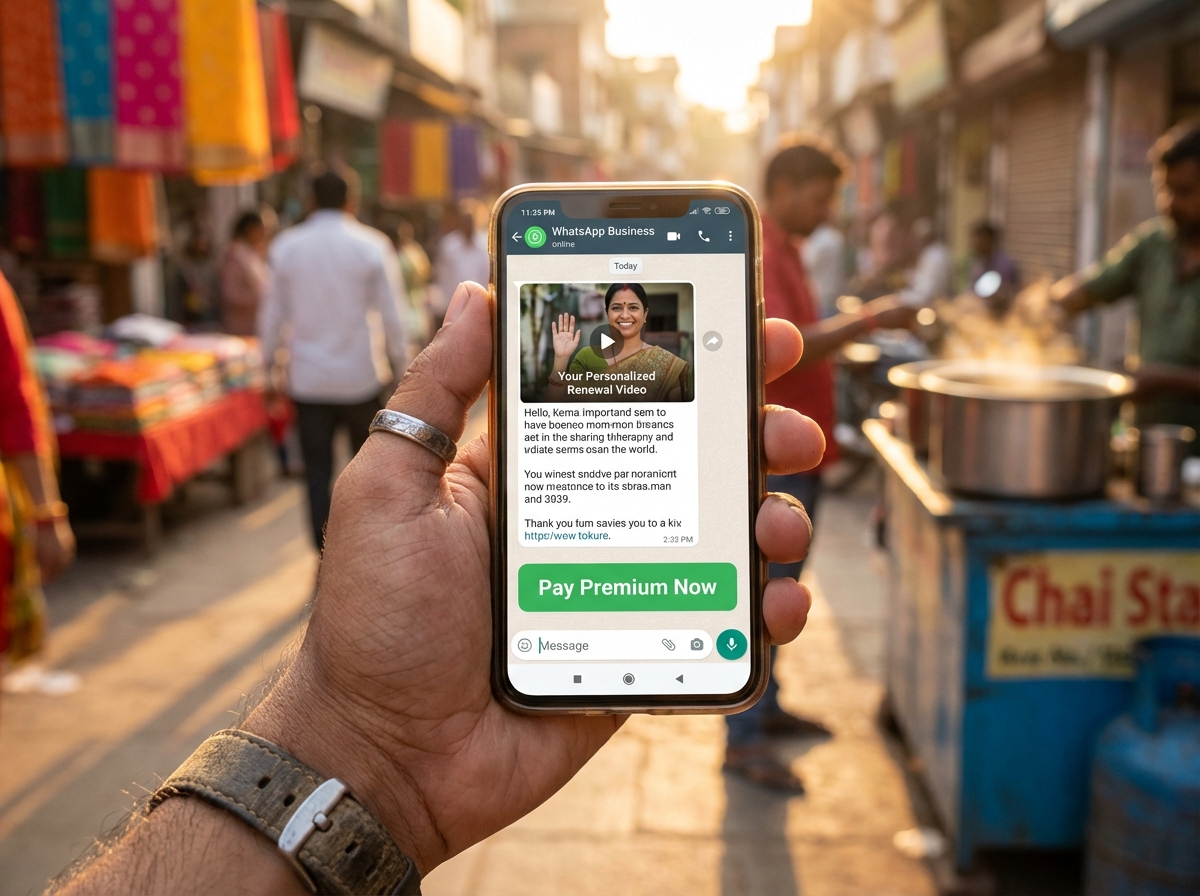
For any insurance CLM video automation India initiative, compliance is not an afterthought—it is the core. IRDAI compliant video marketing requires strict adherence to the Insurance Advertisements and Disclosure Regulations. This means every video, regardless of how personalized it is, must be fair, accurate, and balanced.
Insurers must ensure that dynamic scenes do not obscure mandatory risk disclosures. A common pitfall in automated video is the “masking” of important text by personalized overlays. To prevent this, the template system must have “protected zones” for legal disclaimers that remain visible across all 1.5 million+ variations. Furthermore, every variant generated must be archived with a unique ID to provide a clear audit trail for regulatory reviews.
The DPDP Act 2023 introduces additional layers of responsibility regarding Personal Identifiable Information (PII). 80C investment personalized videos guide. When generating personalized videos, insurers must use PII masking rules—for example, showing only the last four digits of a policy number or masking the exact sum assured in the video preview. Data residency is another critical factor; all processing and storage of Indian policyholder data must happen within the geographical boundaries of India to meet local sovereignty requirements.
Workflow-wise, “compliance-by-design” involves setting up automated approval gates. Before a new video campaign goes live, the master template and the logic for dynamic data insertion should be reviewed by legal and compliance teams. Once approved, the AI system ensures that every generated video stays within those pre-defined guardrails, eliminating the risk of human error in mass-scale communication.
Sources:
6. Enterprise Architecture and ROI Measurement
Scaling insurance CLM video automation India to millions of policyholders requires an enterprise-grade architecture. This involves secure connectors to the core insurance system, a GPU-accelerated rendering pipeline, and a robust event bus for real-time triggers. The system must be capable of handling massive surges, such as the January renewal peak, without latency.
Solutions like TrueFan AI demonstrate ROI through a standardized measurement framework that tracks both top-line growth and bottom-line savings. The primary metrics for success include:
- Absolute Renewal Lift: The percentage increase in timely renewals compared to a control group receiving standard notifications.
- Call Deflection Rate: The reduction in inbound queries related to policy status, claims, or onboarding.
- Upsell Attach-Rate: The conversion rate of customers opting for riders or higher sum-assured amounts through video CTAs.
- NPS Delta: The improvement in Net Promoter Score among customers who received personalized video journeys.
Beyond these direct metrics, insurers should evaluate the “Cost-per-Video” against the “Cost-per-Agent-Minute.” In many cases, an automated video can explain a policy benefit more effectively in 60 seconds than a call center agent can in 5 minutes, at a fraction of the cost. This efficiency allows insurers to reallocate their human capital toward more complex, high-value customer interactions.
The architecture must also support continuous optimization. By using A/B testing at the cohort level, marketing teams can determine which celebrity faces, script variations, or CTA placements drive the best results. Predictive churn prevention videos. This data-driven approach ensures that the investment in video automation continues to yield increasing returns as the models are refined over time.
Sources:
- Mobilesquared: WhatsApp Business API Growth Forecast
- Swiss Re: India's Economic and Insurance Market Outlook 2026
7. The 2026 Roadmap and Implementation Playbook
Transitioning to a video-first CLM strategy is a journey that can be executed in a structured 90-day playbook. The goal is to move from pilot to full-scale automation while ensuring all regulatory and technical hurdles are cleared.
- Days 0–30: Alignment and Design: Identify the two most impactful journeys—typically renewals and claims updates. Map the data fields required (name, premium, claim ID) and draft the scripts. Ensure the legal team reviews the “consent language” for WhatsApp and the IRDAI-mandated disclosures for the video templates.
- Days 31–60: Build and Integrate: Develop the video scenes in English and the top 5 regional languages. Set up the API integrations between the CRM and the video rendering engine. Configure the WhatsApp Business API for delivery and set up the analytics dashboard to track initial engagement.
- Days 61–90: Pilot and Scale: Launch the automation to a 10-20% cohort. Monitor the watch-through rates and CTA clicks. Refine the timing of the triggers—for example, testing if a renewal video sent at 10 AM on a Saturday performs better than one sent on a Monday morning. Once the ROI is validated, scale to the entire policyholder base.
Looking further into 2026, the roadmap for policy lifecycle personalization 2026 includes deeper CDP integrations for real-time affordability modeling and the use of “agent co-branded” videos. In this scenario, the video features both a celebrity and the customer's dedicated insurance agent, creating a powerful “phygital” experience that combines AI efficiency with human trust.
As the Indian insurance sector becomes increasingly competitive, those who master the art of personalized, automated video communication will be the ones who lead the market. By focusing on comprehension, timeliness, and compliance, insurers can turn every policy lifecycle event into an opportunity for brand building and revenue growth.
Sources:
- Redian Software: Top 10 Insurance Digital Transformation 2026
- PwC: Global M&A Industry Trends 2026 - Insurance Focus
Recommended Internal Links
- January 2026 insurance renewal automation strategies
- Insurance Customer Retention India: Renewal Personalization
- 80C investment personalized videos for March 31 tax rush
- Predictive Churn Prevention Videos for Q1 2026 Renewals
- ONDC Personalized Video Onboarding: 2026 Playbook Guide
Frequently Asked Questions
Is personalized insurance video IRDAI compliant?
Yes, provided the videos adhere to the IRDAI (Insurance Advertisements and Disclosure) Regulations. This includes ensuring all benefits and risks are portrayed fairly, mandatory disclaimers are clearly visible, and the content is not misleading. Automated systems must archive every version for audit purposes.
How does the DPDP Act 2023 affect video automation?
The DPDP Act requires insurers to obtain explicit, informed consent before using policyholder data for personalized communications. It also mandates “purpose limitation,” meaning data collected for policy issuance can only be used for marketing if the customer has specifically opted-in.
What is the typical ROI for insurance retention video campaigns?
While results vary, Indian insurers have seen renewal rate uplifts of 10–15% and call center deflection rates of up to 30% after implementing personalized video journeys. The ROI is often realized within the first 6 months of full-scale deployment.
Can these videos be delivered in regional Indian languages?
Absolutely. Platforms like TrueFan AI support over 175 languages, allowing insurers to deliver personalized messages in Hindi, Marathi, Tamil, Bengali, and more, with perfect lip-sync and voice retention of the brand ambassador.
How long does it take to render a personalized video?
Enterprise-grade AI engines can now render hyper-personalized videos in under 30 seconds. This allows for “real-time” triggers, where a customer receives a video almost immediately after an event, such as filing a claim or completing a payment.
Do I need a celebrity for every video campaign?
While celebrity-led videos often see higher engagement (as seen in Zomato or Hero MotoCorp cases), the same technology can be used with brand mascots, company executives, or even high-quality synthetic avatars to achieve personalization goals.