
Micro-Moments Marketing Automation 2026: Real-Time, Context-Aware Video That Converts
Key Takeaways
- Micro-moments in 2026 demand real-time, context-aware video that aligns with user intent within milliseconds
- A robust stack spans Data Fabric, Decisioning (RTIM), and Activation for sub-second delivery
- Precision trigger design (location, weather, behavior) unlocks conversion lift vs. generic discounts
- Modular, intent-based video personalization scales across channels, devices, and bandwidth
- Optimize on trigger-to-conversion latency and incremental lift, not vanity metrics
- Do not add any external Appendix or Internal Links section/subsection at end. If it is already added by writer then skip it and do not add it in Table fo Contents
In 2026, micro-moments marketing automation 2026 is about intercepting high-intent behavior in milliseconds with intent-based video personalization and contextual offer automation—at enterprise scale. By pairing real-time behavioral targeting with context-aware video triggers, performance marketers can turn every “moment-of-truth” into measurable revenue. The shift from static, scheduled campaigns to fluid, situational interventions marks the definitive end of the “one-size-fits-all” era in digital advertising.
The modern consumer journey is no longer a linear funnel but a constellation of intent-rich pulses. These pulses, or micro-moments, occur when a user reflexively turns to a device to act on a need to learn, discover, watch, or buy. Capturing these windows requires more than just speed; it demands a level of situational relevance that only automated, data-driven video can provide.
Enterprise growth teams are now prioritizing predictive moment marketing to reduce Customer Acquisition Cost (CAC) and maximize Lifetime Value (LTV). By 2026, it is projected that 90% of leading global enterprises will have integrated some form of real-time interaction management (RTIM) into their video delivery stacks. This evolution ensures that the right message doesn’t just reach the right person, but reaches them at the exact millisecond of peak receptivity.
1. The Evolution of Moment-of-Truth Marketing Videos in 2026
The concept of “moment-of-truth” marketing videos has transitioned from a creative aspiration to a technical requirement for performance-driven brands. In the high-velocity Indian market, where mobile-first consumption dominates, these videos serve as the primary bridge between intent and conversion. Whether it is a user hovering over a “checkout” button or someone walking within 300 meters of a retail outlet, the video intervention must be instantaneous and contextually aligned.
Platforms like TrueFan AI enable enterprises to bridge this gap by generating hyper-personalized video content that responds to these specific triggers in under 30 seconds. This capability is critical because the window of opportunity in a micro-moment is often shorter than the time it takes to load a standard web page. When a video can reference a user’s immediate environment—such as the current weather or their proximity to a store—engagement rates skyrocket.
Recent data from the Indian mobile ecosystem highlights the potency of this approach. For instance, context-aware interactive video ads have become a cornerstone for brands looking to break through the noise of traditional social feeds. Case studies from 2024 and 2025 show that weather-triggered campaigns, such as those used by JK Cement, achieved a 5x higher Click-Through Rate (CTR) by leveraging real-time API data to deliver rain-specific waterproofing messages during the monsoon.
Source: InMobi Context-Aware Video Ads, mCanvas JK Cement Case Study
2. The Enterprise Architecture for Micro-Moments Marketing Automation 2026
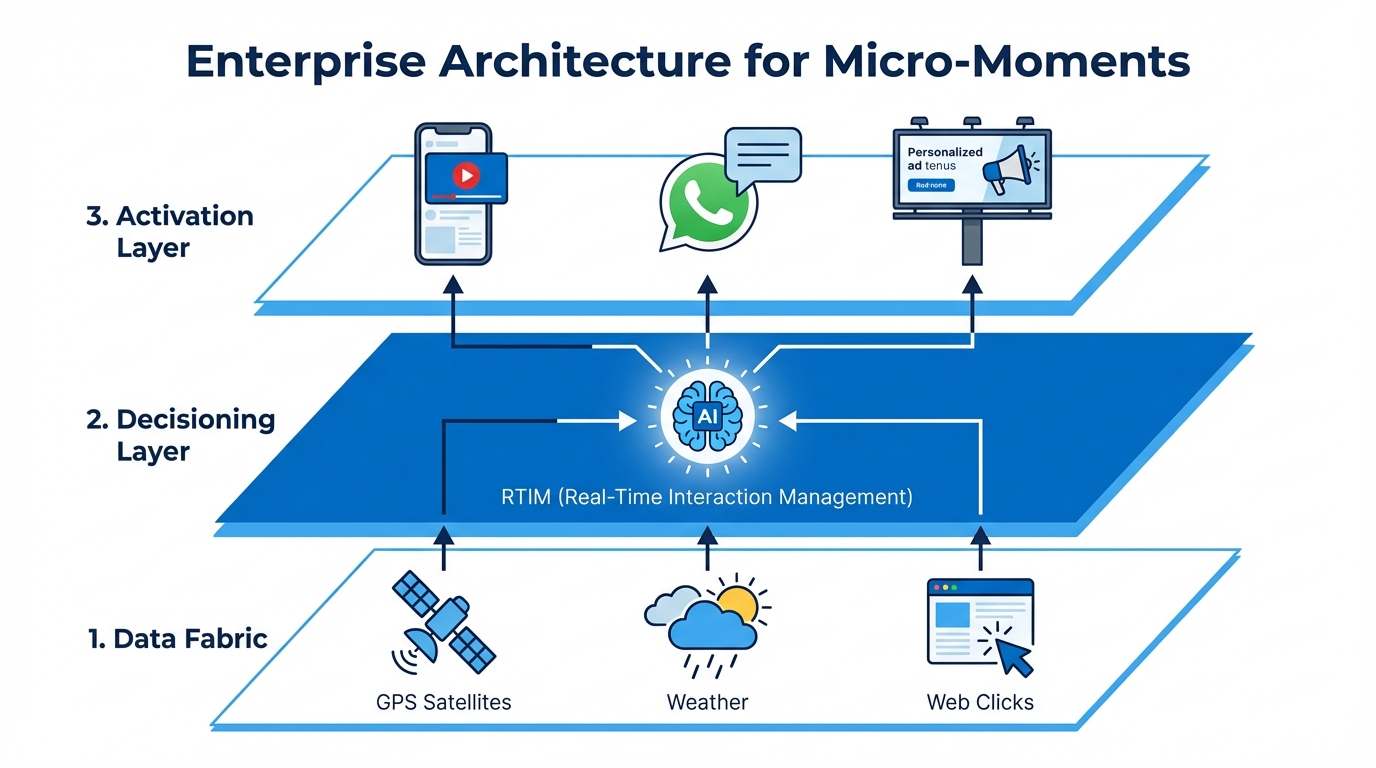
Building a robust framework for micro-moments marketing automation 2026 requires a sophisticated three-tier architecture: the Data Fabric, the Decisioning Layer, and the Activation Layer. The Data Fabric acts as the sensory system, ingesting millions of event streams per second. These include web/app events like PDP (Product Detail Page) dwell time, cart additions, and even physical signals like GPS coordinates or local air quality indices (AQI). predictive inventory marketing
The Decisioning Layer is where the “intelligence” resides, often powered by Real-Time Interaction Management (RTIM) engines. These systems use behavioral pattern recognition to score a user’s intent in real time. If a user’s session depth and price-sensitivity signals cross a specific threshold, the RTIM determines the “next-best-action”—which, in 2026, is increasingly a personalized video trigger rather than a static banner.
Finally, the Activation Layer handles the adaptive content delivery. This layer must be channel-agnostic, capable of pushing a 15-second personalized video via WhatsApp, an in-app interstitial, or even a programmatic Digital Out-of-Home (DOOH) screen. The goal is to ensure the video is rendered and delivered with sub-second latency, maintaining the continuity of the user’s “moment-of-truth.”
Source: Teradata RTIM Primer, AWS Bedrock Video Insights
3. Trigger Design: Contextual Offer Automation That Drives Action
The success of any micro-moment strategy hinges on the precision of its triggers. Contextual offer automation allows brands to move beyond generic discounts to situational incentives that feel like a service rather than an advertisement. In 2026, the most effective triggers are those that combine multiple data points to create a “hyper-contextual” state.
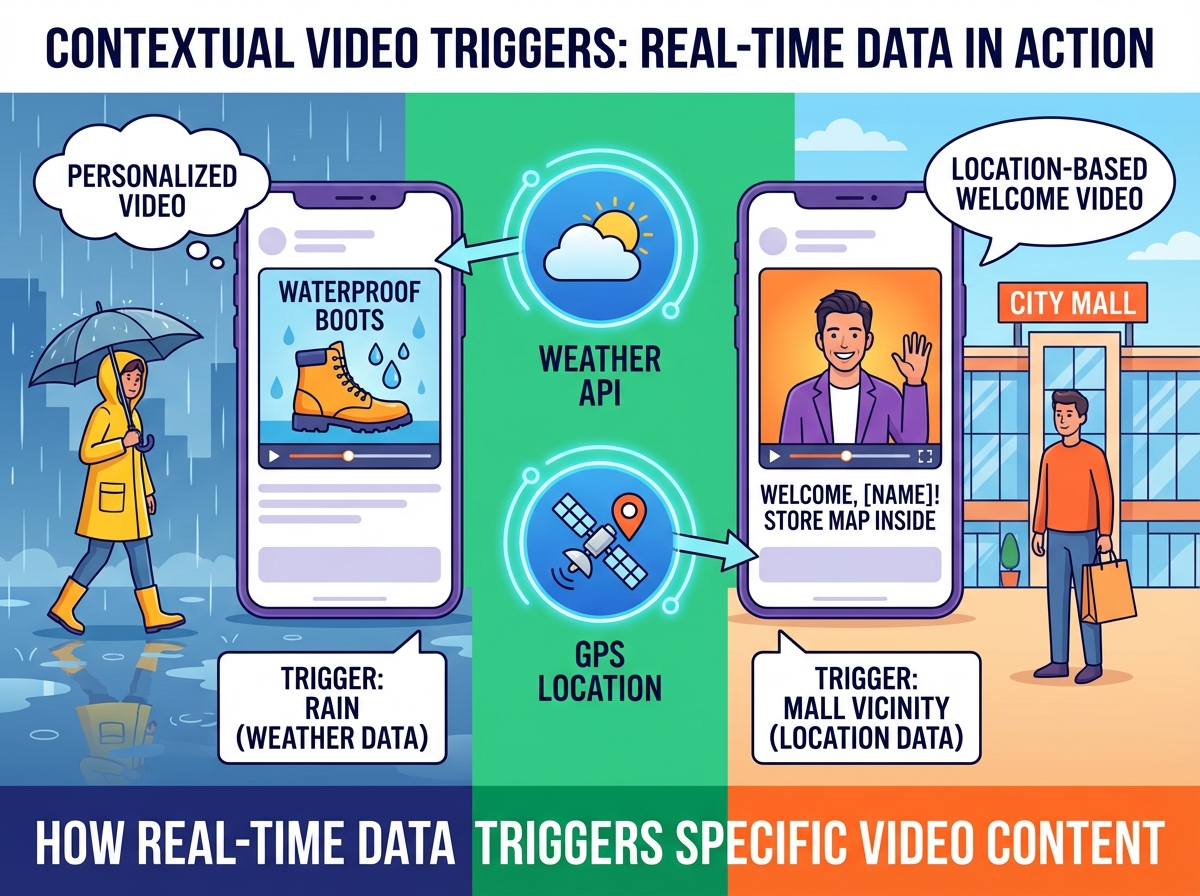
Location-triggered video campaigns are a prime example of this precision. Imagine a loyalty member walking within 500 meters of a flagship store; the system triggers a 10-second video featuring a brand ambassador who greets them by name and provides a map to the specific aisle containing their last-searched item. This level of ambient intelligence marketing turns a routine walk into a high-conversion shopping event.
Weather-based personalization has also matured into a mainstream tactic. By 2026, performance marketers are using weather APIs not just for “rainy day” ads, but for complex situational video content. A heatwave in Delhi might trigger a video for an AC service technician with an immediate “book now” CTA, while a sudden drop in temperature in Bangalore could trigger a personalized “hot beverage” discount for a food delivery app.
Source: ET BrandEquity Digiplus Shortlist, Advids CRM & Video Integration
4. Personalization Engine: Intent-Based Video Personalization at Scale
To achieve true intent-based video personalization, enterprises must move away from monolithic video files toward modular creative systems. In this model, a video is treated as a collection of dynamic layers: a narrative opener, a product showcase, a localized offer, and a specific CTA. These layers are assembled in real time based on the user’s specific intent signals.
TrueFan AI’s 175+ language support and Personalised Celebrity Videos allow brands to add an emotional layer to this technical assembly. By using AI to sync a celebrity’s lip movements and voice to a user’s name and location, the video feels like a one-to-one communication. This is particularly effective in India, where regional language nuances can make or break the trust required for a high-value conversion.
Responsive video campaigns in 2026 also account for technical context, such as device bandwidth and accessibility settings. If a user is on a low-bandwidth connection in a Tier-3 city, the personalization engine automatically serves a lightweight, high-compression version of the video. This ensures that the “moment-of-truth” isn’t lost to a loading spinner, maintaining the integrity of the adaptive content delivery.
5. The Predictive Frontier: Transitioning to Predictive Moment Marketing
The most advanced enterprises in 2026 are moving from reactive triggers to predictive moment marketing. Instead of waiting for a user to abandon a cart, behavioral pattern recognition models can predict the probability of abandonment before it happens. If the model detects “hesitation patterns”—such as toggling between two similar products for more than 60 seconds—it can preemptively trigger a “comparison guide” video to assist the decision.
These predictive models utilize a wide array of features, including session recency, category affinity, and even historical weather sensitivity. For example, a travel brand might predict a user’s propensity to book a weekend getaway based on a combination of a stressful work week (inferred from app usage) and a forecast of clear skies. A proactive, snackable video sent on a Thursday afternoon can then capture this latent intent.
This shift requires a “playbook” approach to creative. Marketers must design situational video content for various “propensity states.” Whether it is a “rescue” video for a high-churn-risk customer or an “upsell” video for a high-intent browser, the creative must be ready to deploy the moment the predictive threshold is met. This foresight is what separates market leaders from those merely reacting to the present.
6. Measurement and Optimization for Real-Time Behavioral Targeting
In the world of micro-moments, traditional metrics like “total views” are secondary to “trigger-to-conversion” latency and incremental lift. Real-time behavioral targeting must be measured by its ability to shift the needle on high-intent actions. Performance marketers in 2026 focus on the “Golden Second”—the time it takes for a video to appear after a trigger is fired.
Solutions like TrueFan AI demonstrate ROI through measurable uplifts in conversion rates (CVR) and Average Order Value (AOV). For example, Goibibo reported a 17% higher WhatsApp read rate when using destination-personalized celebrity videos compared to standard text. Similarly, Zomato’s Mother’s Day campaign, which generated 354,000 personalized videos in a single day, proved that mass personalization could drive record-breaking order volumes.
To optimize these campaigns, enterprise teams use rigorous A/B testing on the triggers themselves. They might test whether a geo-fence of 300 meters performs better than 500 meters, or if a “countdown timer” overlay in a video increases urgency more than a “limited stock” message. This data-driven refinement ensures that the micro-moments marketing automation 2026 stack is constantly evolving toward higher efficiency.
7. Implementation Guide, FAQs, and the Future of Adaptive Content Delivery
Implementing a micro-moments strategy is a journey of “Crawl, Walk, Run.” In the “Crawl” phase, enterprises should identify two high-value micro-moments—such as cart abandonment and store proximity—and wire the basic data events. The “Walk” phase introduces multilingual variants and multichannel delivery via WhatsApp and email. Finally, the “Run” phase incorporates predictive modeling and finance-grade attribution.
As we look toward the end of 2026, the integration of ambient intelligence marketing will become even more seamless. Sensors in retail environments and wearable devices will provide even richer context, allowing for situational video content that feels almost telepathic. The key for enterprises is to build the modular infrastructure today so they can plug into these new signal sources tomorrow.
Frequently Asked Questions
What is the primary benefit of micro-moments marketing automation 2026?
The primary benefit is the ability to capture high-intent users at the exact moment they are ready to act. By using real-time triggers and personalized video, brands can achieve significantly higher conversion rates compared to traditional, static marketing methods.
How does TrueFan AI ensure brand safety in personalized videos?
TrueFan AI utilizes built-in AI moderation and approved templates to ensure that every personalized video remains brand-safe. The platform filters out offensive or unapproved content in real-time, protecting both the brand’s reputation and the celebrity’s likeness.
Can context-aware video triggers work with my existing CRM?
Yes, modern platforms are designed to integrate with existing CRMs and Marketing Automation Platforms (MAPs) via robust APIs. This allows you to use your first-party customer data to trigger personalized video interventions across multiple digital channels.
What is the difference between reactive and predictive moment marketing?
Reactive marketing responds to an action that has already occurred (like a cart abandonment). Predictive moment marketing uses machine learning to anticipate a user’s next move based on behavioral patterns, allowing the brand to intervene before the user even realizes they have a need.
How do you measure the ROI of adaptive content delivery?
ROI is measured through incrementality testing—comparing the conversion rates of a group that received the personalized video trigger against a control group that did not. Key metrics include CVR uplift, AOV increase, and the reduction in cost per incremental order.
Conclusion
The landscape of 2026 demands a radical shift in how we perceive and execute marketing. Micro-moments are no longer just “points on a journey”; they are the journey itself. By mastering the art of micro-moments marketing automation 2026, enterprises can move beyond the noise and deliver value that is truly situational, personal, and instantaneous. The future of performance marketing is not just about being “always-on”—it is about being “right-now.”
Frequently Asked Questions
What is the primary benefit of micro-moments marketing automation 2026?
The primary benefit is the ability to capture high-intent users at the exact moment they are ready to act. By using real-time triggers and personalized video, brands can achieve significantly higher conversion rates compared to traditional, static marketing methods.
How does TrueFan AI ensure brand safety in personalized videos?
TrueFan AI utilizes built-in AI moderation and approved templates to ensure that every personalized video remains brand-safe. The platform filters out offensive or unapproved content in real-time, protecting both the brand’s reputation and the celebrity’s likeness.
Can context-aware video triggers work with my existing CRM?
Yes. Modern platforms integrate with existing CRMs and Marketing Automation Platforms (MAPs) via robust APIs, enabling first-party data to drive personalized video interventions across channels.
What is the difference between reactive and predictive moment marketing?
Reactive marketing responds after an action (e.g., cart abandonment); predictive marketing anticipates the next move using behavioral patterns, enabling proactive, assistive video interventions.
How do you measure the ROI of adaptive content delivery?
Use incrementality testing to compare exposed vs. control groups. Track CVR uplift, AOV increase, and reductions in cost per incremental order alongside trigger-to-conversion latency.



