
Quick Commerce Holi Marketing 2026: The Hyperlocal Video Playbook for 10-Minute Color Delivery India
Estimated reading time: ~17 minutes
Key Takeaways
- Win Holi’s “golden hour” by deploying hyperlocal video personalization down to the PIN-code and neighborhood level.
- Use real-time inventory and ETA signals to auto-swap creatives and prevent out-of-stock promotion.
- Build platform-specific tactics for Blinkit, Zepto, and Instamart, aligning offers with dark-store stock.
- Close the loop with WhatsApp commerce for low-friction catalog, PIN capture, and UPI/COD checkout.
- Measure performance via delivered order rate, 0–60 min conversions, and PIN-level ROAS.
The 60-minute “panic-buy” window on Holi morning has evolved from a logistical challenge into a high-stakes revenue battlefield for D2C and enterprise brands. As we approach March 4, 2026, the mandate for quick commerce Holi marketing 2026 has shifted from simple inventory placement to the orchestration of neighborhood-specific, real-time engagement. Consumers no longer just hope for 10-minute color delivery India; they expect a frictionless, personalized journey that mirrors the urgency of the festival itself.
To win in this hyper-competitive landscape, growth leaders must move beyond static banners. The 2026 thesis for market leadership relies on a sophisticated mix: neighborhood-level video personalization, real-time inventory signals, and seamless WhatsApp-to-order flows. By aligning instant gratification Holi shopping behaviors with automated creative technology, brands can compress the discovery-to-delivery cycle and achieve defensible ROI on platforms like Blinkit, Zepto, and Swiggy Instamart.
The Psychology of Instant Gratification Holi Shopping in 2026
In the 2026 retail landscape, instant gratification Holi shopping is defined by a consumer's psychological demand for immediate reward and absolute delivery certainty. During the Holi window, this behavior is intensified by three primary drivers: acute scarcity (fear of stock-outs), extreme time pressure (impending family gatherings), and sensory anticipation. Data from the 2025 festive season indicated that 72% of quick commerce users in India finalized their purchase decisions based on the displayed ETA rather than brand loyalty alone.
The “panic-buy” persona is the dominant demographic on Holi morning. These are convenience-first shoppers who prioritize low-friction checkouts and guaranteed same-hour festival fulfillment. For enterprise brands, this means conversion targets must be optimized for the “golden hour”—the period between 8:00 AM and 11:00 AM when demand for gulal, thandai, and pichkaris peaks. Market signals from previous years, including the Raksha Bandhan surge of 2025, show that quick commerce platforms now handle 3x the volume of traditional e-commerce during these micro-windows.
By 2026, the quick commerce sector in India is projected to reach a $15 billion valuation, with festive spikes accounting for nearly 40% of annual GMV for top-tier D2C brands. This growth is fueled by the expansion into Tier 2 and Tier 3 cities, where the expectation for organic color quick delivery has become a standard benchmark for service quality. Brands that fail to acknowledge this shift toward “instant-or-nothing” risk losing significant market share to agile, hyperlocal competitors.
Sources:
Decoding the Platform Landscape: Blinkit Zepto Festival Campaigns and Instamart Formats
Navigating the Blinkit Zepto festival campaigns ecosystem requires a nuanced understanding of each platform's unique surface areas. In 2026, successful brands are moving away from generic “Happy Holi” creatives toward platform-exclusive Holi deals. These are high-value bundles co-developed with platform category teams, specifically geo-capped to ensure that advertised stock matches the physical inventory available in the nearest dark store.
Blinkit has optimized its interface for high-velocity discovery, utilizing homepage hero tiles and festival-specific category shelves. For quick commerce Holi marketing 2026, the focus on Blinkit should be on aligning the 10-minute color delivery India promise with localized ETA bands. If a dark store in South Delhi is experiencing a rider shortage, the creative must dynamically adjust to reflect a “30-minute” window to maintain consumer trust.
Zepto’s strength lies in its morning micro-windows. Their “festival essentials” category often sees the highest engagement between 7:00 AM and 9:00 AM. Brands should copy and improve upon Zepto’s cluster-based promotions by offering “Neighborhood Flash Sales” that are only visible to users within a 2km radius of a specific dark store. Meanwhile, Swiggy Instamart’s Brandverse and video stories provide a canvas for witty, high-engagement content that mirrors their famous OOH banter.
Sources:
- Media4Growth: Swiggy Instamart’s witty OOH collaborations
- ET BrandEquity: Blinkit’s Holi ad with a harmony twist
- afaqs!: Holi campaign roundup featuring Zepto
Hyperlocal Gulal Delivery Videos: Neighborhood Flash Sales Personalization at Scale
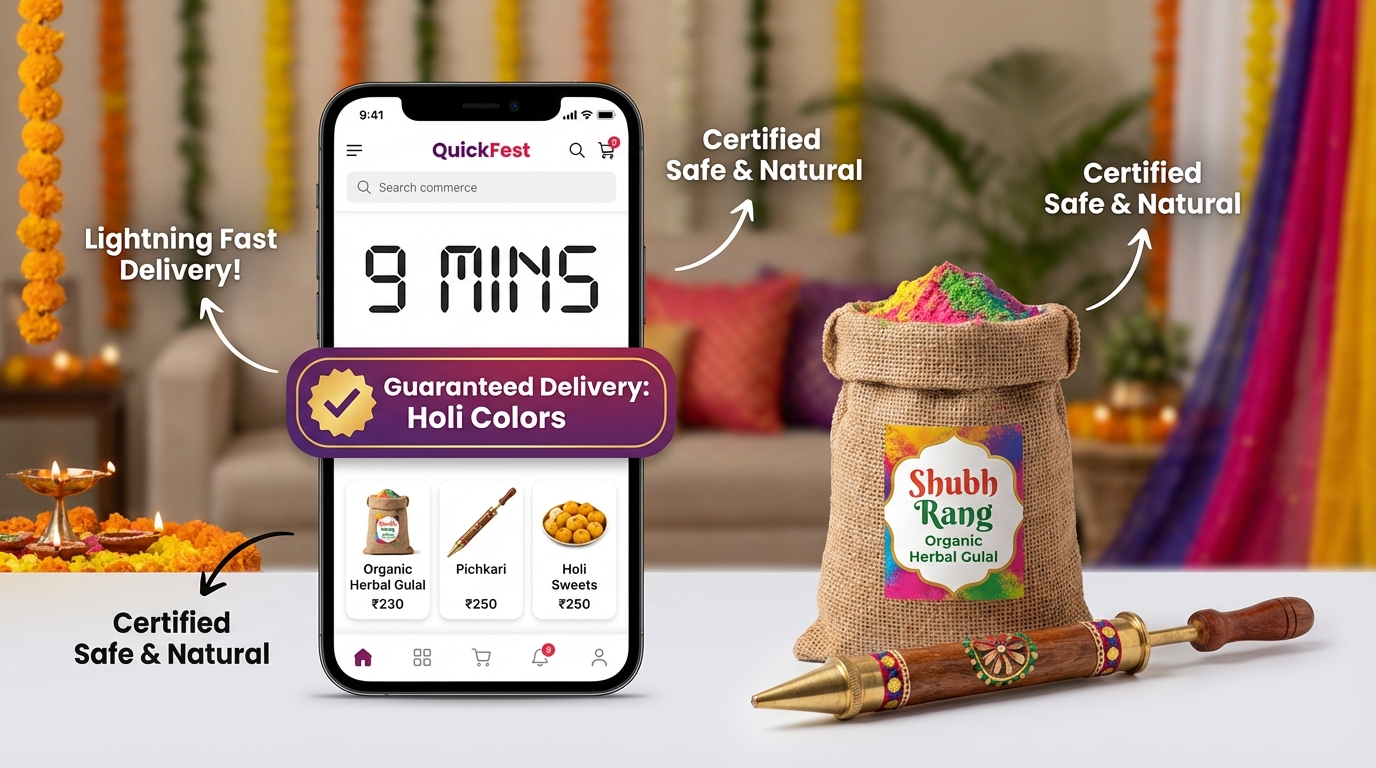
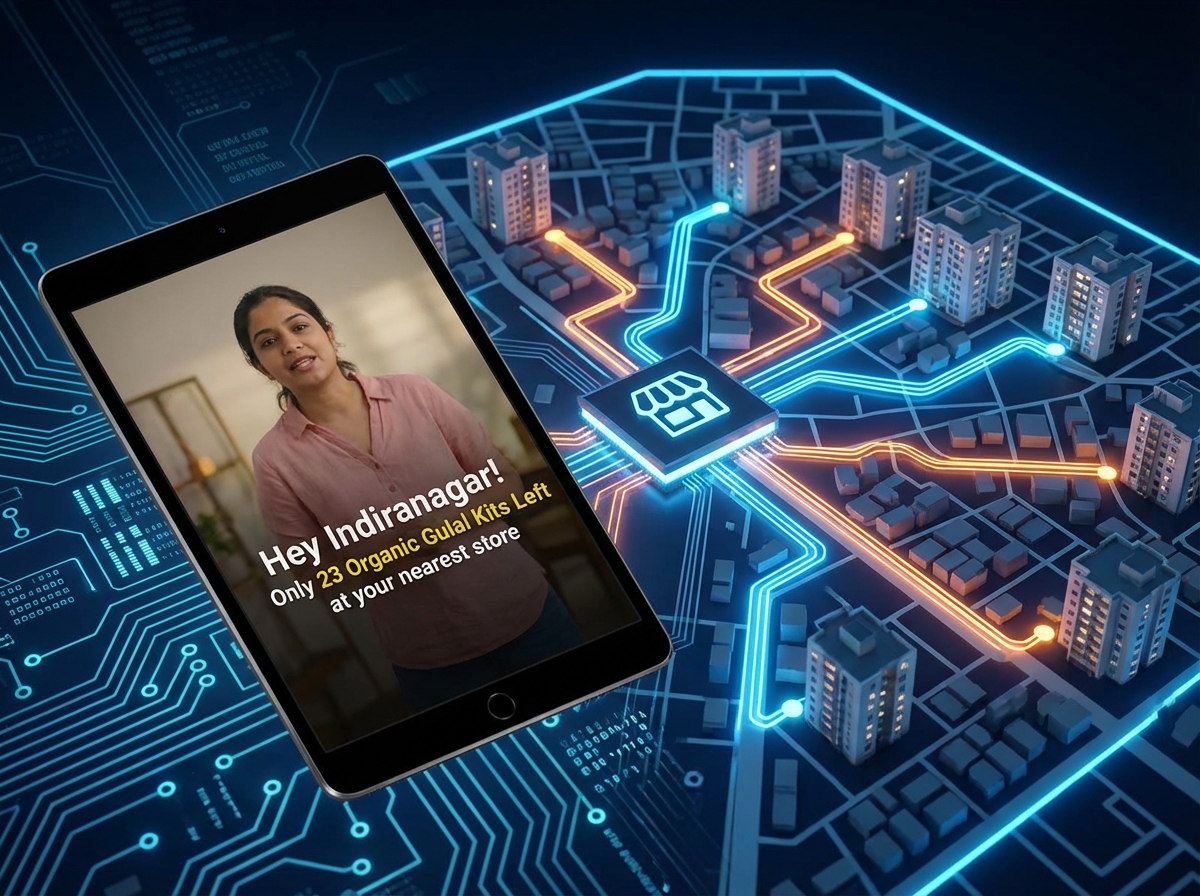
The most significant breakthrough in quick commerce Holi marketing 2026 is the deployment of hyperlocal gulal delivery videos. These are short-form (10–20 second) video creatives localized down to the PIN-code or colony level. By integrating neighborhood name callouts and live stock banners, brands can create a sense of local urgency that static ads cannot replicate. For instance, a video might state, “Hey Indiranagar, only 23 organic gulal kits left at your nearest store—ETA 9 mins.”
Platforms like TrueFan AI enable enterprise brands to generate these thousands of localized variants instantly. By ingesting inventory APIs and dark store ETAs, the system can produce videos that feature Hinglish microcopy and location-based urgency triggers. This level of neighborhood flash sales personalization ensures that the creative is always relevant to the viewer's immediate context, significantly boosting click-through rates.
To implement this, brands should utilize three primary script skeletons. The “Scarcity-First” script focuses on dwindling stock numbers. The “Social-Proof-First” script highlights how many people in that specific neighborhood have already ordered. The “Bundle-First” script promotes a curated Holi kit (e.g., gulal + pichkari + white tee) as a one-tap solution for the last-minute shopper. This strategy transforms a generic national campaign into a series of highly effective local activations.
Sources:
Operational Excellence: Real-Time Inventory Video Alerts and Dark Store Festival Marketing
In 2026, the integration of marketing and operations is the ultimate competitive advantage. Real-time inventory video alerts act as API-triggered creative swaps that occur when a specific SKU’s stock hits a pre-defined threshold (e.g., fewer than 30 units). This prevents the wasted ad spend associated with promoting out-of-stock items and allows for automatic pausing of creatives, ensuring a seamless user experience.
Effective dark store festival marketing involves more than just inventory management; it requires a strategic alignment of the pick-path and festival assortment. By placing high-demand Holi items like herbal colors and sweets near the packing station, dark stores can reduce the “click-to-dispatch” time. Furthermore, when rider supply tightens, the messaging must dynamically shift from “10-minute delivery” to “Reserve your 6:00 PM slot,” managing consumer expectations while maintaining the 10-minute color delivery India brand equity.
Implementation requires a robust threshold logic. High-priority SKUs should be monitored every 60 seconds, with fallback rules in place for when SLAs degrade. For example, if a dark store's average delivery time exceeds 45 minutes due to high demand, the “instant” messaging should be replaced with “scheduled” delivery options. This operational agility ensures that the brand's promise of same-hour festival fulfillment remains credible even during peak volatility.
Sources:
WhatsApp Commerce Integration Holi: Closing the Discovery-to-Delivery Loop
The final frontier of quick commerce Holi marketing 2026 is the seamless transition from social discovery to transactional completion. WhatsApp commerce integration Holi allows brands to capture the “panic-buy” intent directly within India’s most popular messaging app. By using click-to-WhatsApp ads featuring hyperlocal videos, brands can lead users into an automated catalog flow where they can select Holi kits, provide their PIN code, and complete the purchase via UPI or COD.
The funnel begins with a personalized video ad that triggers a pre-filled greeting mentioning the user's neighborhood. Automated quick replies then guide the user through various options: “Gulal Kits,” “Pichkaris,” or “Festive Combos.” This method significantly reduces the friction of app-switching and leverages the high trust associated with WhatsApp. By 2026, it is estimated that 35% of quick commerce festive orders will originate from direct messaging channels.
For enterprise brands, adherence to WhatsApp Business Terms and DPDP compliance is non-negotiable. This includes obtaining explicit consent for messaging and providing clear opt-out mechanisms. Using Hinglish and vernacular variants in the chat flow further enhances the “neighborhood” feel of the campaign, making the instant shopping conversion optimization process feel personal rather than transactional.
Sources:
Quick Commerce ROI Measurement and Instant Shopping Conversion Optimization
Measuring the success of a quick commerce Holi marketing 2026 campaign requires a shift from traditional vanity metrics to high-intent “lag” indicators. While VTR (View Through Rate) and CTR (Click Through Rate) provide initial insights, the true measure of ROI lies in the “delivered order rate” and the “0–60 minute conversion percentage.” Brands must track CAC (Customer Acquisition Cost) and ROAS (Return on Ad Spend) at the individual PIN-code level to understand which neighborhoods are driving the most value.
Solutions like TrueFan AI demonstrate ROI through their ability to run multi-armed bandit tests on video variants in real-time. By comparing the performance of a “name-mention” video against a “stock-scarcity” video, growth leaders can allocate budget toward the highest-performing creative assets. Additionally, using geo-holdouts—where certain PIN codes receive generic ads while others receive hyperlocal videos—provides a defensible baseline for measuring the incremental lift provided by personalization.
Instant shopping conversion optimization also involves tactical “nudges” such as urgency timers tied to dark store cut-off times and social proof overlays (e.g., “4,200 Holi orders delivered in Mumbai this morning”). These elements, combined with 1-tap reorder buttons for returning customers, create a high-velocity sales environment. By analyzing the AOV (Average Order Value) lift from platform-exclusive bundles, brands can refine their assortment strategy for future festivals.
Sources:
Enterprise-Grade Personalization with TrueFan AI: The 2026 Execution Framework
For enterprise-level execution, the scale of personalization required for Holi is staggering. TrueFan AI's 175+ language support and Personalised Celebrity Videos allow brands to deploy thousands of unique assets that speak directly to the consumer in their preferred dialect and neighborhood context. This isn't just about changing text; it’s about a complete “virtual reshoot” capability that allows brands to swap offer lines or product visuals without the need for expensive additional production.
The TrueFan AI framework is built for the low-latency requirements of quick commerce. With render SLAs of under 30 seconds, the platform can generate real-time inventory video alerts that reflect the exact state of a dark store's shelves. This technical agility is supported by enterprise-grade governance, including ISO 27001 and SOC 2 compliance, ensuring that all personalization inputs and celebrity likenesses are handled with the highest level of security and brand safety.
As brands finalize their quick commerce Holi marketing 2026 strategies, the focus must remain on the “neighborhood” experience. By combining TrueFan AI’s hyper-personalization with the logistical power of Blinkit, Zepto, and Instamart, enterprise brands can ensure that their organic color quick delivery messaging reaches the right person, in the right language, at the exact moment of need.
Sources:
Executive Playbook Checklist for Holi 2026
- Inventory Sync: Connect your brand’s inventory API to the quick commerce platform’s dark store data.
- PIN Taxonomy: Map your target neighborhoods to specific PIN codes for hyperlocal targeting.
- Creative Library: Generate a library of hyperlocal gulal delivery videos using TrueFan AI, including neighborhood and language variants.
- WhatsApp Flow: Set up a click-to-WhatsApp funnel with automated cataloging and UPI payment integration.
- DCO Thresholds: Define the stock levels (e.g., <30 units) that will trigger a change in video messaging or a pause in ad spend.
- Measurement Setup: Establish geo-holdout groups to measure the incremental lift of your personalized campaigns.
- Compliance Review: Ensure all “organic” and “non-toxic” claims are backed by accessible certifications.
Frequently Asked Questions
How does quick commerce Holi marketing 2026 differ from previous years?
In 2026, the focus has shifted from national campaigns to hyper-local, neighborhood-specific execution. Brands are now using real-time inventory data to trigger video ads that reflect live stock levels and actual delivery ETAs for specific PIN codes.
What are the best platforms for 10-minute color delivery India?
Blinkit, Zepto, and Swiggy Instamart remain the leaders. Each offers unique advertising surfaces, such as Blinkit’s festival shelves and Swiggy’s Brandverse, which are essential for capturing the Holi “panic-buy” window.
Can TrueFan AI help with regional language personalization for Holi?
Yes, TrueFan AI supports over 175 languages and dialects, allowing brands to create vernacular video content that resonates with diverse consumer segments across India, from metro hubs to Tier 3 cities.
What metrics should I use for quick commerce ROI measurement?
Beyond CTR, focus on the delivered order rate, 0–60 minute conversion percentage, and ROAS at the PIN-code level. These metrics provide a clearer picture of how hyperlocal marketing impacts the bottom line.
How do I ensure brand safety with AI-generated hyperlocal videos?
Enterprise solutions like TrueFan AI include built-in moderation filters and compliance protocols (ISO 2701) to ensure that all generated content adheres to brand guidelines and legal standards, including celebrity likeness rights.



