
Real-time interactive AI avatars India: How enterprises can deploy two-way video chat AI for customer service in 2026
Estimated reading time: 9 min
Key Takeaways
- In 2026, real-time interactive AI avatars in India deliver two-way video chat AI with sub-200ms latency for human-like service.
- A successful stack combines streaming ASR, LLM reasoning with RAG, neural TTS, and neural rendering via WebRTC.
- Enterprises use avatars for KYC triage, live commerce, and AI avatar Zoom meetings to scale multilingual support.
- Studio by TrueFan AI assets paired with OpenAI realtime voice enable composable, compliant deployments under the DPDP Act.
- Prioritize edge placement, ABR, and a governance layer to ensure brand safety, performance, and cultural nuance.
Real-time interactive AI avatars India are no longer a futuristic concept; they are the definitive standard for enterprise customer engagement in 2026. Defined as photorealistic, AI-driven digital humans capable of two-way video chat AI with sub-200ms end-to-end latency, these avatars enable live AI avatar conversations that feel as natural as a human interaction. By integrating multilingual responses and instantaneous context retrieval, Indian enterprises are moving beyond static, one-way videos toward real-time video engagement AI that can listen, reason, and respond dynamically.
The shift in 2026 is driven by the convergence of the OpenAI realtime voice integration, high-speed 5G penetration across Tier-2 Indian cities, and the maturation of neural rendering. For Customer Service leaders and Product Managers, the goal is clear: deploy interactive digital humans India that can handle complex queries while maintaining brand tone and cultural nuance. This guide provides the strategic blueprint for implementing a conversational AI video platform 2026 that delivers dynamic AI avatar responses at scale.
1. What are Real-Time Interactive AI Avatars? Components and 2026 Trends
In 2026, the distinction between a "chatbot" and an "interactive digital human" is defined by presence. Interactive digital humans India are sophisticated personas that process live audio/video input, perform LLM-based reasoning, and render frame-accurate animations via WebRTC. Unlike the static avatars of 2023, today’s live AI avatar conversations support "barge-in" (the ability to interrupt the AI), emotional intelligence, and long-term memory.
The Technical Building Blocks
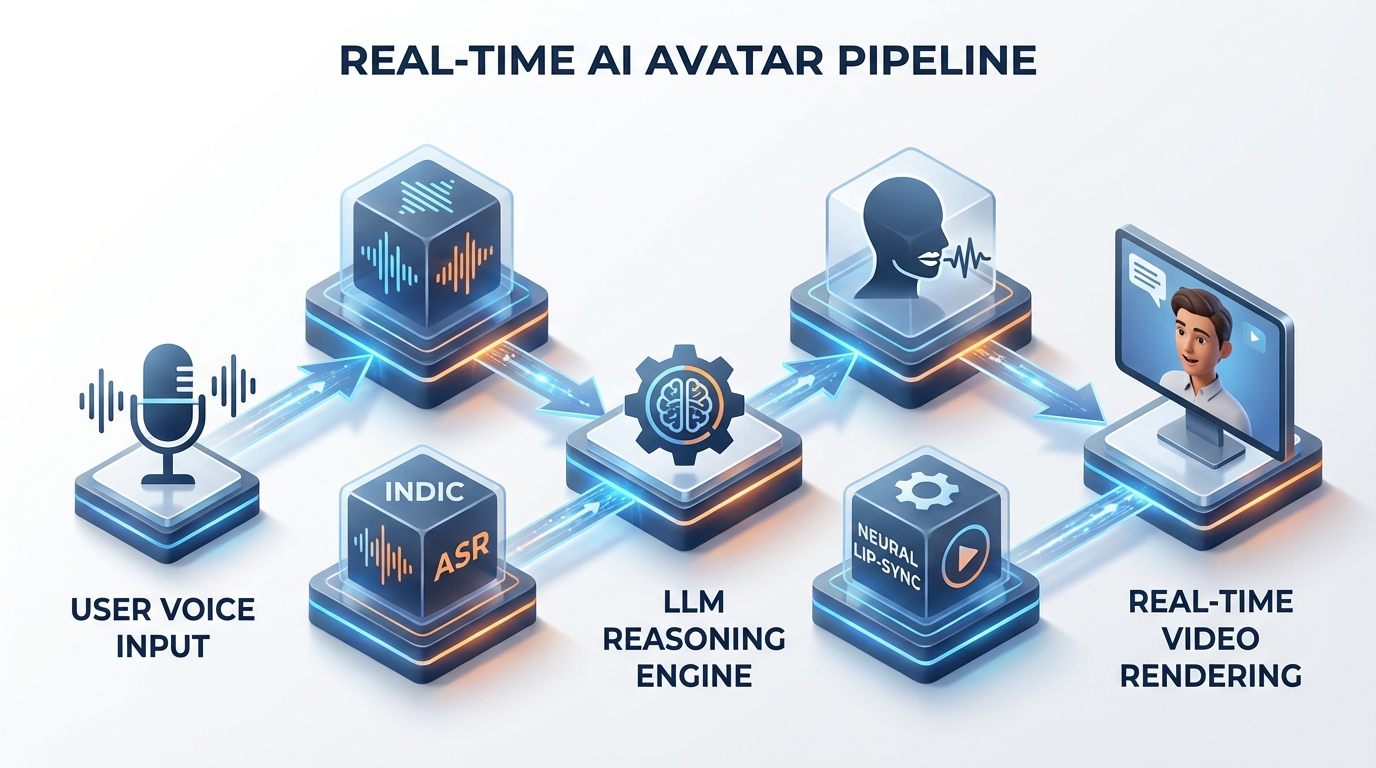
To achieve dynamic AI avatar responses, the 2026 stack relies on five core pillars:
- Low-Latency Capture: High-fidelity audio (16 kHz+) with advanced acoustic echo cancellation (AEC) to ensure the AI doesn't "hear" itself.
- Streaming ASR (Automatic Speech Recognition): Specialized models for Indic languages (Hindi, Tamil, Bengali, Marathi, Telugu) that provide partial hypotheses for faster turn-taking.
- Reasoning Engine: LLMs equipped with Retrieval-Augmented Generation (RAG) to pull from live CRM data and product FAQs.
- Neural TTS & Lip-Sync: Voices with Indian English and regional prosody, where viseme (visual phoneme) timing is synchronized to the millisecond.
- Neural Rendering: Converting those visemes into photorealistic mouth and facial movements in real-time.
Why 2026 is the Tipping Point
Recent data highlights why this technology has reached mass adoption:
- Market Growth: The Indian conversational AI market is projected to reach $12.4 billion by the end of 2026, with a 35% CAGR (Source: NASSCOM).
- Enterprise Priority: 72% of Indian BFSI and E-commerce firms have prioritized real-time video engagement AI over traditional text-based bots (Source: PwC 2026 AI Predictions).
- Latency Benchmarks: With 5G-Advanced, edge-compute latency in Indian metros has dropped to <150ms, making two-way video chat AI indistinguishable from human calls.
- Language Accuracy: Modern models now achieve 88% accuracy in "Hinglish" code-switching, a critical requirement for the Indian demographic.
- ROI Metrics: Enterprises report a 40% reduction in Average Handle Time (AHT) for complex KYC processes when using interactive avatars (Source: BCG 2026 Digital Trends).
Platforms like Studio by TrueFan AI enable enterprises to bridge the gap between static content and these interactive futures by providing the high-fidelity avatar assets needed for the "face" of the AI.
Source: NASSCOM: How to build an AI avatar step-by-step
2. The 2026 Stack for Real-Time Video Engagement AI
Deploying a conversational AI video platform 2026 requires a reference architecture that prioritizes speed and regional compliance. The "Composable Stack" is the preferred choice for Indian enterprises needing deep integration.
The Reference Architecture
- Client Layer: A web or mobile interface capturing microphone and camera data, utilizing WebRTC for bi-directional streaming.
- Logic Layer: OpenAI realtime voice integration acts as the brain, handling streaming audio in/out and managing stateful sessions with enterprise tools (CRM, API).
- Avatar Rendering Layer: A neural talking-head service that receives viseme data from the logic layer and streams back the video frames.
- Governance Layer: A "walled garden" that filters profanity, redacts PII (Personally Identifiable Information), and ensures the avatar adheres to brand guidelines.
India-Specific Performance Targets
To succeed in the Indian market, technical teams must optimize for varied network conditions:
- Edge Placement: Deploy TURN (Traversal Using Relays around NAT) servers in Mumbai, Delhi, and Chennai to minimize round-trip time.
- Adaptive Bitrate (ABR): The system must automatically downscale video quality if a user is on a congested 4G network in a Tier-3 town, prioritizing audio clarity over 4K resolution.
- Barge-in Logic: In India’s often noisy environments, the AI must distinguish between background noise and a user’s intent to interrupt.
Studio by TrueFan AI's 175+ language support and AI avatars provide the necessary localized "look and feel" that ensures these technical stacks resonate with regional audiences.
Source: OpenAI Realtime API Overview
3. Enterprise Use Cases: Where Interactive Avatars Shine in India
The application of real-time interactive AI avatars India spans the entire customer lifecycle. In 2026, we see three primary areas of dominance:
Tier-1 Triage and KYC
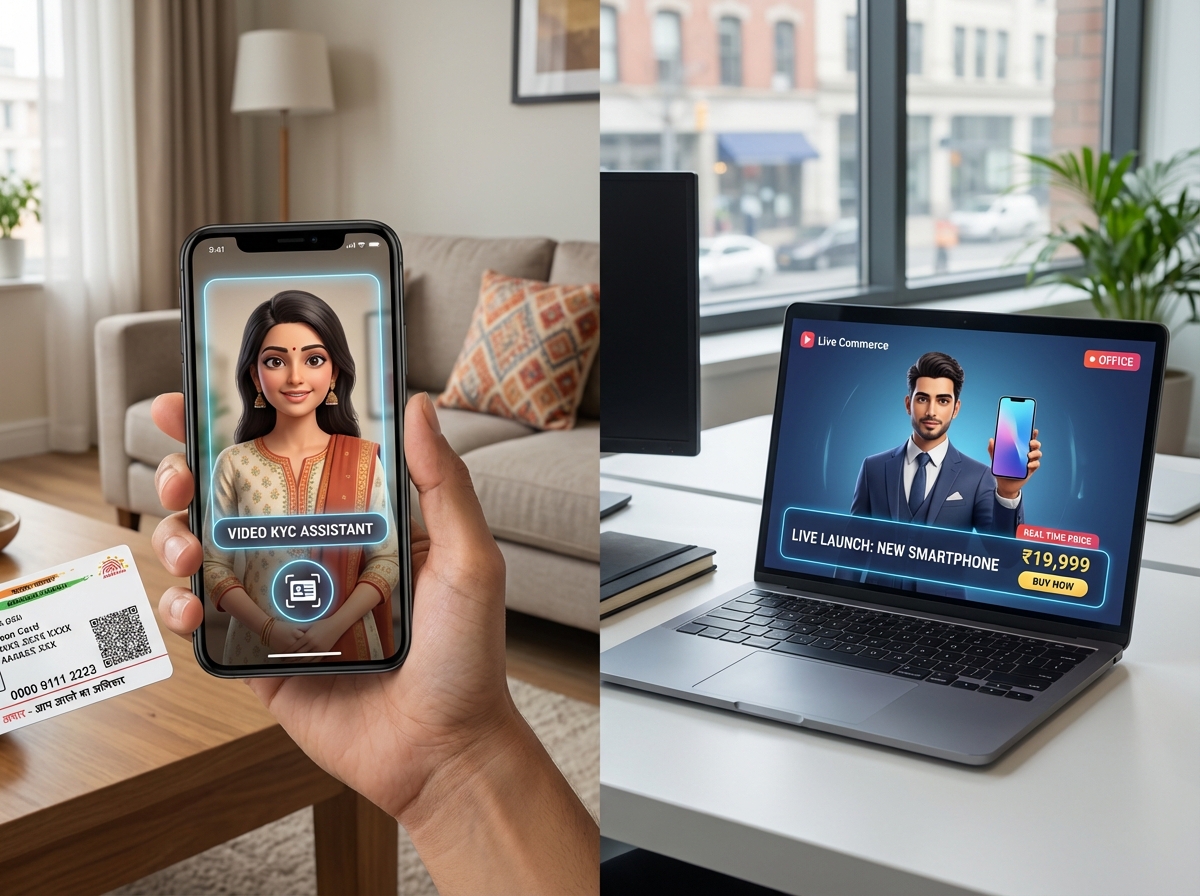
Customer service departments use interactive customer service avatars to handle the heavy lifting of identity verification. In the BFSI sector, an avatar can guide a user through a Video-KYC process, checking documents in real-time and answering questions about form fields. This "guided experience" reduces drop-off rates by 25% compared to self-serve forms.
Live Commerce and Brand Spokespeople
The live AI spokesperson India has become a staple of E-commerce. During major sales events like "Big Billion Days," these avatars act as 24/7 shopping assistants. They can compare two smartphone models side-by-side on screen, check real-time inventory, and apply personalized discount codes—all within a live AI avatar conversation.
AI Avatar Zoom Meetings
For B2B enterprises, AI avatar Zoom meetings are used for partner training and large-scale briefings. Instead of a static webinar, a real-time avatar can join a Zoom call, present data, and take live questions from hundreds of participants in their native language, providing a level of scale impossible for human presenters.
Source: Campaign Asia: The Future of Live Commerce
4. Platform Landscape: HeyGen Review and the TrueFan Advantage
When evaluating a conversational AI video platform 2026, enterprises often look at established players. A common starting point is the HeyGen interactive avatar review.
HeyGen Interactive Avatar Review
Strengths:
- Ease of Use: Exceptional for rapid prototyping and simple "script-to-video" workflows.
- Zoom Integration: Offers a dedicated app to send avatars into meetings.
- Library: A vast array of pre-built avatars and voices.
Considerations for Indian Enterprises:
- Latency: As a global platform, latency for real-time interactions can sometimes exceed the 300ms "uncanny valley" threshold if not optimized for Indian edge nodes.
- Data Residency: Compliance with India’s DPDP Act requires strict data handling which may require custom enterprise agreements.
- Brand Control: Customizing an avatar to look exactly like a specific Indian celebrity or brand mascot often requires a more bespoke, "consent-first" approach.
The Composable Alternative
Many Indian firms are choosing a hybrid approach. They use high-quality assets from Studio by TrueFan AI for the visual representation and pair them with the OpenAI realtime voice integration for the conversational logic. This allows for:
- Full Compliance: Keeping data within Indian borders.
- Custom Logic: Deep integration with local payment gateways and CRMs.
- Superior ROI: Solutions like Studio by TrueFan AI demonstrate ROI through lower production costs and higher engagement rates compared to traditional video production.
Source: Softlabs Group: AI Avatar Companies in India
5. Implementation Blueprint: Pilot to Production & DPDP Compliance
Deploying real-time interactive AI avatars India requires a structured 6-8 week pilot phase.
Phase 1: Scope and Intent (Weeks 1-2)
Identify 2-3 high-volume intents. For a telecom provider, this might be "Plan Upgrade" and "Data Balance Inquiry." Define your success metrics: target a 20% increase in containment (queries resolved without human intervention).
Phase 2: Cultural and Language Tuning (Weeks 3-4)
Develop scripts that reflect Indian etiquette. Use "Hinglish" for urban audiences and pure regional languages for rural sectors. Ensure the dynamic AI avatar responses include respectful forms of address (e.g., using "Ji" or appropriate regional honorifics).
Phase 3: Technical Integration and DPDP Compliance (Weeks 5-6)
This is the most critical step for 2026. Under the Digital Personal Data Protection (DPDP) Act, enterprises must:
- Obtain Explicit Consent: Use a clear UI overlay before the camera/mic activates.
- Provide Disclosures: Clearly state that the user is interacting with an AI.
- Data Minimization: Only process the audio/video streams necessary for the interaction and set strict retention policies.
- Watermarking: Ensure all AI-generated video is watermarked to prevent deepfake misuse.
Phase 4: Testing and Optimization (Weeks 7-8)
Test the two-way video chat AI across different ISPs (Jio, Airtel, BSNL). Measure the "Interruption Recovery Time"—how quickly the AI stops talking when the user speaks. Aim for <120ms for a natural feel.
Source: MeitY: Digital Personal Data Protection Act 2023
6. Zoom and Meeting Workflows: The New Frontier
The integration of AI into collaborative spaces is a major trend for 2026. AI avatar Zoom meetings allow brands to maintain a constant, professional presence in virtual rooms.
Two Implementation Paths
- The App Path: Using a pre-built connector (like the HeyGen Zoom app). This is ideal for "one-to-many" broadcasts or training sessions where the interaction is semi-scripted.
- The SDK Path: Using the Zoom Video SDK to build a custom participant. This "Composable Path" allows the avatar to act as a full participant that can:
- Listen to all speakers and provide real-time summaries.
- Access a private knowledge base to answer technical questions live.
- Sync with the CRM to log meeting notes and action items automatically.
Step-by-Step SDK Integration
- Initialize Media: Set up a WebRTC session that pipes the avatar's AV stream into the Zoom Video SDK.
- Sync Logic: Use the OpenAI realtime voice integration to process the meeting's audio stream.
- Visual Feedback: Ensure the avatar maintains "active listening" cues (nodding, eye contact) even when not speaking to maintain the illusion of presence.
Conclusion
The era of real-time interactive AI avatars India is here. By combining the power of two-way video chat AI with the strategic depth of a conversational AI video platform 2026, Indian enterprises can provide a level of service that is both scalable and deeply personal. Whether it's through AI avatar Zoom meetings or real-time video engagement AI on a mobile app, the goal remains the same: to create meaningful, human-like connections in a digital-first world.
As you begin your journey, remember that the "face" of your AI is as important as its "brain." Choosing a partner that understands the nuances of the Indian market—from language to compliance—is the first step toward a successful deployment. Consider pairing Studio by TrueFan AI assets with best-in-class conversational engines for results that delight customers and meet enterprise-grade standards.
Frequently Asked Questions
How do real-time interactive AI avatars handle poor internet connectivity in India?
In 2026, advanced platforms use Adaptive Bitrate (ABR) and edge-based TURN servers. If the connection drops below a certain threshold, the system gracefully fallbacks to an "audio-only" mode or a low-bandwidth text-plus-avatar-still-image mode to ensure the conversation isn't lost.
Are these avatars compliant with the Indian DPDP Act?
Yes, provided the implementation includes explicit consent flows, clear AI disclosures, and localized data processing. Studio by TrueFan AI's 175+ language support and AI avatars are built with a "consent-first" model, ensuring all digital twins are fully licensed and compliant with global and local safety standards.
Can an AI avatar really handle interruptions?
With the OpenAI realtime voice integration, the latency for "voice activity detection" is low enough that the AI can stop its current stream the moment it detects a user's voice, allowing for natural, back-and-forth dialogue.
What is the typical cost of deploying a real-time avatar for a large enterprise?
Costs vary based on the "Build vs. Buy" decision. A composable stack involves API costs (per minute) and rendering costs. However, the ROI is typically realized within 6-9 months through reduced human agent overhead and increased conversion rates in live commerce.
How do I ensure the avatar doesn't say something off-brand or offensive?
Enterprises must implement a Governance Layer or "Walled Garden." This includes real-time LLM guardrails that filter output against a list of prohibited topics (politics, hate speech) and ensure the tone remains consistent with the brand's persona.



