Voice Commerce Personalization in India 2026: Building Multilingual Conversational Shopping for 650M Vernacular Users
Estimated reading time: ~9 minutes
Key Takeaways
- India’s shift to voice-first experiences in 2026 is driven by vernacular users, 5G, and conversational payments like Hello! UPI.
- Winning brands will deliver multilingual, low-latency voice-to-checkout journeys that remove typing friction.
- Growth in Tier-2/3 markets hinges on voice SEO in regional languages and trust via local dialects and scripts.
- Smart speaker commerce integration and personalized, dialect-specific videos boost engagement and conversions.
- Measure impact with voice assistant marketing ROI metrics: assisted revenue, intent detection, and multi-turn completion.
Voice commerce personalization India 2026 is the inflection point where vernacular voice search, smart speaker commerce integration, and conversational AI marketing tools converge to unlock ROI for enterprises. As the digital landscape shifts from “mobile-first” to “voice-first,” the ability to engage 650 million vernacular users in their native dialects is no longer a luxury but a strategic mandate for market dominance.
Executive Summary: The 2026 Voice Commerce Mandate
- Market Velocity: India’s voice commerce revenue is projected to surge from USD 1,568M in 2024 to USD 7,469.5M by 2030, with 2026 serving as the critical scale-up window.
- Demographic Shift: India is on track for 900M+ internet users by 2025, with growth almost exclusively driven by Indic-language speakers in Tier-2 and Tier-3 regions.
- Technological Catalyst: The National Payments Corporation of India (NPCI) has launched “Hello! UPI,” enabling seamless, hands-free conversational payments across voice channels.
- Enterprise Objective: Deploying low-latency, multilingual voice-to-checkout flows that eliminate typing friction and maximize voice assistant marketing ROI.
1. The 2026 Market Moment for Voice Commerce Personalization India 2026
The convergence of high-speed 5G penetration and a maturing Generative AI ecosystem has created a perfect storm for voice commerce personalization India 2026. For the first time, the technological infrastructure can support the linguistic complexity of the Indian subcontinent at scale. This shift is primarily driven by the “typing friction” inherent in traditional e-commerce interfaces, which often alienates users who are more comfortable communicating in Hindi, Tamil, or Bengali than navigating English-centric menus.
Data from the IAMAI-Kantar ICUBE 2024 report indicates that rural India is now driving the majority of new internet additions, with a preference for voice-first discovery. This behavioral evolution is not merely about convenience; it is a fundamental shift in how trust is established. In Tier-2 and Tier-3 markets, tier-2 voice adoption strategies must account for the fact that voice shopping is becoming a routine-reduction behavior. Users are moving away from the cognitive load of searching for “1kg Basmati Rice” via a keyboard and toward the natural ease of saying, “Ache wale chawal ek kilo bhej do” (Send one kilo of good quality rice).
Furthermore, the business readiness for this transition is at an all-time high. Approximately 48% of Indian enterprises are already conducting GenAI pilots, many of which focus on natural language commerce India. By 2026, these pilots will transition into full-scale production environments where voice-activated customer engagement becomes the primary driver of top-line growth. The integration of voice into the purchase journey reduces the abandonment rates typically seen in complex checkout processes, particularly when those processes are localized to the user's specific dialect and cultural context.
Sources:
- India Voice Commerce Market Projections
- IAMAI-Kantar ICUBE 2024 Report
- IBEF: India's Internet User Growth
2. Architecting Natural Language Commerce India: From Intent to Checkout
Building a robust framework for natural language commerce India requires a departure from standard Western models. In the Indian context, “natural language” is rarely a single tongue; it is a fluid mix of code-switching (e.g., Hinglish) and regional nuances. A successful conversational shopping experience must parse these intents with high precision, presenting options through a mix of voice and dialect-specific shopping videos to bridge the gap between digital browsing and physical store experiences.
The journey begins with discovery, where a user initiates a query via a smart speaker, a WhatsApp voice note, or an in-app microphone. The system must not only recognize the words but also the underlying intent and the specific dialect. For instance, a query for “kapda” (cloth/clothes) in North India requires different disambiguation than a similar query in a different regional context. Once the intent is classified, the commerce core—integrated with semantic product catalogs—ranks results based on the user’s CRM profile and geographic location.
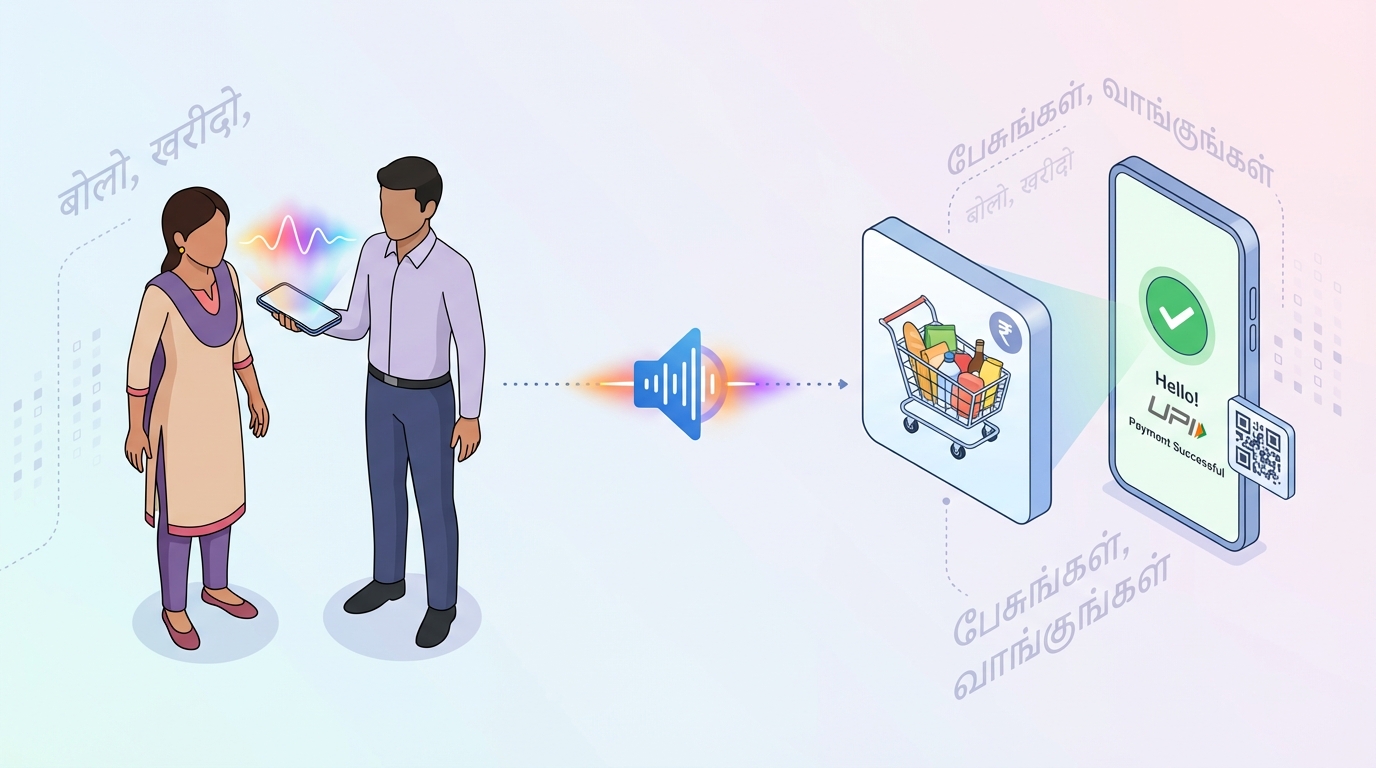
A pivotal development in this journey is the integration of “Hello! UPI.” This NPCI-led innovation allows for voice-authorized payments, completing the “voice-to-checkout” loop. Flipkart has already demonstrated the viability of this model with its AI-driven voice assistant for grocery shopping, which supports Hindi and English. By allowing users to browse, add to cart, and checkout using only their voice, Flipkart has set the benchmark for voice-activated customer engagement. For enterprises, the goal in 2026 is to replicate this success across diverse categories, from fashion to financial services, ensuring that the smart speaker commerce integration is as seamless as a face-to-face transaction.
Sources:
3. Scaling Multilingual Voice Marketing Automation with TrueFan AI
To achieve true scale, enterprises must move beyond reactive voice search to proactive multilingual voice marketing automation. This involves triggering personalized voice and video messages based on the user’s lifecycle stage, previous purchase history, and linguistic preference. Platforms like TrueFan AI enable brands to bridge the gap between generic automation and hyper-personalized engagement by generating content that resonates at a local level.
TrueFan AI's 175+ language support and Personalised Celebrity Videos allow enterprises to create dialect-specific shopping videos that can be delivered via WhatsApp or in-app notifications. Imagine a scenario where a user in Tamil Nadu receives a personalized video message in Tamil, featuring a familiar face, reminding them that their favorite brand of coffee is back in stock. This level of personalization significantly increases the likelihood of a reorder, as it leverages both the trust of a known personality and the comfort of the mother tongue.
The technical orchestration of this automation involves a sophisticated speech and language layer. This includes Automatic Speech Recognition (ASR) and Text-to-Speech (TTS) models tuned for Indian accents, as well as Speech Synthesis Markup Language (SSML) to ensure natural-sounding prosody and honorifics. When these conversational AI marketing tools are integrated with a brand's CRM, they can automate complex flows—such as seasonal vernacular campaigns or price-drop alerts—without human intervention. This not only reduces operational overhead but also ensures a consistent brand voice across all Hindi Tamil Bengali voice search touchpoints.
Coverage Gap Addressed: Code-Switching Nuances
Most global NLU models struggle with “Hinglish” or “Tanglish.” A superior Indian strategy involves training models specifically on code-switched datasets, allowing the system to understand a sentence like “Mujhe blue color ki shirt dikhao under two thousand” without failing on the English components.
4. Tier-2 Voice Adoption Strategies and Voice SEO Regional Languages
The real growth engine for 2026 lies in Tier-2 and Tier-3 cities, where digital literacy may be high but English proficiency is often lower. To capture this market, tier-2 voice adoption strategies must focus on building trust and reducing technical barriers. This includes implementing on-device ASR to handle low-bandwidth conditions and providing clear, vernacular consent prompts to ensure data privacy. Trust is further bolstered when the system uses local honorifics and cultural markers, making the interaction feel less like a machine and more like a local shopkeeper.
A critical component of this strategy is voice SEO regional languages. Traditional SEO focuses on keywords typed into a search bar, but voice SEO requires optimizing for how people actually speak. This means capturing natural language long-tail queries and ensuring that content is available in script-native formats (Devanagari, Tamil, Bengali) rather than just transliterated English. For example, a user asking “Aaj sabzi offers kya hain?” (What are the vegetable offers today?) should be directed to a page that has been semantically indexed for that specific vernacular query.
Effective voice SEO also involves the use of FAQ and HowTo schema markup, which helps search engines and voice assistants pull the most relevant “featured snippets” for voice queries. By optimizing for Hindi Tamil Bengali voice search, brands can ensure they are the first point of contact when a user asks their smart speaker for a product recommendation. This visibility is essential for driving conversational shopping experiences that lead to high-intent traffic and, ultimately, higher conversion rates in regions that were previously difficult to penetrate.
Coverage Gap Addressed: Script-Native Content
Many brands make the mistake of using Latin script for Hindi or Tamil content. For 2026, search engines are prioritizing native scripts. Using Devanagari for Hindi metadata is essential for ranking in voice-activated searches performed by vernacular users.
5. Measuring Voice Assistant Marketing ROI and the 180-Day Roadmap
For the C-suite, the ultimate validation of voice commerce lies in the voice assistant marketing ROI. Measuring this requires a new set of KPIs that go beyond standard click-through rates. Enterprises must track “Assisted Revenue,” which accounts for journeys that may start with a voice query but end on a different channel. Key metrics include the voice intent detection rate, the product match rate, and the completion rate for multi-turn dialogs. Solutions like TrueFan AI demonstrate ROI through measurable uplifts in read rates and conversion when personalized video is paired with voice-led nudges.
To implement a successful voice commerce strategy, a pragmatic 90–180 day plan is essential:
- 0–30 Days (Audit & Design): Conduct a comprehensive audit of voice SEO regional languages and map out the top 50 intents in Hindi, Tamil, and Bengali. Design the initial dialog schemas and set up PII (Personally Identifiable Information) controls.
- 30–90 Days (MVP Launch): Launch a pilot using WhatsApp voice and smart speaker flows for high-frequency categories like grocery or personal care. Integrate “Hello! UPI” for a seamless checkout and begin producing dialect-specific shopping videos.
- 90–180 Days (Scale & Optimize): Expand language coverage to include more dialects and refine the NLU models based on pilot data. Deepen the integration with multilingual voice marketing automation to trigger reorder reminders and loyalty rewards.
Risk management is equally important. As voice commerce scales, so do the risks associated with ASR accuracy and payment fraud. Mitigating these risks involves continuous model retraining on consented data and implementing “human-in-the-loop” protocols for high-value transactions. By following NPCI guidelines and maintaining SOC2/ISO-aligned data handling, enterprises can build a secure environment that encourages voice-activated customer engagement without compromising user trust.
Sources:
6. Visualizing the Future: Executive FAQ and Strategic Outlook
As we look toward the end of the decade, the distinction between “e-commerce” and “conversational commerce” will vanish. The future is a seamless blend of voice, video, and AI that anticipates user needs before they are even articulated.
Conclusion: The Path to Conversational Dominance
The transition to voice commerce personalization India 2026 represents a fundamental re-imagining of the relationship between brands and consumers. By prioritizing natural language commerce India, enterprises can dismantle the linguistic and technical barriers that have historically limited digital penetration in the heartland.
The integration of smart speaker commerce integration, multilingual voice marketing automation, and high-impact visual content like dialect-specific shopping videos creates a holistic ecosystem where the user feels understood and valued. As 2026 approaches, the brands that invest in these conversational architectures today will be the ones that own the ears—and the wallets—of the next 650 million users.
Ready to lead the voice revolution?
- Primary CTA: Book an enterprise workshop to scope your conversational AI marketing tools and design your 2026 voice-to-checkout flows.
- Secondary CTA: Access our Multilingual Voice Marketing Starter Kit for Hindi, Tamil, and Bengali pilots.
Frequently Asked Questions
What is voice commerce personalization and why is it critical for India in 2026?
Voice commerce personalization tailors the entire voice-led shopping journey—from greeting to payment—based on a user’s language, dialect, and history. It is critical now because India’s vernacular user base has reached a tipping point, and NPCI’s Hello! UPI enables secure, hands-free checkout.
How do we measure the ROI of voice-activated customer engagement?
Track assisted revenue, reductions in CAC across Tier-2 markets, LTV uplift via automated reorders, and operational metrics like intent detection, product match rate, and multi-turn completion. Personalised video paired with voice-led nudges often delivers 3x–5x engagement uplift.
How does the system handle the vast diversity of Indian dialects?
Start with dominant languages (Hindi, Tamil, Bengali) and major dialects. Use conversational AI tools that support disambiguation: ask clarifying questions or present a dialect-specific shopping video when ASR confidence is low.
Is voice commerce secure, especially for payments?
Yes. NPCI’s framework for conversational payments plus multi-factor authentication (voice biometrics and/or OTP) ensures voice transactions are as secure as standard digital payments.
Can voice SEO really improve our visibility in regional markets?
Absolutely. Optimizing for voice SEO in regional languages captures natural-language queries that typed SEO misses, helping brands win top recommendations on smart speakers and mobile assistants.