

Blockchain video verification India 2026: The enterprise playbook for AI content authenticity, deepfake prevention, and Web3 compliance
Estimated reading time: 10 minutes
Key Takeaways
- Enterprises in India must adopt blockchain video verification and C2PA manifests by 2026 to combat deepfakes and prove content authenticity.
- Cryptographic content signing and on-chain anchors create tamper-evident provenance, enabling instant, verifiable trust signals for viewers.
- Evolving Indian regulations (DPDP, MeitY advisories, FIU-IND KYC trends) point to stricter Web3 video marketing compliance and traceability.
- A reference architecture spans trusted capture, C2PA-first post-production, and distributed ledger video tracking through to smart contract rights.
- Select platforms that support C2PA 2.x, HSM-backed keys, and seamless verification UX to scale authenticity without slowing campaigns.
Meta Description: How CISOs and brand safety teams can deploy blockchain video verification in India by 2026—C2PA, cryptographic content signing, tamper-proof provenance, and Web3 compliance.
The Trust Imperative: Navigating Blockchain Video Verification India 2026
The digital landscape in India is approaching a critical inflection point where the distinction between authentic and synthetic media is becoming indistinguishable to the naked eye. For CISOs and brand safety teams preparing for 2026 campaigns, blockchain video verification India 2026 is no longer a futuristic concept but a mandatory pillar of the enterprise trust and compliance blueprint. As AI-generated video scales to meet hyper-personalized marketing demands, the risk of deepfake brand impersonation and misinformation necessitates a robust framework for verifiable provenance.
The problem is multifaceted: sophisticated deepfakes can erode brand equity in minutes, while evolving legal and audit requirements in India demand a clear, tamper-evident record of the video lifecycle. Without deepfake prevention technology and immutable content verification, enterprises face significant legal exposure and a breakdown in consumer trust. This playbook provides a practical reference architecture to ensure that every frame of synthetic media carries a cryptographically signed pedigree, providing audit-ready logs and synthetic media trust signals that empower viewers to verify authenticity instantly.
By 2026, the promise of this technology is a seamless integration of Web3 protocols into the marketing stack, delivering a verifiable chain-of-custody from creation to consumption. This guide outlines the rollout strategy for achieving blockchain content provenance, ensuring your organization remains compliant with India’s tightening digital regulations while leveraging the power of AI at scale.
The Technical Foundation: C2PA, Cryptographic Signing, and Content Provenance
To operationalize trust, enterprises must first adopt a standardized vocabulary and technical framework for blockchain content provenance. Content provenance is defined as a cryptographically verifiable chain-of-custody that records exactly where, when, how, and by whom a video was captured, edited, and published. This process is anchored in manifests and digital signatures that travel with the asset, ensuring that its history is transparent and unalterable.
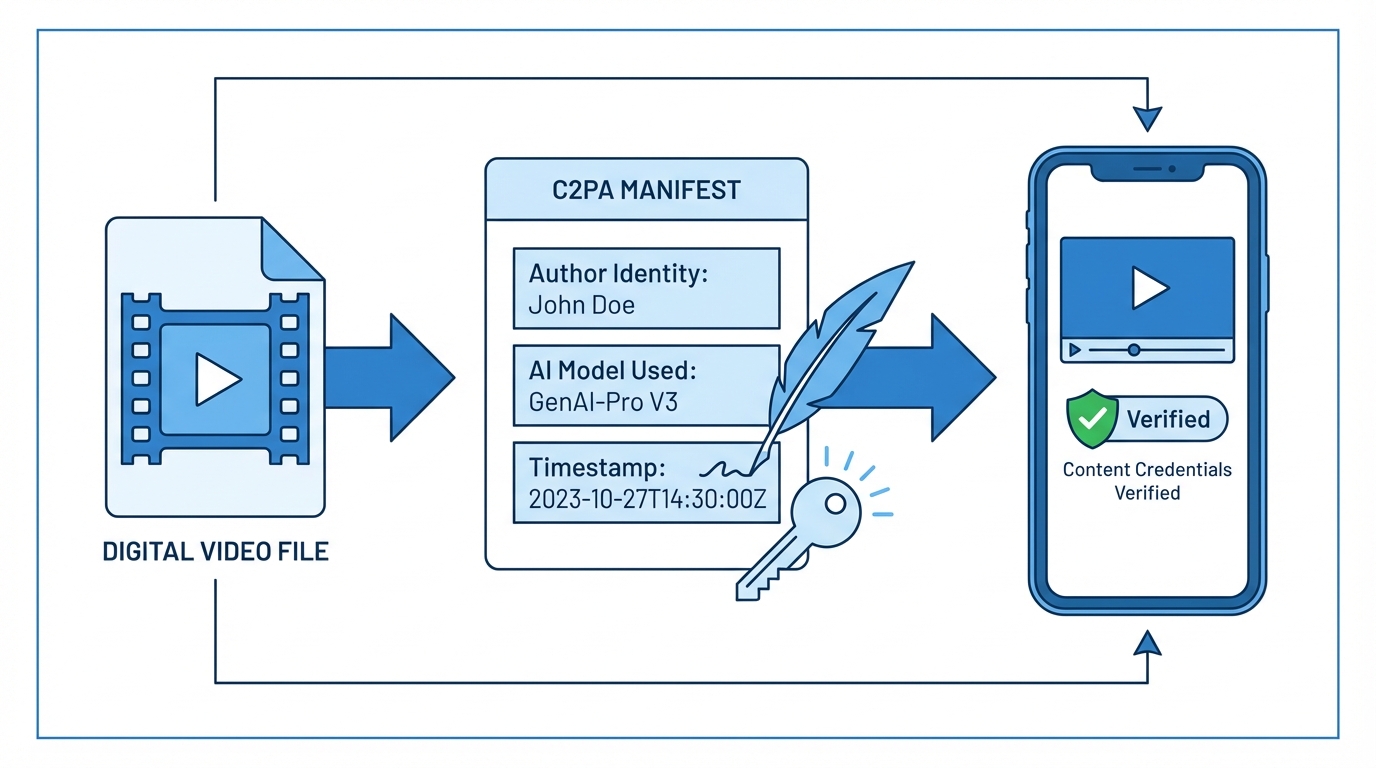
Central to this foundation is cryptographic content signing, which involves signing a C2PA (Coalition for Content Provenance and Authenticity) manifest C2PA manifest guide with a private key at every stage of the creative pipeline. When a video is edited or exported, a new claim is added to the manifest, and the entire package is signed; verification then uses the corresponding public key to ensure the integrity of the authorship. This creates immutable content verification, where tamper-evident proofs—such as hashes and timestamps—are stored on a blockchain or append-only log to prove no post-signing alteration has occurred.
Furthermore, synthetic media trust signals serve as the user-facing layer of this architecture, often manifesting as “Content Credentials” badges Content Credentials badges. These indicators allow viewers to click and reveal the asset’s full history, from the initial AI model prompts to the final export. By utilizing decentralized video validation, any relying party can verify these provenance proofs without depending on a single central authority, utilizing distributed ledger consensus to maintain a universal source of truth.
India’s 2026 Regulatory Landscape: Operationalizing Web3 Video Marketing Compliance
The regulatory environment in India is rapidly evolving to address the risks associated with synthetic media and data privacy. The Digital Personal Data Protection (DPDP) Act of 2023 serves as the primary anchor, mandating strict principles for personal data processing, consent, and data fiduciary obligations. For enterprises, this means that personalized video pipelines and their associated provenance logs must be designed with auditability and data minimization at their core.
MeitY (Ministry of Electronics and Information Technology) has issued several deepfake advisories that signal a move toward mandatory disclosure and labeling for synthetic media. These advisories, coupled with CERT-In’s emphasis on deepfake threat mitigations, suggest that by 2026, Web3 video marketing compliance will require explicit traceability for all AI-generated content. The National e-Governance Division (NeGD) has also released a practical playbook for enforcement, urging legal responses and explicit controls that favor a provenance-first strategy over reactive detection.
The broader financial landscape in India provides a glimpse into the future of digital verification. As of January 8, 2026, FIU-IND has implemented significantly tougher KYC norms for crypto exchanges, including mandatory live selfies and geo-tagging to prevent fraud. This trend toward high-bar identity verification and traceability is expected to bleed into the marketing sector, where AI content authenticity certification will become a standard requirement for enterprise-grade campaigns. Platforms like TrueFan AI enable brands to navigate these complexities by integrating compliance-first workflows into their video generation engines.
Source: DPDP Act 2023 Overview
Source: MeitY Deepfake Advisory
Source: FIU-IND KYC Upgrades 2026
Source: India's On-Chain Trends 2026
Source: NeGD Deepfake Playbook
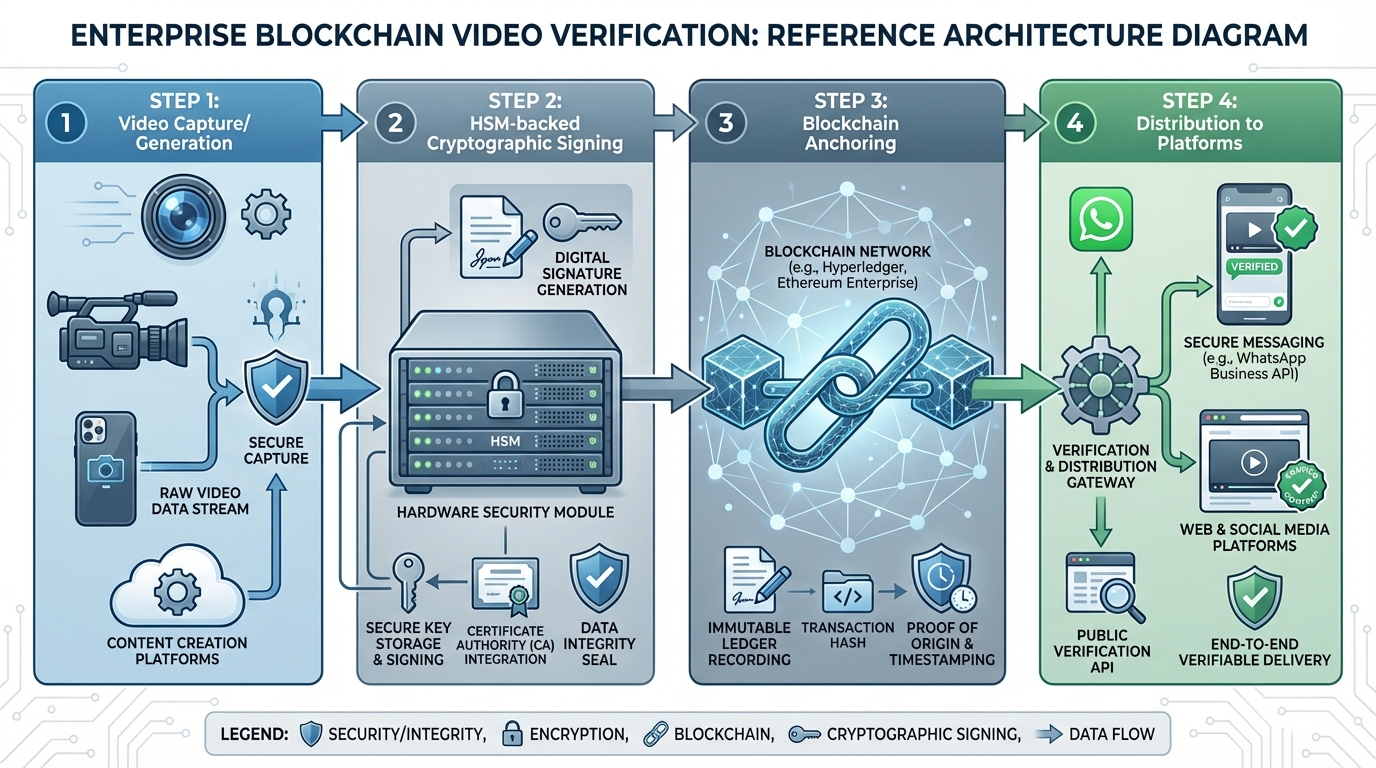
Reference Architecture for Enterprise-Grade Provenance
Building a robust system for blockchain video verification India 2026 requires an end-to-end architecture that secures the video from capture to consumption. The process begins with trusted ingestion, where device attestation and secure time-source synchronization (using RFC 3161 or blockchain timestamps) ensure the initial asset is legitimate. Every asset is assigned a unique ID and tagged with specific policy metadata regarding consent and usage rights, aligning with DPDP requirements.
During the post-production phase, the system must implement C2PA-first controls. At each edit or export, the platform generates a manifest that includes claims about the AI models used, the specific prompts, and the identity of the operator. This manifest is signed using hardware-backed keys (HSM or Cloud KMS) to prevent unauthorized tampering. The resulting tamper-proof video certification is then anchored to a blockchain, creating a permanent, append-only record of the video’s integrity and history.
For distribution, distributed ledger video tracking allows the enterprise to monitor how assets are used and shared across different platforms. This architecture also supports smart contract video rights, which can automate the enforcement of usage windows and geographical restrictions. In some high-value campaigns, NFT video authentication may be used to issue limited-edition, verifiable versions of content, providing an additional layer of exclusivity and trust for consumers. This comprehensive approach ensures that decentralized video validation is available to any auditor or platform that needs to verify the content's origin.
Implementation Playbook: From Pilot to 2026 Scale
The transition to a provenance-backed video strategy should be executed in three distinct phases over 180 days. Phase 1 focuses on pilot programs and hardening the core infrastructure. Enterprises should select high-risk use cases, such as CEO messages or influencer-led synthetic talent spots, to test C2PA signing and HSM integration. During this 90-day window, the goal is to establish a permissioned ledger for internal compliance while drafting disclosure policies that align with the latest MeitY advisories.
Phase 2 involves scaling these capabilities to all marketing channels, including live streams and user-generated content (UGC) campaigns. This stage introduces distributed ledger video tracking to manage assets at scale and enables decentralized validation endpoints for third-party partners. It is also the time to integrate deepfake prevention technology, combining proactive provenance with reactive detection and takedown workflows. TrueFan AI's 175+ language support and Personalised Celebrity Videos can be integrated here to ensure that localized content remains as secure and verifiable as global assets.
Phase 3, the “Assurance and Certification” stage, focuses on long-term governance and transparency. This includes establishing a cadence for cryptographic key rotation and pursuing formal AI content authenticity certification through third-party audits. Brands should begin practicing blockchain transparency marketing by publishing quarterly reports that summarize their verification rates and compliance metrics. This ongoing commitment to transparency not only satisfies regulatory requirements but also builds a lasting competitive advantage based on consumer trust.
Measuring Success and Selecting the Right Verified Video Marketing Platform
To evaluate the effectiveness of a blockchain video verification India 2026 strategy, CISOs must track specific KPIs that reflect both security and business value. Key metrics include provenance coverage (the percentage of assets signed and anchored), verification latency, and trust signal engagement (how often users interact with Content Credentials). Furthermore, compliance metrics such as the percentage of assets with correct disclosure labels and the mean time to recover (MTTR) from deepfake incidents are essential for regulatory reporting.
When selecting a verified video marketing platform, enterprise buyers should demand a specific set of capabilities. The vendor must support C2PA 2.x standards, offer HSM-backed cryptographic content signing, and provide a seamless viewer-facing UX for verification. Solutions like TrueFan AI demonstrate ROI through their ability to deliver millions of hyper-personalized, consent-first videos while maintaining a rigorous security posture, including ISO 27001 and SOC 2 compliance. Their API-first architecture allows for rapid integration into existing CRM and WhatsApp workflows, ensuring that provenance does not come at the cost of speed.
Ultimately, the goal is to create a marketing ecosystem where transparency is a feature, not a burden. By choosing a platform that automates smart contract video rights and provides tamper-proof video certification, brands can reduce creative cycle times and mitigate the risks of rights disputes. As we move into 2026, the ability to provide a “verified” badge on every piece of synthetic media will be the hallmark of a market leader in the Indian digital economy.
Summary of Outcomes:
By implementing this playbook, Indian enterprises can achieve verifiable authenticity, faster regulatory audits, and higher consumer trust. The integration of blockchain transparency marketing and AI content authenticity certification will be the defining standard for brand safety in 2026.
CTA: Book a 60–90 day India 2026 provenance pilot with TrueFan Enterprise to operationalize your blockchain content provenance strategy today.
Frequently Asked Questions
How does cryptographic content signing with C2PA reduce deepfake risk versus detection alone?
While detection tools attempt to identify “fakes” by looking for artifacts, cryptographic content signing focuses on proving what is “real.” It creates a secure, verifiable trail from the moment of creation. A layered defense strategy uses deepfake prevention technology to catch malicious content, while C2PA manifests provide the positive proof of authenticity that detection alone cannot offer.
What’s the difference between blockchain content provenance and immutable content verification?
Blockchain content provenance refers to the entire history and chain-of-custody of a digital asset—who made it, what was changed, and where it has been. Immutable content verification is the technical mechanism (using hashes and blockchain anchors) that ensures this provenance data has not been altered after the fact. One is the “story” of the video, and the other is the “lock” that keeps that story honest.
Can decentralized video validation scale to live or near-live streams in India?
Yes, by using optimized signing protocols and permissioned ledgers for low-latency logging, decentralized video validation can support live content. For blockchain video verification India 2026, enterprises will likely use a hybrid approach: signing manifests in near-real-time and batching those proofs for periodic anchoring to public chains to manage costs and speed.
Do we need NFT video authentication to meet Web3 video marketing compliance?
No, NFT authentication is an optional tool for specific use cases, such as limited-edition collectibles or high-value brand assets. While it can enhance Web3 video marketing compliance by providing a unique token of authenticity, the core requirement for most enterprises will be the underlying C2PA manifests and ledger-based provenance logs.
How do smart contract video rights reduce rights disputes and ease audits?
Smart contracts encode usage terms—such as expiration dates and regional restrictions—directly into the metadata of the video. This enables distributed ledger video tracking, where the contract can automatically trigger re-consent flows or “expire” the content’s verification status once the rights window closes. This creates an automated, audit-ready trail that significantly reduces the manual overhead of rights management. Platforms like TrueFan AI are designed to handle these complex governance hooks at scale, ensuring that every personalized video remains within its legal and ethical boundaries.



