AI sales outreach videos: How enterprise teams accelerate complex deals with personalized video at scale
Estimated reading time: ~13 minutes
Key Takeaways
- AI-personalized, role-aware videos drive higher reply rates and faster stakeholder alignment across long enterprise cycles.
- Scalable ABM programs use CRM and intent data to auto-generate account-specific video variants while maintaining brand consistency.
- Late-stage momentum improves with stage-aware clips, week-in-review summaries, and virtual reshoot updates for rapid iteration.
- Buying-committee “packs” deliver CFO/CTO/CMO-aligned messaging that accelerates consensus and reduces objections.
- A 90-day playbook with KPIs, governance, and DPDP workflows enables compliant scale and measurable cycle-time reduction.
In the high-stakes environment of enterprise sales, the traditional outreach playbook is rapidly losing its efficacy. AI sales outreach videos have emerged as the definitive solution for teams navigating 6–12 month sales cycles involving complex buying committees. These are not generic recordings; they are AI-generated, role-aware, and data-driven assets created from a single master recording and programmatically personalized by account and stakeholder.
Platforms like TrueFan AI enable enterprise teams to drive higher reply rates and faster stakeholder alignment by delivering hyper-personalized content at an unprecedented scale. By leveraging these tools, sales organizations can bridge the gap between human-led relationship building and the efficiency of automated prospecting. This strategic shift is essential for engaging modern buying committees, which now frequently include CFOs, CTOs, CMOs, and procurement leads, each requiring distinct value propositions.
The necessity for clarity and trust in B2B video personalization scale has never been greater. As enterprise teams strive for repeatable personalization, the ability to generate thousands of role-specific video variants ensures that every touchpoint is relevant and impactful. This guide explores how enterprise leaders are utilizing AI sales outreach videos to compress deal cycles and secure a competitive advantage in 2026.
Sources:
The 2026 Enterprise Landscape: Why B2B Video Personalization Scale is Non-Negotiable
As we move through 2026, the Indian enterprise landscape has shifted toward an AI-first operating model, as highlighted by recent NASSCOM insights. Organizations are no longer experimenting with isolated AI tools but are integrating them into the core of their revenue-generating motions. This evolution is driven by the need for multi-touch personalization at scale, where customer experience (CX) is directly aligned with revenue metrics.
According to the KPMG Global Tech Report 2026, while 84% of companies have reported significant AI adoption, the maturity of these implementations varies. The challenge for enterprise sales teams is moving beyond basic automation to sophisticated, governed personalization. B2B video personalization scale allows teams to produce account-specific video variants using CRM and intent data, maintaining brand consistency across diverse regions and languages.
Furthermore, the operationalization of the Digital Personal Data Protection (DPDP) Act 2023 has introduced stringent requirements for data handling and consent in India. Enterprise teams must now ensure that their personalized outreach is not only effective but also fully compliant with national privacy standards. This regulatory environment necessitates the use of platforms that offer robust security postures and transparent data processing workflows.
The convergence of Account-Based Marketing (ABM) and CX has made personalized video a primary lever for growth. Industry reports from ETBrandEquity indicate that brands prioritizing deep personalization are seeing a marked improvement in stakeholder engagement. In a market where digital noise is at an all-time high, a personalized video serves as a “pattern interrupt” that captures the attention of busy executives.
Sources:
High-Impact Use Cases: From AI Personalized Prospecting Videos to LinkedIn Automation
The application of AI sales outreach videos begins at the top of the funnel with AI personalized prospecting videos. These short, 20–45 second dynamic clips are generated from a master template, automatically inserting variables such as the prospect's name, company, and specific pain points. This method transforms cold outreach into a warm, tailored experience that significantly boosts open and reply rates.
Strategic placement of these videos is critical for success. Sales Development Representatives (SDRs) are increasingly using them as the first step in outbound email sequences or as embedded content on 1:1 microsites. By including an auto-generated GIF thumbnail with the prospect's company logo, teams can create an immediate visual hook that encourages the viewer to click and watch.
LinkedIn video outreach automation has also become a cornerstone of modern social selling. By using rules-based delivery, teams can send personalized video messages via InMail based on specific triggers like a prospect's new role or recent company funding. This approach ensures that the outreach is timely and contextually relevant, which is vital for building trust on professional networks.
Account-based video marketing (ABM) takes this a step further by creating tiered video libraries mapped to specific ICP (Ideal Customer Profile) tiers. For Tier 1 accounts, teams might produce bespoke executive introductions, while Tier 2 and 3 accounts receive modular templates that insert industry-specific variables. This tiered model allows for high-touch engagement without the prohibitive costs of traditional video production.
TrueFan AI's 175+ language support and Personalised Celebrity Videos allow enterprise teams to localize these use cases for regional decision-makers across India. Whether it is a Hindi-speaking procurement lead in Delhi or a Tamil-speaking CTO in Chennai, the ability to deliver content in the recipient's native language with perfect lip-sync is a significant differentiator. This level of localization ensures that the brand's message resonates deeply, regardless of geographical or linguistic barriers.
Sources:
Orchestrating the Buying Committee: Multi-Stakeholder Engagement and RFP Personalization
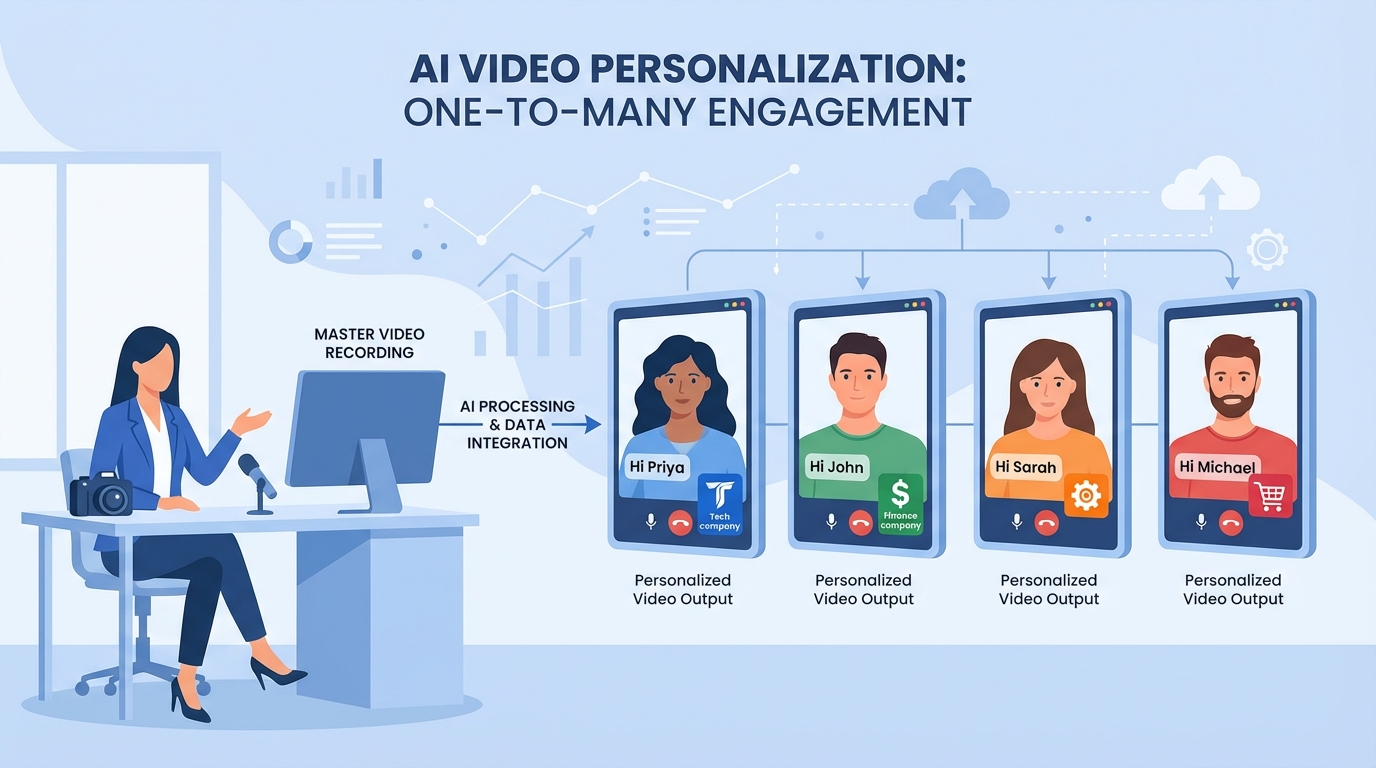
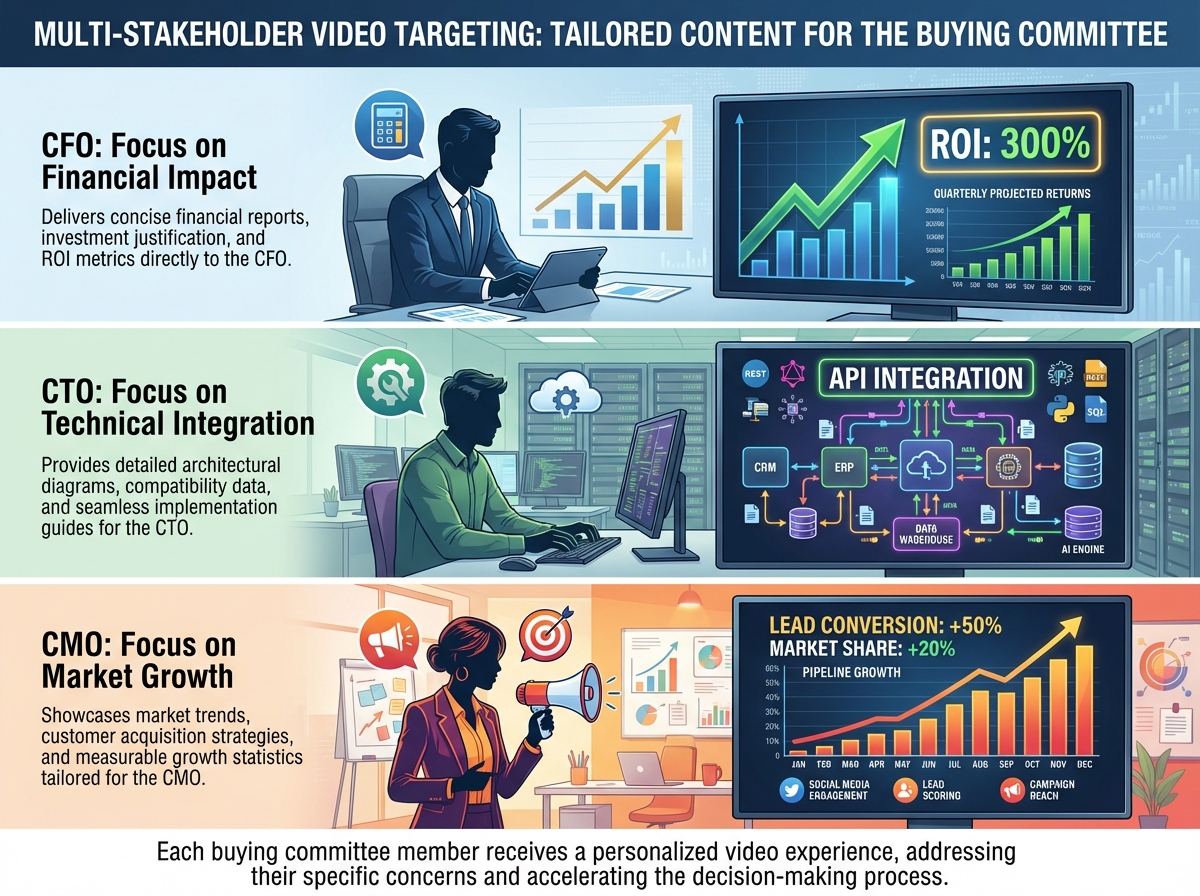
Enterprise deals are rarely won by engaging a single person; they require consensus across a diverse buying committee. Multi-stakeholder engagement videos address this by providing curated packs of role-aligned clips. These “committee packs” empower your internal champion to circulate precise, objection-busting content to the CFO, CTO, and CMO, ensuring that each leader receives information relevant to their specific concerns.
CFO CTO CMO aligned messaging is the key to navigating these complex hierarchies. For the CFO, the focus must be on TCO (Total Cost of Ownership), ROI, and risk-adjusted benefits. A 60-second ROI explainer can often do more to secure budget approval than a 50-page slide deck. Conversely, the CTO requires technical depth, focusing on integration architecture, API readiness, and security posture, often necessitating a 90-second technical summary.
The CMO and GTM (Go-To-Market) leaders are primarily interested in pipeline lift, conversion impact, and brand integrity. Providing them with a 30-60 second outcomes reel that demonstrates how the solution drives growth can quickly secure their buy-in. By tailoring the narrative to each persona, sales teams can proactively address objections and reduce the friction typically found in multi-stakeholder deals.
RFP response video personalization is another late-stage application that is gaining traction. By embedding role-specific videos into RFP portals or digital binders, teams can provide a human touch to a traditionally dry process. These videos can include executive summaries, implementation plans, and commercial overviews, each tailored to the specific function reviewing that section of the proposal.
This approach also serves as a powerful trust signal. Including videos that detail ISO 27001/SOC 2 compliance and data handling practices aligned with the DPDP Act demonstrates a level of professional rigor that sets a vendor apart. In 2026, where security and privacy are top-of-mind for enterprise buyers, these personalized technical explainers are often the deciding factor in high-value RFP wins.
Sources:
Deep-Stage Momentum: Deal Acceleration and Procurement Cycle Video Automation
Maintaining momentum in the middle and late stages of a deal is often where enterprise teams struggle most. Deal acceleration AI videos solve this by automating stage-aware clips such as pilot kickoffs, weekly recap summaries, and decision-memo explainers. These assets keep stakeholders engaged during the “quiet periods” of a long sales cycle and ensure that the value proposition remains top-of-mind.
A particularly effective pattern is the “week-in-review” video, which is auto-assembled from CRM notes and tasks. This 45-60 second summary provides a clear record of progress and next steps, reducing the risk of asynchronous misalignment. Additionally, dynamic objection-handling FAQs can be generated on the fly, addressing specific concerns raised during meetings with personalized video responses.
Virtual reshoot technology is the engine that makes this level of agility possible. It allows teams to update spoken lines, pricing models, or compliance statements in existing footage without the need for fresh shoots. This means that if a deal's scope changes or a new regulation is introduced, the sales team can update their entire video library in hours rather than weeks, maintaining presenter continuity across all assets.
Procurement cycle video automation is the final frontier in deal closure. By providing standardized, auto-updated explainers for legal, data protection, and SLA (Service Level Agreement) terms, teams can significantly reduce the back-and-forth of redlining. A 60-90 second legal overview that clearly outlines DPDP alignment and data retention policies can expedite the approval process by providing procurement teams with the exact information they need in a digestible format.
These procurement-focused videos act as a “closing readiness” pack. They address the granular details of the commercial model and renewal terms, ensuring that there are no surprises during the final signature phase. By automating these repetitive but crucial explanations, enterprise sales teams can focus their energy on high-value negotiations while the AI handles the routine clarifications.
Sources:
The Enterprise Blueprint: Workflow, Governance, and DPDP Compliance
Implementing AI sales outreach videos at an enterprise level requires a structured data-to-storyboard system. This workflow begins by mapping CRM and intent fields to video variables such as name, role, industry, and pain signals. A logic layer then determines which script modules to use; for example, if the recipient is a CFO, the system automatically swaps in the ROI-focused module and relevant financial proof points.
Enterprise sales enablement also requires a robust template library. This includes master scripts for prospecting, role introductions, and procurement FAQs, along with visual tokens like dynamic lower-thirds and CTA panels. The goal is to create a production line that is both agile and consistent, allowing for the rapid generation of thousands of brand-approved video variants.
Governance and security are the bedrock of any enterprise AI program. Organizations must enforce Role-Based Access Control (RBAC), SSO/SCIM integration, and comprehensive audit logs to ensure that only authorized personnel can generate and distribute content. Furthermore, every video must pass through moderation filters to block unapproved claims and ensure brand safety, protecting the organization from legal and reputational risks.
Compliance with India's DPDP Act 2023 is a non-negotiable requirement for 2026. This involves embedding consent UI and data subject request (DSR) workflows directly into the outreach stack. Teams must document the lawful basis for processing personal data and adhere to principles of data minimization and storage limitation. By integrating these compliance measures into the video generation process, enterprises can scale their outreach with confidence.
Finally, the distribution stack must be fully integrated with the existing MarTech and SalesTech ecosystem. Whether the videos are delivered via email, LinkedIn, or personalized microsites, all engagement data—such as watch time and completion rates—should flow back into the CRM. This allows for accurate attribution and enables sales leaders to identify which video modules are driving the highest ROI across different industries and personas.
Sources:
The 90-Day Implementation Playbook and Measurement
Launching a successful AI sales outreach program requires a phased approach that prioritizes learning and optimization. In the first two weeks, teams should focus on strategy and KPI design, selecting a pilot group of 50–150 target accounts. Key metrics to track include positive reply rates, meeting accepts, and stage-to-stage conversion lift. This initial phase sets the benchmark for the rest of the pilot.
Weeks three through five are dedicated to the “build” phase. This involves creating the initial template set, including AI personalized prospecting videos and the multi-stakeholder “committee pack.” During this time, the technical team configures CRM field mapping and sets up the UTM taxonomy for tracking. It is also the time to establish the LinkedIn video outreach automation sequences, ensuring they are aligned with DPDP-purpose limitations.
The “launch and optimize” phase occurs between weeks six and ten. Here, teams run A/B tests on video hooks, thumbnails, and CTA placements. Virtual reshoot technology is leveraged to iterate on scripts based on real-world feedback without needing to re-film. This agility is what allows enterprise teams to refine their messaging in real-time, significantly increasing the effectiveness of the outreach as the pilot progresses.
In the final weeks, the focus shifts to scaling and enablement. Successful assets are pushed into the broader enterprise sales enablement portal, and SDR/AE managers are trained on how to use the videos in their daily workflows. Measurement is continuous, with a focus on account-level multi-touch attribution. Solutions like TrueFan AI demonstrate ROI through measurable reductions in deal cycle time and increased stakeholder coverage depth.
By the end of the 90-day pilot, organizations should have a clear understanding of the impact of personalized video on their sales funnel. The data gathered will inform the full-scale rollout, allowing the organization to expand into new regions and languages with a proven, high-performing playbook. This systematic approach ensures that the investment in AI video technology translates into tangible business outcomes.
Sources:
Ready to accelerate your enterprise deals? Book a 30-minute enterprise pilot scoping session to launch AI sales outreach videos across your key regions. Our team will help you build a ready-to-use committee pack and procurement explainer set, providing you with the storyboard templates and KPI worksheets needed for a successful 90-day rollout.
Book Your Scoping Session Now | Download the Enterprise Video Enablement Checklist
Recommended Internal Links
Frequently Asked Questions
How do AI sales outreach videos work for enterprise deals?
AI sales outreach videos function by mapping CRM data to dynamic video templates. A single master recording is used to generate thousands of personalized variants where the speaker addresses the prospect by name and mentions specific account details. This process is governed by enterprise-grade security and integrated into the sales stack for seamless delivery. TrueFan AI provides the infrastructure to manage this at scale, ensuring brand consistency and high-quality output.
Are AI personalized prospecting videos compliant with India’s DPDP Act?
Yes, provided the platform and the sales team adhere to the principles of consent and purpose limitation. Enterprise teams must ensure that they have a lawful basis for processing the data used for personalization and provide clear opt-out mechanisms. Leading platforms incorporate these compliance requirements into their workflows, including data minimization and secure storage practices as mandated by the MeitY guidelines.
What results can account-based video marketing deliver in 90 days?
In a typical 90-day pilot, enterprise teams often see a 2x to 3x increase in positive reply rates and a significant lift in meeting accepts. Furthermore, by using role-aligned videos for the buying committee, teams report faster stakeholder alignment and a reduction in overall deal cycle time. These results are driven by the “pattern interrupt” effect of personalized video in a crowded digital environment.
Can virtual reshoot technology be used to update existing sales content?
Absolutely. Virtual reshoot technology allows teams to modify the audio and lip-sync of an existing video to reflect new pricing, product updates, or compliance requirements. This eliminates the need for expensive and time-consuming re-shoots, allowing sales enablement teams to keep their video libraries current and relevant with minimal effort.
How does multi-stakeholder engagement benefit from personalized video?
Personalized video allows you to speak directly to the unique concerns of each member of the buying committee. By providing a CFO with an ROI-focused video and a CTO with a technical security overview, you address objections before they are even raised. This proactive approach builds trust and ensures that all decision-makers have the information they need to move the deal forward.