
Video Commerce Conversion ROI India 2026: Benchmarks, A/B Frameworks, and Cost Analysis for AI Product Demos
Estimated reading time: ~12 minutes
Key Takeaways
- AI PDP videos consistently lift conversion by 25–40% over static images, reducing returns and building trust across Tier 2/3 markets.
- Use a rigorous ROI formula focused on incremental gross profit, not vanity metrics like views.
- Studio by TrueFan AI enables localized, multilingual demos at scale, cutting production costs by up to 90%.
- A/B testing with proper sample size, ABR, and lazy loading is critical to isolate true performance lift.
- Typical payback is 1.5–2 months; WhatsApp video remarketing can further 3x CTRs versus text.
In the rapidly evolving landscape of Indian e-commerce, video commerce conversion ROI India 2026 has become the definitive metric for D2C brands looking to dominate the market. As the shopper base expands beyond Tier 1 metros, the ability to translate product value through immersive, high-fidelity video has shifted from a “nice-to-have” to a core financial driver. By 2026, the quantified financial return from implementing product page AI video demos is expected to be the primary differentiator between stagnant growth and market leadership for Indian e-retailers.
1. Executive Summary: The 2026 ROI Thesis for Indian D2C
The thesis for 2026 is clear: Product Detail Page (PDP) videos, specifically those powered by AI avatars and automated generation, compress the purchase journey by bridging the “trust gap” inherent in digital shopping. For the Indian market, where the online shopper base is projected to reach 350 million by 2026, the ROI of video commerce is no longer speculative.
The ROI Formula for 2026:
To accurately measure success, CFOs and CRO specialists must move beyond vanity metrics like “view counts” and focus on the following formula:
- ROI = (Incremental Gross Profit from Video – Total Video Costs) / Total Video Costs
- Incremental Gross Profit = (Incremental Orders × (AOV × Gross Margin %)) – Incremental Returns/Cancellations.
Market Context & Benchmarks:
According to recent industry data, the India e-retail market is scaling toward a massive GMV, with penetration deepening into Tier 2 and Tier 3 cities. Platforms like Studio by TrueFan AI enable brands to capitalize on this growth by automating the production of localized, high-converting video content. Explore related guidance on AI Voice Cloning for Indian Accents.
- Projected Video Commerce GMV (India 2026): Estimated to hit $8.5 billion as shoppable formats become the standard.
- Conversion Lift Expectation: Brands implementing AI product demos are seeing a baseline CVR improvement of 25% to 40% compared to static imagery.
- Payback Period: With the reduction in AI production costs, the typical payback period for a PDP video rollout in the beauty or electronics category is now 1.5 to 2 months.
Sources:
2. Why PDP Video Wins vs. Static Images in India
The battle of AI product demo video vs static image is being won by video due to three fundamental shifts in Indian consumer behavior.
A. Cognitive Load and Attribute Clarity
Static images often fail to convey the “tactile” reality of a product—the drape of a saree, the true sound of a speaker, or the viscosity of a serum. For the 270 million+ shoppers currently active in India, video reduces the cognitive effort required to “imagine” the product. PwC India’s research highlights that localized content and visual clarity are paramount for shoppers in Tier 2 and Tier 3 cities who may be more risk-averse.
B. The “Short-Form” Priming Effect
The explosion of short-form video platforms in India has conditioned users to consume information in 15–30 second vertical bursts. When a shopper lands on a PDP and finds a video format similar to their social feed, the friction to consume that information is near zero. This familiarity drives a higher conversion rate video vs photo e-commerce than in any previous era.
C. Multilingual Trust and Accessibility
India is a linguistically diverse market. A static image with English text has limited reach. Studio by TrueFan AI’s 175+ language support and AI avatars allow brands to instantly pivot their PDP demos into Hindi, Tamil, Telugu, or Bengali. This hyper-localization builds immediate trust, which is the strongest currency in Indian e-commerce. Learn more with AI Voice Cloning for Indian Accents and Real-time Interactive AI Avatars for India.
Key Performance Indicators (Projected 2026):
- PDP Dwell Time: +70% increase when video is present.
- Add-to-Cart (ATC) Rate: 15–20% higher for video-enabled pages.
- Return Rate Reduction: 12% decrease in apparel due to better “fit” visualization.
Source:
3. Data & Benchmarks: Product Video Conversion Lift Data (India-Centric)
To justify the investment, we must look at the video commerce ROI benchmarks D2C across various high-growth categories in the Indian market.
2026 Category-Specific Benchmarks
| Category | Baseline CVR (Static) | Video CVR (AI Demo) | Lift (%) | AOV Impact |
|---|---|---|---|---|
| Beauty & Personal Care | 2.8% | 3.9% | +39% | +8% |
| Consumer Electronics | 1.2% | 1.8% | +50% | +12% |
| Fashion & Apparel | 3.5% | 4.4% | +25% | +5% |
| Home & Kitchen | 1.5% | 2.1% | +40% | +15% |
The Impact of AI Avatars on Conversion
A recent video vs image conversion study India suggests that AI avatars—specifically those that look and speak like local influencers—outperform generic stock footage by 2.2x. This is because the “human” element in the video provides a spokesperson for the brand, answering FAQs in real-time within the video script. For deeper context, see Real-time Interactive AI Avatars for India.
ROI Drivers in 2026:
- Reduced Production Cost: AI-generated videos cost 90% less than traditional shoots.
- Dynamic Updating: The ability to change price callouts or “limited time offers” within the video without a reshoot.
- WhatsApp Integration: Using video snippets in WhatsApp remarketing flows has shown a 3x higher click-through rate (CTR) than text-only messages. See Automotive WhatsApp Video Marketing.
Source:
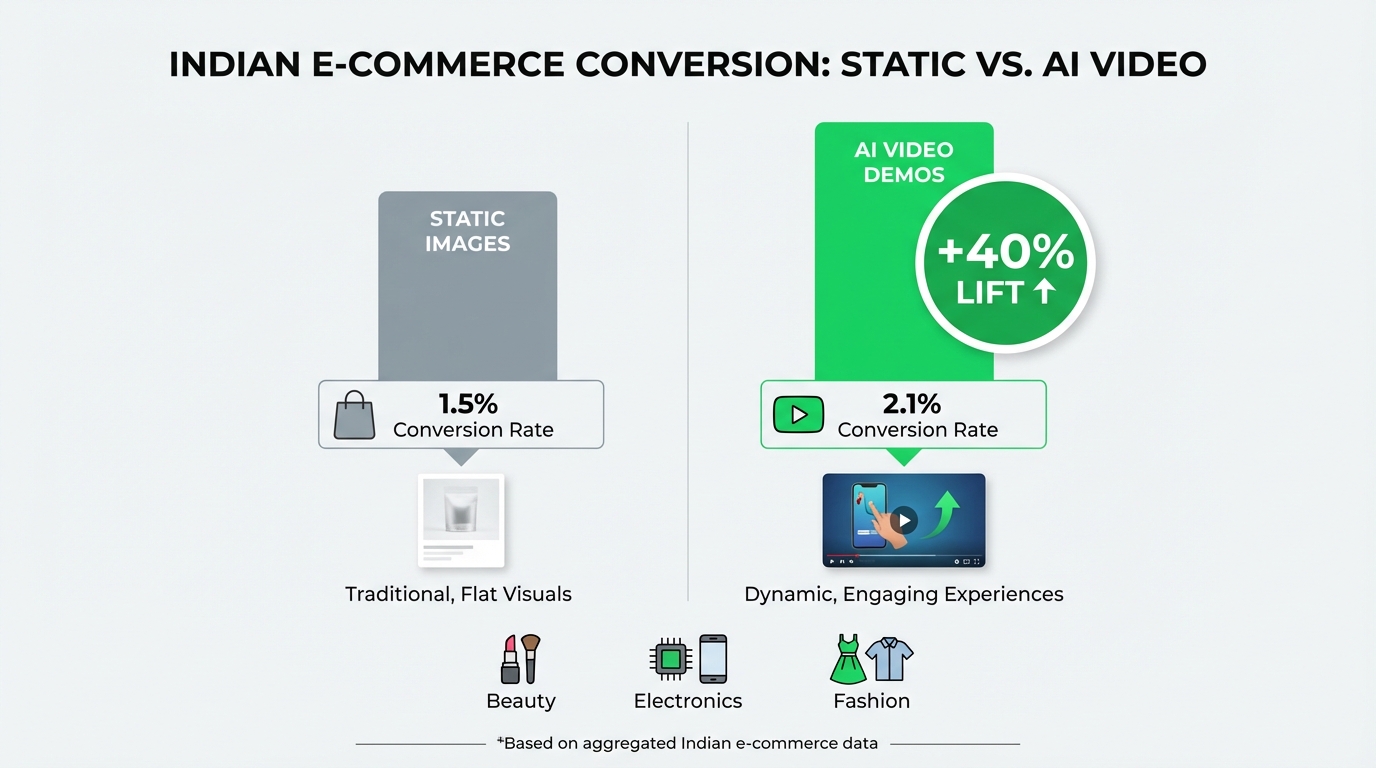
4. The Experimentation Framework: A/B Test Video vs Image E-commerce India
Implementing video without a rigorous e-commerce video testing framework India is a missed opportunity for optimization. To achieve the best conversion rate optimization AI video results, brands must follow a structured A/B testing protocol.
Step 1: Define Primary and Secondary Metrics
- Primary: PDP Conversion Rate (Orders / Unique PDP Visitors).
- Secondary: ATC Rate, Video Completion Rate (VCR), and Return Rate (measured over 30 days).
Step 2: Sample Size and Statistical Power
In the Indian context, traffic can be volatile due to sales events (like Big Billion Days). Ensure your test runs for at least two full business cycles (14–28 days).
- MDE (Minimum Detectable Effect): Aim for a 10% relative lift.
- Confidence Level: 95% (α = 0.05).
Step 3: Controlling for Performance
One of the biggest “silent killers” of video ROI is page load speed. In India, where 4G/5G speeds vary drastically between metros and rural areas, your video implementation must be lightweight.
- Poster Frames: Use optimized WebP images as placeholders.
- Lazy Loading: Ensure the video player only initializes when it enters the viewport.
- Adaptive Bitrate (ABR): Serve 360p for low-bandwidth users and 1080p for high-speed connections.
Step 4: Segmentation Analysis
Don’t just look at the aggregate lift. Segment your data by:
- Geography: Metro vs. Tier 2/3 (Does video have a higher lift in regions with lower brand awareness?).
- Device: High-end iOS vs. Budget Android.
- Traffic Source: Does video convert better for “cold” social traffic or “warm” search traffic?
Solutions like Studio by TrueFan AI demonstrate ROI through their built-in analytics dashboards that allow for this level of granular segment tracking, ensuring that every video variant is pulling its weight.
Source:
5. Implementation Deep-Dive: Shopify, WooCommerce, and Custom Stacks
To achieve a significant product page video conversion improvement, the technical execution must be flawless. Here is how to implement AI product videos across the most common platforms in India.
Shopify (India-Specific Optimization)
- Native Media Integration: Use Shopify’s native “Product Media” blocks. This ensures that the video is part of the main gallery and works with most theme lightboxes.
- Schema.org VideoObject: Manually or via app, ensure VideoObject structured data is present. This allows your product videos to appear in Google Video Search and “Rich Results,” driving organic traffic.
- CDN Strategy: Ensure your video assets are served via a CDN with points-of-presence (PoPs) in Mumbai, Delhi, and Bangalore to minimize latency.
WooCommerce
- HLS Streaming: Avoid uploading raw MP4s to your WordPress server. Use a dedicated video hosting service that supports HLS (HTTP Live Streaming) to ensure smooth playback on mobile devices.
- Custom Hooks: Use the woocommerce_product_thumbnails hook to inject your AI video as the second or third item in the gallery, which is the “sweet spot” for engagement.
Custom Stacks (React/Next.js/Headless)
- Player Choice: Use lightweight players like video.js or shaka-player.
- Event Schema: Standardize your dataLayer events. Track video_start, video_25_percent, video_50_percent, and video_complete.
- Server-Side Tracking: To combat cookie-blocking, use server-side GTM to tie video views to final purchase events for accurate attribution.
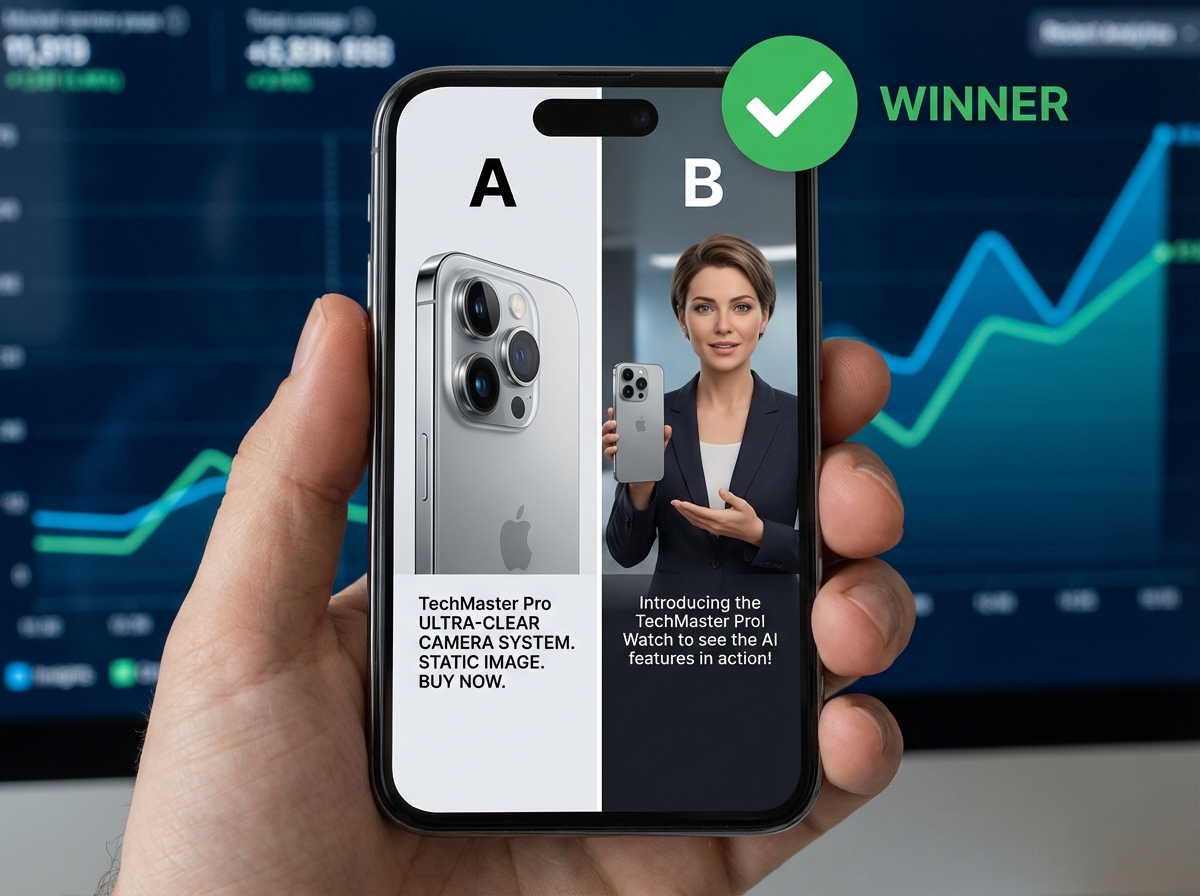
6. Cost Analysis & Payback: The AI Video ROI Calculator
A comprehensive AI video implementation cost analysis must account for both the “hard” costs of technology and the “soft” costs of operations.
Cost Components (Estimated 2026)
- Production: ₹500 – ₹2,000 per video (using AI automation) vs. ₹50,000+ (traditional shoot).
- Platform/SaaS: Monthly subscription for generation and hosting.
- CDN/Egress: Variable based on traffic (typically negligible with modern compression).
The AI Video ROI Calculator India (Example)
Let’s look at a typical Indian D2C brand in the “Home Decor” space:
- Monthly PDP Traffic: 200,000 sessions.
- Baseline CVR: 1.5% (3,000 orders).
- AOV: ₹2,500.
- Gross Margin: 40%.
- Video Implementation Cost: ₹1,50,000 (One-time setup + 100 AI videos).
- Expected CVR Lift: 20% (New CVR = 1.8%).
The Result:
- New Monthly Orders: 3,600 (+600 orders).
- Incremental Monthly Revenue: ₹15,00,000.
- Incremental Monthly Gross Profit: ₹6,00,000.
- Payback Period: Less than 10 days.
- Annualized ROI: >4,000%.
For brands looking to scale, using an AI video investment ROI calculator helps in prioritizing which SKUs to video-enable first (typically high-margin, high-traffic, or high-return items).
Source:
7. Future Outlook & FAQs
As we move toward 2026, the convergence of “shoppable” social video and PDP video will become seamless. A video created for an Instagram Reel will be automatically resized, captioned in three languages, and deployed to a Shopify PDP within minutes.
Frequently Asked Questions
Q1: How does video impact SEO for Indian e-commerce sites?
A: Video significantly improves “Time on Page,” a key ranking signal. Furthermore, properly tagged videos (using Schema.org) can appear in Google’s Video tab and as rich snippets in the main SERP, often increasing organic CTR by 10–15%.
Q2: Is AI video better than UGC (User Generated Content)?
A: They serve different purposes. UGC is excellent for social proof, but AI product demo video vs static image comparisons show that AI demos are superior for explaining technical features, dimensions, and usage instructions in a consistent brand voice.
Q3: What is the ideal length for a PDP product demo?
A: For the Indian market, 20–35 seconds is the “Goldilocks zone.” It’s long enough to cover 3–4 key USPs but short enough to maintain 80%+ completion rates on mobile devices.
Q4: Can I use AI videos for WhatsApp marketing?
A: Yes. In fact, sending a 15-second AI-generated product demo via WhatsApp Business API to users who abandoned their carts is one of the highest-ROI activities for D2C brands in 2026. See Automotive WhatsApp Video Marketing.
Q5: How does Studio by TrueFan AI handle data security and enterprise-grade requirements?
A: Platforms like Studio by TrueFan AI enable enterprise-level security by adhering to ISO 27001 and SOC 2 standards. They provide built-in content moderation, watermarking, and consent-first data processing, ensuring that brand assets are protected while delivering high-performance video at scale.
Q6: What is the most common mistake in video commerce implementation?
A: The most common mistake is failing to include captions. Over 70% of mobile users in India browse with sound off. If your video doesn’t have clear, localized subtitles, your conversion lift will be significantly lower.
Conclusion: The Path to 2026
The transition to a video-first PDP strategy is no longer a luxury for Indian D2C brands—it is a survival requirement. By leveraging product demo video ROI case studies and implementing a rigorous A/B test video vs image e-commerce India strategy, brands can unlock unprecedented growth. The tools are ready, the data is clear, and the Indian consumer is waiting to be “shown,” not just “told.” Whether it’s through AI avatar Zoom meetings or PDP videos, the execution matters. Explore Real-time Interactive AI Avatars for India for the next step.
Data Sources & Research References:
- Bain & Company (2025): How India Shops Online. Analysis of the $60B+ GMV market and the 270M+ shopper base. Read the Bain report
- Redseer (2024): Indian Short-Form Video Platforms Report. Insights into the $5B+ live commerce trajectory. Download the Redseer report
- PwC India (2024): How India Shops Online. Deep dive into Tier 2/3 consumer preferences and content formats. See PwC India study
- Moneycontrol/RedSeer (2022): Live Commerce Growth Forecast. Early indicators of shoppable video efficacy. Read the forecast
- TrueFan AI (2026): Social Commerce Video Integration. Technical guide for enterprise CRM and WhatsApp sync. Integration guide
Recommended Internal Links
Frequently Asked Questions
How do I calculate video commerce ROI correctly?
Use ROI = (Incremental Gross Profit from Video – Total Video Costs) / Total Video Costs. Compute incremental gross profit from added orders, AOV, margin, and subtract returns/cancellations. Avoid vanity metrics and tie to net contribution.
What conversion lifts should D2C brands expect in 2026?
India-focused benchmarks show 25–40% CVR lift on PDPs with AI demos, with category variance: +39% in Beauty, +50% in Electronics, +25% in Apparel, and +40% in Home & Kitchen.
Which technical factors most impact video ROI?
Page speed and delivery: use lazy loading, WebP posters, and adaptive bitrate streaming. Track video_start through video_complete and attribute conversions via server-side tagging.
How fast is the payback period for AI PDP videos?
Most Indian D2C brands see payback within 1.5–2 months. In high-traffic scenarios, payback can occur in under 10 days due to higher CVR, AOV lift, and reduced returns.
How does Studio by TrueFan AI help with localization at scale?
Studio by TrueFan AI provides AI avatars and 175+ language support, enabling brands to auto-generate localized PDP demos (Hindi, Tamil, Telugu, Bengali, and more) with consistent brand voice and analytics.



