Corporate Training Video AI: How CHROs Automate Onboarding, Personalize Learning, and Prove ROI
Estimated reading time: ~14 minutes
Key Takeaways
- Corporate training video AI automates video creation, localization, and distribution to reduce time-to-productivity and content debt.
- AI-powered L&D platforms integrate with HRIS/LMS to trigger role-specific, multilingual learning paths with governance and auditability.
- Virtual instructor AI and microlearning pipelines enable rapid “virtual reshoots,” consistent messaging, and scalable coaching.
- Multilingual training content with lip-sync and voice retention reaches vernacular workforces and improves compliance outcomes.
- Analytics-led learning links training to KPIs so CHROs can prove ROI within 90 days via efficiency, ramp time, and engagement.
In the rapidly evolving landscape of 2026, the traditional corporate training model has reached a breaking point. As Chief Human Resources Officers (CHROs) and Learning & Development (L&D) leaders navigate a talent market where AI fluency is now a baseline requirement, the demand for corporate training video AI has shifted from a “nice-to-have” innovation to a core operational necessity. This technology represents the convergence of generative AI and agentic workflows, allowing enterprises to automatically produce, personalize, and distribute high-fidelity training content across the entire employee lifecycle.
By integrating directly with Human Resource Information Systems (HRIS) and Learning Management Systems (LMS), an AI-powered L&D platform can now trigger event-based video delivery that is role-specific, multilingual, and data-driven. The stakes for this transition are high. In India’s tech-driven economy, AI-related job demand is expected to cross 1 million by 2026, intensifying the need for continuous, scalable skilling. Organizations like Citigroup have already set the precedent by launching mandatory AI training for 175,000 employees to enhance prompt-writing and technical literacy. For the modern CHRO, the goal is clear: eliminate content production debt and replace inconsistent, legacy e-learning with high-impact employee training automation.
What Corporate Training Video AI Solves for CHROs and L&D (2026 India Lens)
The primary challenge facing L&D leaders today is the “time-to-productivity” gap. Traditional video production is slow, expensive, and rigid, often resulting in content that is outdated by the time it reaches the learner. Corporate training video AI solves this by decoupling content from the physical constraints of filming.
Faster Onboarding and Role-Specific Ramping
Enterprises are now utilizing automated employee onboarding to bridge the gap between Day-0 and Day-30. By using AI to generate role-specific video paths, a new hire in Bangalore and a sales lead in Mumbai can receive the same core cultural message but entirely different technical primers, all triggered automatically by their start date in the HRIS. This ensures that the first 30 days are focused on high-value skill acquisition rather than administrative navigation.
Consistency Through Virtual Instructor AI
Maintaining a consistent brand voice across a global workforce is historically difficult. With virtual instructor AI, enterprises can create brand-safe avatars of internal subject matter experts (SMEs) or senior leaders. These avatars deliver centrally governed instruction that can be updated in minutes via “virtual reshoots” without ever needing a camera crew. This ensures that compliance standards and strategic pivots are communicated uniformly across all departments.
Multilingual Reach and Vernacular Accuracy
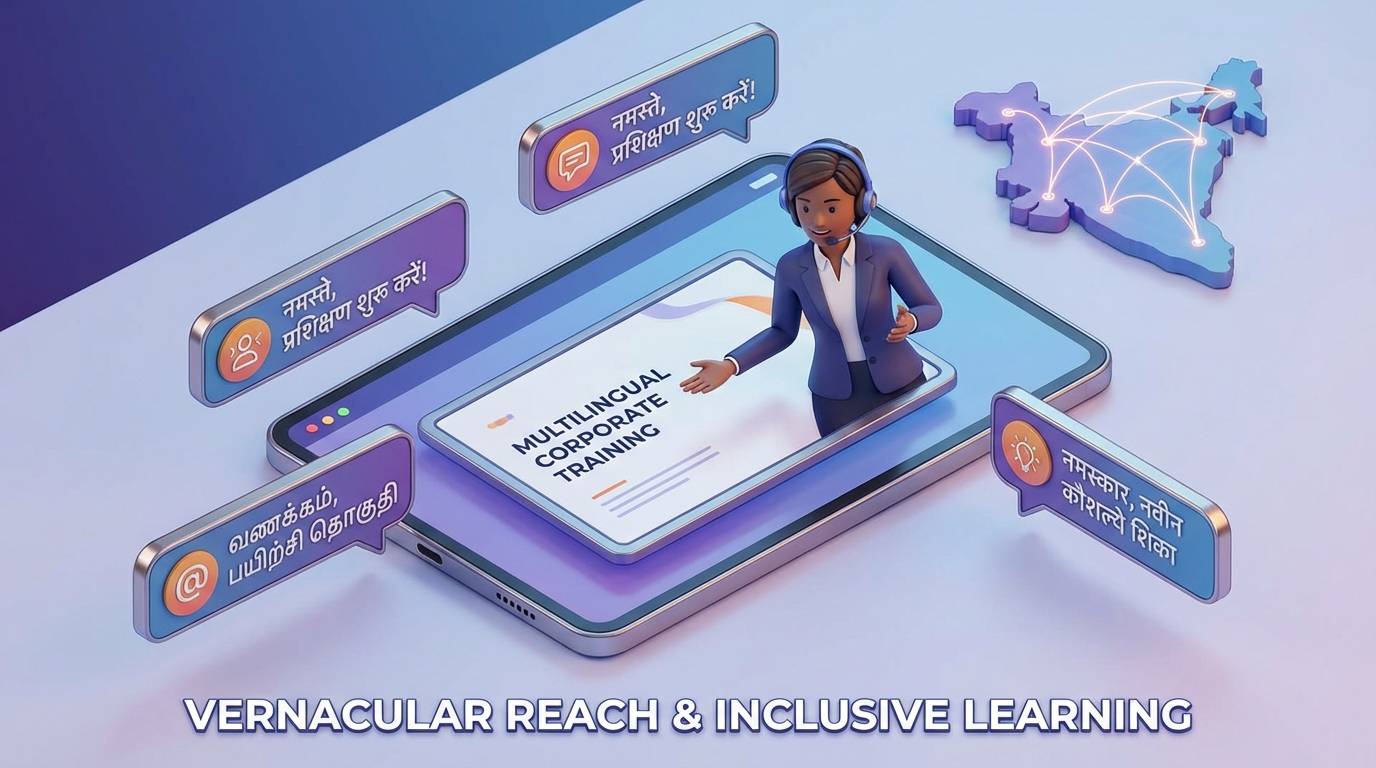
In the Indian context, the “Bharat” market requires more than just English-language content. Multilingual training content must now support over 175 languages and dialects, including Hinglish, Tamil, and Marathi, with perfect lip-sync and voice retention. This level of localization is critical for reaching frontline workforces and ensuring that safety and compliance protocols are understood at a native level, thereby reducing operational risk.
Sources:
- People Matters: The future of learning & development: 2026 and beyond
- NASSCOM: India’s AI Talent Crisis Is Real
- ET HR: Citigroup launches mandatory AI training for 175,000 employees
Inside an AI-Powered L&D Platform: Enterprise Architecture and Governance
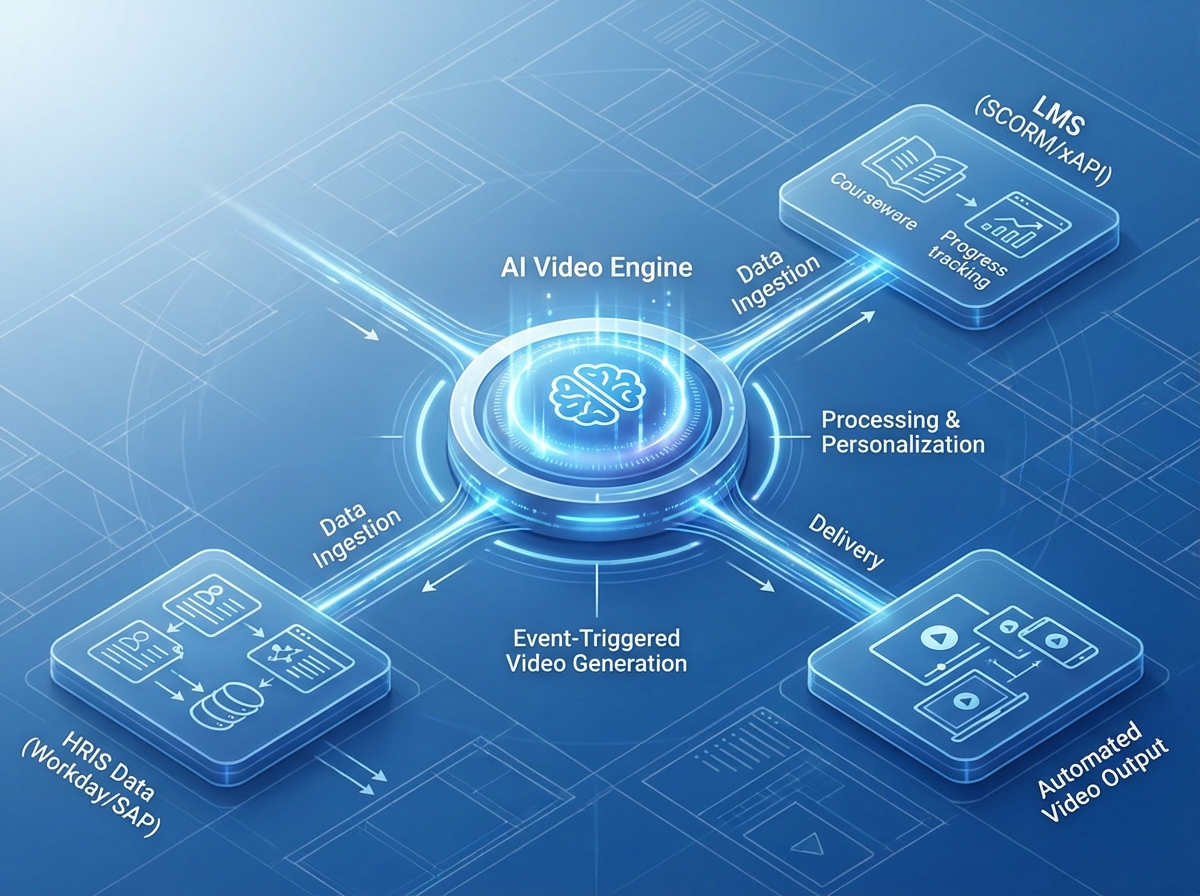
Deploying corporate training video AI at scale requires more than just a video generator; it requires a robust AI-powered L&D platform built on enterprise-grade architecture. For CHROs, the focus is on how these tools integrate with existing infrastructure to ensure security, compliance, and seamless data flow.
Core Integrations and API Workflows
A sophisticated platform must integrate with HRIS giants like Workday or SAP SuccessFactors and LMS environments via SCORM or xAPI. These integrations allow for “event-triggered” video generation. For example, when a candidate accepts an offer, a webhook can trigger the creation of a personalized welcome video. Platforms like TrueFan AI enable this level of automation, allowing enterprises to process videos in batches and distribute them through secure internal channels.
Governance and Content Lifecycle Management
Enterprise governance demands strict role-based access control (RBAC) and approval workflows. Content must move through a defined lifecycle: from initial script-to-video draft, through SME approval, to a versioned release, and finally to retirement when the policy changes. This ensures that no outdated or unapproved training material is ever accessible to the workforce. Audit logs provide a transparent trail of who created, edited, and approved every second of video content.
Security and Data Residency
When dealing with employee data and proprietary SOPs, security is non-negotiable. An enterprise-ready AI-powered L&D platform must maintain ISO 27001 and SOC 2 certifications. Data residency options are crucial for global firms that must comply with local data protection laws (like India’s DPDP Act). Furthermore, PII (Personally Identifiable Information) handling guardrails ensure that personalization does not compromise employee privacy.
Sources:
Automated Employee Onboarding and Customer Onboarding Videos
The first impression an employee or customer has of an organization often dictates their long-term retention and success. Automated employee onboarding and automated customer onboarding videos use AI to create a high-touch experience without the high-touch cost.
The Day-0 to Day-30 Employee Journey
The onboarding process is no longer a single orientation day; it is a 30-day orchestrated sequence.
- Day-0: Upon signing, the employee receives employee engagement videos from the CEO and their immediate manager, welcoming them to the culture.
- Day-1 to Day-7: The focus shifts to virtual instructor AI-led role primers. These are short, 90-second modules covering IT setup, security protocols, and team introductions.
- Day-8 to Day-30: AI-driven nudges deliver personalized learning videos based on the employee's specific role KPIs. If a sales hire is struggling with a specific product feature, the system automatically generates a micro-coaching video to address that gap.
CX Enablement via Automated Customer Onboarding
The same technology applies to customer success. Automated customer onboarding videos reduce the support load by providing “how-to” series embedded directly in the product help center or delivered via WhatsApp. By automating these visual guides, companies can speed up the Time-to-Value (TTV) for new users, ensuring they reach their “Aha!” moment faster and with less friction.
Scaling Consistent Experiences
By systematizing these workflows, Indian enterprises are ensuring that every stakeholder—whether an employee in a remote office or a global customer—receives a consistent, on-brand experience. This level of employee training automation removes the variability of human delivery and ensures that critical information is never missed during the high-pressure onboarding phase.
Sources:
- TrueFan AI: Automated Video Welcome Sequence
- People Matters: The world of work in 2026: Ten trends to watch
Personalized Learning Videos and Microlearning Video Automation
The shift toward “skills-based” organizations requires a departure from one-size-fits-all training. Personalized learning videos and microlearning video automation allow L&D teams to deliver content that is mapped to an individual’s unique skill gaps and performance signals.
The Microlearning Pipeline
Microlearning is most effective when it is delivered in “bursts” of 60 to 120 seconds. The production of these thousands of variants is made possible through script-to-video pipelines.
- Input: Existing SOPs, slide decks, or policy wikis are fed into the AI.
- Generation: The AI generates a script and converts it into a video using a virtual instructor AI.
- Batching: The system creates variants for different regions, languages, and seniority levels.
TrueFan AI's 175+ language support and Personalised Celebrity Videos allow for a level of engagement that traditional corporate videos simply cannot match, making the learning process feel less like a chore and more like a tailored experience.
Spaced Repetition and Nudges
To ensure knowledge retention, the AI-powered L&D platform uses spaced repetition. If an employee fails a quick quiz after a module, the system triggers a re-engagement video three days later. These nudges can be delivered via MS Teams, Slack, or mobile apps, meeting the employee where they already work.
Tracking the Skill Signature
The true power of personalized learning videos lies in the analytics. L&D leaders can track completion rates, time-on-task, and question-level correctness. More importantly, they can see how these learning metrics correlate with business KPIs, such as sales ramp time or customer satisfaction scores. This data-led approach allows for the continuous optimization of the training curriculum. ONDC seller onboarding marketing
Sources:
Virtual Instructor AI and Multilingual Training Content
As organizations grow more distributed, the need for a “human” face in digital training becomes more acute. Virtual instructor AI provides that presence at scale, while multilingual training content ensures that the message is accessible to everyone.
Scalable Coaching with AI Avatars
A virtual instructor AI is a brand-safe avatar that can deliver scripted and adaptive instruction. Unlike static videos, these avatars can be updated instantly. If a factory SOP changes, the L&D manager simply updates the script, and the AI generates a new video in minutes. This “virtual reshoot” capability eliminates the need for expensive studio time and ensures that the workforce always has the most current information.
Vernacular Learning for the Global Workforce
In 2026, providing training only in English is a significant barrier to equity and safety. Multilingual training content must be localized with high accuracy, accounting for local dialects and cultural nuances. This is particularly relevant in India, where “Hinglish” and regional languages dominate daily communication.
- Lip-Sync Accuracy: The AI ensures that the avatar’s mouth movements match the translated audio, maintaining the “uncanny valley” threshold and improving learner focus.
- Voice Retention: The system can retain the original speaker’s voice characteristics across different languages, maintaining a consistent persona for the internal trainer.
Human-in-the-Loop Oversight
While the AI handles the heavy lifting of generation and translation, the “human-in-the-loop” remains vital. Local SMEs must review vernacular content for accuracy and cultural appropriateness. This hybrid approach ensures that corporate training video AI remains a tool for empowerment rather than a source of misinformation.
Sources:
- People Matters: Who teaches AI? Why the human-in-the-loop is the new gold-collar job
- TrueFan AI: Hinglish AI video for Bharat
Compliance Training Videos and Performance Coaching AI
For industries like BFSI (Banking, Financial Services, and Insurance) and pharmaceuticals, training is often a regulatory mandate. Compliance training videos and performance coaching AI provide the defensible records and continuous improvement needed to satisfy both auditors and stakeholders.
Measurable Proof of Compliance
Compliance training videos are no longer just about “checking a box.” They are now integrated with sophisticated tracking systems that monitor:
- Time-Spent Checks: Ensuring the employee actually watched the content.
- Attestations: Digital signatures linked to specific policy versions.
- Audit Trails: Exportable logs that map training completion to specific regulatory requirements.
Solutions like TrueFan AI demonstrate ROI through the drastic reduction in administrative overhead required to manage these mandatory cycles, allowing HR teams to focus on strategic initiatives rather than chasing completions.
Data-Backed Performance Coaching
Beyond compliance, performance coaching AI uses real-time data to drive behavioral change. By analyzing KPI deltas—such as a sudden drop in call center quality scores or a lag in sales pipeline velocity—the system can automatically generate individualized micro-coaching videos. These videos provide specific, actionable feedback and practice tasks, creating a continuous feedback loop that traditional annual reviews cannot provide.
The Shift to Analytics-Led Learning
The integration of AI and analytics is the final piece of the ROI puzzle. By linking learning activities directly to business outcomes, CHROs can finally prove the value of L&D. Whether it is a reduction in compliance incidents or an increase in average handle time (AHT) efficiency, the impact of employee training automation is visible on the bottom line. ONDC seller onboarding marketing
Sources:
- People Matters: Integrating AI and Analytics to Drive ROI
- NASSCOM: Technology Sector in India — Strategic Review 2026
Implementation Blueprint: A 90-Day Pilot for CHROs
Transitioning to an AI-powered L&D platform requires a structured approach. A 90-day pilot allows organizations to test high-impact use cases and build the internal “muscle” for AI-led content operations.
Day 0–15: Strategy and Scope
The first step is selecting 2–3 high-impact use cases, such as automated employee onboarding for a specific department or a critical compliance module. L&D leaders must define target personas and inventory existing SOPs that are ripe for conversion into microlearning video automation. This phase also involves mapping the integration plan for HRIS and LMS systems to ensure data flows securely.
Day 16–45: Content Ops and Build
During this phase, the team establishes the script-to-video pipeline. This includes creating the virtual instructor AI avatars and producing the initial batch of multilingual training content. A quality assurance (QA) loop with SMEs ensures that the AI-generated content is accurate and aligns with the brand’s voice.
Day 46–75: Launch and Measure
The pilot is launched to a specific cohort. Analytics are instrumented to track not just completion, but also engagement and knowledge retention. A/B testing can be performed on different video lengths or avatar styles to see what resonates best with the workforce. Managers are also enabled with dashboards to track their team's progress.
Day 76–90: Iterate and Scale
The final 15 days are dedicated to reviewing the KPIs against the initial success metrics. If the pilot demonstrates a significant reduction in production time and an increase in learner engagement, the organization can formalize the governance SOPs and begin scaling the solution to other departments and regions.
Sources:
Conclusion: The Future of L&D is Personal, Automated, and Visual
As we move deeper into 2026, the role of the CHRO is becoming increasingly technical. The ability to leverage corporate training video AI is no longer just about efficiency; it is about creating a resilient, agile, and highly skilled workforce. By adopting an AI-powered L&D platform, organizations can finally deliver on the promise of personalized learning at scale, ensuring that every employee—regardless of their location or language—has the tools they need to succeed in an AI-driven world.
Whether it is through automated employee onboarding, compliance training videos, or performance coaching AI, the shift toward visual, automated learning is inevitable. The organizations that embrace this transition today will be the ones that lead the market tomorrow.
Ready to transform your L&D strategy?
Start an enterprise pilot of TrueFan AI Studio for onboarding and compliance or book a solution assessment for HRIS/LMS integrations.
Recommended Internal Links
Frequently Asked Questions
What is corporate training video AI and how does it integrate with our LMS/HRIS?
Corporate training video AI is the use of generative AI to create, localize, and personalize training videos. It integrates with your LMS (like Moodle or Cornerstone) and HRIS (like Workday) via APIs and webhooks. This allows the system to automatically trigger video delivery based on employee data, such as a new hire's start date or a change in job role.
How do virtual instructor AI avatars differ from standard talking-head videos?
Unlike standard videos that require a physical shoot, virtual instructor AI avatars are digital representations that can be updated instantly. You can change the script, the language, or the background without re-filming. This makes them significantly more scalable and cost-effective for large-scale employee training automation.
What’s the best cadence for microlearning video automation in onboarding?
For automated employee onboarding, a “drip” cadence is most effective. We recommend 1–2 micro-lessons (60–90 seconds each) per day for the first week, followed by weekly skill-based nudges for the remainder of the first 30 days. This prevents cognitive overload and improves long-term retention.
How do we ensure accuracy in multilingual training content for Indian dialects?
Accuracy is ensured through a combination of advanced AI models tuned for Indian phonetics (like Hinglish) and a human-in-the-loop review process. Platforms like TrueFan AI provide high-fidelity lip-sync and voice retention, but we recommend a final QA check by a local SME to ensure cultural nuances are captured.
How do we prove ROI for employee training automation within 90 days?
ROI is typically proven through three metrics: (1) Production Efficiency: reduction in time and cost vs. traditional shoots; (2) Time-to-Productivity: faster ramp to role performance; (3) Engagement: higher completions and quiz scores compared to static formats.