
B2B Buying Committee Video Mapping: Your Q1 Playbook for Multi-Stakeholder Consensus
Estimated reading time: ~11 minutes
Key Takeaways
- Map the 6–10 stakeholders and deliver persona-specific videos to resolve conflicting priorities and accelerate consensus.
- Sequence content in Q1 to create multi-stakeholder sales orchestration across ROI, security, GTM impact, and procurement.
- Use automation to trigger content from CRM/MA systems and scale with hyper-personalized video in 175+ languages.
- Track time-to-consensus and Stakeholder Coverage Index to prove ROI and win Q1 budget approvals.
- Standardize decisions with a vendor evaluation scorecard that embeds video evidence for proof-driven alignment.
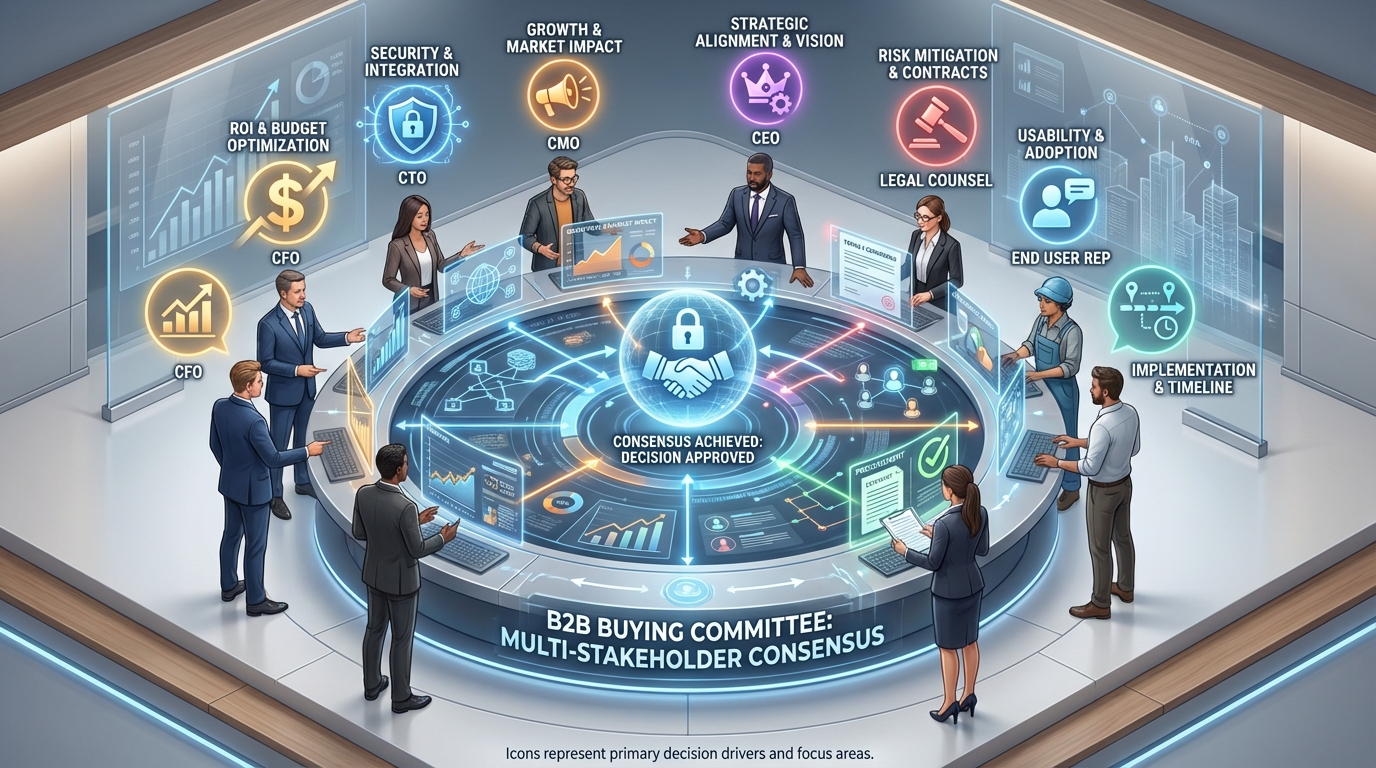
B2B buying committee video mapping is the definitive strategic framework for enterprise sales leaders aiming to secure Q1 budget approvals in an increasingly fragmented procurement landscape. By auditing the 6–10 decision makers involved in complex deals—including the CFO, CTO, CMO, and Procurement—teams can deliver persona-specific video content that addresses unique objections and accelerates the path to consensus. This methodology ensures that every stakeholder, from the technical architect to the economic buyer, receives a tailored narrative that aligns with their specific KPIs and risk tolerances.
In the high-stakes environment of Q1, where “use it or lose it” budget dynamics dictate the pace of enterprise spending, the ability to orchestrate multi-stakeholder sales orchestration is no longer a luxury. Research indicates that enterprise buying groups now require multiple levels of review and sign-off, often involving 6–10 distinct decision makers who conduct independent research before ever meeting as a group. B2B buying committee video mapping bridges this gap by providing a unified yet personalized communication layer that reduces friction and compresses the time-to-consensus.
Sources:
- LeadSquared: Healthcare Sales Strategies & Multi-Sign-Offs
- Advertising Week: The State of the Enterprise B2B Buyer’s Journey
- Pepper Content: Advanced Content Marketing Trends
Why Buying Committees Stall Complex Sales Cycles (and How Video Mapping Fixes It)
Complex sales cycle acceleration is frequently hindered by the “divergent narrative” problem, where different stakeholders operate with conflicting information and priorities. Each member of the buying committee typically engages in 4–5 independent research activities, leading to a situation where the CFO focuses on OpEx vs. CapEx while the CTO is preoccupied with API security. Without a centralized method to unify these perspectives, the internal friction results in “no decision” or delayed Q1 approvals.
By 2026, the shift toward preference-based, lifecycle engagement has made generic sales decks obsolete in the enterprise sector. Data shows that 82% of B2B buyers now prefer video-led education that addresses their specific stage in the journey, from initial problem identification to final vendor assessment. Video mapping fixes the fragmentation by delivering a consistent core message while allowing for persona-level nuance that speaks directly to the individual’s professional anxieties and goals.
In the Indian B2B ecosystem, the proliferation of GenAI video capabilities has set a new standard for engagement. Decision makers now expect a level of personalization that mirrors consumer-grade experiences, making buying committee consensus building a matter of digital sophistication. When a procurement officer receives a 60-second video explaining vendor viability and compliance artifacts, the perceived risk of the transaction drops significantly, allowing the deal to move toward finalization.
Sources:
Decision Maker Journey Mapping Across 6–10 Stakeholders
Effective decision maker journey mapping requires a granular understanding of the enterprise hierarchy and the specific “veto points” within the committee. In a typical 2026 enterprise deal, the journey is not linear; it is a series of parallel evaluations that must be synchronized through targeted content. Mapping these roles involves identifying the primary KPIs, the most likely objections, and the specific “aha” moments required for each persona to move from skepticism to advocacy.
The Economic Buyer (CFO/Finance) is primarily concerned with the Total Cost of Ownership (TCO) and the speed of value realization. Their journey focuses on financial risk mitigation and the alignment of the investment with the broader corporate fiscal strategy for the year. Conversely, the Technical Buyer (CTO/CIO/CISO) evaluates the architecture fit, scalability benchmarks, and compliance with regional regulations, such as India’s evolving data protection frameworks.
Beyond the C-suite, the journey must account for Procurement, Legal, and Operations. Procurement seeks transparency in pricing and contracting speed, while Legal focuses on data protection and consent frameworks. The Internal Champion acts as the glue, requiring tools that help them win room-by-room alignment. Mapping these 6–10 roles ensures that enterprise decision maker alignment is achieved by addressing the specific “job-to-be-done” for every individual involved in the sign-off process.
Sources:
- LeadSquared: Multi-Level Reviews in Indian Enterprises
- Advertising Week: Gartner Research on Decision Maker Groups
Persona-Specific Videos That Drive Buying Committee Consensus Building
Economic Buyer Messaging Alignment (CFO)
The CFO requires a high-density, 60–90 second video that quantifies the ROI and the payback period in months. This video should present clear OpEx/CapEx options and a value realization plan that aligns with Q1 budget cycles (see the digital transformation budget planning guide). By focusing on sensitivity to risk and the impact on the bottom line, the messaging removes the financial ambiguity that often stalls enterprise deals.
Technical Buyer Video Content (CTO/CISO)
Technical stakeholders need a 90-second deep dive into the architecture, security posture, and integration capabilities. This video should include a brief demo snippet of the API or SSO functionality to provide tangible proof of technical viability. The goal is to move the CTO from a “security risk” mindset to seeing the solution as a seamless addition to their existing tech stack.
C-Suite GTM Impact (CMO)
For the CMO, the focus shifts to pipeline lift and personalization at scale. A 60–75 second video highlighting how the solution accelerates campaign velocity and provides multi-channel reusability (LinkedIn, WhatsApp, Email) is essential. This messaging should emphasize the competitive advantage gained through superior stakeholder engagement and market responsiveness.
Procurement Influencer Videos
Procurement videos should be concise, 60-second clips that address vendor viability, compliance artifacts, and contracting timelines (see B2B procurement cycle acceleration 2026). By providing a clear checklist and demonstrating pricing transparency, these videos preempt the standard administrative delays. This proactive approach to procurement influencer videos ensures that the final hurdle of the sales cycle is cleared with minimal friction.
Champion Enablement Video Tools
The Internal Champion is your most valuable asset, and they need a 45–60 second “video deck” they can forward internally. This tool should include objection-handling clips specifically designed for their CFO and CTO. Empowering the champion with high-quality, forwardable content ensures that your narrative remains intact even when you are not in the room.
Sources:
Multi-Stakeholder Sales Orchestration and Personalized Stakeholder Engagement
Multi-stakeholder sales orchestration is the process of sequencing these persona-specific videos to create a unified momentum toward a “yes.” In Q1, this orchestration must be compressed into a 6-week window to capture available budget. The sequence begins with the CFO and CTO receiving their respective ROI and security videos within 48 hours of the initial discovery call, establishing immediate credibility and alignment.
During the alignment phase (Weeks 2–4), the focus shifts to the broader committee. This includes sending the procurement checklist video and the CMO impact video, followed by a joint “bridge” video that addresses the intersection of value and risk for the CFO and CTO. This phase is designed to trigger a cross-functional internal meeting where the stakeholders are already pre-aligned on the core benefits of the solution.
The finalization phase (Weeks 4–6) involves the “reassurance” layer. Legal and Compliance receive videos detailing data protection, while Operations gets a clear adoption and training plan. The orchestration concludes with a summary recap video sent to the entire committee, aligning everyone on the final decision criteria and the immediate next steps for implementation. This level of personalized stakeholder engagement ensures that no member of the committee feels overlooked or uninformed.
Sources:
- TrueFan AI: Video Personalization ROI Metrics
- Battery Ventures: State of Enterprise Tech Spending (2025)
Enterprise Sales Enablement Automation: Operationalizing at Scale
Enterprise sales enablement automation is the engine that allows high-growth teams to execute this complex mapping strategy across hundreds of accounts simultaneously. By integrating video production with CRM and Marketing Automation (MA) systems, triggers can be set to deliver the right video the moment a lead moves to a new stage or a new contact is added to the account. This ensures that the momentum of the deal is maintained without manual intervention from the Account Executive.
Platforms like TrueFan AI enable this level of scale by allowing a single 15-minute recording session to generate thousands of hyper-personalized videos. These videos can dynamically update fields like the recipient’s name, company, and industry, ensuring that every stakeholder feels the content was created specifically for them. Furthermore, the ability to perform virtual reshoots means that if a product feature or pricing model changes, the entire library of videos can be updated without the need for a new filming session.
TrueFan AI’s 175+ language support and Personalised Celebrity Videos (see celebrity endorsement video use cases) provide an additional layer of engagement, particularly in the diverse Indian market. Whether the stakeholder prefers communication in Hindi, Tamil, or Marathi, the platform ensures perfect lip-sync and voice retention, making the message resonate on a cultural level. This technical capability, combined with ISO 27001 and SOC 2 compliance, makes it the ideal solution for enterprises that demand both scale and security in their sales enablement efforts.
Sources:
Q1 30–60–90 Day Rollout Plan: The Execution Blueprint
0–30 Days: The Pilot Foundation
The first 30 days are dedicated to stakeholder inventory and message matrix development. Identify the top 10 Tier-1 accounts and map the 6–10 roles within each, documenting their specific goals and objections. Draft the five core scripts—CFO, CTO, CMO, Procurement, and Champion—and produce the initial video templates. Integrate these templates with your CRM to ensure that the first wave of B2B account penetration videos is ready for launch.
31–60 Days: Scaling the Strategy
In the second month, expand the program to Tier-2 accounts and introduce more specialized videos for Operations and Legal. This is the time to start A/B testing different messaging angles, such as OpEx vs. CapEx framing for the CFO or security-first vs. integration-first for the CTO. Introduce WhatsApp Business as a delivery channel for high-intent personas, providing a more direct and personal touchpoint that cuts through the noise of a crowded inbox (see WhatsApp catalog video marketing).
61–90 Days: Optimization and Institutionalization
The final 30 days of the quarter focus on attribution and velocity analysis. Review the data to see which videos had the highest watch-through rates and which CTAs drove the most meetings. Use these insights to refine the scripts and re-cut top-performing segments. By the end of Q1, you will have a proven business case with clear ROI metrics, allowing you to secure ongoing budget for the rest of the year and institutionalize video mapping as a core sales competency.
Sources:
- TrueFan AI: Case Studies and Engagement Lifts
- Battery Ventures: Cloud Software Spending Report (2023)
Measurement, ROI, and Frequently Asked Questions
To prove the efficacy of B2B buying committee video mapping, sales leaders must track a specific set of KPIs that resonate with the C-suite. Time-to-consensus is the most critical metric, measuring the days from the initial proposal to the final committee sign-off. Additionally, the Stakeholder Coverage Index—the number of roles engaged with a persona video versus the total number of mapped roles—provides a clear picture of how well the sales team is penetrating the account.
Solutions like TrueFan AI demonstrate ROI through significant lifts in stage velocity and win rates. By providing a TCO summary and risk mitigation data directly within the video content, sales teams can align with the finance department’s review cadence more effectively. This data-driven approach transforms the sales process from a series of subjective conversations into a measurable, repeatable engine for growth that is easily defensible during Q1 budget reviews.
Sources:
Driving Efficiency via Vendor Evaluation Scorecard Automation
Vendor evaluation scorecard automation (see vendor selection video presentations) solves this by providing a standardized, weighted framework for comparison, integrated with embedded video evidence.
An automated scorecard ensures that all stakeholders are evaluating the vendor against the same criteria, reducing the risk of “internal misalignment” late in the cycle. This transparency builds trust with the procurement office and speeds up the final vote.
The 2026 Standardized Evaluation Template
| Evaluation Criteria | Weighting | Stakeholder Owner | Video Evidence Link |
|---|---|---|---|
| Financial ROI & TCO | 30% | CFO / Finance | ROI_Video_Link |
| Technical Architecture | 25% | CTO / CIO | Security_Demo_Link |
| GTM & Pipeline Impact | 20% | CMO / Sales | GTM_Impact_Link |
| Compliance & Security | 15% | Legal / CISO | Compliance_Artifacts |
| Operational Ease | 10% | Ops / Champion | Adoption_Plan_Link |
Sources:
- WNS Procurement: Regional emphasis on governance and resilience
Localizing Success: B2B Sales Cycle Acceleration India
For organizations targeting the Indian market, B2B sales cycle acceleration India requires a nuanced understanding of local communication preferences and regulatory requirements. India’s enterprise landscape is unique, with a heavy reliance on mobile-first communication and a growing emphasis on data sovereignty.
WhatsApp Business has surpassed email as the primary channel for stakeholder “nudges” and quick updates in India. Delivering decision-maker consensus building videos via WhatsApp ensures nearly 100% open rates and allows for rapid feedback loops. However, this must be balanced with strict adherence to the India Digital Personal Data Protection (DPDP) Act.
Localization is another critical lever. While English remains the language of business, providing procurement compliance documentation videos in regional languages like Hindi, Tamil, or Bengali can significantly speed up approvals in manufacturing hubs or regional BFSI branches (see regional language video SEO). This demonstrates a level of commitment to the local market that generic global competitors often miss.
Furthermore, the Indian procurement cycle is often influenced by “relationship-based” trust. Using exact-voice localization for stakeholder videos helps maintain the personal touch of the account executive while scaling the message across a 15-person committee. This blend of high-tech automation and high-touch localization is the hallmark of a successful 2026 India strategy.
Sources:
- Shopify India: CRO and proof-driven journeys in complex B2B cycles
Frequently Asked Questions
What does a CFO need to see to approve AI video investments?
A CFO requires a clear, quantified payback model and a sensitivity analysis that accounts for different market conditions. They are looking for a conservative estimate of how the investment will improve win rates and reduce the sales cycle length, ultimately leading to a lower Customer Acquisition Cost (CAC).
How do CTO/CISO evaluate technical buyer video content?
Technical leaders look for evidence of architecture fit, data security, and ease of integration. They want to see that the solution complies with international standards like ISO 27001 and SOC 2, and they value a “sandbox” approach where they can test the API and SSO functionality before a full rollout.
How to structure procurement influencer videos to speed vendor onboarding?
Procurement videos should focus on transparency and compliance. Include a link to a vendor assessment checklist and provide clear documentation on pricing, terms, and the contracting timeline. This reduces the back-and-forth communication that often delays the final signature.
Can TrueFan AI handle regional languages for Indian enterprise deals?
Yes, the platform supports over 175 languages, including major Indian regional languages like Hindi, Bengali, and Tamil. This allows sales teams to deliver personalized messages that resonate with stakeholders in their preferred language while maintaining perfect voice and lip-sync quality.
How does video mapping impact the Internal Champion’s effectiveness?
Video mapping provides the champion with professional, high-impact materials that they can use to advocate for the solution internally. By giving them role-specific objection handlers for their peers in Finance and IT, you turn them into a more effective internal salesperson, ensuring your value proposition is communicated accurately across the organization.



