Vernacular Voice Search Optimization 2026: Multilingual Answer Engine Optimization, Video, and Voice Commerce for India’s Next 650M Users
Estimated reading time: 14 minutes
Key Takeaways
- By 2026, voice, vernacular, and video will dominate discovery in India; brands must optimize for assistant-read answers.
- Adopt Multilingual AEO with structured data (FAQPage, HowTo, VideoObject) and dual-script content for Hindi, Tamil, Bengali, and dialects.
- Build an NLP SEO stack: intent clustering, human-edited transcripts, and inLanguage tags to drive regional video visibility.
- Scale production via personalized regional videos and APIs to enable voice commerce and hyper-local relevance.
- Measure success across coverage, visibility, engagement, and commerce for voice-led journeys.
India’s digital landscape is undergoing a seismic shift as the internet user base prepares to exceed 900 million by 2026, a growth trajectory fueled almost entirely by Indic language speakers. Vernacular voice search optimization 2026 has emerged as the critical enterprise methodology for brands seeking to capture this “Next Billion Users” segment through regional language video SEO and multilingual answer engine optimization.
This playbook provides a data-backed blueprint for SEO Directors and Content Strategy Leaders to architect, execute, and measure voice-first strategies. By modeling local voice search intent across Hindi, Tamil, Bengali, and diverse dialects, enterprises can move beyond simple translation to true cultural resonance. Leveraging advanced technical stacks and platforms like TrueFan AI enable brands to deliver hyper-personalized, voice-optimized video content that dominates the evolving assistant-driven search ecosystem. Explore AI celebrity video marketing in India for deeper context.
Why 2026 is the Tipping Point for India’s Voice–Vernacular–Video Triad
The convergence of voice, vernacular, and video (VVV) is no longer a futuristic projection; it is the current reality of the Indian search experience. By 2026, voice search is expected to account for over 60% of all queries in India, with regional languages outperforming English in both volume and growth rate. This shift is driven by a “shared vernacular” on platforms like YouTube, where users increasingly prefer conversational, video-first answers over text-heavy search results.
The ecosystem is expanding beyond global giants. The launch of the Indus Appstore, which supports AI-powered voice search in 10 Indian languages, signals a major shift in “assistant surfaces.” Enterprises must now optimize for discovery across Google Assistant, Alexa, and OEM-integrated voice search tools that cater to non-English speakers.
This tipping point necessitates a transition from traditional SEO to Multilingual Answer Engine Optimization (AEO). In 2026, visibility is defined by being the “chosen answer” read aloud by a voice assistant or featured in a generative AI snippet. For Indian enterprises, this means producing regional language video SEO assets that are technically marked up to be parsed by these sophisticated algorithms.
Source: India’s internet users to exceed 900M by 2025 - IBEF
Source: Google India Year in Search Report
Source: Indus Appstore Voice Search in 10 Languages - Moneycontrol
Source: YouTube India Trends: Shared Vernacular - Google Blog
How Voice Behavior Varies Across Hindi, Tamil, Bengali, and Local Dialects
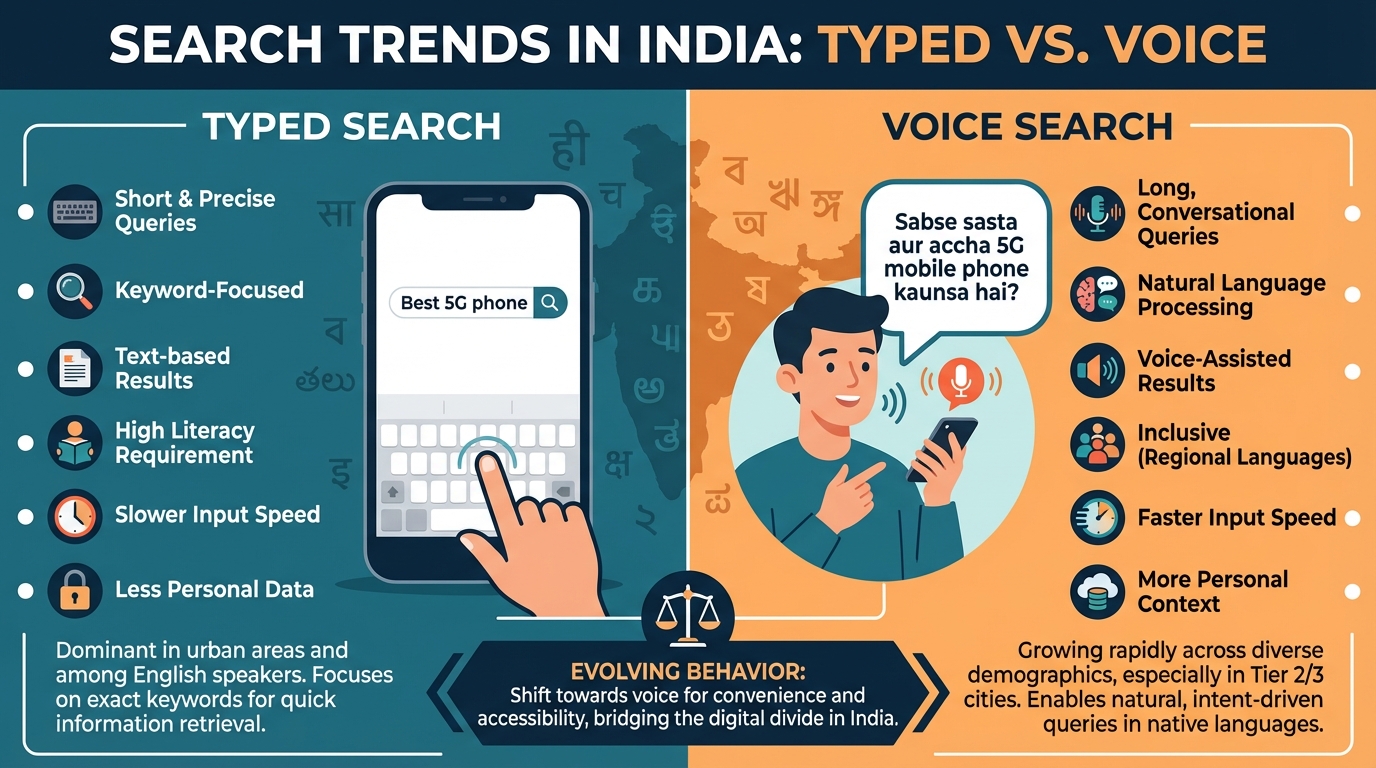
Effective vernacular voice search optimization 2026 requires deep linguistic modeling. Voice queries are inherently more conversational and longer than typed searches, often featuring polite particles, local slang, and “code-switching” (mixing English with native tongues).
Hindi Voice Query Targeting
Hindi search behavior is characterized by high volumes of “Hinglish” and Romanized script usage. Queries often follow a question-first structure using “kaise” (how), “kahan” (where), and “kab” (when). For example, a user might ask, “IRCTC ticket kaise book karen?” or “Sabse sasta 5G plan kya hai?”
To optimize for Hindi, enterprises should produce dual-script content (Devanagari and Roman) and create Q&A blocks with 35–50 word canonical answers. Implementing FAQPage schema and LocalBusiness markup is essential for capturing “near me” intents like “Paani purifier price near me.”
Tamil Voice Search Content
Tamil presents unique challenges due to its agglutinative nature, where case endings and suffixes are added to root words. Searchers often use transliteration on mobile devices. A typical query might be “Chennai arugil sirantha car sevai enge?” (Where is the best car service near Chennai?).
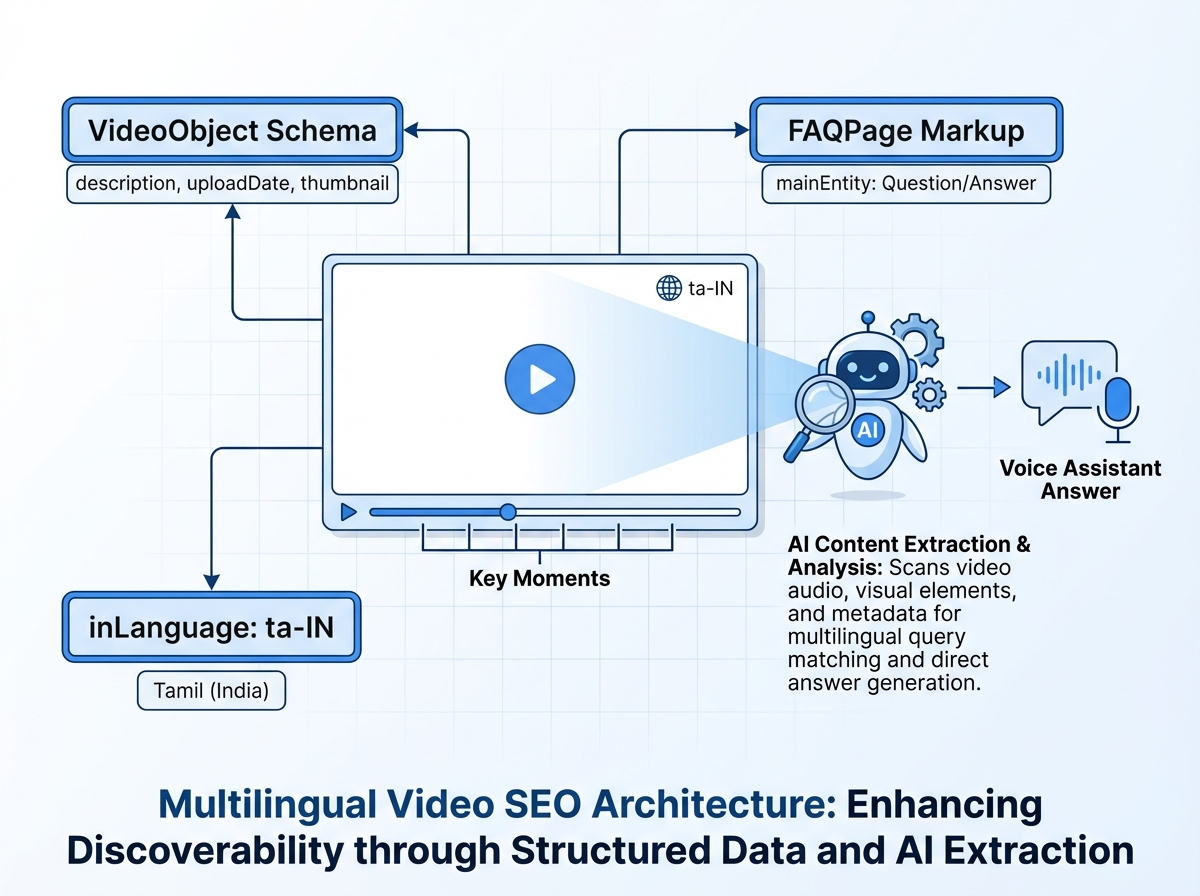
Regional language video SEO for Tamil must include VideoObject schema with the inLanguage tag set to “ta-IN.” Capturing “key moments” in videos for questions starting with “eppadi” (how) or “yen” (why) ensures that Google can surface specific video segments as answers.
Bengali Conversational SEO
Bengali voice search is marked by polite conversational markers and specific intent words like “kivabe” (how) and “kothay” (where). A finance-related query might be “Mediclaim kivabe korben?” (How to do Mediclaim?).
Optimization involves building Bengali answer blocks that feed into AEO systems. Using bn-IN inLanguage tags and rich entities for sectors like healthcare and BFSI ensures that the content is recognized as authoritative for regional queries.
Regional Accent Optimization
The final layer of modeling is regional accent optimization. Automatic Speech Recognition (ASR) systems often struggle with the diverse accents of the Hindi belt, Tamil Nadu districts, or Bengali dialects. Enterprises must maintain an accent QA grid, testing content against real-world voice search logs to refine phonetic spellings and synonyms.
Source: Digital Marketing Trends 2026: India Market Focus - Reach Skyline
Source: 13 Digital Marketing Trends for Indian Brands - Royalways
Technical Stack for Multilingual Voice Marketing and Regional Language Video SEO
Building a technical foundation for vernacular voice search optimization 2026 requires a move toward Natural Language Processing (NLP) SEO. This involves leveraging entity extraction and intent clustering to produce scripts that mirror spoken queries.
NLP SEO and Intent Clustering
Instead of focusing on individual keywords, enterprises should cluster vernacular long-tail keywords by intent type: how-to, comparison, transactional, and troubleshooting. By mining question patterns in each language, brands can generate per-language FAQs that provide canonical answers in the 35–50 word range—the ideal length for voice assistant read-outs.
Video SEO Building Blocks
Regional language video SEO is the cornerstone of discovery in 2026. Required technical markup includes:
- VideoObject Schema: Defining name, description, thumbnailUrl, and duration.
- inLanguage Tag: Specifying
hi-IN,ta-IN, orbn-IN. - SeekToAction & Clip Markup: Allowing search engines to identify and jump to “key moments” within the video.
- Human-Edited Transcripts: Ensuring that ASR-generated captions are corrected for dialect-specific nuances.
A case study by ABP News demonstrated that optimizing video across eight Indian languages using structured data and transcripts led to a 30% growth in traffic, proving the ROI of this technical investment.
Speakable Schema and Voice Assistant Integration
While Speakable schema has limited support in some regions, it remains a vital signal for news-heavy content. For broader enterprise use, the workaround is to rely on FAQPage and HowTo schema. These structures allow voice assistants like Google Assistant and the voice search on Indus Appstore to parse and retrieve concise spoken answers.
Source: ABP Cross-Regional Video SEO Case Study - Google Developers
Source: Indus Appstore Voice Search Feature - The Hindu
Voice Commerce Content Strategy Aligned to Local Voice Search Intent
Voice commerce is projected to be a multi-billion dollar opportunity in India by 2026. A successful voice commerce content strategy structures product discovery and checkout guidance in vernacular languages to support conversational purchase flows.
Conversational Product FAQs
Enterprises must move beyond static product descriptions. Content should address common voice-led questions such as “Price kya hai?” (What is the price?), “EMI available hai?”, or “Return policy kya hai?”. These should be localized with equivalent conversational markers in Tamil, Bengali, and Marathi.
Local Inventory and Transactional Explainers
For retail and BFSI, integrating LocalBusiness schema is non-negotiable. Users searching for “Near me” intents need immediate answers regarding store hours, stock availability, and phone numbers. Furthermore, transactional explainers like “UPI se payment kaise karein” (How to pay via UPI) should be available as short, vertical video clips. See Quick Commerce Festival Marketing 2026 for distribution strategies.
Social Commerce Integration
Distribution is key. These voice-optimized video assets should be deployed across YouTube Shorts, Instagram Reels, and regional platforms like ShareChat, Moj, and Josh. This aligns with the 2026 trend of social commerce growth in India, where “Voice Search & Vernacular Reach” are the primary drivers of user acquisition. Explore the Gen Z Creator Automation 2026 guide for tactical workflows.
Source: Social Media Marketing Trends in India - Web Marlins
Source: SEO Trends 2026: Answer Engine Optimization - ThatWare
Enterprise Blueprint to Scale Across 10+ Indian Languages
Scaling vernacular voice search optimization 2026 across a dozen languages requires a robust governance model and advanced AI capabilities. Enterprises cannot rely on manual translation; they need a generative AI pipeline that maintains brand consistency while ensuring local relevance.
Governance and Operating Model
A dedicated “Vernacular SEO Taskforce” should include SEO leads, language editors, and schema technologists. The workflow involves fortnightly intent mining from Search Engine Results Pages (SERP) and “People Also Ask” (PAA) boxes, followed by monthly assistant retrieval tests to ensure content is being correctly parsed.
Leveraging TrueFan AI for Scale
TrueFan AI’s 175+ language support and Personalised Celebrity Videos (personalised video & celebrity endorsement for SaaS) provide a massive advantage for enterprises looking to scale regional language video SEO. By using a single celebrity shoot, brands can generate millions of personalized videos where the star addresses the customer by name in their native dialect—achieving perfect lip-sync and voice retention. Compare approaches with the voice sync accuracy comparison guide and strategies for AI celebrity video marketing in India.
Solutions like TrueFan AI demonstrate ROI through hyper-personalization via APIs, allowing brands to insert dynamic data like city names, specific product offers, or local dealership details. This level of personalization has been shown to lift engagement significantly, as seen in Zomato’s Mother’s Day campaign, which delivered 354,000 personalized videos in a single day.
Case Vignettes of Success
- Hero MotoCorp: Generated 2.4 million personalized festive greetings localized by dealership, driving a massive surge in service center visits.
- Goibibo: Used personalized WhatsApp videos tied to searched destinations, resulting in a 17% higher read rate and significant conversion uplift.
- Cipla: Strengthened doctor relationships by sending 6,400 personalized acknowledgments for Doctor’s Day.
Implementation Checklist and Measurement for 2026
To dominate vernacular voice search optimization 2026, enterprises should follow a structured 90-day rollout plan.
30–60–90 Day Rollout
- Day 30: Cluster top 100 questions per language. Draft canonical answers and produce 10 pilot videos. Implement
VideoObjectandFAQPageschema. - Day 60: Expand to 300 questions. Add
ClipandSeekToActiontimestamps. Begin assistant retrieval testing on Android and Indus Appstore. - Day 90: Scale to additional dialects. Integrate with WhatsApp Business APIs for automated distribution. Reference rapid fulfillment personalization strategies. Instrument conversion attribution for voice-led journeys.
KPI Framework
Success should be measured across four pillars:
- Coverage: Percentage of top search intents with canonical answers in each language.
- Visibility: Number of featured snippet wins, PAA inclusions, and assistant read-out rates.
- Engagement: Watch-time and retention rates for regional language video SEO assets.
- Commerce: Assisted conversions and store visits originating from voice-led search sessions.
On-Page and Schema Specifications
Every regional landing page must feature H2/H3 localized headings and dual-script support. The schema must be granular, specifying the inLanguage for every VideoObject and FAQPage. Video assets must include human-validated SRT files and entity-rich descriptions to ensure the highest possible ranking in multilingual answer engines.
Conclusion
The era of English-centric, text-only SEO is ending. As India’s internet matures, the winners will be those who operationalize vernacular voice search optimization 2026 to meet users where they are: speaking their native tongue into a mobile device. By combining technical SEO excellence with the power of generative AI for video, enterprises can build a future-proof strategy that captures the hearts and wallets of the next 650 million users.
Ready to lead the vernacular revolution?
- Get a regional language video and AEO readiness audit today.
- Pilot a 30-day voice commerce content strategy with personalized videos.
- Book a demo with TrueFan AI to deploy Hindi, Tamil, and Bengali videos at scale.
Frequently Asked Questions
What is the difference between traditional SEO and vernacular voice search optimization 2026?
Traditional SEO focuses on text-based keywords and desktop/mobile SERPs. Vernacular voice search optimization 2026 prioritizes conversational, long-tail queries in regional languages, optimizing for voice assistant read-outs and video-first answers in a zero-click environment.
How does regional language video SEO impact brand visibility?
By using structured data like VideoObject and Clip markup, brands can appear in “Key Moments” on Google Search and YouTube. This allows users to find specific answers within a video, significantly increasing the chances of being the “featured answer” for voice queries.
Why is the Indus Appstore important for voice search in India?
The Indus Appstore provides a localized alternative to global app stores, offering voice search in 10 Indian languages. This expands the “assistant surface” area, requiring enterprises to optimize their content for a broader range of regional voice-enabled platforms.
Can AI help in scaling regional language video content?
Yes, platforms like TrueFan AI enable enterprises to scale video production by localizing content into 175+ languages with perfect lip-sync. See the voice sync accuracy comparison guide for details. This allows brands to maintain a consistent celebrity or brand ambassador voice across diverse regional markets without multiple shoots.
What are the best schemas for multilingual answer engine optimization?
The most effective schemas for AEO in 2026 are FAQPage, HowTo, and VideoObject. These provide the structured data necessary for AI models and voice assistants to extract and read aloud concise answers to user questions.



