Green loan marketing automation 2026: Personalized impact videos that win India’s budget season
Estimated reading time: ~12 minutes
Key Takeaways
- Budget-season demand can be converted into funded loans with hyper-personalized impact videos across solar, EV, and ESG products.
- Environmental ROI and sustainability score visualizations build trust and reduce greenwashing risk.
- An integrated stack—data, creative engine, delivery, and analytics—enables real-time personalization and “virtual reshoots.”
- RBI/SEBI-aligned compliance with verified methodologies is essential for claims and disclosures.
- Omnichannel distribution via WhatsApp, microsites, and RM toolkits drives higher engagement and funded loan lift.
Green loan marketing automation 2026 is how India’s BFSI can turn budget-season intent into funded solar and EV loans and climate positive investment marketing—by showing verified impact, not just making claims. As India moves toward its aggressive 2030 climate goals, the financial sector is witnessing a structural shift where sustainability is no longer a niche preference but a core driver of retail and SME credit demand.
1. India’s 2026 Sustainable Finance Landscape: The Strategic Shift
The Indian financial landscape in 2026 is defined by a convergence of regulatory maturity and a surge in “conscious” consumerism. With the Reserve Bank of India (RBI) and the Securities and Exchange Board of India (SEBI) tightening frameworks around green deposits and ESG disclosures, banks and NBFCs are under pressure to move beyond generic eco-friendly financing campaigns.
Retail demand for rooftop solar and electric vehicles (EVs) has hit an inflection point, driven by rising energy costs and favorable state-level subsidies. By early 2026, India’s renewable energy capacity is projected to exceed 250 GW, with a significant portion coming from decentralized solar installations that require specialized financing.
Sustainable finance personalization India has become the primary differentiator for top-tier lenders. Consumers now expect their financial partners to not only provide capital but also to quantify the environmental benefits of their choices in real-time. Explore the green financing marketing 2026 playbook
Trust is the new currency in this market. The RBI’s Framework for Acceptance of Green Deposits now mandates rigorous third-party verification and impact reporting, ensuring that every rupee labeled “green” is backed by verifiable environmental outcomes.
Sources:
- ET Wealth: India’s big bets for 2026
- IBEF: Growth of green finance in India
- RBI: Framework for Acceptance of Green Deposits (FAQ)
2. Defining Green Loan Marketing Automation 2026: The New Tech Stack
Green loan marketing automation 2026 refers to the orchestrated, multi-channel journeys that automatically generate and deliver hyper-personalized, vernacular video content triggered by CRM signals. This isn't just about sending an email; it’s about delivering a 30-second renewable energy loan video that addresses the customer by name and shows their specific rooftop’s solar potential.
Platforms like TrueFan AI enable enterprises to bridge the gap between complex financial data and engaging consumer content. By integrating with existing CDPs and CRMs, these systems can trigger personalized video generation the moment a customer shows interest in a green product.
The modern martech stack for sustainable banking video content includes:
- Data Foundation: Real-time integration with credit bureaus, geo-spatial data for solar potential, and consent-managed CRM segments.
- Creative Engine: API-driven video templates that can render dynamic text, charts, and voiceovers in under 30 seconds.
- Delivery Layer: Seamless distribution via WhatsApp Business API, personalized microsites, and in-app notifications. Learn about voice commerce in India, 2026
- Analytics Loop: Tracking not just clicks, but the “Environmental ROI” of each campaign—measuring the total CO2e avoided through funded loans.
In 2026, the ability to perform “virtual reshoots” is critical. If a state government updates its EV subsidy overnight, marketing teams can update thousands of personalized videos instantly without needing a new production cycle.
Sources:
3. The Science of Impact: Environmental ROI and Score Visualization
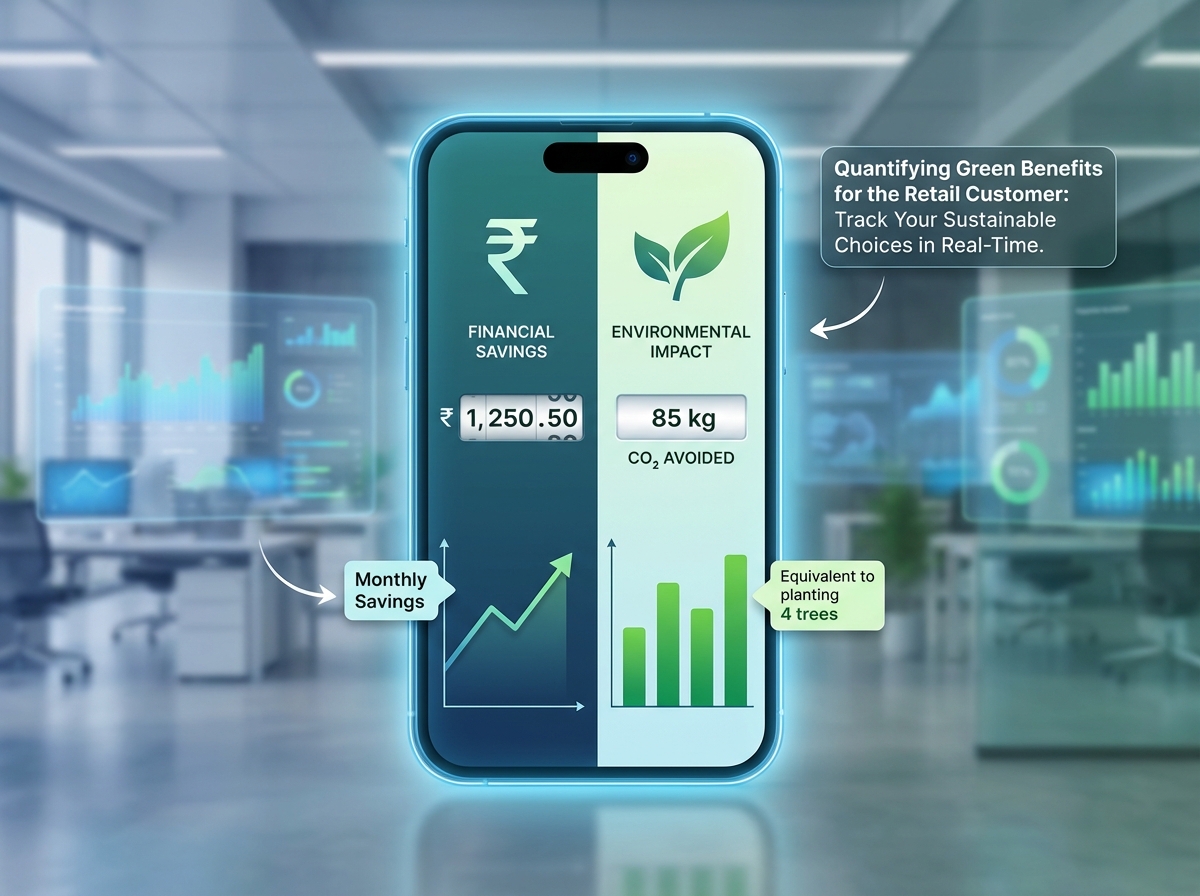
To win the trust of the 2026 consumer, lenders must master the art of impact visualization. This involves moving beyond abstract “green” labels and providing concrete, data-backed proof of environmental benefit through environmental impact calculators.
Environmental ROI demonstration videos are the gold standard for this. These videos provide a side-by-side comparison of financial savings (like EMI vs. electricity bill reduction) and environmental gains (like kilograms of CO2e avoided annually).
Sustainability score visualization is another critical component. Using SEBI’s BRSR Core framework as a baseline, lenders can now provide dynamic overlays in their videos that show a fund’s or a project’s sustainability KPIs.
- Solar Calculations: Videos now calculate kW sizing based on rooftop area proxies and local irradiance data, showing a 7-10 year IRR.
- EV Calculations: Personalization includes the user’s daily commute distance to show total cost of ownership (TCO) savings and grid-adjusted carbon reduction.
- ESG Benchmarking: Visual gauges compare a mutual fund’s carbon intensity against its peers, providing transparency that was previously unavailable to retail investors.
By grounding these visualizations in methodologies like those provided by TERI, banks can ensure their claims are audit-ready and compliant with anti-greenwashing regulations.
Sources:
4. High-Conversion Playbooks: Solar, EV, and ESG Campaigns
Executing green loan marketing automation 2026 requires specific playbooks for different product categories. Each journey must be designed to reduce friction and maximize the emotional resonance of the “green” choice.
Solar Financing Customer Acquisition
The journey begins with a lead magnet: a 30-second video personalized by name and city. Using DISCOM-specific tariff data, the video shows the customer exactly how much they could save.
- Trigger: Customer searches for “solar rooftop” or visits a partner installer site.
- Action: Instant WhatsApp video showing a 3D visualization of solar panels on a generic rooftop in their neighborhood.
- KPI: 25% higher conversion from lead to site-survey request compared to static ads.
EV Loan Personalization Strategies
For EV financing, the focus is on the “range anxiety” and “cost-to-run” myths. A personalized video can show a range map based on the user's home-to-office commute.
- Trigger: Pre-approved credit signal combined with an “auto interest” tag in the CRM.
- Action: A video featuring a celebrity or expert explaining the state-specific EV subsidy and the nearest charging stations.
- KPI: Significant reduction in “cost per funded loan” due to higher engagement with renewable energy loan videos.
ESG Investment Video Campaigns
Wealth managers are using sustainability score visualization to drive green mutual fund personalization. Instead of a 20-page prospectus, investors receive a 60-second video summary of the fund's ESG performance.
- Trigger: SIP renewal or high-balance alert.
- Action: A video showing the “Climate Positive” impact of their portfolio, such as the number of trees equivalent to their investment's carbon offset.
- KPI: Increased AUM in ESG-themed funds and higher retention among millennial investors.
Sources:
5. Omnichannel Distribution: Reaching the Conscious Consumer in 2026
The success of eco-friendly financing campaigns depends on meeting the consumer where they are. In 2026, this means a heavy reliance on WhatsApp, interactive microsites, and RM (Relationship Manager) toolkits.
TrueFan AI's 175+ language support and Personalised Celebrity Videos allow banks to communicate in the local dialect of the customer, which is essential for building trust in semi-urban and rural markets. A farmer in Maharashtra is far more likely to engage with a solar pump loan offer if the video is in Marathi and features a familiar face. See the regional-language voice shopping guide
Distribution strategies for 2026 include:
- WhatsApp Business API: Delivering sub-30 second renders directly to the user's chat, allowing for instant interaction. Voice commerce India 2026 strategies
- Interactive Microsites: Gated pages where users can toggle their loan amount and see their environmental ROI update in real-time on a video.
- Green Bond Marketing Automation: Institutional investors receive automated video updates on the “use of proceeds,” showing real-time progress of the renewable projects they have funded.
Climate positive investment marketing is no longer about broad-based awareness; it is about one-to-one communication that makes the investor feel like a partner in the energy transition.
Sources:
6. Compliance and Measurement: Navigating RBI and SEBI Frameworks
As the market for green finance grows, so does the scrutiny. Marketing teams must work hand-in-hand with compliance to ensure that every claim in their environmental ROI demonstration videos is substantiated.
Key compliance guardrails for 2026:
- Substantiation: Every carbon reduction claim must link back to a public methodology page.
- Naming Conventions: ESG funds must strictly follow SEBI guidelines regarding fund naming and asset allocation.
- Data Privacy: Personalization must be based on explicit consent, with clear opt-out mechanisms for AI-generated content.
Measurement has also evolved. Beyond traditional metrics like CTR and CVR, BFSI leaders are now tracking “Sustainability Alpha.” This measures the additional value—both financial and reputational—generated by green products.
Solutions like TrueFan AI demonstrate ROI through detailed analytics dashboards that track video completion rates and the subsequent lift in loan applications. By correlating video engagement with funded loan data, banks can prove the effectiveness of their green loan marketing automation 2026 strategies.
Carbon credit investment videos are also emerging as a tool for MSMEs. These videos explain the complex world of voluntary carbon markets, helping smaller businesses understand how they can participate in the green economy while managing their own emissions.
Sources:
7. FAQ and Strategic Roadmap for 2026
Implementing a full-scale green loan marketing automation 2026 strategy requires a phased approach. Most enterprises start with a 4-week pilot focusing on a single product, like solar rooftop loans, before scaling to their entire green portfolio.
Frequently Asked Questions
How does green loan marketing automation 2026 differ from traditional marketing?
Traditional marketing uses static, one-size-fits-all messaging. The 2026 approach uses real-time data to create hyper-personalized videos that show a customer's specific financial and environmental ROI, significantly increasing trust and conversion.
Is the data used for environmental impact calculators accurate?
Yes, the calculators use standardized grid emission factors and local irradiance data. While the results are “illustrative,” they are grounded in verified methodologies like those from the CEA or TERI, ensuring they meet RBI and SEBI transparency standards.
Can we use celebrity ambassadors for these personalized videos?
Absolutely. Platforms like TrueFan AI allow you to use a single celebrity shoot to generate millions of personalized messages. This combines the trust of a known face with the relevance of personal data. See AI celebrity video marketing in India
How do we ensure compliance with anti-greenwashing laws?
By ensuring every video includes a link to a detailed methodology page and by using assured data points from SEBI BRSR Core reports. Transparency is the best defense against greenwashing allegations.
What is the typical ROI for these personalized campaigns?
Enterprises typically see a 2x to 3x lift in engagement rates and a 15-20% increase in funded loan volume compared to non-personalized digital campaigns.
How long does it take to render a personalized video?
With modern API-driven engines, a unique, high-quality video can be rendered in under 30 seconds, enabling real-time delivery via WhatsApp or web interfaces.
The 4-Week Execution Roadmap
- Week 1: Define your data segments and select your impact methodology. Draft scripts that balance financial benefits with environmental proof.
- Week 2: Integrate your CRM with your video generation API. Set up your environmental impact calculators with local data overlays.
- Week 3: Launch a pilot for a high-intent segment (e.g., existing home loan customers for solar top-ups). Perform A/B tests on video length and CTA framing.
- Week 4: Analyze the pilot data, optimize the creative templates, and scale the automation across your EV and ESG investment funnels.
By following this playbook, Indian BFSI institutions can lead the transition to a sustainable economy while capturing the massive wealth creation opportunity of the 2026 budget season.
Sources:
Frequently Asked Questions
What tools are required for green loan marketing automation in 2026?
You’ll need a data foundation (CRM/CDP integrations and consent management), an API-driven video creative engine, delivery channels like WhatsApp Business API and microsites, and analytics to measure Environmental ROI and conversions.
How do personalized videos integrate with WhatsApp Business API?
Video renders are generated on demand via API and delivered as media messages or links to personalized microsites through WhatsApp Business API, enabling instant, trackable engagement.
How do banks measure Environmental ROI in these campaigns?
Banks quantify CO2e avoided per funded loan, align calculations with public methodologies (e.g., TERI/CEA), and correlate video engagement with funded loan data to attribute environmental and financial outcomes.
How can BFSI ensure consent and privacy compliance?
Use explicit opt-ins, purpose limitation for data use, granular preference centers, and clear opt-out mechanisms. Ensure all claims link to methodology pages and align with RBI/SEBI disclosure norms.