
Voice Commerce Vernacular India 2026: Enterprise Playbook for Tier-2/3 Growth
Estimated reading time: 12 minutes
Key Takeaways
- Vernacular voice commerce will be the default interface for 650M+ users by 2026, demanding voice-first architectures.
- Win discovery with regional voice SEO, AEO, and schema; design answers for conversational, long-tail queries.
- Drive conversion via personalized voice offers, dialect-specific videos, and low-friction, voice-enabled payments like Hello UPI.
- Scale with multilingual automation, governance, and secure infrastructure; measure via a dedicated voice KPI tree.
- Ensure privacy, accessibility, and inclusivity across dialects, accents, and bandwidth constraints for tier-2/3 markets.
The digital landscape in the Indian subcontinent is undergoing a seismic shift from “type-and-search” to “speak-and-transact.” By the dawn of 2026, the implementation of voice commerce vernacular India 2026 strategies will no longer be a competitive advantage but a fundamental requirement for enterprise survival. As the next billion users migrate online, the friction of traditional keyboards—unoptimized for complex Indic scripts—is being replaced by the fluid efficiency of natural language commerce India.
Current projections indicate that by 2026, vernacular voice commerce will become the default interface for over 650 million regional users, representing a market opportunity valued at approximately $7.47 billion. This transition is fueled by the fact that 73% of internet subscribers in India now prefer vernacular content over English, marking it as the most transformative trend for the 2026 digital marketing ecosystem. Furthermore, Hindi voice searches have already surged by nearly 400%, signaling a massive appetite for vernacular voice shopping in tier-2 and tier-3 cities.
For CTOs and marketing technologists, the mandate is clear: move beyond simple translation and embrace a sophisticated, voice-first architecture. This playbook outlines the technical and strategic roadmap to capturing regional growth through answer engine optimization (AEO), multilingual automation, and high-conversion conversational journeys.
Source: Regional Language Voice Shopping: 2026 Growth Guide
Source: Digital Marketing Trends for 2026 India Market Focus
Source: How Voice AI is Making Shopping Accessible in Tier-2 Cities
The 2026 Opportunity for Voice Commerce in India
The year 2026 represents a pivotal convergence point where infrastructure, affordability, and user behavior align to make voice commerce India 2026 the primary driver of retail growth. India is projected to reach approximately 900 million smartphone users by this period, with the vast majority of new adoption originating from non-metro regions. These users are bypassing the desktop era entirely, favoring mobile-first and voice-first interactions that accommodate varying levels of literacy and technical proficiency.
Tier-2/3 Consumption Patterns and Voice-First Behaviors
In rural and semi-urban markets, typing in native scripts like Devanagari or Bengali is often cumbersome due to the complexity of character input on small screens. Consequently, speech has become the default user interface, reducing cognitive load and accelerating the path to purchase. Tier-2 voice adoption strategies must account for this “low-friction” requirement by enabling end-to-end journeys that require zero typing.
Consider a typical 2026 consumer journey in a tier-2 city like Indore or Coimbatore. A user might initiate a search by saying, “Sasta pressure cooker 5 litre dikhao” (Show me a cheap 5-liter pressure cooker). The system must not only understand the intent but also provide a comparative analysis, allow the user to say “Cart mein add karo” (Add to cart), and finalize the transaction via “Hello UPI se pay karo” (Pay using Hello UPI). This seamless integration of vernacular voice shopping into daily life is what will define the market leaders of the next decade.
Vernacular Growth Drivers: Discovery, Trust, and Ease of Use
The acceleration of natural language commerce India is underpinned by three pillars: regional-language discovery, trust-building through familiar voices, and frictionless payments. The National Payments Corporation of India (NPCI) has already laid the groundwork with “Hello UPI,” a conversational payment initiative designed to allow users to complete transactions using voice commands.
Trust is further amplified when brands utilize localized celebrity or creator voices to guide the shopping experience. When a consumer hears a recommendation in their native dialect—complete with culturally relevant idioms—the psychological barrier to online transacting diminishes. This “trust-by-proxy” model, combined with the technical ease of voice-activated checkouts, creates a high-velocity sales environment that English-centric platforms cannot replicate.
Source: Vernacular Voice Commerce: Unlocking India's Next Billion Shoppers
Source: AI & Vernacular Voices: India's Scramble for Data
Source: Official Hello UPI: Conversational Payments by NPCI
Regional Voice SEO and Discovery
To capture the 2026 market, enterprises must master voice SEO regional languages, a discipline that differs significantly from traditional text-based SEO. Voice queries are longer, more conversational, and highly specific. Optimizing for these requires a deep understanding of linguistic nuances across Hindi, Tamil, Bengali, and other major regional languages.
Hindi Voice Search Marketing: Intent Clusters and Schema
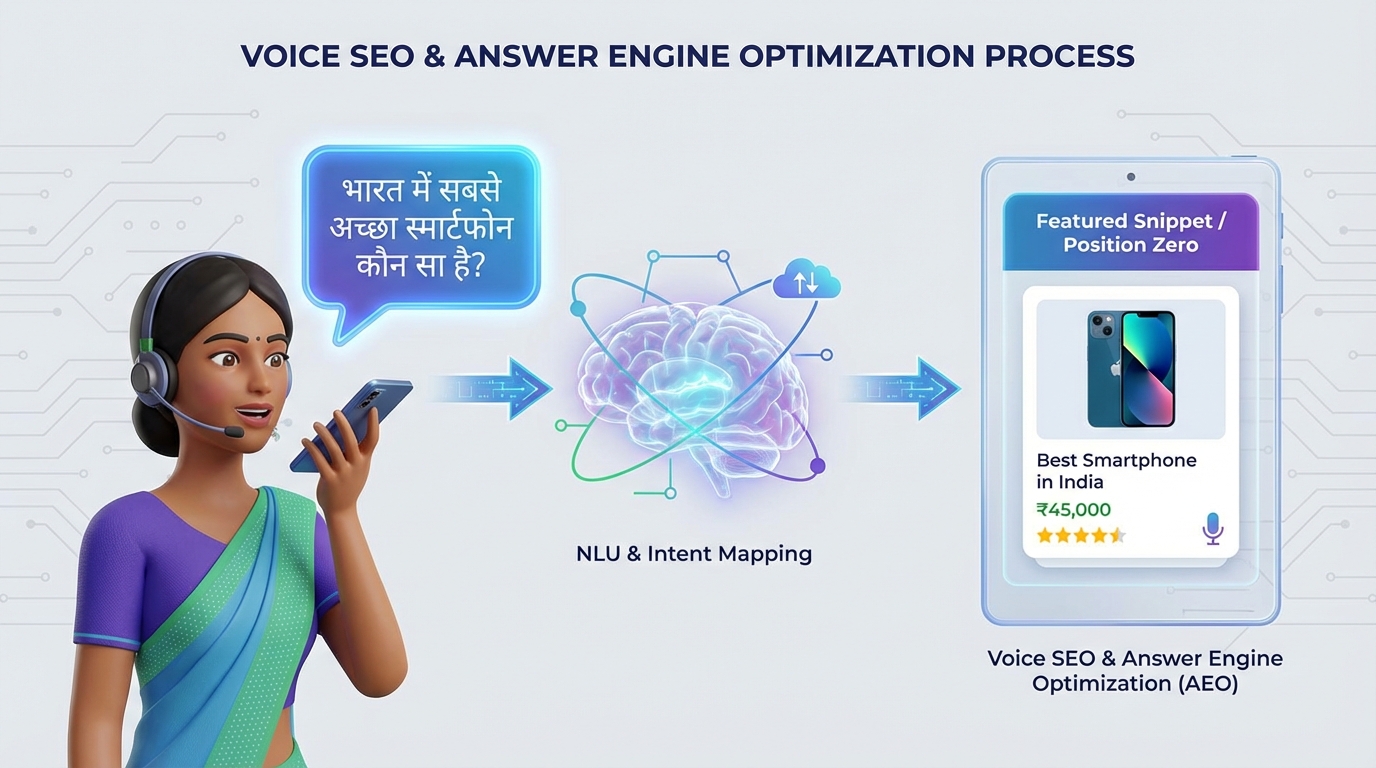
Hindi voice search marketing requires a shift toward long-tail keywords and intent-based clusters. Users typically employ a mix of Hindi and English (Hinglish), necessitating a bilingual NLU (Natural Language Understanding) approach. Key intent clusters include:
- Transactional: “Sabse sasta [product] dikhao” (Show me the cheapest [product]).
- Navigational: “Mere paas ki kirana dukaan” (Grocery store near me).
- Support: “Mera order kab aayega?” (When will my order arrive?).
Technical implementation must include specific Schema.org markups such as Product, FAQ, HowTo, and Speakable. For voice assistants to read out answers effectively, content should be structured in 25–40 word snippets that provide direct, jargon-free value.
Tamil Voice Commerce Optimization: ASR and Agglutination
Tamil voice commerce optimization presents unique challenges due to the language's agglutinative nature, where words are formed by joining multiple morphemes. Automatic Speech Recognition (ASR) systems must be trained to handle complex compound words and the frequent use of “Tanglish” (Tamil-English mix).
Optimization strategies should focus on phonetic variants and dialectal differences between regions like Chennai, Madurai, and Coimbatore. For instance, a query like “Intha thayarippu EMI-la kidaikkuma?” (Is this product available on EMI?) requires the system to recognize “EMI” as a loanword while processing the Tamil syntax correctly.
Bengali Conversational AI: NLU and Disambiguation
For Bengali conversational AI, the focus must be on entity extraction and disambiguation. Bengali speakers often use varied honorifics and regional dialects (e.g., Dhakai vs. Ghoti), which can confuse standard NLU models. Systems must be designed with explicit ambiguity prompts—if a user asks for a “saree,” the AI should immediately follow up with questions about fabric or occasion in a short, conversational turn.
Voice Commerce Answer Engine Optimization (AEO)
Voice commerce answer engine optimization is the practice of structuring data so that AI assistants (Alexa, Google Assistant, or in-app bots) can retrieve it as a definitive “Position Zero” answer. This involves building a comprehensive AEO FAQ library for every supported language. These answers must be concise, typically between 25 and 40 words, and optimized for natural prosody so they sound human when read aloud.
| Language | Sample Voice Query | AEO Optimized Answer (25-40 words) |
|---|---|---|
| Hindi | “UPI se payment kaise karein?” | “UPI se payment karne ke liye, ‘Pay’ kahein, apna PIN darj karein aur transaction pura karein. Yeh surakshit aur turant hota hai.” |
| Tamil | “Return policy enna?” | “Nengal vangiye porulai 7 natkul thiruppi tharalam. App-il ‘Return’ section-ai payanpaduthavum ya voice command moolam seiyalam.” |
| Bengali | “Delivery koto dine hobe?” | “Apnar delivery sadharonoto 2 theke 3 diner moddhe pouche jabe. Order track korte ‘Amar order kothay’ bolun.” |
Source: How Voice AI is Making Shopping Accessible in Tier-2 Cities
Source: Regional Language Voice Shopping: 2026 Growth Guide
Designing High-Conversion Conversational Journeys
Creating a successful voice commerce ecosystem requires more than just speech recognition; it demands conversational commerce personalization. This involves tailoring every interaction based on the user’s history, location, and linguistic preference to drive higher conversion rates.
Voice-Activated Personalized Offers
The integration of voice-activated personalized offers with an enterprise CRM or CDP (Customer Data Platform) allows for real-time decisioning. When a user engages via a voice channel, the system identifies them through their phone number or SSO, evaluates their RFM (Recency, Frequency, Monetary) score, and renders a custom offer.
For example, a high-value customer in West Bengal might receive a voice prompt saying, “Shubho Nabobarsho! Apnar jonno special 20% discount ache” (Happy New Year! There is a special 20% discount for you). This level of hyper-localization significantly reduces churn and increases the average order value (AOV).
Dialect-Specific Shopping Videos
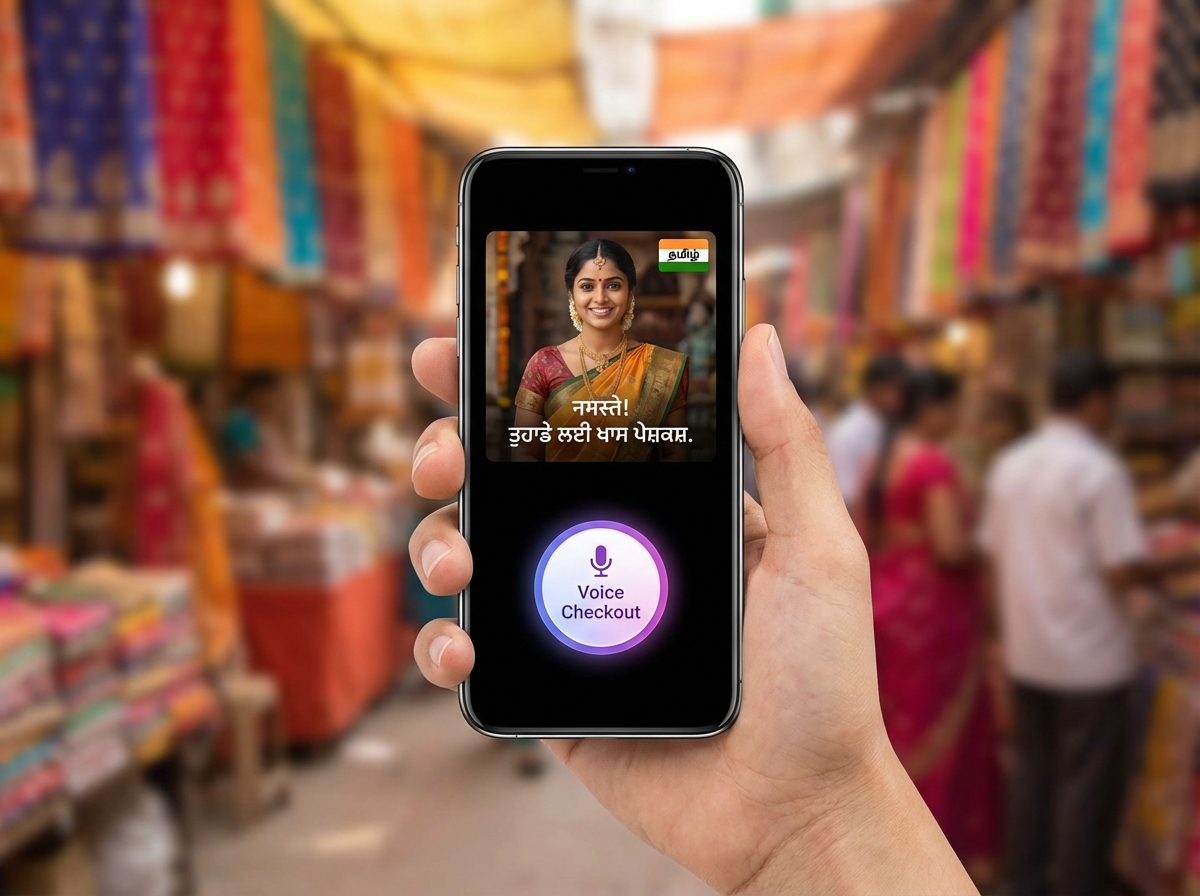
To bridge the gap between discovery and purchase, enterprises are deploying dialect-specific shopping videos. These are short, shoppable video creatives rendered in the user's specific dialect with on-screen CTAs that link directly to voice-enabled checkout flows. Platforms like TrueFan AI enable brands to scale this by automating the creation of personalized video content that resonates with regional sensibilities.
TrueFan AI's 175+ language support and Personalised Celebrity Videos allow enterprises to create thousands of unique assets that address users by name in their native tongue. This approach has been proven effective in large-scale campaigns for brands like Zomato and Hero MotoCorp, where millions of personalized messages were delivered to drive specific consumer actions.
Smart Speaker Commerce Integration
Smart speaker commerce integration is the final frontier of the home shopping experience. By 2026, in-app voice flows will be mirrored on devices like Amazon Echo and Google Home. Users will be able to say, “Alexa, reorder my usual atta from BigBasket,” and the system will handle the SKU selection, coupon application, and payment authorization seamlessly. To succeed here, brands must ensure their product catalogs are “voice-ready,” with phonetic aliases for every item.
Source: TrueFan AI Enterprise Offerings
Source: Digital Marketing Trends for 2026 India Market Focus
Multilingual Voice Marketing Automation at Scale
Scaling voice commerce across India’s 22 official languages requires a robust framework for multilingual voice marketing automation. This involves orchestrating triggered flows and lifecycle campaigns that respond to user behavior in real-time.
Triggered Flows and Lifecycle Campaigns
Enterprises should implement a “Voice-First” lifecycle strategy:
- Browse Abandonment: If a user views a product in the app but doesn't buy, trigger a vernacular voice reminder via WhatsApp.
- Reorder Nudges: Use predictive analytics to send a voice prompt when a household staple is likely to run out.
- COD to Prepaid Shift: Offer a small incentive via a voice call to encourage users to switch from Cash on Delivery to Hello UPI.
Governance and Technical Architecture
Managing variants across Hindi, Tamil, and Bengali requires strict governance. This includes maintaining terminology glossaries to ensure brand consistency and performing regular script QA to avoid cultural faux pas.
The enterprise reference architecture for natural language commerce India typically includes:
- ASR (Automatic Speech Recognition): Dialect-aware models that handle “code-mixing.”
- NLU (Natural Language Understanding): Intent mapping specific to the product catalog.
- TTS (Text-to-Speech): Natural-sounding voices with regional prosody.
- TrueFan AI Integration: For rendering personalized, dialect-specific video messages that serve as the “front-end” of the conversation.
By using TrueFan AI’s APIs, developers can trigger personalized video messages that are rendered and delivered in under 30 seconds, providing a near-instantaneous response to user triggers. This infrastructure is supported by ISO 27001 and SOC 2 compliance, ensuring that enterprise data remains secure throughout the automation process.
Source: BHASHINI: National Language AI Platform
Source: Hello UPI Official Overview
Source: TrueFan AI Enterprise Capabilities
Measuring Voice Assistant Marketing ROI
Proving the effectiveness of voice initiatives requires a specialized approach to attribution and performance tracking. Voice assistant marketing ROI cannot be measured by clicks alone; it requires a multi-dimensional KPI tree.
Attribution Models for Voice Sessions
Attributing a sale to a voice interaction can be complex, especially when the journey spans multiple devices. Enterprises should adopt a “Voice-Session ID” approach, where every voice interaction is tagged and tracked through to the final transaction. This allows for last-touch or multi-touch attribution models that accurately reflect the role of voice in the conversion funnel.
The Voice KPI Tree
To evaluate success, CTOs should monitor the following metrics:
- Activation Rate: Percentage of monthly active users (MAUs) who engage with voice features.
- Intent Completion Rate: How often the AI successfully understands and fulfills a user request.
- Add-to-Cart (Voice): The rate at which voice searches lead to cart additions.
- Prepaid Mix: The increase in digital payments via Hello UPI compared to COD.
Solutions like TrueFan AI demonstrate ROI through detailed analytics dashboards that track engagement and conversion lift for personalized video journeys. For instance, Goibibo saw a 17% higher WhatsApp read rate by using celebrity-personalized travel nudges, a clear indicator of how vernacular personalization drives measurable business outcomes.
Source: India Voice Assistant Market Trends
Source: TrueFan AI Case Studies
Tier-2 Voice Adoption Strategies and Field Enablement
Successfully launching voice commerce vernacular India 2026 in non-metro markets requires more than just technology; it requires a strategy for field enablement and user education.
Low-Bandwidth Design and Trust Signals
In many tier-2 and tier-3 areas, internet connectivity can be intermittent. Tier-2 voice adoption strategies must include lightweight voice models that can function on low-bandwidth networks or even offer offline support for basic queries. Building trust is equally critical; using real-voice TTS (Text-to-Speech) instead of robotic-sounding synthesis can make the technology feel more approachable to first-time users.
Regional Influencer and Retail Enablement
Partnering with local creators to produce “how-to” content in native tongues is a powerful way to demystify vernacular voice shopping. Brands can also implement in-store kiosks where customers can practice using voice commands to find products or check prices. These physical touchpoints serve as a bridge, helping users transition from traditional retail to the world of voice-enabled e-commerce.
Source: How Voice AI is Making Shopping Accessible in Tier-2 Cities
Source: Vernacular Voice Commerce & 900M Smartphones
Risks, Compliance, and Accessibility
As voice commerce becomes mainstream, enterprises must navigate the complexities of data privacy and inclusive design. Natural language commerce India involves handling sensitive biometric data (voiceprints), which necessitates a “privacy-by-design” approach.
Data Privacy and Consent Logs
Obtaining explicit consent for voice recording is mandatory. Enterprises must maintain auditable consent logs and ensure that all PII (Personally Identifiable Information) is encrypted. Furthermore, bias testing across dialects is essential to ensure that the system performs equally well for a user in rural Bihar as it does for one in urban Delhi.
Accessibility and Inclusivity
Voice commerce is a powerful tool for inclusivity, particularly for users with visual impairments or those who struggle with literacy. Systems should include “slow-speech” modes and frequent confirmation prompts to reduce errors. Supporting multiple accents and dialects ensures that no user is left behind due to their linguistic background.
TrueFan AI maintains a strong security and compliance posture, utilizing ISO 27001 and SOC 2-grade practices. Their built-in moderation filters ensure that all generated content is brand-safe and compliant with local regulations, providing a secure environment for enterprise-scale voice marketing.
Source: BHASHINI: Supporting Inclusive Language Access
Source: TrueFan AI Security and Compliance
Conclusion
The roadmap for voice commerce vernacular India 2026 is built on the pillars of linguistic precision, technical orchestration, and deep personalization. By mastering voice SEO regional languages and implementing multilingual voice marketing automation, enterprises can unlock the massive potential of India’s tier-2 and tier-3 markets. The convergence of Hello UPI, Bhashini’s AI backbone, and advanced personalization tools creates a fertile ground for brands to thrive.
As you refine your voice assistant marketing ROI models, remember that the goal is to create a frictionless, trust-based environment where every Indian can shop in their mother tongue.
Book an enterprise demo to launch voice commerce vernacular India 2026 in 90 days.
Frequently Asked Questions
How can I buy products using voice in Hindi?
To buy products in Hindi, simply activate the voice assistant and say, “[Product name] dikhao.” Once you find the item, say “Cart mein dalo” and “Hello UPI se pay karo” to complete the purchase.
Is voice shopping available in Tamil and Bengali?
Yes, most major Indian e-commerce platforms are integrating Tamil voice commerce optimization and Bengali conversational AI to allow users to search, compare, and buy products entirely through native speech commands.
Can I pay using Hello UPI by voice?
Hello UPI allows for conversational payments. You can authorize transactions by speaking your intent and confirming with your secure PIN, making it a cornerstone of the voice commerce vernacular India 2026 experience.
How do platforms like TrueFan AI help in voice commerce?
TrueFan AI enables brands to create personalized, dialect-specific shopping videos that guide users through the voice commerce journey, significantly increasing trust and conversion rates in regional markets.
What are the benefits of voice commerce for tier-2 cities?
Voice commerce removes the barrier of typing in complex scripts, making digital shopping accessible to users with varying literacy levels. It provides a faster, more intuitive way to navigate apps and complete transactions.



