Answer Engine Optimization Video Content: The 2026 Enterprise Playbook for AI Overviews and Voice Search
Estimated reading time: 11 minutes
Key Takeaways
- AI Overviews and voice assistants drive an answer-first search economy where extractable video answers win visibility
- Structure videos with 40–75 word answer segments, chapters, captions, and matching on-page TL;DRs to capture snippets
- Implement advanced schema markup (VideoObject, Clip, seekToAction) and build AEO clusters for topical authority
- Scale trust with E-E-A-T: on-camera experts, citations, compliance signals, and entity-linked metadata
- Optimize for conversational, regional voice search with natural-language Q&A scripting and high-fidelity audio
In the rapidly evolving digital landscape of 2026, the traditional search engine results page (SERP) has undergone a fundamental transformation into an answer-centric ecosystem. For enterprise SEO directors, the priority has shifted from merely ranking for keywords to dominating the “answer layer” through sophisticated answer engine optimization video content. This strategic shift is driven by the ubiquity of Google AI Overviews, which now synthesize complex information into immediate, zero-click responses for over 65% of informational queries.
The emergence of Generative Search Experience (GSE) means that visibility is no longer guaranteed by a blue link; it is earned through structured, authoritative, and machine-readable media. Platforms like TrueFan AI enable enterprises to bridge the gap between high-volume video production and the granular technical requirements of modern answer engines. By 2026, brands that fail to optimize their video assets for direct-answer extraction risk becoming invisible in an era where conversational AI and voice assistants act as the primary gatekeepers to consumer information.
1. The 2026 Landscape of AI Overviews Video SEO 2026
The search environment in 2026 is defined by “Search Generative Experience” (SGE) maturity, where AI Overviews prioritize mixed-media citations to validate their generated responses. Research indicates that AI Overviews increasingly summarize and answer directly on SERPs, requiring brands to optimize for entity clarity and structured answers to maintain relevance. For enterprise leaders, this means AI Overviews video SEO 2026 is no longer an experimental tactic but a core pillar of discovery.
Google’s algorithms now prioritize “key moments” and timestamped segments within videos that provide the most direct answer to a user’s prompt. By 2026, approximately 85% of AI-generated summaries for “how-to” and “what is” queries include a video citation or a suggested clip. This shift necessitates a move toward semantic search video content, where the video script, transcript, and metadata are all aligned to a specific entity or concept within the Knowledge Graph. Regional language video SEO.
To win in this landscape, enterprise content must move beyond broad topical coverage. AI engines look for concise spoken answers—typically between 40 and 75 words—that can be easily extracted and presented as a definitive response. Indian SEO agencies have noted that AI Overviews often cite multiple sources simultaneously, meaning your video must not only be authoritative but also structured in a way that makes it the most “extractable” source among competitors.
Source: Google SERPs 2026 Changes and Organic Traffic
Source: Staying on the Map in 2026: SEO for the AI Era
Source: AI SEO Playbook for 2026
2. Zero-Click Optimization Strategies for High-Authority Video
The rise of the zero-click SERP has fundamentally changed the KPI framework for enterprise content. In 2026, success is measured by “impression-based authority” where your brand provides the answer directly on the search page, even if the user never clicks through to your website. Implementing zero-click optimization strategies requires a radical redesign of how video content is scripted and formatted.
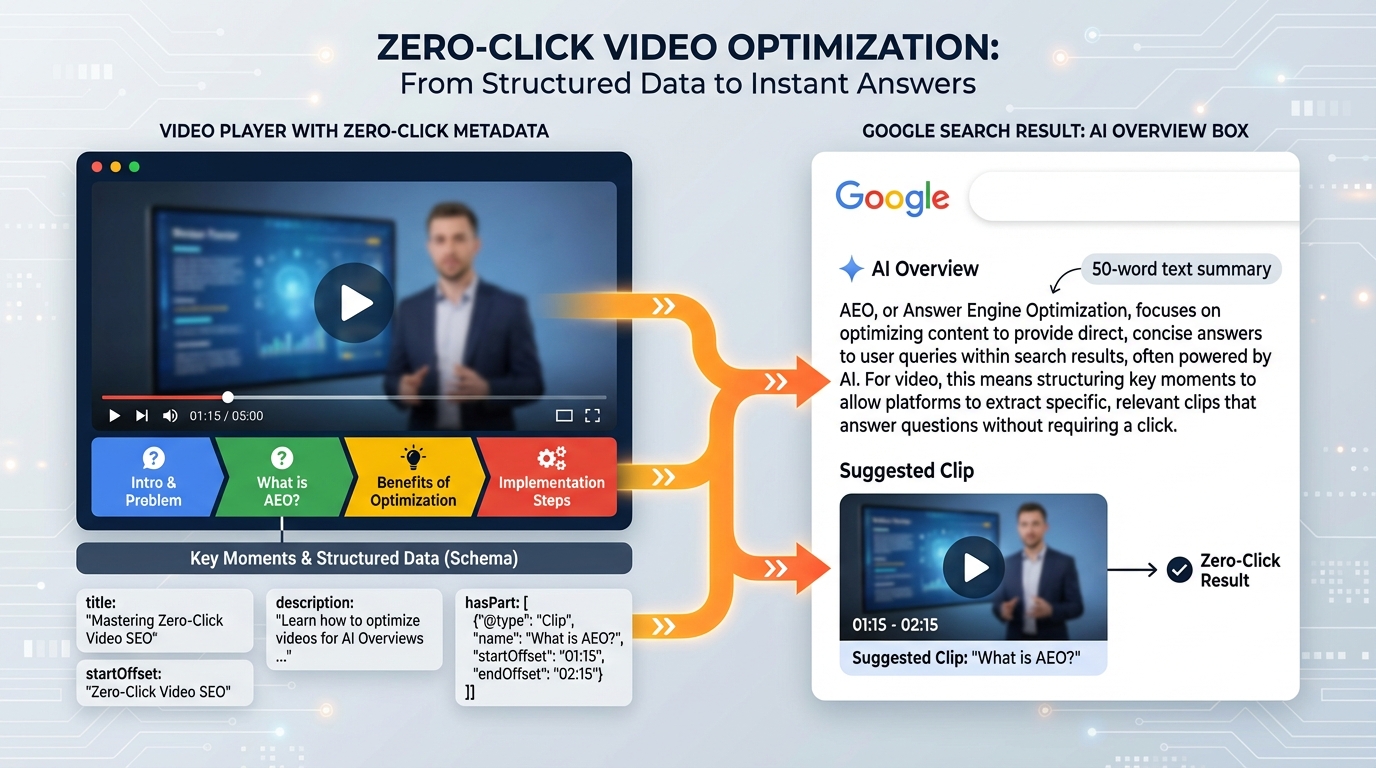
The primary mechanism for zero-click dominance is the “Suggested Clip” or “Key Moment” feature. To capture this real estate, videos must be chapterized using natural-language questions as headers. Each chapter should begin with a “definition statement”—a 40–75 word spoken segment that provides a standalone answer to the chapter's heading. This allows AI engines to parse the audio and present it as a featured snippet or a voice search response without requiring the user to watch the full video.
Furthermore, on-SERP answer design involves aligning your video’s visual cues with its spoken content. Using on-screen text overlays for key definitions and numbered lists for procedural steps helps AI vision models confirm the relevance of the clip. Indian digital marketing playbooks emphasize that optimizing for question-form queries and specific snippet patterns is the most effective way to maintain brand presence in a zero-click environment. By providing “skimmable” video assets, enterprises ensure they remain the primary citation in the AI's response loop.
Source: Winning Zero-Click Snippets in 2026: Advanced Guide
Source: Digital Marketing Strategy for 2026: The New Playbook
3. Designing Featured Snippet Video Content for Answer Engines
Securing the “Position Zero” of 2026 requires a specialized approach to featured snippet video content. Unlike traditional video marketing, which often relies on long introductions and storytelling, snippet-optimized video is clinical and structured. The goal is to provide the “best” answer to a specific query in the shortest possible time, using a format that Google’s “Answer Engine” can easily digest.
Scripting for snippets involves a “Lead with the Answer” philosophy. Every H2-equivalent section in your video should start with a direct response to a potential user question. For example, if the topic is “How to implement SOC 2 compliance,” the video should not start with the history of security; it should start with: “To implement SOC 2 compliance, an organization must follow five key steps: gap analysis, control mapping, evidence collection, third-party audit, and continuous monitoring.” This 40-word block is perfect for extraction.
Technical alignment is equally critical. The captions must exactly match the spoken lines to reinforce the semantic signals sent to the search engine. Additionally, pairing the video with a matching “TL;DR” box on the webpage—containing the same 40–75 word answer—creates a powerful reinforcement loop. This dual-signal approach (video + text) significantly increases the likelihood of the content being selected for a featured snippet. Mobile-first layouts are also essential, as snippet stability in 2026 is heavily influenced by how quickly and clearly the answer renders on handheld devices.
Source: How to Win at SEO: Future-Proofing Your Strategy
Source: Winning Zero-Click Snippets in 2026: Advanced Guide
4. Voice Search Video Optimization and Conversational SEO
By 2026, voice search has transitioned from simple commands to complex, multi-turn conversations. Voice search video optimization now focuses on capturing the nuances of natural language and regional dialects. In India, where voice search adoption is growing at a staggering 40% year-over-year, enterprises must optimize for “everyday language” rather than formal corporate jargon to remain competitive. Regional language video SEO.
Conversational SEO video marketing requires a Q&A-first scripting structure. Instead of titling a video “Enterprise Cloud Security Features,” a more effective title for voice discovery would be “What are the most important security features for enterprise cloud storage?” The video should then be structured as a series of answers to related long-tail questions. This mirrors how users interact with AI assistants like Gemini, Alexa, or Siri, which often pull audio snippets from high-authority video content to answer user queries.
Technical signals for voice search include fast mobile performance and clear, high-fidelity audio that AI transcription services can process with 100% accuracy. Furthermore, linking your video to strong entity signals—such as your Organization’s schema and the Person schema of the expert on camera—helps the answer engine verify the “who” behind the “what.” This builds the necessary trust for an AI assistant to recommend your content as the definitive answer.
Source: The New Way to Do SEO in 2026
Source: AEO vs SEO: Key Differences and Importance
Source: SEO Statistics 2026: Video and Visual Search Growth
5. Technical Implementation: Schema Markup Video Content and AEO Clusters
The backbone of any successful AEO strategy is the underlying data structure. Schema markup video content provides the machine-readable roadmap that allows AI engines to navigate your video. In 2026, simply having a VideoObject tag is insufficient. Enterprises must implement advanced properties like Clip and seekToAction to enable deep-linking into specific segments of the video. Regional language video SEO.
Clip markup is essential for defining specific chapters with unique names and timestamps. This directly feeds the “Key Moments” feature on Google Search. For more dynamic environments, seekToAction allows the search engine to create its own timestamps based on the user's specific query, providing a more personalized “jump-to-answer” experience. TrueFan AI's 175+ language support and Personalised Celebrity Videos can be integrated into these schema-rich workflows, ensuring that localized versions of your content maintain the same level of technical optimization across different regions and languages. Voice sync accuracy comparison guide.
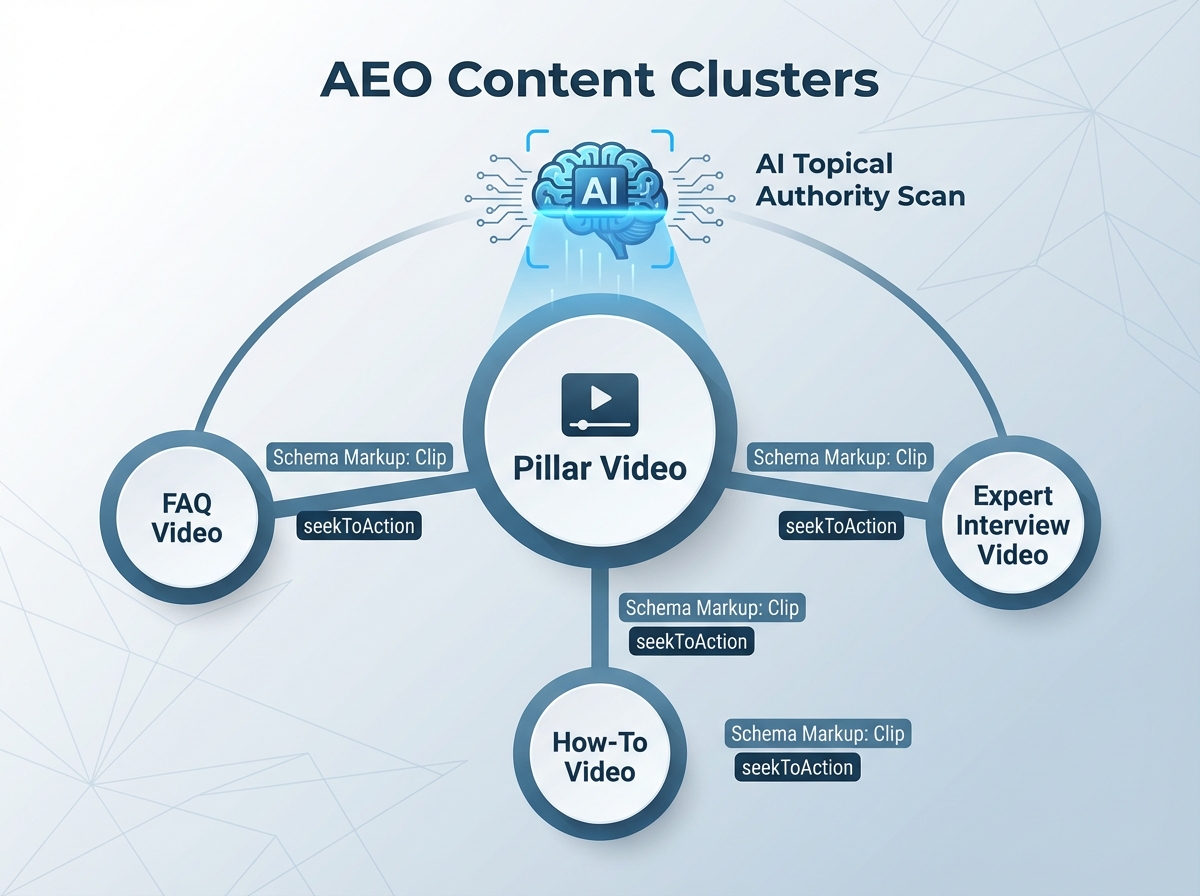
Beyond individual videos, the concept of AEO content clusters is vital. This involves creating a “Pillar” video supported by a cluster of “Satellite” videos (FAQs, How-Tos, Comparisons). Each video in the cluster should be interlinked using consistent entity markup, creating a “topical authority” web that AI engines can easily map. For instance, a pillar video on “Digital Transformation” should link to a How-To video on “Cloud Migration Steps” and an FAQ video on “Digital Transformation ROI,” all sharing the same Organization and Expert schema to reinforce E-E-A-T.
Source: How to Use Schema Markup to Improve SEO
Source: Types of Schema Markup for Search Visibility
Source: Google Search Central Live India: Key Takeaways
6. Scaling E-E-A-T Video Optimization for Enterprise Authority
In an era of AI-generated content, human expertise has become the ultimate premium. E-E-A-T video optimization (Experience, Expertise, Authoritativeness, and Trustworthiness) is the primary filter Google uses to determine which answers are safe to display in AI Overviews. For enterprises, this means demonstrating “Real E-E-A-T” by putting verified subject matter experts (SMEs) on camera and backing their claims with verifiable data.
Solutions like TrueFan AI demonstrate ROI through their ability to scale expert-led content without sacrificing the personal touch that builds trust. By using AI to handle the localization and versioning of expert videos, enterprises can maintain a consistent “human” presence across 175+ languages. This is particularly important for industries like finance, healthcare, and technology, where the “Trustworthiness” component of E-E-A-T is scrutinized by AI moderation layers. Voice sync accuracy comparison guide.
To further reinforce authority, every AEO video should be accompanied by “proof artifacts.” This includes on-screen citations of proprietary data, links to ISO 27001 or SOC 2 compliance pages, and detailed expert bios. AI answer engines are programmed to look for these “trust signals” when deciding which source to cite. If your video is the only one in its niche that provides a clear citation of a 2026 industry study or a government regulation, it becomes the default “authoritative” answer for that topic.
Source: Digital Vigyapan: E-E-A-T in 2026 SEO
Source: TrueFan AI Enterprise Executive Document: Security and Compliance
Conclusion: Dominating the Answer Layer in 2026
The transition to an answer-first search economy represents the most significant shift in digital marketing since the rise of mobile. By 2026, the brands that lead their industries will be those that have mastered answer engine optimization video content. This requires a holistic approach that combines high-quality expert production with rigorous technical schema implementation and a deep understanding of conversational intent.
By focusing on AI Overviews video SEO 2026, implementing robust zero-click optimization strategies, and building comprehensive AEO content clusters, enterprises can ensure they remain the primary source of information for their customers. The future of search is not just about being found; it is about being the answer. As AI continues to mediate the relationship between brands and consumers, your ability to provide structured, authoritative, and easily extractable video answers will be your greatest competitive advantage.
Final Strategic Checklist for Enterprise Leaders:
- Audit existing video assets for “extractable” 40–75 word answer segments.
- Implement
ClipandseekToActionschema across all high-priority video content. - Develop a “Voice-First” scripting template that prioritizes natural language questions.
- Leverage AI-driven localization to capture regional and conversational search volume.
- Monitor GSC for “Key Moment” and “Rich Result” performance to iterate on chapter titles.
Frequently Asked Questions
What is the difference between SEO and AEO for video?
Traditional SEO focuses on ranking a page for a keyword to drive traffic. Answer Engine Optimization (AEO) focuses on structuring video content so that AI engines can extract a direct answer and present it to the user on the SERP or via voice. AEO is about being the “source of truth” for an AI's response.
How long should the “answer” segments in my video be?
For optimal extraction by AI Overviews and featured snippets, your spoken answers should be between 40 and 75 words. This length is concise enough for a summary but long enough to provide meaningful context and include necessary keywords.
Does schema markup really impact AI Overview inclusion?
Yes. In 2026, schema markup like VideoObject, Clip, and FAQPage acts as a direct signal to Google’s AI. It helps the engine understand the structure of your video, making it significantly easier to cite your content as a primary source in a generated answer.
How can I scale video content for multiple languages in India?
Using platforms like TrueFan AI, enterprises can take a single expert-led video and localize it into 175+ languages with perfect lip-sync and voice retention. Voice sync accuracy comparison guide. This allows you to capture voice search and conversational queries in regional languages like Hindi, Tamil, and Bengali while maintaining a high E-E-A-T profile. Regional language video SEO.
What are the most important KPIs for AEO video content?
Beyond traditional views, you should track AI Overview inclusion rates, Featured Snippet wins, “Key Moment” coverage in search results, and voice query impressions. These metrics indicate how well your content is performing as a direct answer source.
How do I prevent zero-click results from hurting my conversions?
While AEO often leads to zero-click outcomes, you can mitigate this by including mid-video CTAs, offering downloadable frameworks or templates in the description, and using the “authority” gained from the SERP answer to drive users toward high-intent demo or contact pages.