Holi Quick Commerce Marketing 2026: The 10-Minute Delivery Personalization Playbook
Estimated reading time: ~14 minutes
Key Takeaways
- Use real-time inventory and SLA feeds to trigger hyperlocal flash sales that match dark-store availability.
- Deploy hyperlocal video personalization with neighborhood callouts, multi-language creatives, and urgency overlays.
- Win retail media with platform partnerships on Blinkit, Zepto, and Instamart using co-branded bundles and deep links.
- Recover carts via personalized WhatsApp/SMS videos that are stock-aware and time-bound to drive action.
- Follow a disciplined H‑28 to H+3 execution timeline covering forecasting, integrations, scale-up, and post-mortem.
The landscape of Indian retail has undergone a seismic shift, moving from planned seasonal purchases to the era of instant gratification shopping. As we approach March 2026, Holi quick commerce marketing 2026 is no longer just about banner takeovers; it is about 10-minute delivery festival personalization that synchronizes with neighborhood-level inventory. Explore the quick commerce Holi marketing 2026 guide.
For growth marketing leaders and e-commerce heads at platforms like Blinkit, Zepto, and Swiggy Instamart, the 2026 festival window represents a high-stakes race for share-of-wallet. With Holika Dahan falling on March 3 and Rangwali Holi on March 4, 2026, the window for conversion is measured in minutes, not days. Success requires a tactical, inventory-led system that bridges the gap between digital demand and dark-store reality. See the quick commerce festival marketing 2026 framework.
The objective of this guide is to provide a comprehensive framework for deploying real-time inventory flash sales and hyperlocal color delivery videos. By stitching together live supply data with rapid delivery personalization, brands can dominate the March 2026 peak and achieve unprecedented quick commerce conversion optimization. Read rapid fulfillment personalization strategies.
1. The 2026 Demand Curve: Navigating the Holi Quick Commerce Landscape
Understanding the temporal dynamics of Holi 2026 is critical for inventory staging and media spend allocation. According to DrikPanchang, Rangwali Holi will be celebrated on March 4, 2026, which places the primary surge window between February 25 (H-7) and March 5 (H+1). This period is characterized by two distinct buyer behaviors: the "Planners" who stockpile staples and the "Impulsives" who drive the massive spike in instant gratification shopping on the morning of the festival.
The category mix for 2026 is shifting toward premium, safety-conscious selections. While traditional gulal remains a staple, there is a projected 40% increase in demand for organic color quick delivery options, including herbal variants and skin-safe formulations. Beyond colors, the "Holi Kit" now includes white apparel, high-pressure pichkaris, stain-removal soaps, and premium sweets like Gujiya, all requiring same-hour festival fulfillment to meet consumer expectations.
Data from industry leaders suggests that nearly 65% of Holi-related orders on quick commerce platforms occur between 8:00 AM and 1:00 PM on the day of Rangwali Holi. This hyper-compressed window necessitates a robust dark store festival marketing strategy where stock velocity is monitored in real-time. Brands must align their promotional windows with dark-store sell-through goals to ensure that "Out of Stock" (OOS) messages do not erode brand trust during peak hours.
Sources:
- DrikPanchang: Rangwali Holi date and timings (2026)
- Indian Express: Holi 2026 dates and details
- Shiprocket India: Top selling Holi products
2. Real-Time Inventory Flash Sales: Turning Dark Store Data into Revenue
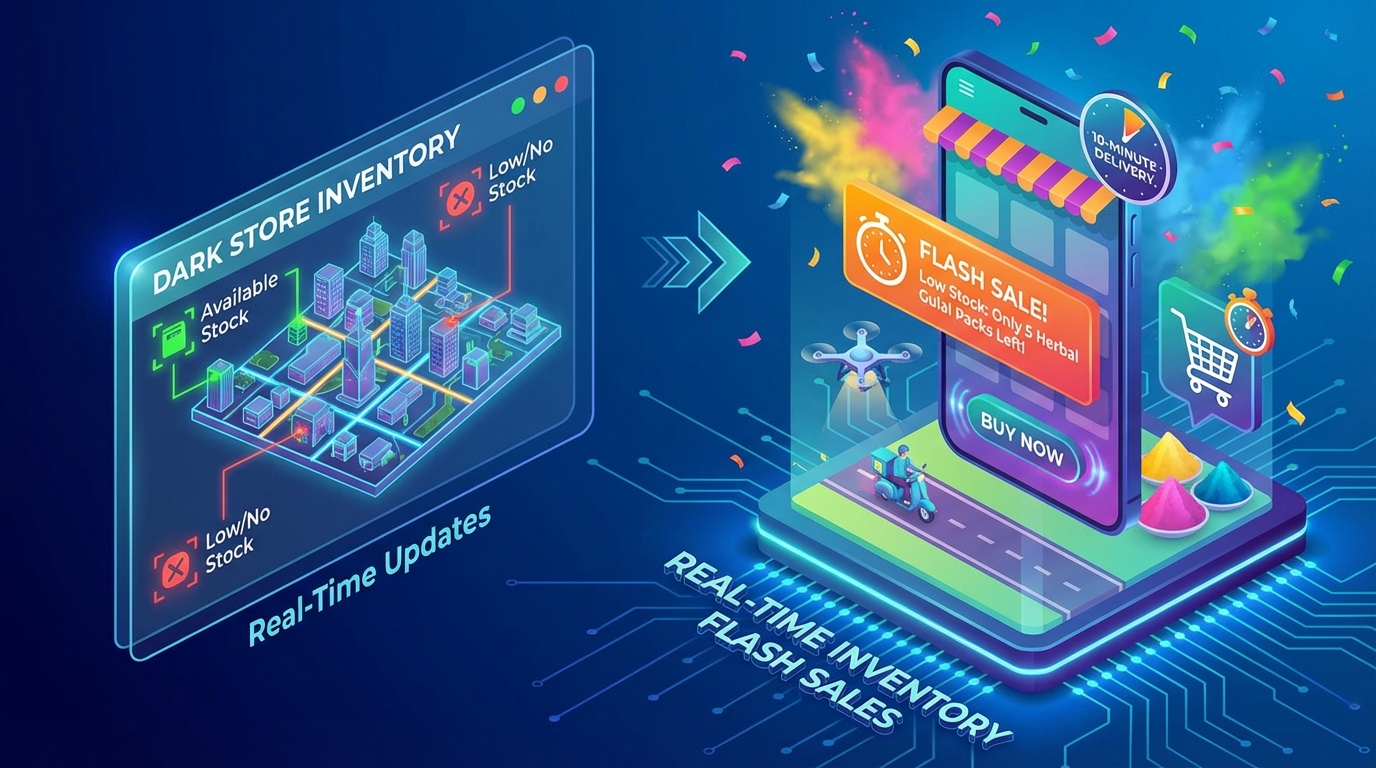
In the 2026 ecosystem, static advertising is obsolete. The most effective way to drive urgency is through real-time inventory flash sales that are programmatically tied to local stock levels. This involves setting up an automated engine that launches promotional bursts only when specific SKU thresholds are met within a particular pin code or dark store radius. Learn about instant shopping video triggers.
For instance, a brand can trigger a "2-Hour Gulal Rush" creative specifically for users in South Delhi when the local dark store shows an inventory of over 500 units of organic gulal. Conversely, if the stock drops below a safety buffer, the system must auto-pause the urgency creatives to prevent customer dissatisfaction. This level of dark store festival marketing ensures that every marketing rupee is spent on products that are actually available for 10-minute delivery. Quick commerce festival marketing 2026 best practices.
Platforms like TrueFan AI enable brands to automate this entire workflow by ingesting live inventory feeds and rendering dynamic video assets that reflect current stock counts. By using location-based urgency triggers, such as "Only 12 packs of herbal pink left in Indiranagar," brands can achieve a significant lift in click-through rates. This strategy effectively turns the logistical constraints of quick commerce into a powerful psychological lever for conversion. Quick commerce video personalization in India.
Furthermore, the integration of real-time SLA (Service Level Agreement) data is paramount. If a specific neighborhood is experiencing a delivery delay of over 30 minutes due to high demand, the marketing engine should automatically switch from "10-minute delivery" messaging to "Pre-order for your evening party" or "Deliver before lunch" prompts. This transparency builds long-term loyalty and optimizes the same-hour festival fulfillment experience. Rapid fulfillment personalization strategies.
Sources:
3. Hyperlocal Color Delivery Videos: The New Standard for Personalization
The creative frontier for Holi quick commerce marketing 2026 is defined by hyperlocal color delivery videos. These are dynamic, API-rendered short-form videos that visualize real-time data points—such as stock count, delivery ETA, and neighborhood-specific offers—directly within the video content. This approach moves beyond generic "Happy Holi" ads toward high-utility, conversion-focused communication. See hyperlocal video personalization examples.
A typical 2026 creative motif might feature a high-energy visual of herbal colors with a dynamic overlay stating: "Andheri West: 7 herbal gulal packs left, deliver in 10 minutes. Use code HOLI-AND7." This level of rapid delivery personalization resonates with the modern consumer who values time and local relevance above all else. By mentioning the specific neighborhood or even the "society cluster," brands can create a sense of community-driven demand. Build instant shopping video funnels.
To execute this at scale, the creative system must support multi-language rendering. TrueFan AI's 175+ language support and Personalised Celebrity Videos allow brands to deliver these hyperlocal messages in the consumer's preferred tongue, whether it is Hindi, Marathi, or Bengali, ensuring cultural resonance across diverse Indian geographies. This is particularly effective for neighborhood-specific Holi offers where local dialects can significantly increase engagement.
Content guardrails are equally important in this creative process. Brands must emphasize the use of safe, organic colors and avoid offensive stereotypes or community-specific tropes. In 2026, social responsibility is a key component of brand equity; therefore, including messages about water conservation or skin safety within these hyperlocal videos can enhance the brand's reputation while driving quick commerce conversion optimization.
Sources:
- Shiprocket India: Herbal/organic colours category trends
- GoDaddy India: Cultural relevance and localized offers
4. Platform Partnerships: Navigating Blinkit, Zepto, and Swiggy Instamart
The success of any Holi quick commerce marketing 2026 campaign relies heavily on deep integration with platform giants like Blinkit and Zepto. These platforms are the primary gateways for instant gratification shopping, and securing prime digital real-time estate is essential. Brands should focus on co-branded "Holi Essentials" tiles and platform-exclusive gulal deals to stand out in a crowded marketplace. Tactics for Blinkit and Zepto Holi campaigns.
A critical component of this partnership is the sharing of real-time inventory signals. By collaborating with platform category managers, brands can co-orchestrate real-time inventory flash sales that include low-stock badges and "Trending in your area" ribbons. These location-based urgency triggers are highly effective at moving inventory in high-density clusters, such as large housing societies or college campuses, where demand is predictably high.
Merchandising for the Holi peak also requires a sophisticated bundling logic. Instead of selling individual items, brands should promote "Holi Party Packs" that include organic gulal, pichkaris, and stain-removal soaps. Offering these as platform-exclusive deals on Zepto or Blinkit creates a sense of exclusivity and encourages higher average order values (AOV). These bundles should be tailored to the specific demographics of the dark store's catchment area. Holi quick commerce strategies for merchandising.
Finally, the use of deep links is a non-negotiable requirement for 2026. Every hyperlocal color delivery video or social media ad must lead the user directly to a pre-filled cart or a specific category page on the quick commerce app. This reduces friction in the user journey and is a cornerstone of quick commerce conversion optimization, ensuring that the transition from "discovery" to "delivery" happens in seconds. Implement deep-linkable instant shopping triggers.
Sources:
- Shiprocket India: Holi product categories to stock and bundle
- TrueFan AI: Holi 2026 marketing campaigns India guide
5. Festival Cart Abandonment Recovery: Reclaiming Lost Revenue in Real-Time
During the chaotic peak of Holi morning, cart abandonment rates can skyrocket as users jump between apps to find the fastest delivery time or the best price. In 2026, a standard "Come back and shop" email is insufficient. Brands need a festival cart abandonment recovery system that is automated, time-bound, and powered by personalized video. Design instant shopping video funnels.
The playbook for 2026 involves triggering a personalized video via WhatsApp or SMS within 10 to 20 minutes of a user dropping off. This video should dynamically display the remaining stock in the user's nearest dark store and offer a time-bound coupon that is only valid for the next 30 minutes. This creates a powerful "fear of missing out" (FOMO) that is grounded in the reality of same-hour festival fulfillment. Quick commerce video personalization for recovery.
Solutions like TrueFan AI demonstrate ROI through their ability to rotate creative lines via virtual reshoots. This means a brand can update the SKU mix or the discount percentage in their recovery videos without needing to conduct new video shoots. If a specific pichkari goes out of stock, the system automatically swaps it for a similar available item in the video, ensuring the recovery message remains accurate and actionable.
To maximize effectiveness, these recovery journeys must be suppressed if the delivery SLA exceeds a certain threshold or if the item becomes completely unavailable. This prevents the frustration of a user returning to a cart only to find they cannot receive their items before the festivities begin. By maintaining this level of operational integrity, brands can turn abandoned carts into successful 10-minute delivery festival personalization stories.
Sources:
6. The Execution Playbook: A Strategic Timeline for Holi 2026
Executing a high-velocity Holi quick commerce marketing 2026 campaign requires a disciplined timeline that starts weeks before the first color is thrown. The preparation phase (H-28 to H-14) is focused on demand forecasting, securing organic color quick delivery supplies, and finalizing platform-exclusive gulal deals. This is the time to align with dark store partners on stock levels and delivery radius. Reference Holi quick commerce strategies.
Between H-14 and H-7, the focus shifts to technical integration. Marketing teams must stand up their inventory and ETA feeds and configure the rule engine for real-time inventory flash sales. This is also the window to build video templates with stock and ETA overlays. Testing location-based urgency triggers and SLA suppression mechanisms during this week is vital to ensure a seamless experience during the actual festival peak. Quick commerce Holi marketing 2026 checklist.
The "H-Week" (February 25 to March 4) is all about scaling and optimization. Brands should launch preview campaigns in select high-density clusters to A/B test different urgency patterns, such as stock meters versus countdown timers. As the demand scales nationally, the system must monitor minutes-to-fulfillment and sell-through rates, rotating creatives via virtual reshoots to stay aligned with live trends and inventory shifts. Nationwide scale-up tactics for Holi week.
Post-festival (H+1 to H+3), a thorough post-mortem is required. This involves analyzing store-level incrementality and the performance of various neighborhood-specific Holi offers. By documenting which language variants and urgency triggers drove the highest lift, brands can build a repeatable growth system for future festivals, ensuring that their quick commerce conversion optimization strategies continue to evolve.
Sources:
Recommended Internal Links
- Quick commerce festival marketing 2026
- Rapid fulfillment personalization strategies
- Quick commerce video personalization in India
- Instant shopping video triggers
- Instant shopping video funnels
- Holi quick commerce strategies
- Quick commerce Holi marketing 2026
- Blinkit & Zepto Holi campaigns
Frequently Asked Questions
How does 10-minute delivery festival personalization work for Holi 2026?
It uses real-time dark-store data to customize messages by pin code. Dynamic creatives show live delivery ETA, available stock of organic colors, and neighborhood-specific discounts—often rendered as short videos. Learn how rapid fulfillment personalization works.
What are the best products to promote for same-hour festival fulfillment?
High-velocity items include herbal gulal, pichkaris, white t-shirts, Gujiya, and stain-removal products. Bundling them into Holi Kits increases conversion on Blinkit and Zepto. See Holi quick commerce strategies.
How can brands manage Out of Stock (OOS) issues during the Holi peak?
Integrate live inventory feeds with the marketing engine to auto-suppress ads for unavailable products in specific locations. This preserves budget and trust. Use instant shopping video triggers.
Can TrueFan AI help with localized marketing for Holi?
Yes. TrueFan AI supports hyperlocal color delivery videos in 175+ languages and can personalize by neighborhood, stock, and ETA to drive immediate action. Explore quick commerce video personalization.
What is the most effective way to recover abandoned carts during Holi?
Send a personalized WhatsApp video within minutes of drop-off, highlighting remaining stock in the nearest dark store and a limited-time coupon to nudge immediate checkout. Build instant shopping video funnels.
Why is organic color quick delivery a major trend for 2026?
Consumers prioritize health and environmental safety. Rapid delivery of certified herbal/organic colors meets this demand, especially in urban clusters. Quick commerce Holi marketing insights.