Agentic AI video assistant D2C website India 2026: Real-time interactive sales avatars for Shopify Plus and Indian D2C
Estimated reading time: ~10 minutes
Key Takeaways
- Agentic AI video assistants are replacing static chat with real-time, low-latency avatars that demo products and sell 24/7.
- Shopify Plus integration via Storefront GraphQL and WebRTC enables instant, on-page transactions and cart actions.
- India-ready experiences hinge on vernacular support, adaptive bitrate streaming, and COD-aware flows.
- DPDP compliance requires explicit consent, data minimization, and clear withdrawal rights for voice/video interactions.
- Measurable ROI includes 15–25% higher conversions, lower returns (RTO), larger AOV, and reduced support costs.
The landscape of digital commerce is undergoing a seismic shift. In 2026, Indian D2C brands are moving from static chat widgets to a real-time agentic AI video assistant D2C website India 2026 real-time interactive AI avatars for India that demos products, answers questions, and sells on-page—24/7—like a Lenskart-style AI avatar guiding try-ons and Myntra’s video-led Glamstream driving engagement. This transition marks the end of the “search and click” era and the beginning of the “converse and convert” era, where autonomous agents act as the primary interface between brands and consumers.
By 2026, the “bot buying” era has officially arrived in India. According to recent data from Storyboard18 (January 2026), quick commerce now accounts for over 15% of total online sales and is growing significantly faster than traditional e-commerce models. This shift is driven by a new generation of shoppers who demand instant gratification and personalized, visual interactions. Furthermore, ET BrandEquity reports that autonomous AI agents are projected to fully transform marketing and commerce by 2026, moving beyond simple automation to goal-seeking behavior that can manage entire purchase lifecycles.
Section 1: The Evolution of the Agentic AI Video Assistant in India’s 2026 D2C Landscape
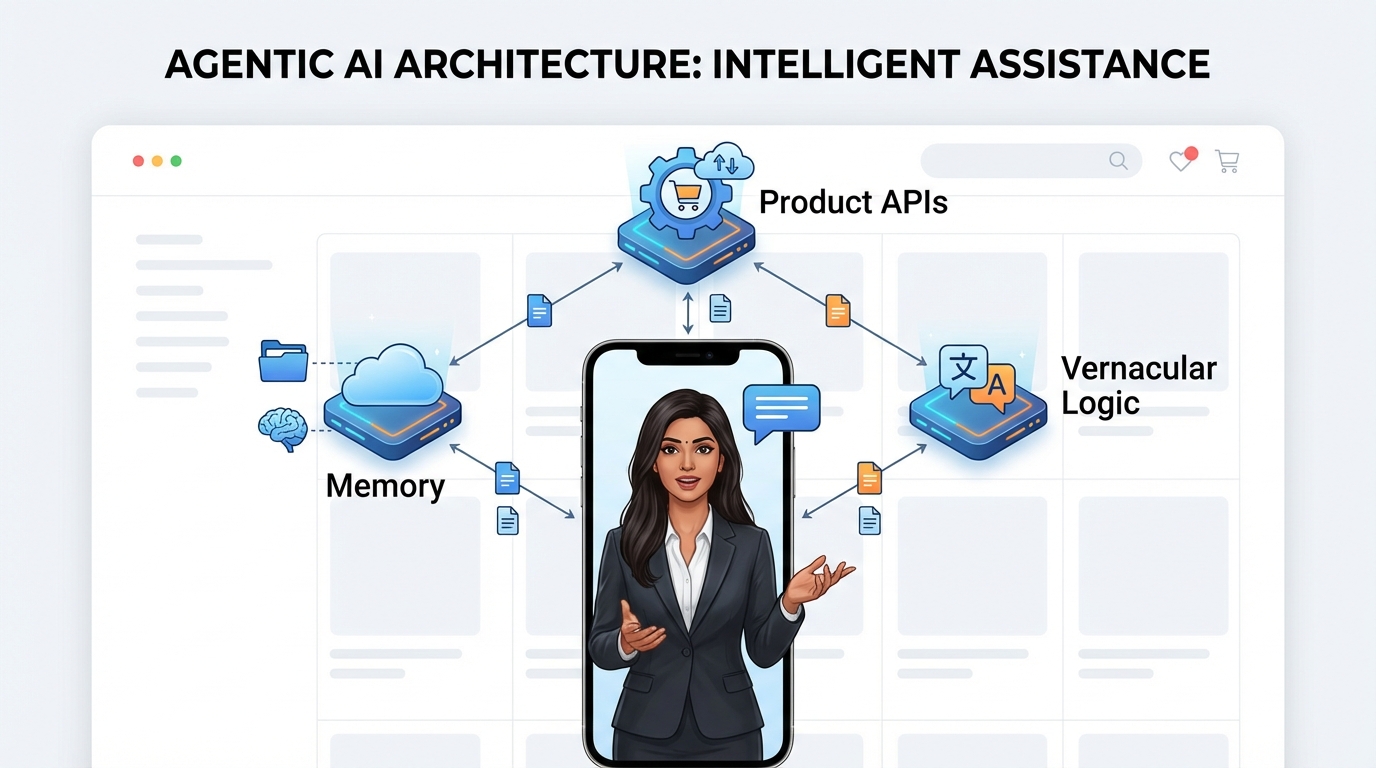
To understand the impact of an agentic AI video assistant India 2026, we must first define what makes an AI “agentic.” Unlike traditional chatbots that follow rigid, scripted paths, agentic AI refers to autonomous, LLM-driven systems equipped with memory and tools. These assistants can perceive session signals, plan multi-step actions (such as comparing three different skincare serums), and act via APIs to add items to a cart or create an order.
In the Indian context, this technology is being optimized for a mobile-first audience, vernacular language preferences, and the unique challenges of Cash-on-Delivery (COD) behavior. A real-time AI video agent e-commerce solution is not just a pre-recorded video; it is a low-latency, streaming avatar with live Text-to-Speech (TTS) and Speech-to-Text (STT) capabilities. These agents respond in under 300–600 ms intervals, creating a natural, human-like conversation that can handle objections and provide contextual product demos in real-time.
The readiness of Indian industry for this leap is documented in EY India’s “AIdea of India: Outlook 2026” report, which flags that nearly 70% of Indian enterprises are now actively exploring or deploying agentic AI to create new business models. This is supported by Google’s recent announcement of an open standard for agentic shopping assistants, designed to connect retailers directly with high-intent shoppers through a unified protocol.
Key 2026 Market Signals:
- Bot-Buying Era: AI agents are increasingly taking over purchase decisions, especially in high-frequency categories (Source: Storyboard18: The rise of bot buying in 2026).
- Marketing Revolution: Autonomous agents are redefined as the “new middleware” for enterprise operations (Source: Zinnov: AI trends redefining 2026).
- Enterprise Readiness: EY India highlights a massive uptake in agentic AI as brands move from experimentation to scale (Source: EY India: Agentic AI outlook).
Section 2: Benchmarking Success: From Lenskart’s Avatars to Myntra’s Glamstream
The blueprint for the video commerce AI assistant India interactive video commerce guide for Instagram in India was laid by early innovators like Lenskart and Myntra. Lenskart’s “Ditto” 3D try-on served as an early benchmark for guided visual assistance, proving that Indian consumers are highly receptive to AI-driven visual tools that reduce purchase uncertainty. Today, the Lenskart style AI avatar has evolved from a simple AR overlay into a sitewide interactive selling partner that can explain lens coatings or frame materials with the nuance of an in-store optician.
Similarly, Myntra’s “Glamstream” has revolutionized content-to-commerce by scaling shoppable video. When Glamstream launched, it targeted a 15% uptick in engagement and aimed to double content-commerce revenue. By 2026, these goals have been surpassed, with video-led engagement becoming the primary driver for Gen Z and Millennial cohorts.
Why Video-First Commerce Wins in India:
- Trust and Transparency: In a market where COD is prevalent, seeing a real-time demo from an interactive sales avatar website D2C real-time interactive AI avatars for India builds immediate trust.
- Vernacular Accessibility: Real-time video agents can switch between Hindi, Tamil, Telugu, and English seamlessly, catering to the “Next Billion Users” who prefer voice and video over text.
- Reduced Cognitive Load: Instead of scrolling through endless product description pages (PDPs), users can simply ask, “Show me a red silk saree for a summer wedding under ₹5,000,” and see a live demo.
According to research by Twimbit on Lenskart’s AI-driven innovations, Lenskart’s digital innovations have fundamentally redefined eyewear shopping, setting a high bar for other D2C categories like beauty, fashion, and electronics to follow.
Section 3: Strategic Use Cases: Transforming Browsers into Buyers with Real-Time Interaction
The implementation of an interactive sales avatar website D2C offers a variety of high-impact use cases that directly influence the bottom line. These agents are no longer just “support” tools; they are proactive sales engines.
- Guided Discovery and Bundling
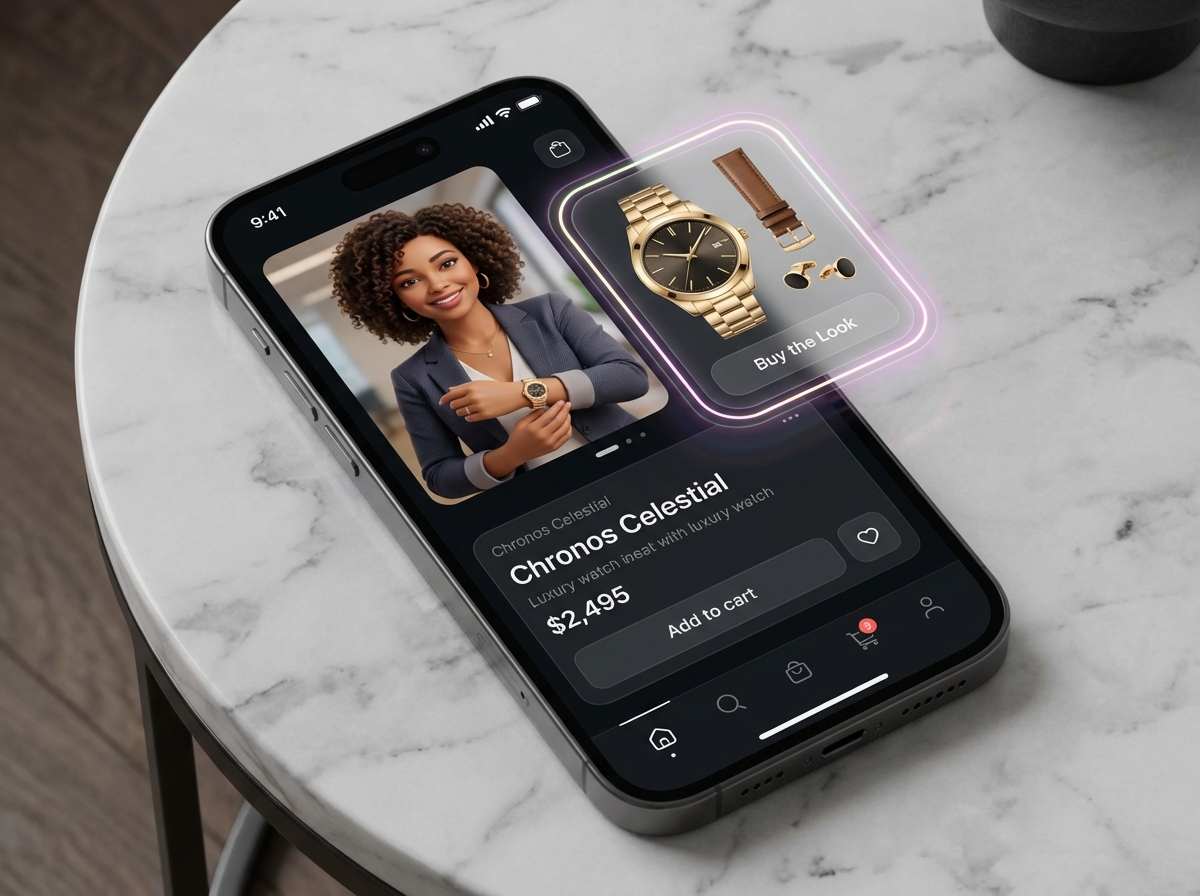
An interactive product demo avatar website can greet a user, qualify their needs with 2–3 targeted questions, and then play micro-demos of recommended products. For example, if a user is looking for a skincare routine, the avatar can compare three different serums, explain the active ingredients, and suggest a sunscreen to bundle for a discount—all while adding the items to the cart in real-time. - Conversational AI Avatar Customer Service India
Post-purchase friction is a major conversion killer. Platforms like Studio by TrueFan AI enable brands to automate complex service flows, such as returns, exchanges, and COD verifications. An agent can verify an order via OTP, explain the return policy in the user's preferred language, and generate a pickup request without human intervention. - 24/7 Video Sales Assistant Automation
The “always-on” nature of AI agents means that a brand never misses a lead. Whether it's 2 AM or a peak festival sale, the 24/7 video sales assistant automation can handle high volumes of traffic, capture leads via WhatsApp, and even rescue abandoned carts by offering a personalized re-demo when the user returns to the site. - Size and Fit Assistance
In fashion D2C, high return rates due to fit issues are a significant cost. An agentic video assistant can ask for body measurements or skin tones, surface relevant User-Generated Content (UGC), and offer fit guidance that mimics the experience of a personal stylist.
Source: ET BrandEquity on autonomous AI agents by 2026 notes that these autonomous agents are becoming the primary drivers of ROI in the Indian D2C sector by 2026.
Section 4: The Technical Blueprint: Shopify Integration and Low-Latency Architecture
Building a D2C website AI video integration that works seamlessly on Indian networks requires a sophisticated technical stack. The primary challenge in India is not just the AI itself, but the delivery of high-quality video over variable 4G and 5G connections.
The Real-Time Stack:
- WebRTC for Low Latency: To achieve a conversational feel, the end-to-end “glass-to-glass” latency must be under 800 ms. WebRTC is the industry standard for bi-directional audio/video streaming, ensuring that the avatar's responses feel instantaneous.
- Streaming ASR and TTS: The system must use streaming speech recognition with partial hypotheses to keep turn-taking tight. Similarly, neural streaming TTS must provide prosody control voice cloning emotion control in India to ensure the avatar sounds natural in Indian English and vernacular languages.
- LLM Orchestration: The “brain” of the assistant must be a tool-using agent that can reflect on its own performance and correct errors in real-time.
Shopify Plus Integration:
For brands on Shopify, the integration is typically handled via an async script in the theme.liquid file. The assistant interacts with the Shopify Storefront GraphQL API to query products, check inventory, and manage carts. Studio by TrueFan AI's 175+ language support and AI voice cloning for Indian accents make it particularly effective for Shopify India merchants who need to scale across diverse linguistic regions without rebuilding their entire frontend.
Data Grounding (RAG):
To prevent “hallucinations” (where the AI makes up product facts), the system uses Retrieval-Augmented Generation (RAG). It indexes the brand's PDPs, FAQs, and policy documents, ensuring that every claim made by the video agent is grounded in the brand's actual data.
Network Optimization for India:
Given the prevalence of mobile shopping on Jio and Airtel networks, the architecture must include:
- Adaptive Bitrate Streaming: Scaling video quality up or down based on the user's current bandwidth.
- Mobile-First UI: Sticky mini-avatars that don't block the main product view and “tap-to-sound” prompts to comply with browser autoplay rules.
Source: Google Ads & Commerce: Agentic commerce protocol provides the foundational protocol for these agentic shopping assistants.
Section 5: Data Privacy and the DPDP Act: Building Trust in the Age of AI Agents
As D2C brands deploy more sophisticated real-time avatar customer engagement tools, compliance with India’s Digital Personal Data Protection (DPDP) Act 2023 becomes paramount. The Act mandates explicit, informed consent for the collection and processing of personal data, which includes voice and video interactions.
DPDP Compliance Checklist for AI Avatars:
- Explicit Consent: Brands must display a clear consent banner before the AI video assistant begins recording or processing user audio. This notice must be available in multiple languages as per the Eighth Schedule of the Indian Constitution.
- Purpose Limitation: The data collected (e.g., a user's skin tone for a makeup recommendation) must only be used for that specific purpose and deleted once the goal is achieved.
- Data Minimization: Only the data necessary for the interaction should be processed.
- Right to Withdraw: Users must have an easy way to withdraw consent and request the deletion of their interaction logs.
Beyond legal requirements, building trust involves “Content Governance.” This includes real-time profanity filters, refusal policies for sensitive topics, and transparent watermarking to indicate that the user is interacting with an AI assistant. Solutions like Studio by TrueFan AI provide a “walled garden” approach, ensuring that all AI-generated content is compliant with both brand safety guidelines and national regulations.
Source: The official MeitY DPDP Act 2023 PDF outlines these requirements in detail.
Section 6: Measuring Success and FAQ: The ROI of Interactive Video Commerce
The ultimate test of any agentic AI video assistant D2C website India 2026 is its impact on conversion and customer lifetime value. Solutions like Studio by TrueFan AI demonstrate ROI through social commerce and shoppable videos through several key performance indicators (KPIs):
- Conversion Rate Uplift: Brands typically see a 15-25% increase in conversion on PDPs where an interactive video agent is present.
- Reduced RTO (Return to Origin): By providing better fit and product guidance, video agents help reduce the number of returns, which is a major cost-saver for Indian D2C brands.
- Increased AOV (Average Order Value): Proactive bundling and upselling by the AI agent lead to larger basket sizes.
- Lower Support Costs: Automating 70-80% of common queries (order tracking, returns) allows human agents to focus on high-value tasks.
Step-by-Step AI Avatar Website Integration Guide
- Data Preparation: Clean your PDP content, FAQs, and return policies.
- Avatar Selection: Choose a persona that matches your brand (e.g., a “Lenskart style AI avatar” for professional trust or an influencer style for fashion).
- Goal Configuration: Define what the agent should do (e.g., “Guide the user to add a bundle to the cart”).
- Shopify Embed: Add the script to your theme and connect your GraphQL API.
- Compliance Setup: Configure your DPDP-compliant consent banners.
- Analytics Hookup: Map events like demo_start and add_to_cart to your GA4 dashboard.
Summary of 2026 Industry Benchmarks
| Metric | 2026 Projection | Source |
|---|---|---|
| Quick Commerce Share | 15%+ of Online Sales | Storyboard18 |
| Enterprise AI Adoption | 70% of Indian Firms | EY India |
| B2B E-commerce Growth | 14.5% CAGR | Trade.gov |
| Marketing Transformation | 100% Autonomous Agent Integration | ET BrandEquity |
| Global E-comm Sales | $8 Trillion+ | Coursera |
By integrating an agentic AI video assistant D2C website India 2026, brands are not just adding a feature; they are evolving their entire customer experience to meet the demands of a high-speed, visual, and autonomous future. Whether you are a Shopify Plus merchant or a rising D2C star, the time to move toward real-time, video-led commerce is now.
External Research Sources:
- EY India: AIdea of India Outlook 2026
- Storyboard18: The Rise of Bot Buying 2026
- ET BrandEquity: Autonomous AI Agents by 2026
- Google Ads & Commerce: Agentic Commerce Protocol
- MeitY: Digital Personal Data Protection Act 2023
- Zinnov: AI Trends Redefining 2026
Recommended Internal Links
- Real-time Interactive AI Avatars India: Live Video Chat
- Interactive Video Commerce Instagram India: 2026 Guide
- Social commerce shoppable videos 2026: ROI guide for India
- AI Voice Cloning Indian Accents: Scale Multilingual Content with Authenticity
- Voice Cloning Emotion Control in India: 2026 Guide for Hindi, Tamil, and Regional Accents
- The Ultimate Guide to the Best AI Voice Cloning Software of 2025
Frequently Asked Questions
How does an agentic AI video assistant handle low-speed internet in Tier 2 and Tier 3 Indian cities?
Modern real-time AI video agent e-commerce platforms use adaptive bitrate streaming and WebRTC. If the connection is too slow for HD video, the system automatically switches to an “audio-first” mode with a static thumbnail or a lower-resolution stream to ensure the conversation remains fluid without buffering.
Can the AI avatar handle “Hinglish” and other regional dialects?
Yes. Advanced agents are trained on massive datasets of Indian speech patterns. Studio by TrueFan AI, for example, supports over 175 languages and is specifically tuned to understand the nuances of Hinglish, as well as regional languages like Tamil, Telugu, and Marathi, ensuring a natural experience for all Indian shoppers. Learn more about AI voice cloning for Indian accents.
Is it possible to hand off a conversation from the AI avatar to a human agent?
Absolutely. The system can be configured to trigger a human handoff if it detects negative sentiment, confusion, or if the user explicitly asks for a “real person.” The human agent receives the full transcript and the current state of the user's cart to provide a seamless transition.
How do we prevent the AI from making false promises or “hallucinating” about discounts?
This is prevented through Retrieval-Augmented Generation (RAG). The AI is grounded in your live Shopify data. It only references your product catalog and active discount rules. If a user asks for something not in the data, the AI is programmed to politely decline or offer the closest available alternative.
What is the typical timeline for deploying an AI video chatbot for Shopify India?
A pilot can be launched in as little as 30 days, often as a soft launch on your top 20 revenue-generating PDPs. A full sitewide rollout, including advanced personalization and multiple vernacular languages, typically takes 60 to 90 days.



