Post-purchase loyalty automation India: The Q4 2025–26 blueprint to drive first-order to second-order conversion and CLV lift
Estimated reading time: 13 minutes
Key Takeaways
- Shift focus from acquisition to retention orchestration with WhatsApp-first automation
- Design 90-day post-purchase sequences to accelerate first-to-second order conversion
- Use personalized CLV optimization videos to educate, replenish, and win back customers
- Automate loyalty and referrals with UPI rewards, QR validation, and tier milestones
- Measure impact via FO→SO rate, watch-through rate, referral conversions, and cohort margin
The landscape of Indian e-commerce in 2026 is defined by a radical shift from customer acquisition to aggressive retention orchestration. As acquisition costs on traditional social channels reach record highs, post-purchase loyalty automation India has emerged as the primary driver for sustainable growth and profitability.
For enterprise D2C brands and mid-market retailers, the window between the first delivery and the second order is the most critical phase of the customer lifecycle. Successfully navigating this period requires more than just generic email follow-ups; it demands a sophisticated blend of predictive analytics and hyper-personalized communication.
By implementing automated, trigger-based workflows across WhatsApp, SMS, and email, brands can transform a single transaction into a long-term relationship. This blueprint explores how to leverage post-purchase engagement sequences and customer lifetime value optimization videos to dominate the Q4 2025–26 festive season and beyond.
1. Defining Post-purchase Loyalty Automation India for the 2026 Market
In the current Indian retail ecosystem, post-purchase loyalty automation India refers to an integrated system of always-on, trigger-based workflows designed to personalize the customer journey post-checkout. This system utilizes real-time data from order management systems (OMS) and customer data platforms (CDP) to deliver relevant content at high-intent moments.
The 2026 market signals indicate that WhatsApp-first automation is no longer optional but a fundamental requirement for Indian commerce. (Quick Commerce Festival Marketing 2026) Brands are now automating everything from order confirmations and branded tracking to replenishment reminders and influencer-led loyalty invitations.
Current trends suggest a move toward unified customer IDs that bridge the gap between app, web, and offline touchpoints. Platforms like TrueFan AI enable brands to deliver these experiences at scale, ensuring that every interaction feels unique to the individual buyer's preferences and regional language.
Core Components of a 2026 Automation Framework:
- Event Triggers: Automated actions based on order_placed, order_shipped, order_delivered, and first_use windows.
- Omnichannel Orchestration: Seamless delivery across WhatsApp Business API, SMS, email, and in-app widgets.
- Hyper-Personalization: Dynamic integration of customer names, city-specific delivery timelines, and SKU-level usage instructions.
- Predictive Logic: Using propensity scores to determine the "Next Best Action" for each specific customer cohort.
Source: https://m.aisensy.com/blog/build-whatsapp-ecommerce-store/
Source: https://www.flowcart.ai/blog/whatsapp-marketing-automation
Source: https://www.clickpost.ai/blog/post-purchase-platform
Source: https://loylt.works/blog/top-channel-loyalty-trends-2026-india.html
Source: https://parcellab.com/blog/retail-trends-and-predictions-shaping-ecommerce-in-2026/
2. The Economics of First-order to Second-order Conversion
The transition from a first-time buyer to a repeat customer is the most significant hurdle in achieving a positive Customer Lifetime Value (CLV). In the Indian market, particularly during high-velocity periods like the Great Indian Festival or Big Billion Days, first-order to second-order conversion is the ultimate metric for health.
Data from 2026 indicates that existing customers contribute approximately 65% of total revenue for top-tier Indian D2C brands. Accelerating the second order within a 30–45 day window significantly stabilizes the repeat purchase rate and improves cohort-level gross margins by amortizing initial acquisition costs.
To optimize this transition, brands must employ retention cohort segmentation. This involves grouping customers not just by what they bought, but by their payment method (COD vs. Prepaid), their geographic region, and their predicted churn risk.
Strategic Advantages of High Conversion Rates:
- CAC Payback Acceleration: Faster recovery of marketing spend allows for more aggressive scaling in competitive quarters.
- Compounding LTV Base: A higher percentage of second-order buyers leads to a larger pool of loyalists who eventually become brand advocates.
- Inventory Efficiency: Predictable repeat behavior allows for better demand forecasting and reduced stock-outs of popular SKUs.
- Margin Protection: By identifying high-potential cohorts, brands can reduce reliance on deep discounts and instead offer value-based incentives.
Source: https://www.clickpost.ai/blog/post-purchase-platform
Source: https://www.shopify.com/in/enterprise/blog/digital-customer-experience
Source: https://www.nector.io/blog/omnichannel-loyalty-program
3. Architecting 90-Day Post-purchase Engagement Sequences
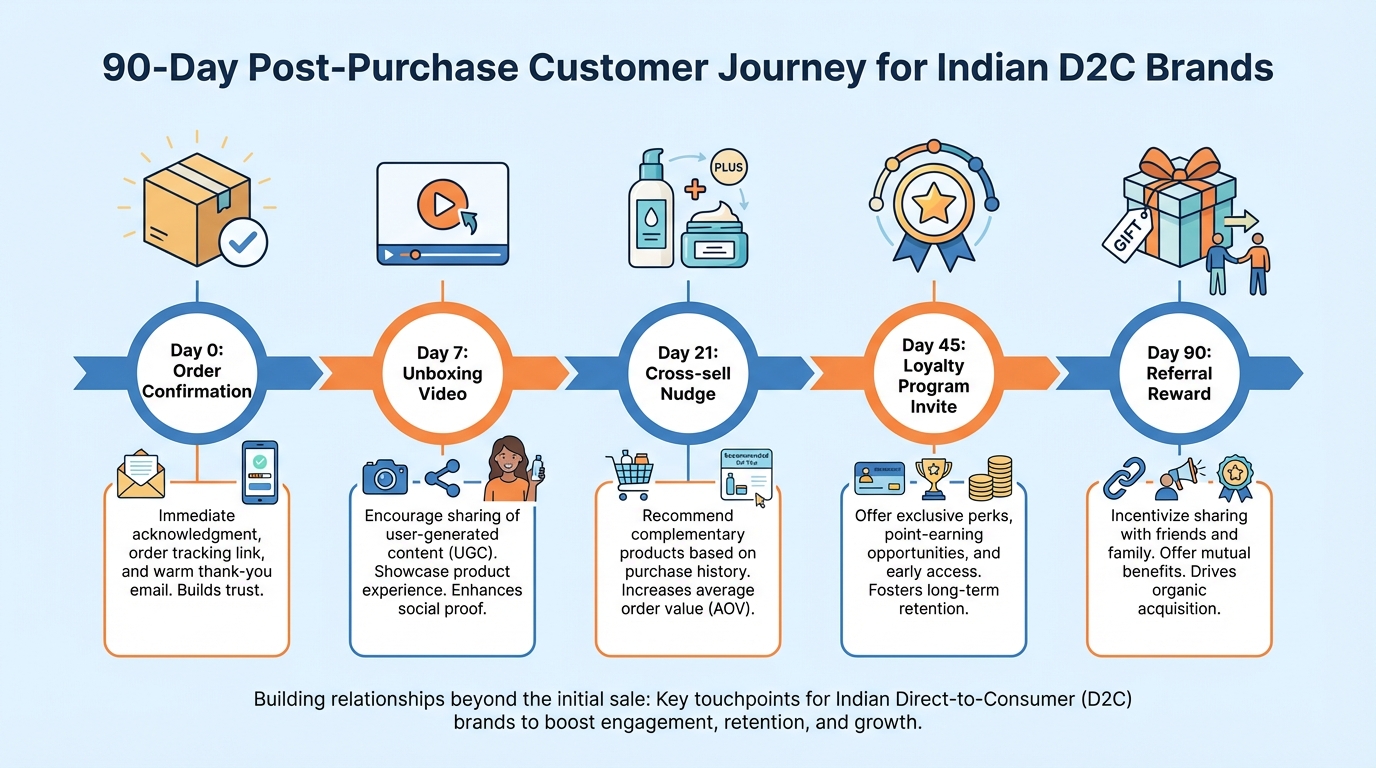
A robust 90-day plan is essential for maintaining momentum after the initial excitement of a purchase fades. These post-purchase engagement sequences must be meticulously timed to align with the customer's product experience and psychological state.
The first 72 hours are dedicated to building trust through branded tracking and proactive communication. As the journey progresses, the focus shifts toward education, value discovery, and eventually, intelligent cross-sell timing based on the specific items purchased.
By Day 30, the automation should pivot toward long-term retention through loyalty enrollment and referral incentives. This structured approach ensures that the brand remains top-of-mind without becoming intrusive, using high-engagement channels like WhatsApp to drive action.
The 90-Day Journey Breakdown:
- Day 0–3 (The Trust Layer): Automated delivery of branded order confirmations and real-time shipping updates. A "How to Track" micro-video can significantly reduce "Where Is My Order" (WISMO) queries.
- Day 5–14 (Usage & Value Discovery): Delivery of SKU-specific unboxing guides and care instructions. This phase is critical for reducing returns and ensuring the customer derives maximum value from the product.
- Day 15–30 (Intelligent Cross-sell & Replenishment): Triggering recommendations for complementary products based on affinity scores. If the product is a consumable, this is the window to initiate replenishment nudges.
- Day 30–60 (Loyalty Integration): Automated invitations to join the brand’s loyalty program, highlighting personalized benefits and instant UPI-linked rewards.
- Day 60–90 (Advocacy & Milestones): Celebrating the customer's journey with the brand through anniversary reminders and personalized referral asks.
Source: https://www.clickpost.ai/blog/post-purchase-platform
Source: https://parcellab.com/blog/retail-trends-and-predictions-shaping-ecommerce-in-2026/
Source: https://www.shopify.com/in/enterprise/blog/digital-customer-experience
Source: https://www.eshipz.com/blog/last-mile-delivery-strategies-2026/
4. Customer Lifetime Value Optimization Videos: The Tactical Library
In 2026, static communication is being rapidly replaced by dynamic, 1:1 video content. Customer lifetime value optimization videos serve as a powerful tool to humanize the brand and deliver complex information in an easily digestible format.
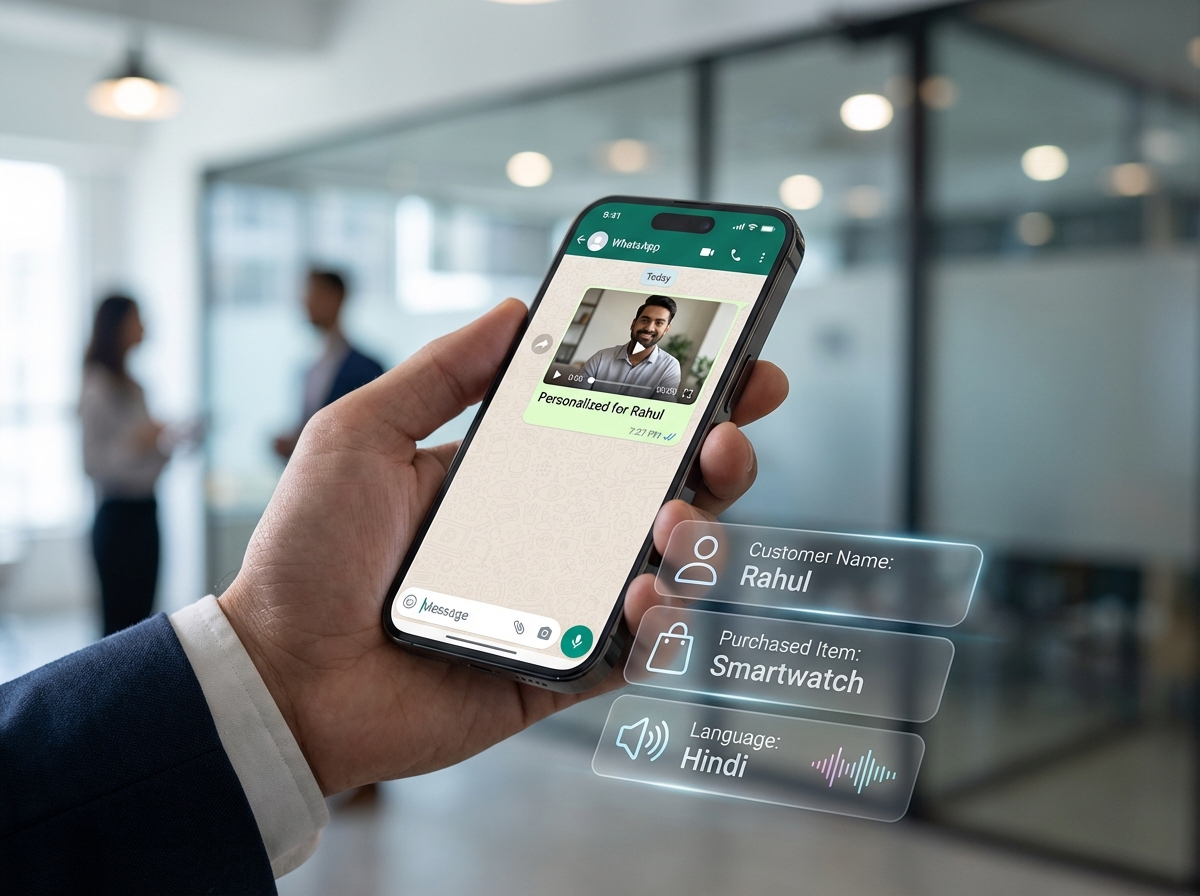
These videos are not generic advertisements; they are data-driven assets that adapt their script and visuals based on the recipient's profile. From unboxing tutorials to personalized replenishment alerts, these videos drive significantly higher click-through rates (CTR) than traditional text or image-based messages.
Furthermore, buyer behavior prediction videos allow brands to intervene before a customer churns. If a customer’s engagement drops, an automated, empathetic win-back video with a time-bound incentive can reignite interest and protect the long-term value of that relationship.
Essential Video Templates for the Post-Purchase Journey:
- The Personalized Unboxing Guide: Greets the customer by name and demonstrates how to get started with their specific SKU.
- The Care & Optimization Tip: Provides expert advice on maintaining the product, which is particularly effective for apparel and electronics.
- The Replenishment Alert: A 1:1 video sent when the product is likely running low, featuring a one-tap reorder button within WhatsApp.
- The Win-Back Sequence: Targeted at high-churn-risk cohorts, offering a personalized "We Miss You" message with a tailored discount.
- The Milestone Celebration: A "Year in Review" style video that highlights the customer's impact and rewards their continued loyalty.
TrueFan AI's 175+ language support and Personalised Celebrity Videos and voice sync accuracy comparison guide allow brands to localize these messages for India's diverse linguistic landscape, ensuring resonance across Tier 1, 2, and 3 cities.
Source: https://www.clickpost.ai/blog/post-purchase-platform
Source: https://parcellab.com/blog/retail-trends-and-predictions-shaping-ecommerce-in-2026/
Source: https://www.nector.io/blog/omnichannel-loyalty-program
5. Loyalty Program Enrollment Automation and Advocacy
Transitioning a repeat buyer into a brand advocate requires a frictionless enrollment process. Loyalty program enrollment automation removes the barriers to entry by using personalized outreach that explains the tangible benefits of joining, such as exclusive access or UPI-enabled cashback.
In the Indian context, loyalty programs are shifting from simple point-based systems to behavioral-led outcomes. Automation allows brands to target high-potential cohorts with "Fast Track" invitations to premium tiers, increasing the perceived value of the program.
Simultaneously, referral program video automation turns satisfied customers into a low-cost acquisition channel. By sending a personalized referral video after a positive NPS (Net Promoter Score) response, brands can encourage social sharing with double-sided incentives that benefit both the advocate and the new lead.
Key Tactics for Loyalty and Advocacy:
- Instant UPI Rewards: Integrating loyalty rewards with UPI for immediate gratification, a major trend for 2026.
- QR-Based Validation: Bridging the gap between online loyalty and offline store visits through automated QR code delivery.
- Personalized Referral Codes: Embedding unique, easy-to-remember referral codes within a personalized video message.
- Tier Upgrade Celebrations: Automated customer journey milestone celebrations that acknowledge when a customer moves to a higher loyalty tier.
- Purchase Anniversary Reminders: Sending a celebratory video on the anniversary of the customer's first purchase to build emotional loyalty.
Source: https://loylt.works/blog/top-channel-loyalty-trends-2026-india.html
Source: https://www.nector.io/blog/omnichannel-loyalty-program
Source: https://m.aisensy.com/blog/build-whatsapp-ecommerce-store/
6. Implementation Blueprint and Measurement for 2026
Executing a high-scale post-purchase strategy requires a seamless integration between your marketing stack and your video personalization engine. The implementation blueprint for 2026 focuses on low-latency rendering and real-time data synchronization to ensure messages are delivered while intent is at its peak.
Solutions like TrueFan AI demonstrate ROI through their ability to render hyper-personalized videos in under 30 seconds, allowing for immediate responses to customer actions. This speed is crucial for repeat purchase incentive videos where the window of opportunity is often narrow.
Measurement must go beyond surface-level metrics like open rates. Brands should focus on cohort-level analysis, tracking the lift in second-order rates, the reduction in time-to-next-purchase, and the overall impact on the LTV/CAC ratio.
The Q4 2025–26 Launch Checklist:
- Data Audit (T-60 Days): Ensure your CDP or CRM is correctly capturing name, language, city, and SKU-level data.
- Creative Scripting (T-45 Days): Develop 6–8 video templates in Hindi and other regional languages to cover the entire 90-day journey.
- Integration & Testing (T-30 Days): Connect your ESP/CRM to the video API and conduct load tests for high-traffic festive days.
- Pilot Phase (T-14 Days): Roll out the automation to a 10–15% holdout group to measure initial conversion lift.
- Full Scale-Up (Peak Weeks): Monitor performance in real-time and use virtual reshoots to update offers without needing new production.
Key KPIs for Success:
- FO→SO Rate: The percentage of first-time buyers who place a second order within 45 days.
- Video Watch-Through Rate: The percentage of recipients who watch the personalized video to completion.
- Referral Conversion Rate: The number of new customers acquired through automated referral videos.
- Cohort Gross Margin: The profitability of specific customer groups after accounting for retention costs.
Source: https://www.eshipz.com/blog/last-mile-delivery-strategies-2026/
Source: https://www.clickpost.ai/blog/post-purchase-platform
Source: https://m.aisensy.com/blog/build-whatsapp-ecommerce-store/
Frequently Asked Questions
What is post-purchase loyalty automation India and why is it critical in 2026?
It is a system of automated, data-driven workflows that manage the customer experience after a sale. In 2026, it is critical because rising acquisition costs make retention the only viable path to profitability for Indian D2C brands.
What is a realistic target for first-order to second-order conversion in India?
While it varies by category, top-performing brands aim for an 18–35% conversion rate within the first 30–45 days. Achieving this requires a mix of timely engagement and personalized incentives delivered via WhatsApp.
How do customer lifetime value optimization videos differ from standard marketing videos?
Standard videos are one-to-many advertisements, whereas CLV optimization videos are 1:1 assets. They dynamically include the customer's name, their specific product, and localized language to drive higher engagement and trust.
Can I implement loyalty program enrollment automation on WhatsApp?
Yes, WhatsApp is the preferred channel for loyalty automation in India. You can automate the entire process from invitation to enrollment and reward distribution using the WhatsApp Business API.
How do TrueFan AI handle the scale of Q4 festive seasons in India?
TrueFan AI is built for enterprise scale, offering real-time API integrations and low-latency rendering. It can process thousands of personalized videos simultaneously, ensuring that every customer receives their message during peak traffic periods like Diwali.
How do buyer behavior prediction videos help in reducing churn?
These videos use predictive models to identify customers who are likely to stop purchasing. By sending an automated, personalized video with a relevant "win-back" offer before they churn, brands can effectively re-engage them.
What are the best practices for referral program video automation?
The best approach is to trigger a referral video immediately after a customer provides a high NPS score. The video should include a personalized code and a clear, double-sided incentive that is easy to share on WhatsApp.
How do I ensure my post-purchase engagement sequences don't feel like spam?
The key is relevance and timing. By using retention cohort segmentation, you ensure that customers only receive messages that are pertinent to their purchase history and current stage in the journey.