
Summer Product Launch Videos 2026: Heat-Wave Personalization Playbook for India (AC, Beverages, Fashion)
Estimated reading time: ~9 minutes
Key Takeaways
- Activate temperature-based triggers aligned to IMD thresholds to time videos when consumer need peaks.
- Use weather-triggered offer videos with dynamic incentives (e.g., 1% off per °C above 35°C) to drive urgency.
- Scale with modular creative systems and city-level localization across languages and inventory states.
- Leverage DOOH + live weather APIs to swap creatives by city, time of day, and heat intensity.
- Measure heat-spike uplift and optimize by temperature band, VTR, and installation/fulfillment capacity.
Summer Product Launch Videos 2026: Seasonal Demand Targeting with Weather-Triggered Personalization
As the Indian subcontinent prepares for an unprecedented climatic shift, the strategy for summer product launch videos 2026 must transcend traditional broadcasting to embrace real-time, localized relevance. The convergence of extreme weather patterns and advanced marketing automation has created a landscape where timing is no longer measured in weeks, but in degrees Celsius. Brands that fail to synchronize their creative output with the rising mercury risk becoming invisible in a market that demands immediate solutions to environmental discomfort.
The 2026 summer season in India is projected to see a significant surge in heat-wave frequency, with the India Meteorological Department (IMD) defining critical thresholds that trigger immediate consumer shifts. For brand managers in the cooling, beverage, and fashion sectors, this means moving beyond static “summer vibes” to dynamic, weather-triggered offer videos. By leveraging temperature-based personalization, enterprises can ensure their messaging hits the peak of consumer need exactly when the heat becomes unbearable.
Platforms like TrueFan AI enable brands to synchronize these triggers with hyper-personalized video content WhatsApp Catalog Video Marketing, transforming a generic advertisement into a localized utility. This playbook outlines the execution framework for winning the 2026 heat-wave season through data-driven video sequencing and seasonal marketing automation.
The 2026 Heat-Wave Reality and the Necessity of Video-Led Launches
The Indian marketing ecosystem in 2026 is defined by a “video or invisible” mandate, where short-form content and automation sit at the core of every successful brand playbook. According to recent digital marketing trends, short-form video dominance has reached a point where 85% of consumer engagement in India occurs within vertical video environments. This shift is particularly pronounced during the April–June period, as heat waves drive consumers indoors and onto their mobile devices for both entertainment and essential shopping.
The IMD’s 2026 heat-wave guidance provides the scientific anchor for these campaigns, establishing thresholds that dictate consumer behavior. A heat wave is officially declared when the maximum temperature reaches at least 40°C in the plains or 37°C in coastal regions, with “severe” heat waves occurring at 47°C or a 6.5°C departure from normal. These aren’t just meteorological stats; they are the primary triggers for seasonal demand targeting that should dictate your video ad spend.
For cooling appliances, beverages, and fashion, the narrative must pivot from aspiration to immediate relief. AC and cooler brands must focus on utility and rapid financing, while beverage brands need to capture “thirst-peak” moments through real-time hydration reminders. Fashion brands, meanwhile, must emphasize breathable fabrics and UV protection as the heat intensifies, using weather-triggered offer videos to move inventory based on local city temperatures.
Sources:
The Mechanics of Seasonal Marketing Automation in India
India’s regional variability presents a unique challenge for summer marketing, as the onset and peak of heat waves vary drastically between cities like Ahmedabad, Chennai, and Delhi. This geographical diversity necessitates seasonal marketing automation in India that can orchestrate city-level triggers and language variants in real time. A “one-size-fits-all” video campaign is no longer viable when one region is experiencing a severe heat wave while another is seeing pre-monsoon showers.
The transformation of Out-of-Home (OOH) to Digital Out-of-Home (DOOH) has unlocked new possibilities for programmatic and dynamic creative. In 2026, DOOH screens in major Indian metros are increasingly integrated with live weather APIs, allowing brands to switch creatives based on the time of day and local temperature. This means a beverage brand can display a refreshing misting visual the moment the local temperature crosses 38°C, creating a powerful psychological link between the environment and the product.
Automation architecture must now handle the complexity of city-specific language localization and offer variations. TrueFan AI’s 175+ language support and Personalised Celebrity Videos ensure that a heatwave alert in Ahmedabad feels as personal as a monsoon greeting in Kochi, maintaining brand consistency across thousands of unique video iterations. This level of scale is essential for managing the rapid-fire nature of summer demand spikes where manual creative production would fail.
Sources:
Temperature-Based Personalization and Weather-Triggered Offer Videos
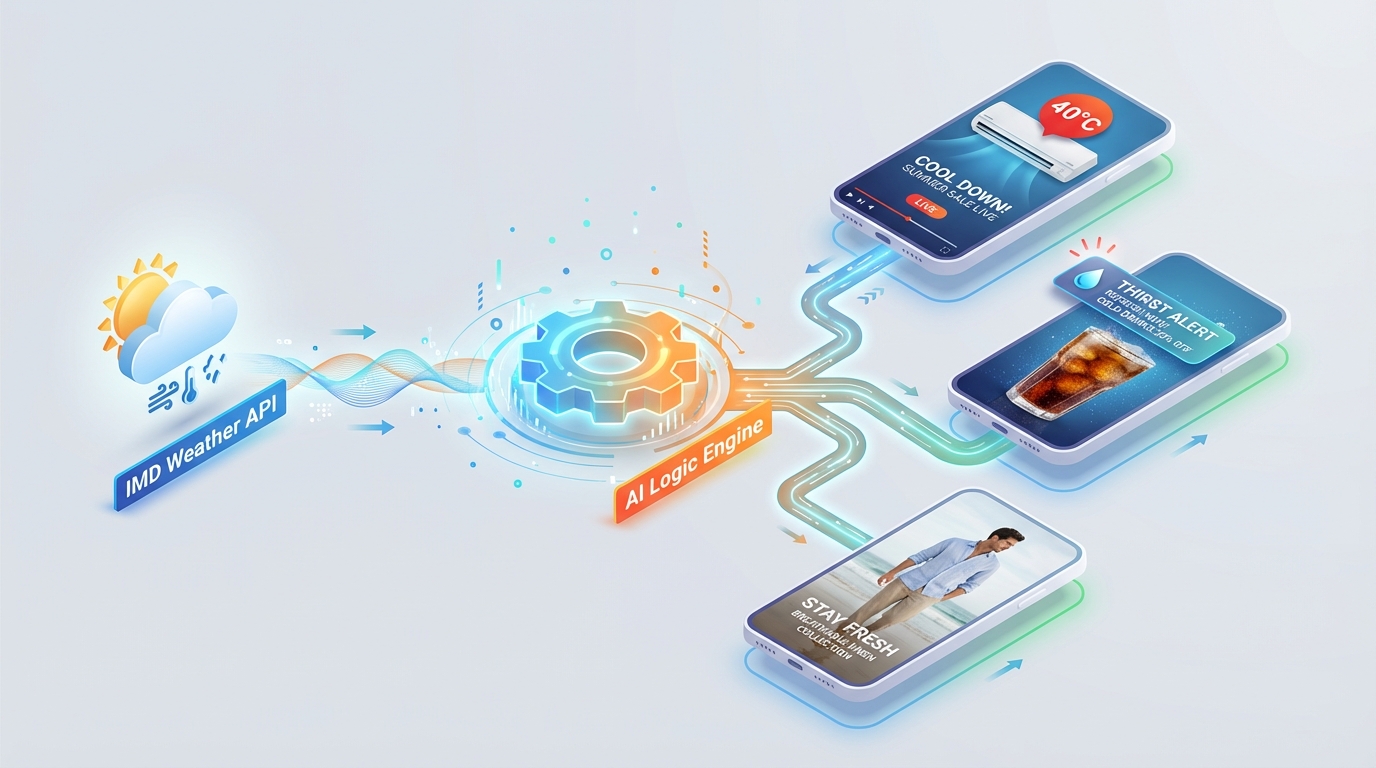
Temperature-based personalization is the process of automating video creative and offer changes based on real-time meteorological data, including temperature, humidity, and “departure from normal” metrics. By integrating IMD feeds or reliable weather APIs, brands can create a “decision tree” that swaps product SKUs, script lines, or price overlays the moment a specific threshold is crossed. This ensures that the consumer sees the most relevant solution to their immediate environmental stress.
Weather-triggered offer videos take this a step further by incorporating dynamic price ladders or incentives tied to the heat. For instance, a brand might offer a “1% discount for every 1°C above 35°C,” creating a gamified urgency that resonates with the consumer’s current experience. This strategy is particularly effective for cooling appliances, where the comfort tipping point typically begins at 35°C, escalating to emergency comfort messaging as temperatures hit the 40°C mark.
The framework for these triggers should also account for the time-of-day matrix. Afternoon heat peaks (1 PM – 5 PM) are the optimal window for cold beverage pushes and “instant delivery” promises. Conversely, early mornings and evenings are better suited for fashion brands promoting commute-friendly apparel or AC brands highlighting installation slots for the following day. This granular targeting ensures that the marketing budget is allocated to the moments of highest potential conversion.
Sources:
Vertical Playbooks: Winning the Summer in Cooling, Beverages, and Fashion
Cooling Appliances (AC/Coolers)
For the cooling sector, the strategy must transition from education in early April to urgent utility by May. Summer product launch videos 2026 for AC brands should use trigger logic: when a city temperature exceeds 35°C, the creative swaps to “Fast-track installation today.” If the temperature hits 38°C, the automation adds a “Free stabilizer or EMI offer” overlay to lower the barrier to purchase during a crisis.
Beverages
Beverage brands must master the “thirst-peak” moment by using weather-triggered offer videos that appear during the hottest hours of the day. In 2026, successful beverage summer campaigns in India are focusing on regional creator-led content that features live temperature counters. If a city receives a severe heat alert, the automation can trigger “Buy-2-Get-1” overlays on quick-commerce platforms, ensuring the brand is the first choice for immediate hydration.
Fashion
The fashion vertical in 2026 is seeing a shift toward fabric-first narratives, with a focus on breathable linens and UV-protective accessories. Brands like Reliance Trends are already setting the pace with summer collection personalization that adapts based on the user’s city. A user in Pune might see a “Breathe easy in linen” video when the temperature hits 35°C, while a user in a cooler region sees a different part of the collection, ensuring maximum relevance and inventory turnover.
Sources:
- Beverage Brands Summer Marketing Trends
- Reliance Trends Summer 2026 Visual Cues
- Garment Show of India 2026 Fabric Innovation
Creative Systems and Automation Architecture for 2026
Building a creative system for summer product launch videos 2026 requires a modular approach where video assets are designed as templates with dynamic layers. These templates should include slots for city names, live temperature badges, and variable offer ladders that update automatically. This allows for the creation of thousands of unique video variants from a single “master” shoot, significantly reducing production costs while increasing local resonance.
The automation architecture must integrate three primary data inputs: weather feeds (IMD), commerce data (inventory and installation capacity), and CRM data (user location and past purchases). When these data points align—for example, a high-value customer in a city hitting 39°C where inventory is available—the system triggers a personalized video via WhatsApp Catalog Video Marketing Guide or Paid Social. This “decision tree” logic ensures that the right message reaches the right person at the exactly right temperature.
Solutions like TrueFan AI demonstrate ROI through this level of hyper-personalization, as seen in their work with major Indian enterprises like Zomato and Hero MotoCorp. By rendering personalized videos in under 30 seconds, brands can respond to weather changes almost instantly, maintaining a “near real-time” presence that static campaigns cannot match. This agility is the key to capturing the fleeting windows of high demand that characterize the Indian summer.
Sources:
Measurement, ROI, and the 2026 Execution Timeline
To accurately measure the success of summer product launch videos 2026 personalized video investment campaigns, brands must look beyond standard CTRs and focus on “heat-spike uplift.” This involves comparing conversion rates during specific temperature bands (e.g., >38°C) against a baseline. Key performance indicators should include incremental revenue per temperature band, the number of installation slots booked during heat waves, and the view-through rate (VTR) of localized vs. generic video assets.
The execution timeline for a successful 2026 summer campaign must begin as early as February.
- Feb–Mar (Setup): Finalize trigger bands based on IMD guidance and connect weather APIs to your creative automation platform.
- Early April (Launch): Release April product launch videos focusing on education and “pre-heat” preparation.
- Late April–May (Ramp-up): Activate weather-triggered offer videos and prioritize budget for metros crossing the 35°C threshold.
- May–June (Peak): Maximize spend during severe heat alerts and use real-time rendering to update offers daily.
This structured approach ensures that the brand is not just reacting to the heat but is strategically positioned to capitalize on it. By the time the monsoon arrives, the focus should shift to retargeting summer buyers for service, maintenance, or seasonal transitions, closing the loop on a highly profitable seasonal cycle.
Sources:
Conclusion
Winning the 2026 summer season in India requires a sophisticated blend of meteorological data, creative agility, and robust automation. By moving toward summer product launch videos 2026 that are triggered by the actual lived experience of the consumer, brands can transform from mere advertisers into essential seasonal partners. Whether it is an AC brand offering a cooling lifeline during a 40°C spike or a beverage brand providing a well-timed hydration reminder, the key to ROI lies in the precision of the trigger and the personalization of the message. As the heat intensifies, the brands that stay “cool” will be those that have automated their relevance.
Recommended Internal Links
- ONDC Personalized Video Onboarding: 2026 Playbook Guide
- WhatsApp Catalog Video Marketing: Tactics for 2026
- WhatsApp Catalog Video Marketing: Automation Strategies
- Conversational Cricket Commerce India: WhatsApp Playbook
- Guide to conversational cricket shopping India on WhatsApp
Frequently Asked Questions
How do summer product launch videos 2026 differ from previous years?
In 2026, the primary difference lies in the integration of real-time weather data and AI-driven personalization. Unlike previous years where “summer” was a static three-month campaign, 2026 strategies rely on city-specific temperature triggers and automated video rendering to match the immediate environmental context of the consumer.
What are the most effective triggers for seasonal marketing automation in India?
The most effective triggers are based on IMD heat-wave definitions. For most brands, 35°C is the “comfort tipping point” where demand begins to spike. Severe heat alerts (40°C+ in plains) should trigger emergency comfort messaging and high-incentive offers to capture urgent demand.
Can small brands implement temperature-based personalization?
Yes. With programmatic DOOH and accessible automation tools, smaller brands can use weather-based triggers. Focus on high-impact cities and modular video templates to achieve enterprise-grade relevance at manageable cost.
How does TrueFan AI handle high-volume rendering for weather-triggered campaigns?
TrueFan AI utilizes an API-driven architecture capable of rendering thousands of personalized videos in near real-time. This enables rapid responses to sudden temperature spikes across different geographies while the weather context remains relevant.
What is the ideal video length for summer product launch videos 2026?
Given short-form dominance, aim for 15–30 seconds. Use the first 5 seconds to mention the user’s city and current temperature to establish immediate relevance and stop the scroll.



