Summer product launch videos 2026: India playbook for heat‑wave personalization and seasonal marketing automation
Estimated reading time: ~13 minutes
Key Takeaways
- Start April product launch videos early to capture demand before peak heat and reduce CAC.
- Use temperature-based personalization with IMD triggers to adapt offers and CTAs to local weather.
- Adopt a WhatsApp-first distribution and inventory-aware automation to drive instant conversions.
- Build vertical-specific hooks for ACs, beverages, fashion, and travel to address real consumer pain points.
- Measure incremental lift with A/B tests; the cost of not personalizing now exceeds the tech investment.
The arrival of April in India no longer signals a mere change in calendar pages; it marks the onset of a high-stakes commercial battlefield where summer product launch videos 2026 must compete with soaring temperatures and shifting consumer temperaments. As the India Meteorological Department (IMD) forecasts an increasing frequency of "above-normal" heatwave days across the subcontinent, the traditional "one-size-fits-all" television commercial is being replaced by hyper-personalized, weather-triggered digital experiences. For Product Marketing Teams and Brand Managers, the challenge in 2026 is not just reaching the audience, but reaching them with a message that mirrors the exact degree of heat they feel outside their window.
Success in this environment requires a departure from static scheduling toward a model of seasonal marketing automation India. By integrating real-time meteorological data with automated video production, brands can now deliver content that feels less like an advertisement and more like a timely solution. Whether it is an AC brand offering a "Heatwave Discount" when the mercury crosses 40°C in Ahmedabad or a beverage brand triggering a refreshing "Quick-Commerce" link during a humid afternoon in Chennai, the future of seasonal marketing lies in the intersection of data and dynamic creative.
Platforms like TrueFan AI enable this level of granular execution by allowing brands to generate thousands of personalized video variants that respond to local environmental triggers. This playbook provides a comprehensive blueprint for navigating the April–June surge, ensuring your brand remains the coolest choice in a record-breaking summer.
Sources:
- IMD: Seasonal Outlook for the hot weather season (PDF)
- IAMAI–Kantar: Internet in India 2024 Report (PDF)
The Strategic Shift: Why April product launch videos are the 2026 inflection point
In the Indian market, April is the psychological and physical threshold for summer demand. Waiting until May to launch full-scale campaigns is a tactical error that results in higher Customer Acquisition Costs (CAC) and lost "share of mind" during the critical research phase. Data from 2025 indicated that nearly 65% of cooling appliance research begins when the first 35°C spike occurs, often weeks before the actual purchase. Therefore, April product launch videos must serve as the foundation for a multi-month engagement strategy that builds a "warm" audience before the peak heat hits.
The digital landscape in 2026 has evolved to support this early-mover advantage. With India's internet user base projected to exceed 950 million, the growth is predominantly driven by rural and semi-urban markets where WhatsApp is the primary gateway to the internet. This shift necessitates a "WhatsApp-first distribution strategy" for summer campaigns. Brands that utilize the early weeks of April to run pre-summer sale campaigns—collecting first-party data through waitlists and "priority access" sign-ups—can bypass the bidding wars on traditional ad platforms that occur during the peak heatwaves of May and June.
Furthermore, seasonal demand targeting in 2026 is no longer about broad geographic regions. It is about city-specific inventory marketing. If a warehouse in Lucknow has a surplus of 1.5-ton 5-star ACs, the marketing automation engine should automatically escalate video ad spend in that specific pincode when the local temperature hits a predefined threshold. This level of synchronization between supply chain and creative output is what separates market leaders from the rest of the pack.
Sources:
- IAMAI Whitepaper: Cultural and seasonal buying trends (PDF)
- IMD Press Release: Heat Wave context (May 2024) (PDF)
Temperature-based personalization: The logic of weather-triggered offer videos
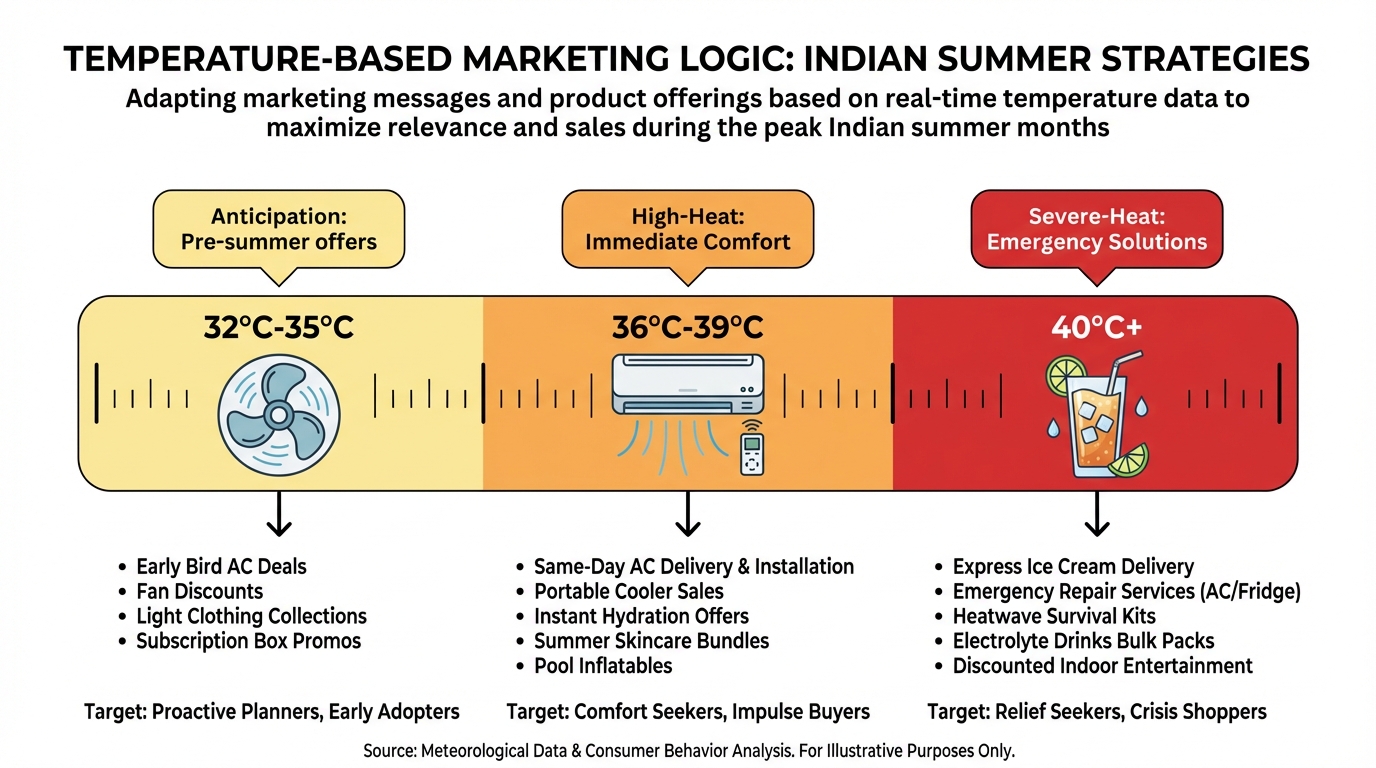
The core of a sophisticated 2026 summer strategy is temperature-based personalization. This involves creating a logic matrix where video content, offers, and calls-to-action (CTAs) change dynamically based on the viewer's local weather. In a country as climatically diverse as India, a single creative cannot resonate simultaneously with a consumer in the dry heat of Rajasthan and another in the humid coastal heat of Kerala.
The trigger logic typically follows three primary bands:
- The Anticipation Band (32°C – 35°C): At this stage, the messaging focuses on "Preparation" and "Prevention." Videos highlight pre-installation services, energy efficiency, and "Early Bird" discounts. The goal is to capture the proactive shopper.
- The High-Heat Band (36°C – 39°C): Here, the messaging shifts to "Immediate Comfort." Weather-triggered offer videos should feature dynamic overlays such as "It’s 38°C in Jaipur—Get your AC delivered in 24 hours." Urgency becomes the primary driver.
- The Severe-Heat Band (40°C+): This is the "Emergency" phase. Messaging focuses on stock availability and priority service. For beverages and fashion, this is the peak time for "Instant Refreshment" and "Breathe-Easy Fabrics."
Implementing this requires a robust API integration between the brand's marketing automation platform and the IMD’s daily bulletins. By automating the rendering of video variants, brands can ensure that a user receives a WhatsApp message with a video that mentions their specific city's temperature within minutes of a heat alert being issued. This level of relevance drives significantly higher engagement rates than generic seasonal greetings.
Sources:
Vertical Playbooks: Executing AC cooler personalized campaigns and more
AC Cooler Personalized Campaigns and Cooling Appliances
For the cooling appliance sector, the primary friction point is often installation and price. AC cooler personalized campaigns should utilize dynamic video to address these head-on. A video could feature an AI-generated spokesperson who says, "Namaste, Rahul! It's reaching 42°C in Nagpur today. We have 5 units of our 5-star inverter AC left in your local store. Buy now on WhatsApp and get guaranteed installation by tomorrow evening." This combines scarcity, local relevance, and a clear service promise.
Beverage Brand Summer Campaigns
In the beverage sector, the window of opportunity is often measured in hours, not days. Beverage brand summer campaigns should focus on "dayparting" and "instant gratification." Using weather-triggered offer videos, a brand can send a 20-minute "Flash Sale" coupon via WhatsApp at 2:00 PM when the "feels-like" temperature is at its peak. The video should ideally include a QR code that links directly to a quick-commerce app personalization flow (like Blinkit or Zepto) with the product already added to the cart.
Summer Fashion Video Marketing
For fashion, the focus shifts to "Material Science" and "Styling." Summer fashion video marketing in 2026 leverages AI to show how fabrics like linen or "cool-tech" cotton perform in high humidity versus dry heat. Personalization can be driven by the user's past purchase history—showing a "Summer Workwear" edit to a corporate professional and a "Beach Vacation" edit to someone who recently searched for travel gear.
Summer Travel Gear Marketing
The travel sector thrives on the "Escape" narrative. Summer travel gear marketing should use temperature triggers in metros to sell the idea of the mountains. When Delhi hits 44°C, a video showing the cool, misty peaks of Himachal Pradesh—featuring the brand's latest rucksacks and weather-resistant gear—creates a powerful emotional pull. The CTA should focus on "Fast Delivery" to ensure the gear arrives before the weekend getaway.
Sources:
- Social Samosa: Beverage brands’ summer campaigns overview
- TrueFan AI: Case studies and enterprise solutions
Seasonal marketing automation India: The 2026 Tech Stack
The transition from manual campaign management to seasonal marketing automation India requires a sophisticated tech stack that can handle high-volume, low-latency data processing. In 2026, the "Golden Triangle" of summer marketing consists of the CRM (Customer Relationship Management), the Weather API (IMD), and the Automated Video Rendering Engine.
The workflow begins with the CRM segmenting the audience by city and language. In India, localization is non-negotiable. TrueFan AI’s 175+ language support and personalised celebrity videos allow brands to communicate with a farmer in Punjab in Punjabi and a tech professional in Bengaluru in Kannada, all while maintaining the same brand voice and celebrity likeness. This level of linguistic precision, combined with lip-sync technology, ensures that the personalized video feels authentic rather than "templated."
Once the segments are defined, the automation engine monitors the IMD heat bulletins. When a "Heatwave Alert" is triggered for a specific region, the system automatically pulls the relevant video template, injects the dynamic data (Name, City, Temperature, Offer), and renders the final video. This video is then pushed through the WhatsApp Business API guide, which remains the most effective channel for high-intent conversion in India.
To ensure seasonal inventory marketing is efficient, the tech stack must also be "inventory-aware." There is no greater waste of ad spend than promoting a product that is out of stock in the viewer's pincode. By linking the video generation engine to the brand's ERP (Enterprise Resource Planning) system, the automation can "failover" to an alternative SKU if the primary product is unavailable, ensuring the customer journey never hits a dead end.
Sources:
Measuring Success: KPIs and ROI in seasonal demand targeting
The ultimate validation of a high-tech summer strategy lies in the data. Seasonal demand targeting must be measured through a lens of "Incremental Lift" rather than just total sales. Because summer demand is naturally high, brands must use A/B testing (Treatment vs. Control groups) to determine how much additional revenue was generated specifically by the personalized video interventions.
Key Performance Indicators (KPIs) for 2026 include:
- Video Play Rate & Completion: Are users watching the personalized content on WhatsApp?
- Weather-to-Conversion Latency: How quickly does a user purchase after receiving a heat-triggered offer?
- Store Footfall Uplift: For beverages and fashion, are digital videos driving offline visits?
- Operational Efficiency: How much did the brand save by using "Virtual Reshoots" instead of traditional production for 50 different city variants?
Solutions like TrueFan AI demonstrate ROI through significant improvements in engagement metrics. For instance, brands have seen up to a 17% higher WhatsApp read rate when using personalized celebrity videos compared to standard text-and-image messages. Furthermore, the ability to generate 350,000+ personalized videos in a single day allows for a level of scale that was previously impossible.
The ROI math is simple: by reducing the "Cost of Delay" (the sales lost by not reacting to a heatwave fast enough) and increasing the "Conversion Rate" (through hyper-relevance), brands can justify the investment in automation. In the competitive landscape of 2026, the cost of not personalizing is far higher than the cost of the technology itself.
Sources:
Conclusion: Mastering the 2026 Heatwave
The 2026 summer season in India will be defined by those who can turn meteorological volatility into a marketing advantage. By moving beyond static campaigns and embracing a framework of summer product launch videos 2026 powered by real-time data, brands can create a level of intimacy with the consumer that was once impossible. The combination of IMD-linked triggers, WhatsApp-first distribution, and AI-driven video personalization allows for a "Segment of One" approach at a national scale.
As the heat rises, the brands that provide the most relevant, timely, and localized solutions will not only win the summer but will build a foundation of loyalty that lasts long after the monsoon arrives. The tools are ready, the data is available, and the consumers are waiting—it is time to launch.
Ready to revolutionize your summer strategy?
Plan and launch your summer product launch videos 2026 with TrueFan’s enterprise-grade personalized video stack. Leverage multilingual AI avatars, virtual reshoots, and IMD-linked triggers to dominate the market.
Visit TrueFan AI to book a demo and start your 2026 planning today.
Recommended Internal Links
- WhatsApp-first playbooks for catalog and video — Align your campaign with a WhatsApp-led distribution strategy.
- WhatsApp Business API automation guide — Deeper automation tactics for chat-to-purchase funnels.
- Predictive inventory marketing 2026 — ERP-linked triggers for inventory-aware creatives.
- Quick-commerce video personalization — Heat-triggered, same-hour offers.
- AI celebrity video marketing in India — 175+ language personalization and celebrity-led variants.
Frequently Asked Questions
How early should we start our summer product launch videos 2026?
Begin in the first week of March with "Discovery" and "Teaser" phases to build warm audiences and collect opt-ins. By the first 35°C spike in April, your automation should pivot from awareness to conversion with weather-triggered offers.
Is WhatsApp the only channel for weather-triggered offer videos?
No. While WhatsApp typically delivers the highest conversion in India, combine it with Email for long-form education and Programmatic DCO for retargeting. See the WhatsApp catalog video marketing playbook for direct-offer strategies.
How does TrueFan AI handle the complexity of 175+ languages?
TrueFan AI uses advanced generative models to retain the original voice and tone while lip-syncing to the target language, ensuring videos in Marathi, Punjabi, Kannada, and others feel native and authentic.
What happens if the IMD data is delayed or inaccurate?
Build "Fallback Logic" into your automation. If real-time city data is unavailable, default to historical monthly averages or a generic "Summer Refresh" creative so campaigns never pause due to a data glitch.
Can we use these strategies for low-ticket items like ice cream or cold drinks?
Absolutely. Low-ticket categories benefit from impulse triggers. A heat-timed video can drive instant purchases via quick-commerce apps. Review quick commerce execution examples for flows that convert within minutes.