AI video creative fatigue solutions India 2026: Automatic video ad refresh for Meta & Google to recover ROAS
Estimated reading time: ~11 minutes
Key Takeaways
- Combat creative fatigue by shifting from big productions to high-velocity AI iteration across hooks, CTAs, and overlays.
- Use automatic video ad refresh on Meta and Google to extend ad lifespan and recover ROAS in days, not weeks.
- Leverage regional localization and silent-first design; India’s diverse, mobile-first audience fatigues faster without frequent variation.
- Implement a closed-loop system for real-time fatigue detection, bulk variant generation, and automated testing.
- Ensure DPDP-compliant governance with disclosures, consent, and watermarking while scaling AI video.
In the hyper-competitive digital landscape of 2026, Indian performance marketers are facing a silent killer of profitability: creative fatigue. As Meta’s Advantage+ and Google’s Performance Max algorithms scale winners faster than ever, the window of effectiveness for a single video asset has shrunk from months to mere days. Implementing AI video creative fatigue solutions India 2026 is no longer a luxury; it is the only way to recover ROAS and maintain a competitive edge. Platforms like Studio by TrueFan AI enable brands to break the cycle of production bottlenecks by automating the creation of high-performing video variations at scale.
1. The 2026 Creative Fatigue Crisis: Why Indian Brands are Seeing ROAS Decay
Creative fatigue in 2026 is defined as the measurable decline in performance—falling Click-Through Rates (CTR), rising Cost Per Acquisition (CPA), and negative audience feedback—when a target segment is overexposed to the same video creative. In India, this problem is amplified by a massive, mobile-first population that consumes content at a velocity 40% higher than the global average.
The Drivers of Fatigue in the Indian Market
By mid-2026, several factors have converged to make creative fatigue the primary obstacle for performance marketers:
- Algorithmic Acceleration: Modern AI-driven bidding systems are designed to find "winners" and pump budget into them instantly. While this drives short-term gains, it leads to "creative burnout" within 72 hours for high-spend campaigns.
- Silent-First Consumption: Over 85% of video views on Indian Reels and Shorts occur with the sound off. If the visual hook doesn't refresh, the "thumb-stop" rate collapses.
- Language Saturation: A generic English or Hindi ad might work initially, but fatigue sets in quickly among regional audiences in Tamil Nadu, Telangana, and West Bengal who crave localized nuances.
- The "Attention Compression" Effect: In 2026, the critical window to capture attention has dropped to just 1.2 seconds. Once an audience recognizes a "stale" hook, they scroll past, signaling to the algorithm that your ad is low-quality.
2026 Data Point: Recent industry benchmarks show that Indian D2C brands ignoring creative rotation see a 35% increase in CPA within just 10 days of a campaign launch. Conversely, brands utilizing performance marketing creative automation India strategies have reported a 22% lift in sustained ROAS over a 90-day period.
Source: AI Digital CTR Benchmarks 2026; WARC Marketing Effectiveness 2026
2. The Blueprint for Performance Marketing Creative Automation in India
To combat creative fatigue Meta Facebook ads effectively, advertisers must shift from a "big production" mindset to a "high-velocity iteration" mindset. This requires a systematic blueprint that leverages AI to generate, test, and refresh assets automatically.
Automatic Creative Refresh Without Production
The traditional model of booking a studio, hiring influencers, and waiting weeks for an edit is dead. Automatic creative refresh without production involves taking a single "base" asset and using AI to swap out the most critical elements: the hook, the CTA, and the background. By iterating on the first 3 seconds of a video, you can extend the lifespan of the remaining 27 seconds by up to 400%.
Video Ad Variation Generator AI (Bulk Formats & Sizes)
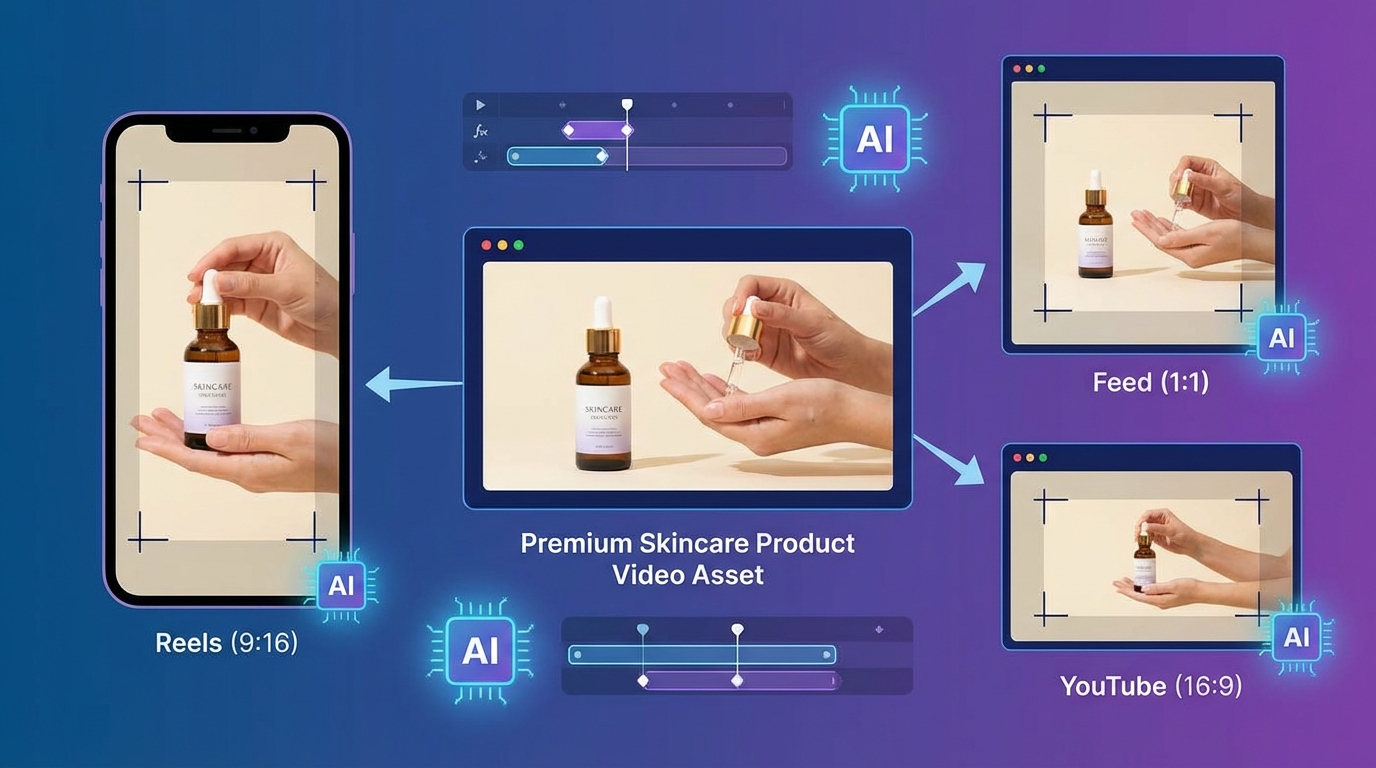
A robust strategy requires a video ad variation generator AI that can output 50+ variants from a single script. This includes:
- Aspect Ratio Optimization: Automatically converting 9:16 (Reels) to 1:1 (Feed) and 16:9 (YouTube) while maintaining focal point integrity.
- Duration Variations: Creating 6s, 15s, and 30s cuts to fit different placement requirements on Google and Meta.
- Visual Overlays: Swapping "Limited Time Offer" banners with "Free Shipping" or "Festive Sale" cues to keep the visual stimulus fresh.
AI Remix Video Assets India (Regional & Cultural Nuance)
India’s diversity is a weapon against fatigue. AI remix video assets India workflows allow brands to take a successful Hindi ad and instantly "remix" it for a Telugu or Marathi audience. This isn't just translation; it's cultural adaptation. Studio by TrueFan AI's 175+ language support and AI avatars allow for perfect lip-syncing in regional dialects, ensuring the ad feels native to every state.
AI Hook Variation Generator (The First 3 Seconds)
The hook is the most fatigued part of any ad. Using an AI hook variation generator, marketers can create 10 different openings for one product demo: see performance marketing video testing.
- The Problem Hook: "Tired of frizzy hair in Mumbai's humidity?"
- The Social Proof Hook: "Why 50,000 Indian women switched to this serum."
- The Direct Offer Hook: "Flat 50% off for the next 24 hours."
- The Curiosity Hook: "The secret ingredient your skincare is missing."
Source: Silverpush: Combatting Ad Fatigue with Innovation; Virvid AI Video Ads Guide 2026
3. End-to-End Workflow: From Fatigue Detection to ROAS Recovery
Recovering your ROAS requires a closed-loop system. You cannot wait for the weekly report to see that your CPA has doubled; you need ROAS recovery AI video tools that trigger action based on real-time data.

Step 1: Detect Fatigue Early
In 2026, "Fatigue Scores" are the primary metric for media buyers. You must monitor:
- Thumb-Stop Rate (TSR) Decay: If your 3-second view rate drops by more than 15% over a 3-day rolling average, fatigue has set in.
- Frequency Thresholds: In the Indian market, a frequency of 3.5+ within a 7-day window often triggers a sharp decline in CTR.
- Negative Feedback Trend: An uptick in "Hide Ad" or "Report" actions on Meta is a lagging indicator that you are over-serving stale content.
Step 2: Generate Bulk Variations
Once fatigue is detected, the system should automatically trigger a video ad variation generator AI. For a single campaign, you should aim for a "Creative Matrix" of:
- 5 unique hooks.
- 3 body variations (Product focus vs. Lifestyle focus).
- 3 CTA end-cards.
- 7 regional languages.
Total: 315 possible variants.
Step 3: Extend Video Ad Lifespan AI Tools
To extend video ad lifespan AI tools must be used to "refresh" the visual DNA of the asset. This includes:
- Narrative Re-ordering: Swapping the middle and end sections to create a new flow.
- Avatar Swapping: Changing the presenter from a Gen-Z influencer to a professional corporate avatar to appeal to a different demographic segment.
- Dynamic Overlays: Using real-time weather or location data to change the ad's background (e.g., showing a "Rainy Day" offer in Bengaluru while showing a "Sunny Day" offer in Delhi).
Step 4: Video Creative Testing Automation AI
Finally, use video creative testing automation AI to run multivariate tests. Instead of manual A/B testing, the AI distributes budget across 20 variants, identifies the top 3 within 48 hours, and kills the underperformers. This "survival of the fittest" approach ensures that only the freshest, most engaging content reaches the bulk of your audience.
Source: TrueFan AI Creative Optimization Framework; TrueFan AI Video Remarketing India 2026
4. Enterprise Capabilities & DPDP Compliance in 2026
As Indian brands scale their AI video production, they must navigate the complexities of the Digital Personal Data Protection (DPDP) Act of 2026. Meta Google video ad refresh AI India strategies must be built on a foundation of governance and ethics.
The DPDP Mandate for AI Marketing
By 2026, the Indian government has strictly regulated synthetic media. Marketers must ensure:
- Clear Disclosures: Any AI-generated avatar or voice must be clearly labeled as "AI-Generated" to maintain consumer trust.
- Consent-First Models: Using an influencer's likeness for AI variations requires explicit, time-bound consent stored in a verifiable ledger.
- Age-Appropriate Content: AI systems must automatically filter and adapt content based on the recipient's age group to comply with DPDP's "protection of minors" clauses.
Why Enterprise Governance Matters
Solutions like Studio by TrueFan AI demonstrate ROI through not just creative volume, but also through rigorous compliance. Enterprise-grade platforms provide:
- ISO 27001 & SOC 2 Certification: Ensuring that brand assets and customer data are handled with bank-level security.
- Watermarking for Traceability: Every AI-generated video is digitally watermarked, allowing brands to track the provenance of their assets and prevent unauthorized deepfakes.
- Real-time Moderation: Profanity filters and brand-safety checks ensure that the AI ad creative generator variations bulk process never produces content that violates platform policies or brand guidelines.
2026 Statistic: 68% of Indian enterprise CMOs cite "Compliance and Data Privacy" as their top concern when adopting generative AI for performance marketing.
Source: EY India: DPDP Compliance Shift; First Launch: DPDP Act for Marketers 2026
5. Implementation Guide: Step-by-Step ROAS Recovery for Media Buyers
If your ROAS is tanking, follow this 6-step implementation guide to refresh ad creatives AI automatically and stabilize your performance.
Step 1: Asset Audit & Fatigue Scoring
Inventory your current library. Tag every video with its current CTR and CPA. Any asset with a CTR 20% below its launch-week average is a candidate for an AI refresh.
Step 2: Build Brand-Safe Base Templates
In your AI video editor, establish your "Brand Kit." This includes your specific hex codes, fonts, and logo placements. This ensures that even when you generate 500 variants, they all look like they belong to your brand.
Step 3: Create a "Hook Bank"
Develop 10 different script openings. Use a mix of:
- UGC-Style: "I can't believe I just found this..." (AI UGC video creator India)
- Expert-Led: "The science behind our new formula..."
- Direct-Response: "Stop scrolling if you want to save ₹500."
Step 4: Bulk Generation & Localization
Use your AI remix video assets India tool to push these hooks into your base templates. Simultaneously, generate versions in Hindi, Tamil, and Hinglish. Ensure the lip-sync is perfect to avoid the "uncanny valley" effect that triggers negative feedback.
Step 5: Automated Deployment
Push your variants to Meta and Google via API. Set up "Automated Rules" in your ad manager:
- Rule: If Frequency > 3.0 AND CTR < 1.0%, then Pause Creative and Enable Next Variant from the Hook Bank.
Step 6: The 7-Day Review Loop
In 2026, the "Set it and Forget it" model is extinct. Every 7 days, review which hooks are winning. Feed the winning scripts back into the AI to generate "Gen-2" variations that double down on the successful patterns.
Source: Atomcomm: AI Video Replacing Traditional Shoots; BossWallah: AI Video Production India 2026
6. FAQs & Testing Rules for 2026
Q1: How often should I refresh my video ads in 2026?
A: For high-budget campaigns (₹5L+ per day), you should swap hooks every 7 days. Mid-roll elements and overlays should be refreshed every 14 days, and the entire creative concept should be cycled every 30 days. Solutions like Studio by TrueFan AI make this cadence possible without increasing your production budget.
Q2: How does the DPDP Act 2026 affect AI video avatars?
A: The DPDP Act requires that any synthetic persona used in advertising must have a "Digital Twin Consent" record. If you are using a virtual avatar, it must be licensed. Furthermore, ads must include a "Synthetic Media" disclosure if the avatar is indistinguishable from a real human.
Q3: What is the "Thumb Stop Rate" benchmark for Tier 2 and Tier 3 India?
A: In 2026, Tier 2 and Tier 3 audiences show higher engagement with vernacular content. A "good" TSR for these regions is 35%+. If your TSR falls below 25%, it is a primary indicator of creative fatigue and requires an immediate hook refresh.
Q4: Can AI remixing handle the nuances of "Hinglish"?
A: Yes. Advanced AI models in 2026 are trained specifically on Indian linguistic patterns. They can seamlessly blend English and Hindi (Hinglish) or other regional combinations, which often perform 18% better in urban centers like Delhi and Mumbai than pure-language ads.
Q5: What is the ROI of "Silent-First" video optimization?
A: Since the majority of Indian users consume video in public spaces or during commutes, silent-first ads (with high-contrast, AI-generated captions) see a 40% higher completion rate. AI tools can now automatically generate these captions in multiple regional languages simultaneously.
Q6: How do I prevent Meta's Advantage+ from over-fatiguing a single winner?
A: Use "Creative Testing Campaigns" (CTC) to vet new assets before moving them into your main Advantage+ shopping campaign. By feeding the algorithm a constant stream of "pre-vetted" AI variations, you prevent it from relying on a single, dying asset. See performance marketing video testing.
Conclusion: The Path to ROAS Recovery
The era of the "static" video ad is over. In 2026, the winners in the Indian market are those who treat their creative as a living, breathing data point. By implementing AI video creative fatigue solutions India 2026, you transform your marketing from a series of expensive "bets" into a high-velocity, automated engine of growth.
Whether you are a D2C brand looking to lower CPA or an enterprise agency managing multi-crore budgets, the goal is the same: automatic creative refresh without production. Explore the AI creative optimization framework. Stop letting creative fatigue drain your margins. Activate your AI-powered creative matrix today and watch your ROAS recover in real-time. See video ad variation generator best practices.
Ready to automate your creative refresh?
Book an Enterprise Demo with TrueFan AI and get a free "Creative Fatigue Diagnostic" for your 2026 campaigns.
Frequently Asked Questions
What is creative fatigue and why does it hurt ROAS?
Creative fatigue occurs when audiences are repeatedly exposed to the same video, driving down CTR, raising CPA, and signaling poor ad quality to algorithms. As delivery optimizations scale winners quickly, assets fatigue in days, shrinking ROAS unless creatives are refreshed at high velocity.
How quickly do Meta and Google video ads fatigue in India?
For high-spend campaigns, top creatives can fatigue within 72 hours. Expect meaningful performance decay inside 7–10 days without hook, overlay, or language refreshes—especially in India’s mobile-first, silent-first environments.
Which metrics should I monitor to detect fatigue early?
Track 3s view rate/TSR decay, frequency (watch for 3.5+ in 7 days), rising CPA, falling CTR, and negative feedback (hide/report rates). Use automated rules to pause fatigued creatives and rotate in fresh variants.
How does Studio by TrueFan AI automate creative refresh?
Studio by TrueFan AI auto-generates bulk video variants by swapping hooks, CTAs, overlays, and languages, then runs multivariate tests to identify winners. It also supports regional lip-sync, watermarking, and governance for DPDP compliance.
Do I need to disclose AI-generated avatars under DPDP?
Yes. DPDP-era guidance requires clear synthetic media disclosures, explicit consent for likeness use, and auditable records. Enterprise-grade workflows include watermarking and moderation to maintain compliance and brand safety.