AI avatar for online coaching India 2026: Practical blueprint to scale Hindi and regional teaching videos without daily recording
Estimated reading time: ~10 minutes
Key Takeaways
- AI avatars let Indian educators scale Hindi and regional language lessons without daily recording.
- A structured script-to-video workflow delivers fast, consistent, and compliant content output.
- WhatsApp-first distribution and microlearning increase completion and engagement rates.
- TCO and ROI favor AI video over traditional studios by 10x on cost and hours saved.
- DPDP compliance and consent-first governance are essential for safe scaling.
The adoption of an AI avatar for online coaching India 2026 has transformed from a futuristic experiment into a core operational necessity for educators aiming to capture the country’s burgeoning ₹58,000 crore coaching market. As we navigate 2026, the Indian EdTech landscape is no longer defined by expensive studio setups or the physical burnout of star faculty. Instead, a camera-free, script-to-video workflow—where an AI digital teacher India presents complex lessons, solves doubts, and delivers revision modules in Hindi and regional languages—has become the gold standard for scalability.
This shift is driven by three critical factors: the maturation of multilingual AI models capable of 175+ languages, a stringent regulatory environment demanding standardized content, and a massive surge in student demand for hyper-personalized microlearning. For coaching institutes in Kota, Delhi, and beyond, the ability to generate high-quality video content without the "daily recording grind" is the only way to remain competitive in a market where student enrollment is increasingly tied to the availability of content in local dialects like Marathi, Tamil, and Bengali.
1. The 2026 Shift: Why AI Avatars are the New Standard for Indian Educators
In 2026, the definition of an "AI avatar" has evolved. It is no longer a robotic, CGI-looking character but a licensed, lip-synced virtual presenter—often a "digital twin" of a real educator—trained to speak with natural prosody and accurate mouth shapes. These avatars render HD and 4K videos from simple text scripts in minutes, allowing institutes to produce a year’s worth of content in a single week.
The Multilingual Mandate
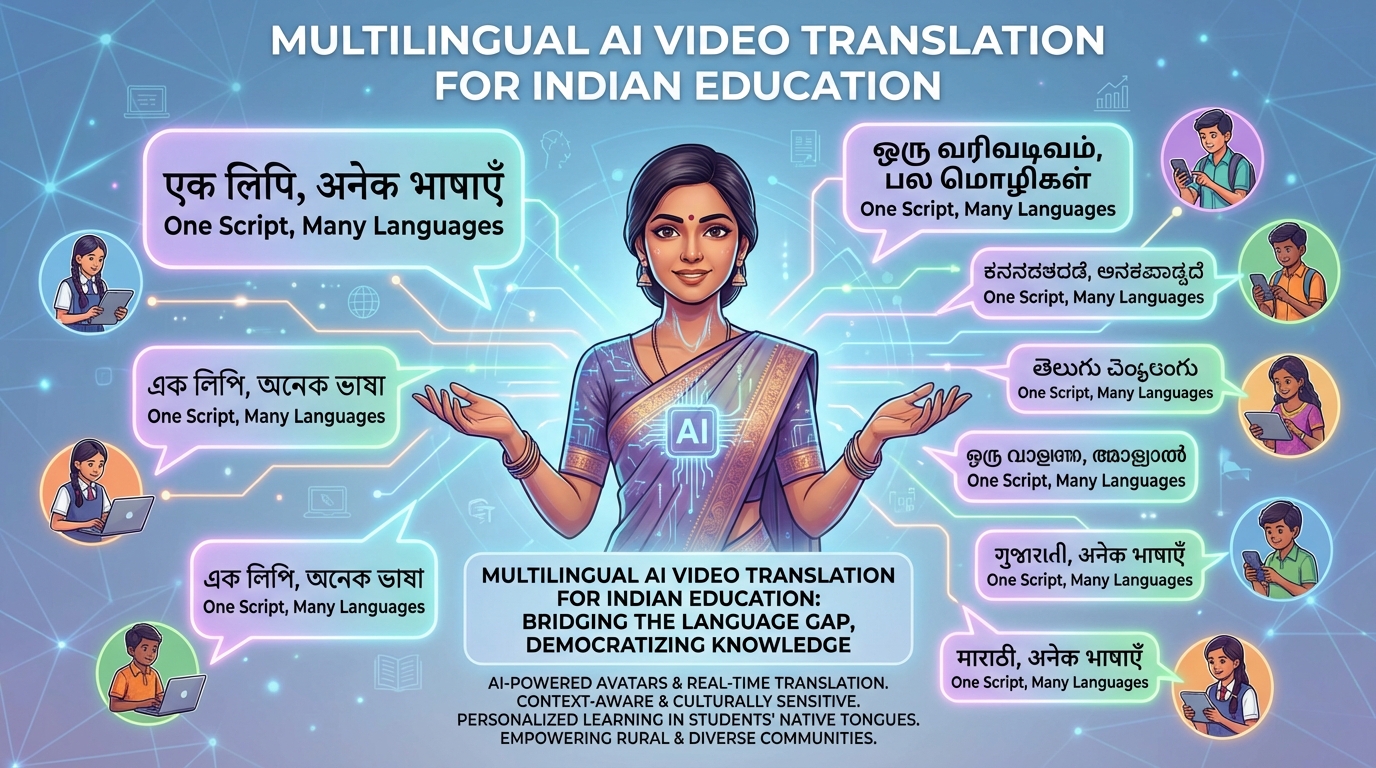
India’s linguistic diversity is its biggest EdTech challenge. By 2026, statistics show that over 70% of new internet users in India prefer consuming educational content in their mother tongue rather than English. Platforms like Studio by TrueFan AI enable educators to convert a single Hindi script into 175+ regional languages with one click, ensuring that a physics lesson recorded in Delhi can be instantly understood by a student in rural Tamil Nadu.
Speed, Scale, and Policy Readiness
The 2026 inflection point is also marked by infrastructure. With distributed GPU backends, the fastest AI video generators can now render a 10-minute lesson in under 60 seconds (fastest AI video generator benchmark). Furthermore, the Indian government’s "AI Avatar Creator Challenge" and updated IBEF reports highlight a policy environment that encourages ethical AI use in creative sectors. This is coupled with the Digital Personal Data Protection (DPDP) Act, which now provides clear frameworks for using digital likenesses, making it safer than ever for institutes to deploy virtual teachers.
Sources:
- ThePrint: India's Tuition Republic Market Size
- IBEF: India’s Big Moment in AI Avatars 2026
- IndiaAI: National AI Avatar Initiatives
2. High-Impact Use-Cases for Indian Coaching Institutes
Educators are no longer just using avatars for "intro videos." In 2026, the EdTech AI avatar video creator India ecosystem supports deep pedagogical integration across the entire student lifecycle.
Course Creation at Scale
The traditional method of filming a teacher in front of a green screen is dead. The modern workflow involves a "Problem → Concept → Example → Quiz" script structure.
- Visuals: Avatars are paired with dynamic whiteboard overlays, 3D diagrams, and real-time formula derivations.
- Output: Institutes are batch-generating 5–8 minute concept explainers for entire chapters of JEE, NEET, or UPSC syllabi in days, not months.
- Multilingual Duplication: A base Hindi lesson is duplicated into Tamil, Telugu, and Marathi, with automated subtitle audits to ensure technical terms (like "Thermodynamics") are translated accurately within the local context.
Doubt-Solving and Interactive Learning
Async doubt-solving is the biggest bottleneck in online coaching. In 2026, tutors use an online tutor AI avatar tool to respond to student queries via WhatsApp.
- The Workflow: A student sends a text doubt → The AI matches it to a pre-recorded avatar explanation or generates a new 60-second response video using a "Doubt → 3-step resolution → Tip" template.
- Two-Way Interaction: Advanced implementations now feature real-time, two-way conversational avatars (two-way conversation AI video guide) that can "talk" to students in a simulated viva or doubt-clearing session, fully compliant with DPDP student privacy norms.
"Unacademy-Style" Content Blueprint
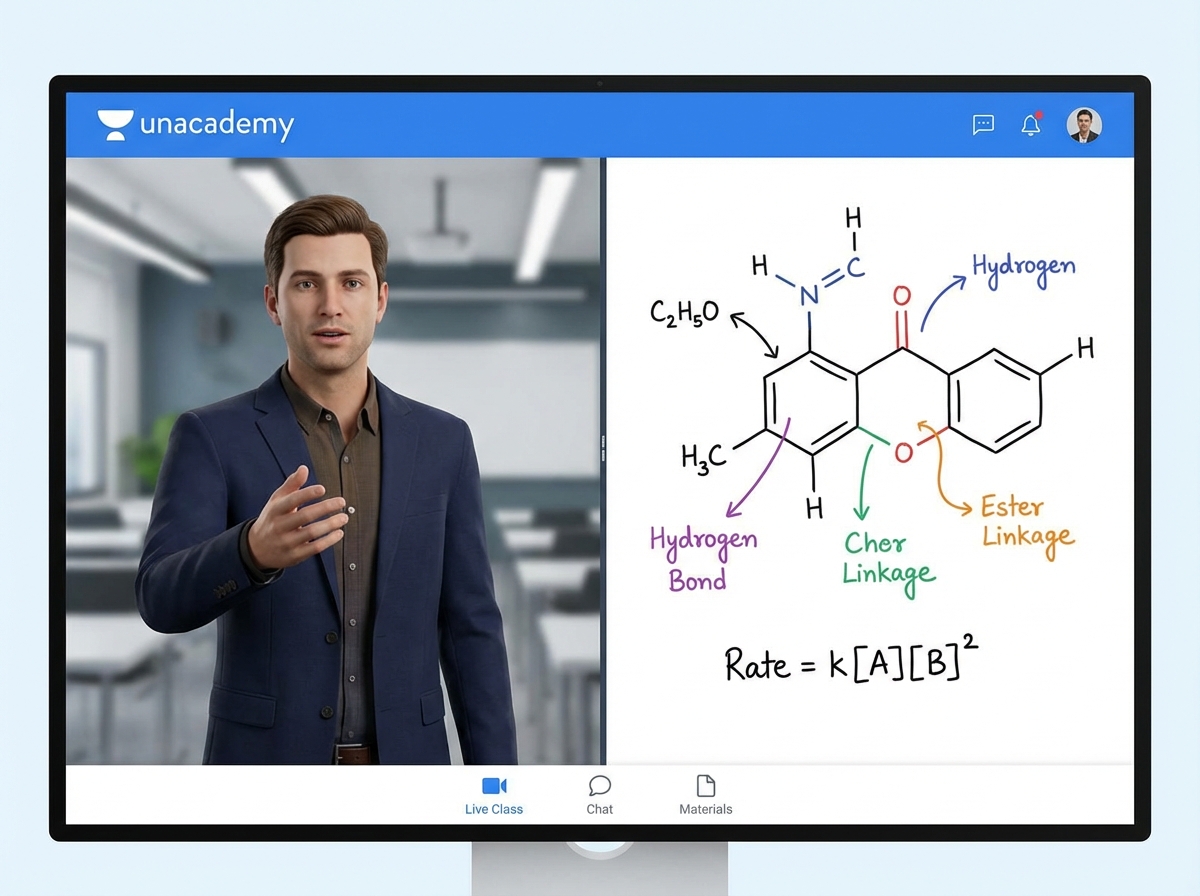
To compete with major EdTech players, smaller institutes are adopting the "Unacademy-style" format: an avatar presenter in the corner, a digital whiteboard taking up the main screen, and timed MCQ interludes to maintain engagement. By maintaining a pacing of 110–140 words per minute in Hindi, these videos achieve 40% higher retention rates than traditional long-form lectures.
Sources:
3. The End-to-End Workflow: From Script to WhatsApp Distribution
Scaling an AI avatar educator India 2026 strategy requires a structured pipeline. You cannot simply "wing it" with AI; you need a blueprint that maps to the India-first tech stack.
Step 1: Scripting with PCPQ Templates
The most successful coaching class AI presenter avatar videos follow the PCPQ (Problem–Concept–Proof–Quiz) framework.
- Hindi-First Writing: Scripts are written in "Hinglish" or pure Hindi, ensuring the AI captures the specific nuances of Indian teaching styles.
- Math Typesetting: Using LaTeX-style inputs ensures that formulas appear correctly on the screen during the avatar’s speech.
Step 2: Choosing the AI Digital Teacher
Selection criteria for an AI digital teacher India include:
- Licensed Library: Ensuring the avatar is not a "deepfake" but a consented digital twin.
- Voice Clarity: The voice must handle regional accents (e.g., a subtle Bihari accent for a teacher targeting students in Patna) to build trust.
- Studio by TrueFan AI's 175+ language support and AI avatars provide the necessary variety to match different brand personas, from a "strict professor" to a "friendly mentor."
Step 3: Visual Assembly and Generation
Videos are rendered in multiple aspect ratios:
- 16:9 for the main Learning Management System (LMS) and YouTube.
- 9:16 for "Revision Reels" on Instagram and YouTube Shorts.
- Generation: Batch processing allows for the simultaneous creation of 50+ videos, which are then run through a "Lip-Sync Audit" to ensure the mouth movements match the technical Hindi terminology perfectly (regional language dubbing test).
Step 4: India-First Distribution
In 2026, the primary classroom is WhatsApp.
- WhatsApp Drip Campaigns: Once a video is generated, it is automatically pushed to student WhatsApp groups via API (AI video webhook for WhatsApp Business).
- Micro-Learning: A "Revision in 120 seconds" video is sent every morning at 7 AM, leading to a 25% increase in mock-test participation.
Sources:
4. ROI Analysis & Tooling: Free Pilots vs. Enterprise Scaling
For an Indian coaching institute, the decision to adopt AI avatars is a financial one. The Total Cost of Ownership (TCO) in 2026 is significantly lower than traditional production.
The INR-First ROI Model
Consider a mid-sized institute producing 100 videos per month.
- Traditional Cost: ₹5,000 - ₹10,000 per video (Studio rent, editor, teacher's time, equipment). Total: ₹5,00,000+.
- AI Avatar Cost: Approximately ₹200 - ₹500 per video. Total: ₹50,000.
- Time Saved: Teachers save 40+ hours of recording time per month, which they can redirect to 1-on-1 mentoring or curriculum design.
Tooling Tiers for 2026
- The Free Pilot: Many educators start by looking to create course with AI avatar free India. These tools allow for 10–30 minutes of monthly video in SD, perfect for testing if students engage with a virtual teacher.
- The Growth Tier: For institutes scaling to YouTube and LMS, the Growth tier (approx. ₹19,999/mo) offers HD quality, 120+ minutes, and team collaboration features.
- Enterprise Rollout: Large-scale EdTechs require 4K resolution, custom digital twins of their celebrity faculty, and SOC 2/ISO 27001 compliance. Solutions like Studio by TrueFan AI demonstrate ROI through integrated WhatsApp automation and white-label portals that keep the brand front and center.
| Metric | Traditional Production | AI Avatar (2026) |
|---|---|---|
| Cost per Minute | ₹1,500 - ₹3,000 | ₹50 - ₹150 |
| Turnaround Time | 48 - 72 Hours | 5 - 10 Minutes |
| Language Scalability | Requires New Shoot | One-Click Conversion |
| Teacher Burnout | High | Zero |
Sources:
- Vasundhara: Best Free AI Video Avatar Generators 2026
- Outlook Business: Coaching Industry Growth and Regulation
5. Governance, Safety, and DPDP Compliance in Indian EdTech
As the AI avatar for online coaching India 2026 market matures, so does the need for ethical safeguards. The 2024-2026 regulatory updates from the Ministry of Education place heavy emphasis on student safety and data privacy.
DPDP Act and Consent-First Models
Under the Digital Personal Data Protection (DPDP) Act, institutes must:
- Obtain Explicit Consent: If an institute creates a digital twin of a teacher, they must have a signed contract and a "revocation protocol" if the teacher leaves.
- Data Minimization: Student data should not be used to "train" public AI models.
- Provenance: All AI-generated educational content must be watermarked to distinguish it from "real" footage, preventing the spread of misinformation or "deepfake" educational content.
Safety Filters for Minors
Since a large portion of the coaching audience is under 18, AI platforms must implement real-time profanity and content filters. This prevents the AI from generating any content that includes political endorsements, hate speech, or explicit material. Leading Indian platforms now offer a "Walled Garden" approach, where the AI can only generate content based on pre-approved, institute-verified scripts.
Sources:
- ThePrint: New Guidelines for Coaching Centres
- TrueFan AI: Two-Way Conversation AI Video & Compliance
6. The 7-Day Sprint: Publishing Your First 30 Avatar Videos
If you are an educator ready to transition to an AI avatar education content automation model, follow this 7-day blueprint to go from zero to 30 published videos.
- Day 1: Curriculum Mapping & Scripting. Identify 10 core concepts. Write scripts using the PCPQ template. Ensure you have a glossary of technical terms in Hindi and your target regional language.
- Day 2: Persona Selection. Choose your AI digital teacher India. Will it be a formal avatar for UPSC or a high-energy avatar for JEE? Set up your brand-safe voice profile.
- Day 3: Base Generation. Generate the 10 base videos in Hindi. Review for pace (120 wpm) and lip-sync accuracy.
- Day 4: Multilingual Expansion. Use one-click conversion to turn those 10 videos into 3 regional variants (e.g., Marathi, Bengali, Telugu). You now have 30 videos.
- Day 5: Micro-Content Creation. Use AI clipping tools (AI video clipping comparison 2026) to extract 60-second "Shorts" from each lesson. Add "Burn-in" captions for better mobile viewing.
- Day 6: Distribution Setup. Upload the 16:9 videos to your LMS/YouTube. Schedule the 9:16 clips for a 7-day WhatsApp drip campaign.
- Day 7: Launch & Analyze. Monitor student completion rates. In 2026, institutes using this sprint model report a 3x increase in content output with a 90% reduction in production costs.
Sources:
Conclusion: The Future of the Indian Classroom
By 2026, the question is no longer if you should use an AI avatar, but how fast you can deploy one. For the Indian coaching industry, which serves millions of students across diverse linguistic landscapes, AI avatars offer the only viable path to high-quality, affordable, and scalable education. Whether you are a solo tutor in a small town or a massive EdTech unicorn, the blueprint is clear: automate the production, localize the language, and dominate the distribution.
Final Research References:
Frequently Asked Questions
Can I use an AI avatar to teach complex subjects like Organic Chemistry or Advanced Mathematics?
Yes. In 2026, the EdTech AI avatar video creator India ecosystem allows for sophisticated visual overlays. While the avatar explains the logic, the screen displays step-by-step formula derivations and molecular structures. The key is to use a platform that supports LaTeX or high-resolution image overlays to ensure technical accuracy.
Will students feel disconnected from a virtual teacher?
Data from 2025-2026 suggests the opposite. When the avatar is a digital twin of a known teacher, or a highly relatable persona speaking the student's local dialect, engagement rates often exceed those of low-quality webcam recordings. The consistency in audio and video quality reduces cognitive load, allowing students to focus more on the content.
How does the pricing work for Indian institutes?
Most platforms offer INR-based pricing. Studio by TrueFan AI's 175+ language support and AI avatars are accessible through tiers like the Starter (₹2,999/mo) for individual tutors and Growth (₹19,999/mo) for scaling institutes. Enterprise plans are available for those needing custom avatars and API integrations.
Is it legal to use a teacher's likeness after they leave the institute?
This depends on your contract. Under the DPDP Act, you must have a clear agreement regarding the "Digital Twin" rights. Most institutes now include a "Digital Likeness Clause" that specifies the duration and scope of use, ensuring full legal compliance.
Can I distribute these videos on ShareChat and Moj?
Absolutely. In 2026, EdTech avatar video marketing India 2026 strategies heavily involve Tier-2 and Tier-3 social platforms. AI avatars are particularly effective here because they can be localized into regional dialects, which perform significantly better on ShareChat and Moj than generic English content (ShareChat and Moj distribution guide).
How do I ensure the AI doesn't make factual errors in the teaching script?
The AI avatar is a "presenter," not a "content creator." You should always provide the verified script. Platforms like Studio by TrueFan AI enable you to maintain 100% control over the spoken word, ensuring that the pedagogy remains accurate while the AI handles the visual and auditory delivery.