WhatsApp video API personalization India 2026: The enterprise guide for D2C growth, CRM, and developer teams
Estimated reading time: ~12 minutes
Key Takeaways
- AI video + WhatsApp is a 2026 must-have for India’s D2C growth across cart recovery, confirmations, and festive moments.
- A robust enterprise architecture spans CRM/CDP, AI video rendering, media/CDN, orchestration, and WhatsApp Cloud API.
- Operate at scale with throughput, quality, and governance—opt-ins, template controls, and DPDPA compliance.
- Adopt event-driven playbooks and multilingual personalization to lift CVR, AOV, and LTV.
- Measure beyond opens—optimize play rate, CVR, CAC payback with continuous experimentation.
For India’s D2C and e-commerce enterprises, WhatsApp video API personalization India 2026 is the next conversion unlock across cart recovery, order confirmation, and festival moments. This enterprise guide shows growth, CRM, and API teams how to execute AI video WhatsApp Business API integration to automate 1:1 videos at scale—safely, compliantly, and measurably for Indian shoppers.
In an era where digital noise is at an all-time high, the transition from static text to hyper-personalized video is no longer a luxury; it is a technical and strategic necessity. As we navigate the 2026 landscape, the integration of generative AI with the WhatsApp Business Platform has created a new frontier for customer engagement that feels human, localized, and immediate.
Table of Contents
- The 2026 Landscape: Why WhatsApp Video Personalization is Non-Negotiable
- Enterprise Architecture for AI Video WhatsApp Business API Integration
- Developer Quickstart: The WhatsApp CRM Video Integration Guide
- Strategic Playbooks: D2C WhatsApp Video Marketing Automation
- Scale and Reliability: Managing Bulk Video Messaging in India
- Compliance and Governance: Navigating DPDPA and Meta Policies
- Measurement Framework: Optimizing for ROI and LTV
- Frequently Asked Questions (FAQ)
1. The 2026 Landscape: Why WhatsApp Video Personalization is Non-Negotiable
By late 2026, WhatsApp usage in India is projected to cross the one billion user milestone. This massive scale has transformed the app from a simple messenger into a comprehensive commerce ecosystem. For D2C brands, the “private feed” behavior—where users treat WhatsApp Channels and chats as their primary source of discovery—has replaced traditional email and SMS marketing.
The Shift to Video-First Commerce
In 2026, the Indian consumer's attention span has shortened, but their appetite for rich media has exploded. With 5G penetration now exceeding 95% in Tier 1 and Tier 2 cities, the technical barriers to high-quality video delivery have vanished. Research indicates that Indian shoppers are 4.5x more likely to engage with a personalized video than a standard text-based notification.
Key drivers for this shift include:
- WhatsApp Channels as Private Feeds: Brands now use Channels to build “owned” distribution lists that act as a private social media feed, where short-form video content drives the highest engagement.
- API Roadmap Tailwinds: Meta’s 2026 updates have introduced smarter automation and native in-chat payments (Flows), making the journey from “watching a video” to “completing a purchase” seamless within the chat interface.
- Deliverability and Quality: As Meta enforces stricter quality scores, personalized, high-value video content ensures higher deliverability compared to generic bulk messages that risk being flagged as spam.
Sources:
- JestyCRM: WhatsApp Marketing Statistics
- Shunyanant: Owning the Private Feed
- Zoko: Future Trends in WhatsApp API
2. Enterprise Architecture for AI Video WhatsApp Business API Integration
Building a robust system for WhatsApp video API personalization India 2026 requires a sophisticated orchestration of multiple enterprise components. It is not just about sending a video; it is about generating the right video for the right user at the right millisecond.
The Core Components
- WhatsApp Business Platform (Cloud API): The backbone for message delivery, media uploads, and webhook management.
- CRM/CDP (Customer Data Platform): The source of truth for user identity (phone number), consent status, and lifecycle events (e.g.,
checkout_abandoned). - AI Video Engine: This is where the magic happens. Studio by TrueFan AI enable enterprises to bridge the gap between static templates and dynamic storytelling by converting CRM data into high-fidelity AI videos featuring digital twins or brand avatars. See the Batch Video Creation Automation guide.
- Media Storage & CDN: High-speed object storage with edge delivery optimized for Indian ISPs to ensure videos play instantly without buffering.
- Orchestration Layer: A middleware that manages job queues, retries, and the mapping of CRM variables to video scripts.
The Data Flow: From Event to Engagement
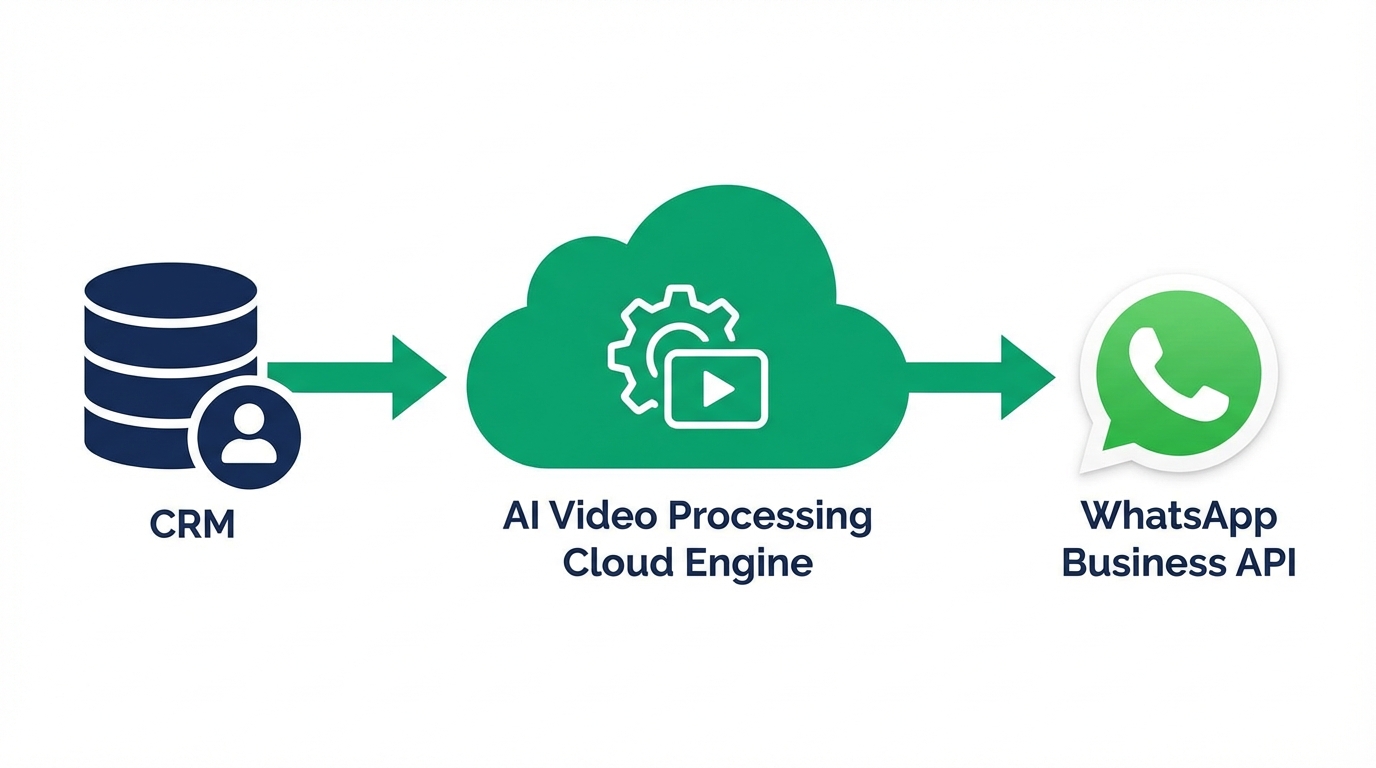
The process begins when a user triggers an event in your e-commerce backend (e.g., abandoning a cart). The orchestration layer captures this event, fetches the user's name and the items left in the cart from the CRM, and sends a request to the AI video engine. Once the video is rendered, a media URL is generated and passed to the WhatsApp API, which then sends a pre-approved video template to the user.
This architecture ensures that the video is not just “personalized” with a name tag, but is contextually relevant, mentioning specific products and offering tailored discounts based on the user's purchase history.
3. Developer Quickstart: The WhatsApp CRM Video Integration Guide
For engineering teams, the implementation of AI video WhatsApp Business API integration involves managing asynchronous workflows and ensuring high availability. This WhatsApp CRM video integration guide focuses on the technical requirements for 2026.
Prerequisites and Setup
- WABA & Meta Verification: Ensure your WhatsApp Business Account is verified and you have the necessary permissions for “Marketing” and “Utility” templates.
- Idempotency Keys: Crucial for preventing duplicate video renders and messages during network retries.
- Webhook Verification: Your endpoint must handle the Meta
hub.challengerequest and respond with a200 OKwithin seconds to maintain a healthy connection.
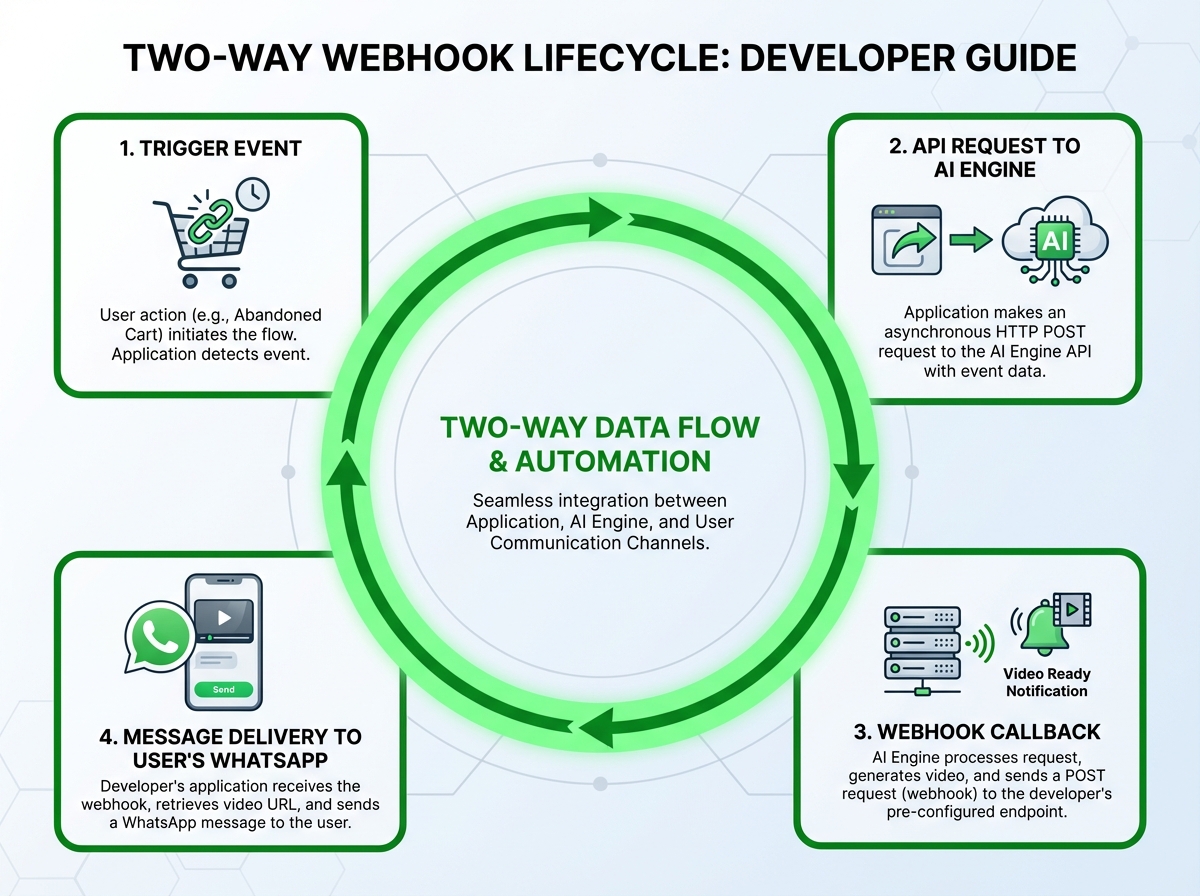
AI Video Webhook WhatsApp Business Flow
The integration relies on a two-way webhook system. First, your system triggers the video generation. Second, the AI engine sends a callback once the video is ready.
Sample Payload for Video Generation (Node.js):
const axios = require('axios');

async function triggerPersonalizedVideo(userData) {
  const payload = {
    avatar_id: "brand_ambassador_01",
    script: `Hi ${userData.name}, we noticed you left the ${userData.product_name} in your cart!`,
    voice_id: "hindi_female_02",
    webhook_url: "https://your-api.com/webhooks/video-ready",
    metadata: {
      phone_number: userData.phone,
      template_id: "cart_recovery_video_v1"
    }
  };

  const response = await axios.post('https://api.truefan.ai/v1/render', payload, {
    headers: { 'Authorization': `Bearer ${process.env.TRUEFAN_API_KEY}` }
  });

  return response.data.job_id;
}
Media Handling and Constraints
In the Indian context, optimizing for varying network speeds is vital.
- File Size: Keep marketing videos under 15MB for optimal delivery on 4G networks.
- TTL (Time to Live): WhatsApp media URLs have a limited lifespan. Ensure your CDN generates pre-signed URLs that remain valid for at least 48 hours to account for delayed message reads.
- Thumbnails: Always provide a high-quality preview image (thumbnail) in the template to encourage clicks.
Source: WhatsApp Business Platform Technical Documentation
4. Strategic Playbooks: D2C WhatsApp Video Marketing Automation
To achieve true D2C WhatsApp video marketing automation, brands must move beyond generic broadcasts and implement event-driven journeys.
Cart Recovery Video WhatsApp API India
Cart abandonment is the single biggest revenue leak for Indian D2C brands. A personalized video message can recover up to 25% more carts than text alone. Explore Cart Recovery Video Automation and AI Video Shopify Cart Recovery.
- Trigger: 30 minutes post-abandonment.
- Personalization: The AI avatar mentions the specific product and offers a limited-time “10% off” coupon visible as an overlay on the video.
- CTA: A “Buy Now” button that deep-links directly to the pre-filled checkout page.
Order Confirmation Video WhatsApp Automated
Transform a boring transactional message into a brand-building moment.
- Trigger: Successful payment.
- Content: A “Thank You” video confirming the order details and providing a visual ETA.
- Upsell: The avatar can suggest a complementary product (e.g., “This belt would look great with the trousers you just bought!”).
Festival Greeting Video Automation WhatsApp
India’s festival calendar (Diwali, Holi, Eid, Onam) provides massive opportunities for bulk video messaging WhatsApp India. Studio by TrueFan AI’s 175+ language support and AI avatars allow brands to localize content for every Indian state instantly, ensuring a greeting in Marathi for a customer in Mumbai and in Tamil for a customer in Chennai. Learn more in the Batch Video Creation Automation guide.
1:1 Video Messaging WhatsApp Automation for VIPs
For high-LTV customers, use “digital twins” of your brand founders or influencers to send 1:1 messages. This level of personalized video campaign WhatsApp API execution builds immense loyalty and differentiates the brand from competitors using generic bots. Explore Real-time Interactive AI Avatars in India.
5. Scale and Reliability: Managing Bulk Video Messaging in India
Scaling WhatsApp video API personalization India 2026 requires more than just a powerful API; it requires a strategy for handling the massive spikes typical of the Indian market, especially during the “Big Billion Days” or Diwali sales.
Throughput and Concurrency
When sending millions of personalized videos, you must manage:
- Rate Limiting: Adhere to Meta's messaging limits (Tier 1 to Tier 4) to avoid account suspension.
- JIT vs. Pre-rendering: For festival greetings, pre-render videos for your top 100,000 customers. For cart recovery, use Just-In-Time (JIT) rendering to ensure the content is current. See the Batch Video Creation Automation approach.
- Queue Management: Use a robust message broker like RabbitMQ or Amazon SQS to handle the backpressure when the AI engine or WhatsApp API experiences latency.
Quality Stewardship
Meta monitors the “Quality Rating” of your phone number. If users report your videos as spam, your rating drops, and your messaging limit will be restricted. To maintain a “High” quality rating:
- Ensure clear opt-in and easy opt-out (a “Stop” button in the chat).
- Monitor “Read” and “Reply” rates as proxies for engagement.
- Refresh video creative every 2-3 weeks to avoid “creative fatigue.”
Source: InsiderOne: WhatsApp Deliverability and Quality Updates
6. Compliance and Governance: Navigating DPDPA and Meta Policies
In 2026, the Digital Personal Data Protection Act (DPDPA) is fully enforced in India. This has significant implications for D2C WhatsApp video marketing automation.
DPDPA Alignment for Video Personalization
- Consent Management: You must have a clear, affirmative consent record for sending marketing videos. This consent must be “purpose-specific”—consenting to order updates does not automatically mean consenting to marketing videos.
- Data Localization: Ensure your AI video partner and cloud providers store PII (Personally Identifiable Information) within Indian borders as required by the latest regulations.
- Right to Erasure: Your system must be able to delete all personalized video assets associated with a user if they exercise their “Right to be Forgotten.”
Template Governance
Meta categorizes messages into Marketing, Utility, and Authentication.
- Marketing: Used for promotions and greetings. These have higher costs but allow for rich media.
- Utility: Used for order updates. These must be strictly transactional. Attempting to sneak marketing content into a Utility template can lead to template rejection or account bans.
Sources:
7. Measurement Framework: Optimizing for ROI and LTV
Solutions like Studio by TrueFan AI demonstrate ROI through measurable uplifts in key performance indicators (KPIs). To succeed, enterprises must move beyond “Open Rates” and focus on “Downstream Revenue.” Explore the Enterprise Video Analytics Platform.
Key Metrics to Track
- Video Play Rate: Percentage of delivered messages where the video was actually watched.
- Conversion Rate (CVR): The number of users who completed a purchase after watching the personalized video.
- Average Order Value (AOV) Delta: Compare the AOV of users who received a personalized video vs. those who received a standard text message.
- Customer Acquisition Cost (CAC) Payback: How much faster does a personalized video journey convert a lead compared to traditional methods?
Experimentation Roadmap
The most successful D2C brands in 2026 use multi-armed bandit testing to optimize their video campaigns. They test:
- Actor Persona: Does a professional actor or a “relatable” micro-influencer drive more sales?
- Script Length: Is a 15-second “quick nudge” better than a 45-second “detailed walkthrough”?
- Language/Dialect: Testing Hinglish vs. pure Hindi vs. regional dialects like Kannada or Telugu.
By continuously feeding these insights back into the CRM, brands can create a self-optimizing loop that increases LTV over time. Read more on video email marketing ROI in India.
Conclusion: The Path Forward
The integration of WhatsApp video API personalization India 2026 represents the pinnacle of modern D2C marketing. By combining the reach of WhatsApp with the emotional resonance of personalized video, brands can create experiences that were previously impossible at scale.
Whether you are looking to rescue abandoned carts, celebrate a festival with millions of customers, or provide VIP concierge service to your top tier, the technical and strategic framework is now ready. The question is no longer if you should automate personalized video, but how quickly you can integrate it into your CRM to stay ahead of the competition in India’s hyper-competitive e-commerce market.
Ready to build? Consult the WhatsApp Business Platform Docs and explore how Studio by TrueFan AI can power your next-gen video campaigns.
Recommended Internal Links
- Cart Recovery Video Automation: AI Tactics for D2C India
- AI Video Shopify Cart Recovery: Boost D2C Retention
- Enterprise Video Analytics Platform: ROI and Attribution
- Batch Video Creation Automation: Scale 1000 Videos Daily
- Real-time Interactive AI Avatars India: Live Video Chat
- Video Email Marketing ROI India: Boost CTR with AI Video
Frequently Asked Questions
How do we handle high-volume festival spikes without system crashes?
Using Studio by TrueFan AI, you can pre-render evergreen segments of your festival videos and only dynamically inject the user's name and specific offer at the moment of sending. This hybrid approach significantly reduces the compute load during peak times like Diwali.
What is the ideal video length for WhatsApp marketing in India?
Based on 2026 engagement data, the “sweet spot” is between 15 and 22 seconds. Anything longer than 30 seconds sees a significant drop-off in completion rates, especially for users on mobile data.
Can we use personalized videos for customer support?
Absolutely. One of the most effective use cases is “Video Onboarding” or “How-to” videos sent via the WhatsApp API after a complex product is delivered. This reduces support tickets and increases product satisfaction. See Real-time Interactive AI Avatars.
How does the WhatsApp API handle video thumbnails?
When you send a video template, you can specify a thumbnail_url. It is critical to use a high-resolution image with a “Play” button overlay to signal to the user that the content is interactive.
Is it possible to personalize the audio or voiceover in the video?
Yes. Modern AI video engines allow for text-to-speech (TTS) personalization where the avatar not only appears to speak but also says the customer's name and details in natural-sounding voices across multiple Indian languages.