AI Video Copyright Law India 2026: The Complete Legal Guide for Commercial Synthetic Media, AI Avatars, and Brand Use
Estimated reading time: ~11 minutes
Key Takeaways
- India’s 2026 IT Rules enforce 2–3 hour takedowns, mandatory “Synthetically Generated” labels, and provenance metadata (C2PA).
- AI videos can be protected if there is human-in-the-loop authorship via direction, selection, and post-production.
- Using AI avatars is legal with explicit NILV consent and clear revocation clauses in talent agreements.
- DPDPA demands granular consent, purpose limitation, children’s data safeguards, and erasure rights for personalized videos.
- Platforms require synthetic media disclosures; governance checklists and tools like Studio by TrueFan AI streamline compliant production.
The landscape of digital content in India has undergone a seismic shift as we move through 2026. AI video copyright law India 2026 now dictates every facet of how brands, creators, and agencies produce and distribute synthetic media. With the Indian synthetic media market projected to reach $1.2 billion this year and nearly 90% of commercial video content utilizing some form of generative AI, the legal stakes have never been higher.
Navigating this environment requires more than just creative flair; it demands a rigorous understanding of the amended IT Rules, the Digital Personal Data Protection Act (DPDPA) 2023, and evolving judicial precedents on authorship. Platforms like Studio by TrueFan AI enable brands to scale their content production while maintaining a 100% compliance record through built-in moderation and licensed avatar frameworks. This guide provides a step-by-step commercial compliance framework to ensure your AI-driven campaigns remain legally sound and protected under Indian law.
1. The 2026 Legal Landscape: IT Rules & Synthetic Media Regulation
In 2026, the Ministry of Electronics and Information Technology (MeitY) finalized the most stringent amendments to the Information Technology (Intermediary Guidelines and Digital Media Ethics Code) Rules. These updates specifically target “synthetic media”—defined as any video, image, or audio created or significantly altered using AI in a way that changes its original meaning.
The Three-Hour Takedown Regime
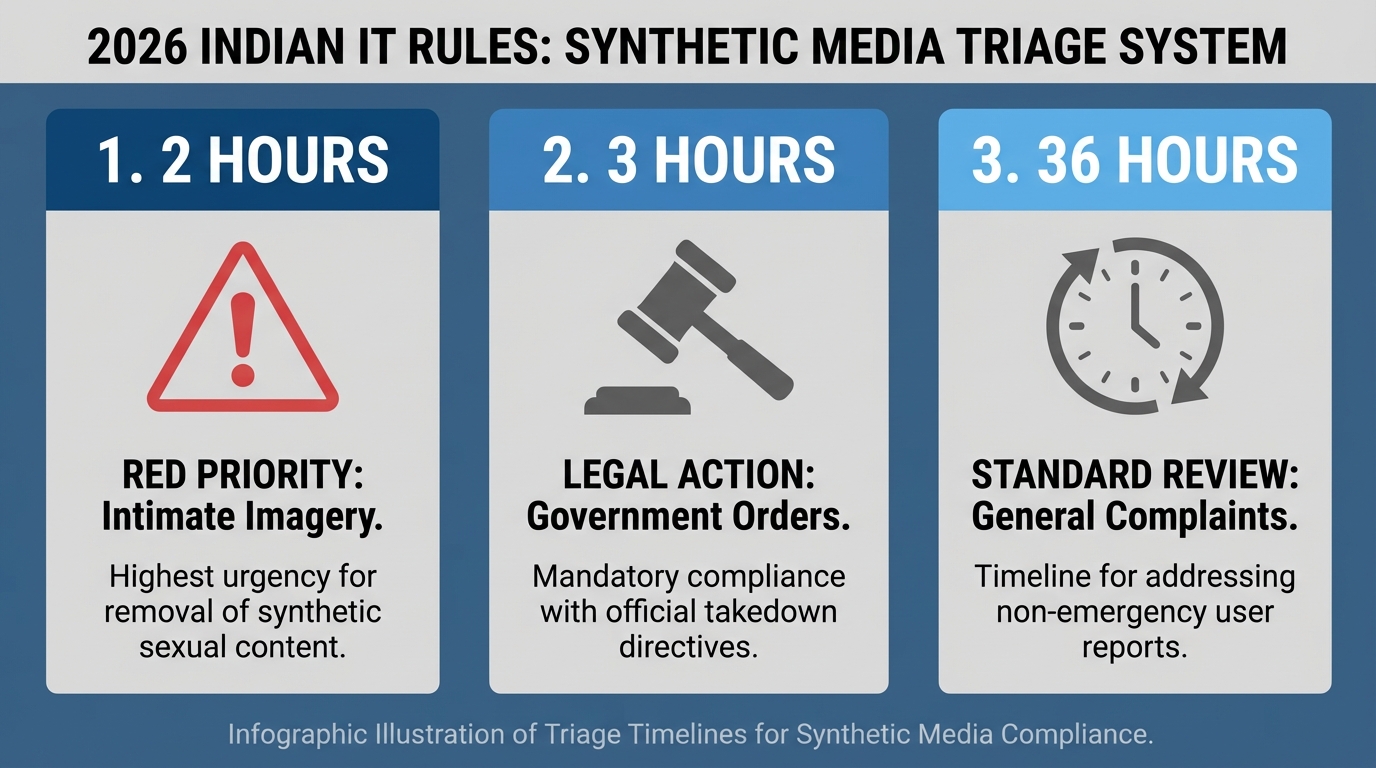
The most critical change for commercial entities is the accelerated takedown timeline. Under the 2026 IT Rules, intermediaries and content creators must adhere to a “triage” system for complaints:
- 2 Hours: For content involving non-consensual sexual explicitness or morphed intimate imagery.
- 3 Hours: For unlawful synthetic content identified by a valid government or court order.
- 36 Hours: For general complaints relating to impersonation or misinformation.
Statistics from Q1 2026 show that MeitY’s compliance monitoring reached an 85% success rate for the 3-hour window, signaling that the era of “wait and see” is over for brand legal teams.
Mandatory Labeling and Provenance
The 2026 rules mandate that all AI-generated content must carry a prominent, non-removable label: “Synthetically Generated.” This isn’t just a visual watermark; it includes embedded metadata standards (often following the C2PA protocol) that trace the asset back to its creation source. Failure to include these identifiers can lead to platform-wide shadow-banning or legal notices under the IT Act. See the brand-safe watermarking guide: Deepfake watermarking requirements India.
Source: SKV Law Offices on IT Rules 2026 Amendment
2. Copyright & Ownership: Is AI Generated Video Copyrightable in India?
One of the most frequent questions from D2C brands is: is AI generated video copyrightable India? The answer lies in the distinction between “computer-generated” and “computer-assisted” works under Section 2(d) of the Indian Copyright Act, 1957.
The “Human-in-the-Loop” Requirement
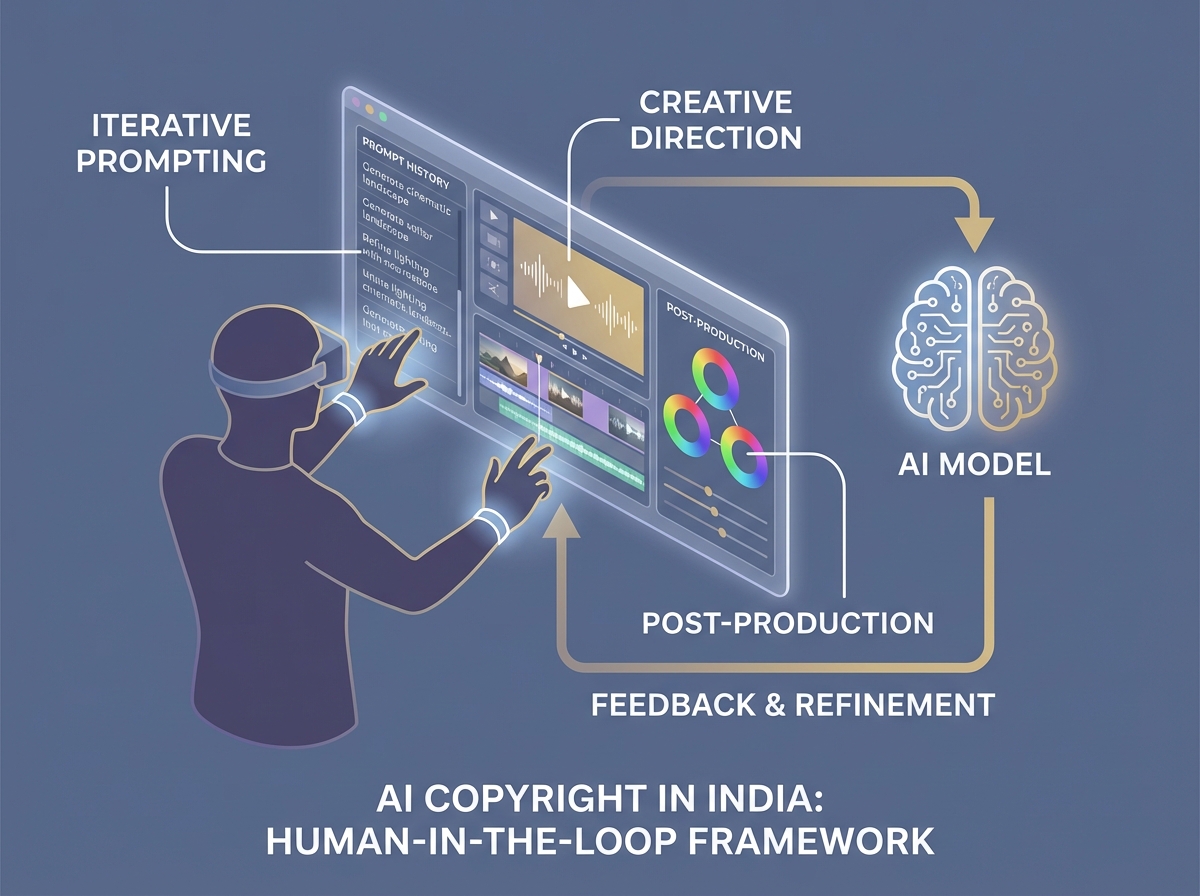
Indian copyright law protects “original” works of authorship. In 2026, the consensus among legal experts and the Copyright Office is that fully autonomous AI outputs—where a human simply provides a one-sentence prompt—remain in a legal gray area and may not be eligible for copyright protection.
To secure ownership, brands must demonstrate a “modicum of creativity” and human control. This is achieved through:
- Iterative Prompting: Documenting the evolution of prompts and creative direction.
- Selection and Arrangement: Choosing specific AI outputs and arranging them into a unique narrative or storyboard.
- Post-Production: Significant human editing, color grading, or integration with non-AI elements.
AI Video Copyright Ownership India: Who Owns the Asset?
Ownership typically follows the “Work for Hire” principle. If an employee creates an AI video using company tools, the employer is the first owner. However, when working with agencies or third-party AI platforms, the contract must explicitly state the assignment of rights.
Content Gap: The Section 2(d) Nuance
Unlike some jurisdictions, Section 2(d)(vi) of the Indian Copyright Act defines the “author” of a computer-generated work as “the person who causes the work to be created.” In 2026, courts have interpreted “causing the work to be created” as requiring more than just the financial backing; it requires the creative spark that directs the AI’s output.
Source: SpicyIP Analysis on AI and Indian Copyright
3. AI Avatars & Personality Rights: Consent Framework for Ads
The use of virtual presenters has exploded, but it brings a complex question: can I use AI avatar for ads legally India? The answer is a resounding “Yes,” provided you have a robust consent framework that respects AI avatar legal rights India. Explore realistic Indian avatars and consent considerations: South Asian AI Avatar Generator.
NILV: The Gold Standard of Consent
For any AI avatar based on a real human (digital twins), brands must secure explicit, written consent for NILV:
- Name: Use of the individual’s name in metadata or credits.
- Image: The visual likeness of the person.
- Likeness: The overall “vibe” or recognizable characteristics.
- Voice: The unique vocal timbre and cadence.
Studio by TrueFan AI’s 175+ language support and AI avatars are built on a “consent-first” model, utilizing real influencers and actors who have pre-cleared their digital rights. This eliminates the risk of “personality rights” litigation, which saw a 300% increase in 2025 as celebrities began suing brands for unauthorized AI voice-overs.
Celebrity AI Likeness Rights India
High-profile cases in the Delhi High Court have established that personality rights are an extension of the Right to Privacy. Brands cannot use an AI avatar that “substantially resembles” a celebrity to imply an endorsement without a specific license.
Content Gap: The Revocation Clause
A critical sub-topic often missed is the “Right to Revoke.” In 2026, talent contracts in India increasingly include clauses allowing actors to revoke consent for their AI avatars if the brand uses them in “sensitive” categories (e.g., alcohol, tobacco, or political ads) that were not previously disclosed.
Source: LiveLaw on Deepfakes and Personality Rights
4. DPDPA Compliance: Privacy and Personalization in AI Video
The Digital Personal Data Protection Act (DPDPA) is now fully operational in 2026, and its impact on DPDPA compliance AI video India is profound. When a brand uses AI to create personalized videos—such as a video that greets a customer by name—they are acting as a “Data Fiduciary.”
Key Obligations for AI Video Personalization
- Notice and Consent: You must provide an itemized notice in clear and plain language (available in all 22 scheduled languages) explaining what data is being used to generate the video.
- Purpose Limitation: If you collected a user’s name for shipping, you cannot use it to generate a personalized AI marketing video without a separate consent.
- Children’s Data: If the target audience includes minors, you must obtain verifiable parental consent. In 2026, the penalty for non-compliance with children’s data rules can reach up to ₹250 crore.
- Right to Erasure: Users have the right to demand the deletion of any AI assets that contain their personal data.
Cross-Border Data Flows
Many AI video tools process data on global servers. Under DPDPA, brands must ensure that the country where the data is processed is not on the government’s “restricted list.” Using localized, ISO 27001-certified platforms ensures that data stays within compliant boundaries.
Source: Official DPDPA 2023 Text - MeitY
5. Platform Governance: YouTube & Social Media Disclosure Rules
Beyond national laws, social media platforms have introduced their own “statutes” for synthetic media. The YouTube AI disclosure legal requirement India is now a mandatory step in the upload workflow for any content that looks realistic but is AI-generated. See step-by-step policy and SOPs: AI avatar YouTube monetization rules for India 2026.
How to Comply on YouTube
When uploading to YouTube Studio, creators must check the “Altered or synthetic content” box if the video:
- Makes a real person appear to say or do something they didn’t.
- Alters footage of a real-world event or place.
- Generates a realistic-looking scene that didn’t actually happen.
YouTube India reports that “Altered Content” labels have increased by 400% since 2024, as the platform’s automated detection systems have become more adept at spotting undisclosed AI. Failure to disclose can lead to the removal of the video or suspension from the YouTube Partner Program. See safe-by-design approval tactics: YouTube AI Avatar Monetization India 2026: Safe Approval.
Provenance Metadata (C2PA)
In 2026, the IT Rules 2026 amendment requires that platforms like Instagram, YouTube, and X (formerly Twitter) must support and display provenance metadata. This means if you generate a video using an AI tool, the “digital fingerprint” of that tool must remain attached to the file. This is a crucial AI content legal guide creators India must follow to avoid being flagged as “misinformation.”
Source: YouTube Help: Disclosing Synthetic Content
6. The Commercial Compliance Checklist: 2026 Brand Governance
To stay ahead of AI video commercial usage rules India 2026, marketing and legal teams should adopt a standardized governance framework. Solutions like Studio by TrueFan AI demonstrate ROI through automated audit logs and built-in content filters that prevent the creation of prohibited content, significantly reducing legal review time. See interactive avatar compliance-in-practice: Real-time Interactive AI Avatars India.
Pre-Production Checklist
- Rights Clearance: Do we own or license the avatar, the voice, and the background music?
- DPDPA Review: Is personal data being used for personalization? Is the notice ready?
- Risk Screening: Does the content touch on “prohibited categories” like political endorsements or sensitive religious topics?
Production & Publishing Checklist
- Labeling: Is the “Synthetically Generated” watermark visible and prominent? See implementation details: Deepfake watermarking requirements India.
- Metadata: Does the file contain the required provenance identifiers?
- Platform Toggles: Has the “Altered Content” box been checked on YouTube/Meta?
Post-Publish Governance
- Takedown SLA: Is there a team ready to respond to a MeitY notice within 3 hours?
- Archive: Are prompt logs and human-in-the-loop documentation stored for copyright defense?
Source: Prime Infoserv on IT Rules 2026 Deepfake Law
Summary of 2026 Compliance Metrics
| Metric | 2024 Baseline | 2026 Status |
|---|---|---|
| Takedown Requirement | 36-72 Hours | 2-3 Hours |
| Mandatory Labeling | Voluntary | Compulsory (Visual + Metadata) |
| DPDPA Penalties | N/A | Up to ₹250 Crore |
| AI Video Market Size | $400M | $1.2B |
| Copyright Protection | Unsettled | Human-in-the-loop standard |
By following this AI content legal guide creators India, brands can harness the power of synthetic media without falling foul of the law. The key is a combination of ethical platform choices, rigorous documentation, and a “consent-first” approach to every frame generated.
Sources & Further Reading:
- MeitY DPDPA Official PDF
- SKV Law Offices: IT Rules 2026 Amendment
- SpicyIP: AI and Authorship in India
- YouTube Help: Synthetic Content Disclosure
- Times of India: India’s New AI Content Rules Explained
Recommended Internal Links
- Deepfake watermarking requirements India: brand-safe guide
- AI avatar YouTube monetization rules for India 2026 Guide
- YouTube AI Avatar Monetization India 2026: Safe Approval
- Real-time Interactive AI Avatars India: Live Video Chat
- South Asian AI Avatar Generator: Realistic Faces 2026
Frequently Asked Questions
Is AI generated video copyrightable India?
Yes, it can be, provided there is significant “human-in-the-loop” involvement. Under the Indian Copyright Act, the person who “causes the work to be created” is the author. To ensure your work is copyrightable, you must document your creative direction, iterative prompting, and post-production edits to prove the asset is not a purely autonomous AI output.
AI video copyright ownership India: who owns what?
Ownership is determined by the contract between the creator and the tool/agency. Generally, if created by an employee, the company owns it. If using a third-party platform, ensure the Terms of Service grant you “Exclusive Commercial Rights.” Always maintain a “Human Authorship Log” to defend your ownership in case of disputes.
Can I use AI avatar for ads legally India?
Yes, provided you have secured explicit NILV (Name, Image, Likeness, Voice) consent from the individual the avatar is based on. For fictional avatars, ensure the platform has licensed the underlying data. Studio by TrueFan AI provides a library of pre-licensed avatars that are fully compliant with Indian advertising standards and personality rights laws.
YouTube AI disclosure legal requirement India: how to use it?
In YouTube Studio, you must select the “Altered or synthetic content” checkbox during the upload process. This will place a label in the video description or on the video player itself. This is mandatory for realistic content that could mislead viewers; failure to comply can lead to account strikes or demonetization. See the full monetization and disclosure guide: AI avatar YouTube monetization rules.
AI deepfake law India commercial: what counts as illegal?
Illegal content includes any synthetic media used for impersonation, fraud, or spreading misinformation that threatens public order. Additionally, the 2026 IT Rules mandate a 2-hour takedown for non-consensual intimate imagery and a 3-hour takedown for content deemed unlawful by government orders.
DPDPA compliance AI video India: do I need consent for personalization?
Absolutely. If your AI video uses a customer’s name, face, or purchase history to personalize the message, you must provide a clear notice and obtain affirmative consent. You must also provide a way for the user to withdraw that consent and have their personalized video data deleted.