Synthetic UGC Video Ads AI India 2026: Scale D2C ROAS with Custom Avatars and Spokesperson Demos
Estimated reading time: ~12 minutes
Key Takeaways
- Synthetic UGC lets Indian D2C brands rapidly produce 50+ video variations, cutting costs by over 95% versus human influencers.
- Localized Hinglish and regional-language scripts consistently lift CTR and ROAS across Reels, Shorts, and PDPs.
- Custom AI avatars and spokesperson demos mirror your ICP and deliver consistent, testable performance at scale.
- Follow ASCI compliance with clear “AI Generated” disclosures and consent-first, licensed avatars.
- Adopt data-driven playbooks (hook-swapping, bulk generation, rapid kill rules) to achieve 3–5x ROAS.
In the hyper-competitive landscape of Indian e-commerce, synthetic UGC video ads AI India 2026 have emerged as the definitive lever for Direct-to-Consumer (D2C) brands looking to break through the noise. As traditional influencer costs skyrocket and creative fatigue sets in within days, performance marketers are pivoting to AI-driven “User Generated Content” that delivers the authenticity of a human creator with the speed of a software script.
For years, D2C founders in India faced a brutal bottleneck: a single high-quality UGC video from a mid-tier influencer could cost anywhere from ₹5,000 to ₹50,000, take two weeks to produce, and often fail the first round of A/B testing. In 2026, that model is obsolete. Today, brands are generating 50+ ad variations in a single afternoon, testing localized “Hinglish” hooks against regional dialects like Tamil and Bengali, and achieving a 3.5x higher ROI compared to static or traditional video assets.
This guide explores how your brand can leverage custom AI avatars and synthetic spokesperson demos to dominate Meta, Google, and Shopify in the 2026 market.
1. What are Synthetic UGC Video Ads? The 2026 Inflection Point
Synthetic UGC (User Generated Content) refers to AI-generated, selfie-style videos where photorealistic AI avatars act as brand spokespeople. Unlike the stiff, uncanny animations of the early 2020s, 2026-era synthetic UGC is indistinguishable from real human content. These videos use advanced text-to-video technology to create natural lip-syncing, emotional inflection, and the “handheld” aesthetic that social media users trust. See the AI spokesperson for YouTube in India guide.
Why 2026 is the Year of AI Video in India
The shift toward synthetic content isn't just about technology; it's about consumer behavior and economic reality.
- Vertical Dominance: 59% of all AI-generated videos are now produced in a 9:16 vertical format, reflecting the total dominance of Reels and YouTube Shorts (Source: ngram: AI video statistics 2026).
- The ROI Gap: Businesses in India using AI for marketing report a staggering 3.5x higher ROI than those sticking to manual production (Source: Cloud9Digital: AI marketing stats 2026).
- Widespread Adoption: 78% of Indian marketing teams now integrate AI-generated video into their quarterly campaigns (Source: ViVideo: AI video statistics 2026).
- Trust Dynamics: Despite being AI-generated, 80% of consumers still trust UGC-style content more than polished studio ads because it mirrors the “peer-to-peer” recommendation format (Source: Buzzinly: UGC statistics 2026).
Platforms like Studio by TrueFan AI enable brands to tap into this trend by providing a library of licensed, photorealistic avatars that look and speak like everyday Indian consumers. This allows brands to skip the “creator hunt” and move straight to the “conversion” phase.
2. The Economics of Scale: Synthetic UGC vs. Real Influencer Costs
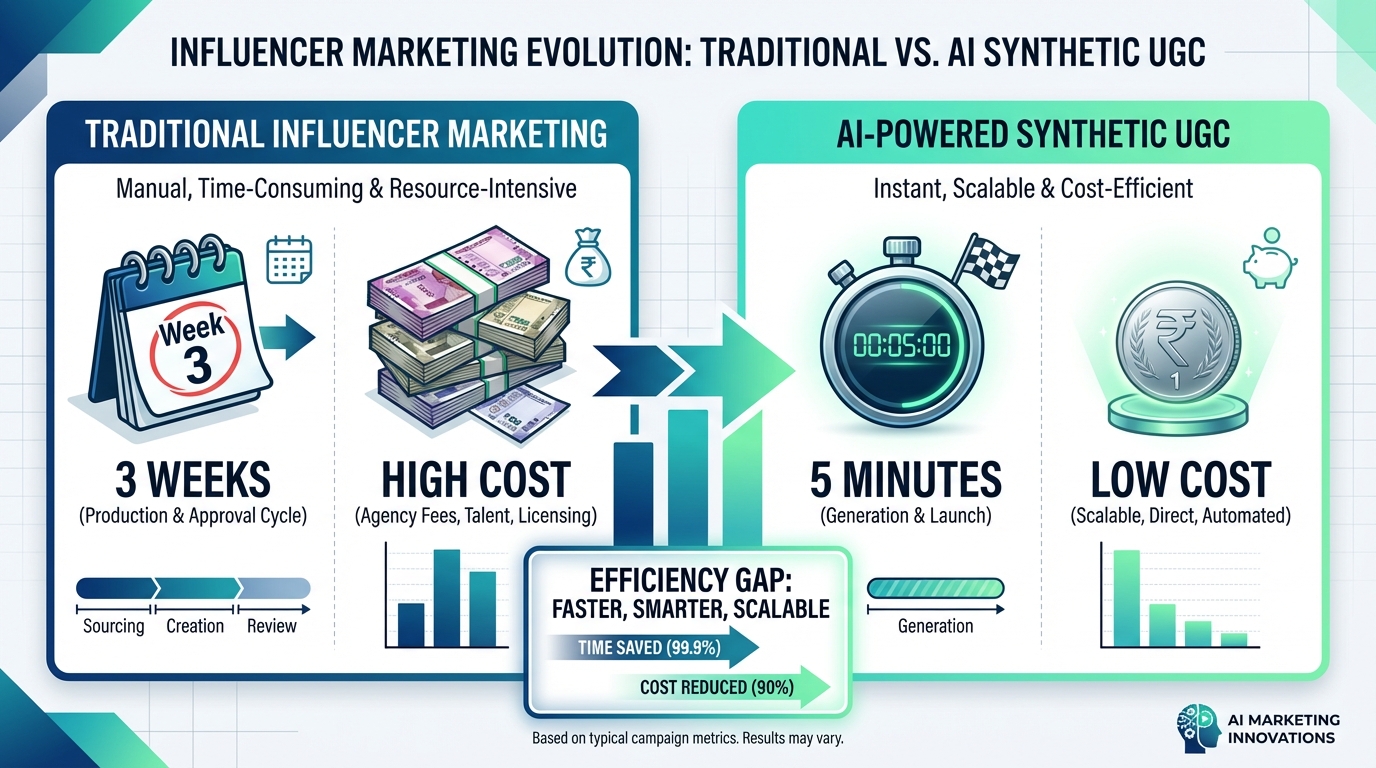
For a D2C brand in India, the math behind synthetic UGC is undeniable. Let’s break down the cost of a typical performance marketing campaign requiring 20 video variations to combat creative fatigue.
The Human Influencer Model (Traditional)
- Creator Fees: 20 videos x ₹10,000 (average mid-tier) = ₹2,00,000.
- Logistics: Shipping samples, briefing, and follow-ups = ~20-30 man-hours.
- Turnaround: 14–21 days from brief to final file.
- Usage Rights: Often limited to 3-6 months; additional fees for whitelisting.
The Synthetic UGC Model (2026)
Using a professional AI video platform, the unit economics shift from “cost per video” to “cost per minute.”
- Platform Cost: A Growth plan (e.g., ₹19,999/month) provides roughly 120 minutes of video.
- Cost per 30-second Ad: Approximately ₹83 in generation costs.
- Total for 20 Videos: ~₹1,660.
- Turnaround: Minutes.
- Usage Rights: Perpetual, as avatars are pre-licensed.
| Metric | Human UGC Influencer | Synthetic UGC (AI) |
|---|---|---|
| Cost per Video | ₹5,000 - ₹50,000 | ₹80 - ₹200 |
| Production Time | 7 - 21 Days | 5 - 10 Minutes |
| Scalability | Low (Linear cost) | Infinite (Bulk generation) |
| Localization | Requires new creator | One-click translation |
| A/B Testing | Expensive & Slow | Instant & Data-driven |
By reducing the cost of a single creative asset by over 95%, brands can afford to fail. You can launch 10 different hooks for the same product, see which one sticks within 48 hours, and double down on the winner—a strategy that is financially impossible with human creators.
3. Step-by-Step: Creating an AI Spokesperson for Product Demos
Creating a high-converting synthetic UGC video ads AI India 2026 campaign requires more than just a script; it requires a deep understanding of the “thumb-stop” mechanics that work in the Indian market.
Step 1: Persona Selection (The ICP Match)
Your avatar must mirror your Ideal Customer Profile (ICP). If you are selling a premium skincare line to metro-dwelling Gen Z, your avatar should reflect that aesthetic. If you are selling a kitchen appliance to Tier-2 households, a more relatable, “homemaker” persona works best.
Step 2: The “Hinglish” Script Framework
In 2026, pure English ads often feel too formal, while pure Hindi might miss the urban demographic. “Hinglish”—the natural blend of both—is the gold standard for conversion. Explore the Hinglish AI video generator guide.
The 30-Second Performance Script Template:
- The Hook (0-3s): Must address a specific pain point. Example: “Baal jhadne se pareshaan ho? Stop scrolling!”
- The Agitation (3-8s): Why other solutions failed. Example: “Maine sab try kiya, par results zero the.”
- The Solution/Demo (8-20s): Introduce the product with a screen overlay or background cutaway.
- Social Proof (20-25s): Mention “1 Lakh+ happy customers.”
- The CTA (25-30s): Clear direction. Example: “Niche link pe click karo aur 20% off pao.”
Step 3: Voice and Localization
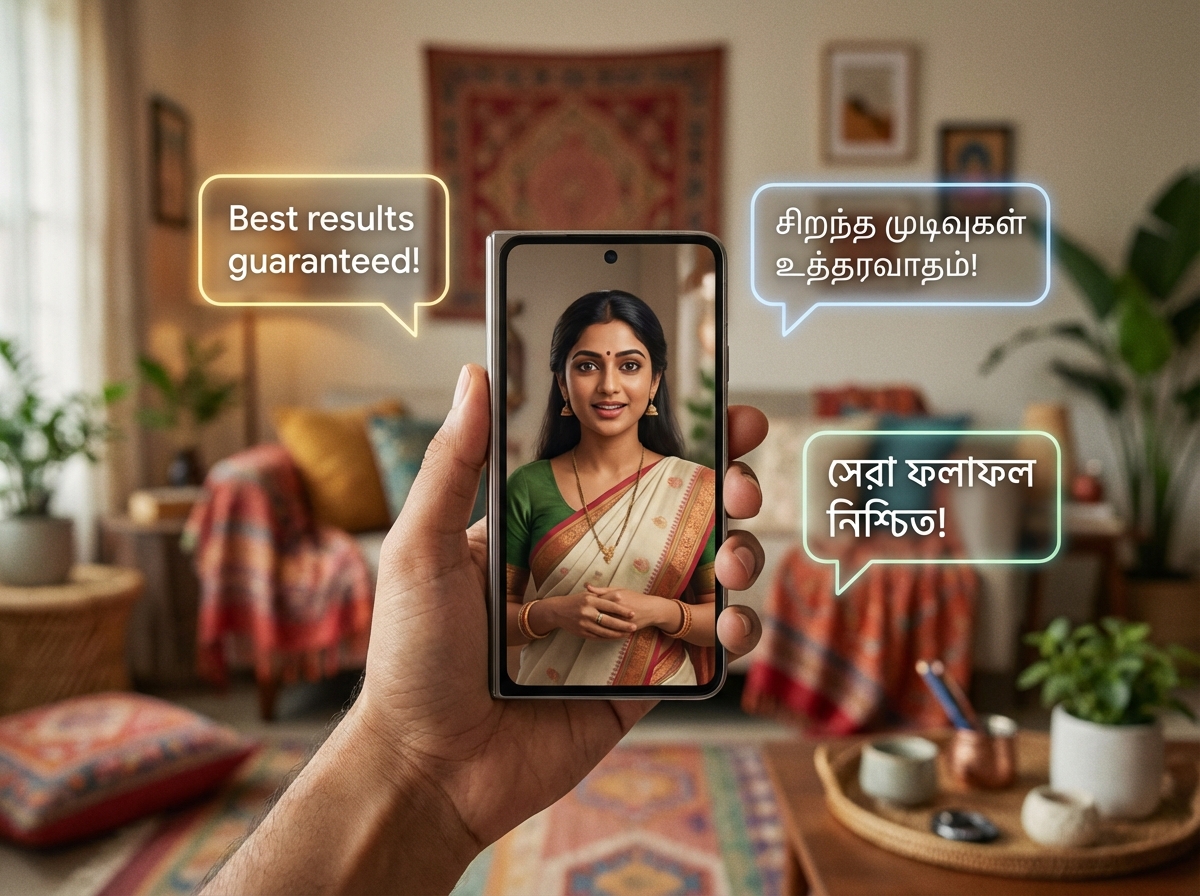
Studio by TrueFan AI's 175+ language support and AI avatars allow you to take that single Hinglish script and instantly localize it into Tamil, Telugu, Kannada, or Marathi. This is crucial for brands scaling across India’s diverse states. The AI ensures the lip-sync remains perfect regardless of the language, maintaining the “human” feel. See the Indian accent voice cloning guide and regional language dubbing test.
Step 4: Visual Polish
Add social-native elements:
- Dynamic Captions: Use bold, colorful subtitles that pop.
- Backgrounds: Use a “living room” or “bathroom” background to mimic a real UGC environment.
- Jump Cuts: Edit the timing to remove any “dead air,” keeping the pace fast and engaging.
4. Scaling from One Script to 50+ Ad Variations
The real power of AI lies in bulk generation. Performance marketing in 2026 is a volume game. If you aren't testing at least 10-20 variations per week, you are leaving ROAS on the table.
The Bulk Workflow (CSV to Video)
Advanced D2C teams use a CSV-based workflow to generate hundreds of ads at once. By setting up a spreadsheet with the following columns, you can automate your creative production:
- Avatar_ID: (e.g., Gunika for Gen Z, Aryan for Fitness)
- Script_Hook: (5 different variations)
- Offer_Text: (Flat 10% off vs. BOGO vs. Free Shipping)
- Language_Code: (hi-IN, ta-IN, en-IN)
- Background_URL: (Different product usage settings)
The “Hook-Swapping” Strategy
Research shows that the first 3 seconds of a video determine 70% of its performance. Instead of making 50 entirely different videos, create 10 different hooks and pair them with the same “body” and “CTA.” See YouTube Shorts attention-grabbing hooks.
- Hook 1 (Curiosity): “Did you know 90% of Indians use the wrong shampoo?”
- Hook 2 (Direct Pain): “Stop wasting money on expensive hair treatments.”
- Hook 3 (Social Proof): “Why everyone on my feed is talking about this brand.”
By testing these hooks in parallel, you can identify the “Winner” within 24 hours and shift your entire ad spend to the highest-performing variant.
5. Channel Playbooks: Meta, Google, and Shopify
Each platform in 2026 has specific requirements for synthetic UGC video ads AI India 2026. Here is how to optimize for each:
Meta (Instagram Reels & Facebook Stories)
Meta’s algorithm in 2026 prioritizes “Watch Time” and “Shareability.”
- Format: 9:16 is mandatory.
- Style: Low-production value. The more it looks like a friend’s story, the better it performs.
- Disclosure: Per ASCI guidelines, ensure a clear “Ad” or “Virtual Influencer” label is visible.
- Strategy: Use Advantage+ Creative to let Meta’s AI swap your AI-generated hooks for different audience segments.
Google & YouTube (Shorts & Discovery)
YouTube Shorts has become the primary discovery engine for Indian D2C. Read the YouTube Shorts automation with AI guide.
- The “Search” Hook: Start with a question people actually type into Google. Example: “Best sunscreen for oily skin in India?”
- Call to Action: Use YouTube’s interactive “Shop Now” buttons integrated directly into the Shorts player. See YouTube Shorts product tagging in India.
- Localization: Segment your campaigns by state and use regional language AI avatars to lower your Cost Per Click (CPC) in non-metro areas.
Shopify & PDP (Product Detail Pages)
- The “Virtual Concierge”: Place a 15-second AI spokesperson video next to your “Add to Cart” button to explain the key benefit or shipping policy.
- Trust Building: Use AI-generated “customer testimonials” (clearly labeled) to explain complex product features.
- ROI Impact: Adding video to a Shopify PDP in 2026 is shown to increase “Add to Cart” rates by up to 24%.
6. Performance Marketing Tactics that Lift ROAS (3-5x Outcomes)
Achieving a 3-5x ROAS isn't about luck; it's about the systematic elimination of underperforming creative.
1. The “Kill” Rule
In 2026, data moves fast. If an ad variant has 1,000 impressions and a Click-Through Rate (CTR) below 0.8%, kill it immediately. Replace it with a new hook generated by your AI tool.
2. Regional Arbitrage
Most Indian brands compete for the same English-speaking audience in Mumbai, Delhi, and Bangalore. Solutions like Studio by TrueFan AI demonstrate ROI through their ability to unlock “Bharat”—the Tier 2 and 3 cities where ad inventory is cheaper and regional language content is scarce. A Tamil-language AI ad for a D2C brand often sees 40% lower Customer Acquisition Costs (CAC) than its English counterpart. See Hinglish AI video marketing.
3. Fatigue Management
Creative fatigue happens when your frequency gets too high. Instead of increasing your bid, refresh your creative. With AI, you can change the avatar’s outfit, the background, or the background music in seconds, “resetting” the ad's novelty in the eyes of the algorithm.
4. The “COD” Factor
In India, “Cash on Delivery” is still a massive trust signal. Ensure your AI spokesperson explicitly mentions “COD Available” and “Easy 7-day Returns.” These small verbal cues in a synthetic UGC video can lift conversion rates by 15-20%.
7. Authenticity, Safety, and Compliance in 2026
As AI content becomes mainstream, the Advertising Standards Council of India (ASCI) has tightened regulations to protect consumers.
ASCI Compliance Checklist
- Disclosure: All synthetic content featuring virtual influencers must include a clear disclosure (e.g., “AI Generated” or “Virtual Influencer”).
- Language: The disclosure must be in the same language as the ad.
- Prominence: The label must be easily readable and not hidden in a tiny font at the bottom of the screen. (Source: ASCI 2025 Compliance Scorecard)
Brand Safety
Using “unauthorized” AI or deepfake technology is a massive legal risk. Ensure your platform uses a “consent-first” model.
- Licensed Avatars: Only use avatars where the original human actor has provided explicit legal consent for their likeness to be used.
- Moderation: Professional platforms like TrueFan AI include built-in filters to prevent the generation of hate speech, political content, or explicit material, protecting your brand's reputation.
- Certifications: Look for ISO 27001 and SOC 2 compliance to ensure your data and scripts are secure.
8. The 2026 Trendline: The Future of D2C Creative Ops
The era of the “Creative Director” as a bottleneck is ending. In 2026, the most successful D2C brands operate like software companies. They have “Creative Ops” teams that manage libraries of AI avatars, test thousands of script variations, and use real-time data to dictate production.
Key Trends to Watch:
- Interactive AI Video: Ads where the AI spokesperson can answer user questions in the comments section via WhatsApp integration.
- Hyper-Personalization: Generating a unique video for a customer based on their past purchase history (e.g., “Hey Rahul, your favorite coffee is back in stock!”).
- 9:16 Baseline: Any brand not producing vertical-first content is effectively invisible to 52% of the social-using population (Source: ngram: AI video statistics 2026).
By adopting synthetic influencer video ads India 2026 today, you aren't just saving money—you are building a scalable, data-driven engine that can out-pace any competitor relying on traditional production methods.
Ready to Scale Your ROAS?
Don't let creative production be the ceiling of your growth. Book a TrueFan Studio Enterprise demo today and launch your first 50-variant AI UGC campaign this week.
- Explore the Avatar Library: Visit Studio TrueFan AI
- View Case Studies: TrueFan AI case studies
Frequently Asked Questions
Is synthetic UGC legal for Meta and Google ads in India?
Yes, it is perfectly legal. However, you must comply with ASCI (Advertising Standards Council of India) guidelines, which require clear disclosure that the content is AI-generated or features a virtual influencer. This maintains transparency and consumer trust.
How does Studio by TrueFan AI handle regional Indian languages?
Studio by TrueFan AI's 175+ language support and AI avatars include specialized models for Indian regional dialects. The system doesn't just translate text; it ensures the lip-syncing and tonal inflections match the cultural nuances of languages like Hindi, Tamil, Telugu, and Bengali. Learn more in the Hinglish AI video generator guide.
Can I use my own brand ambassador as an AI avatar?
Yes. Many Enterprise brands use “Custom Avatar Training.” You can take a few minutes of footage of your founder or a celebrity brand ambassador and create a “Digital Twin.” This allows you to generate infinite new content without the person ever needing to step back into a recording studio. See the AI spokesperson for YouTube in India guide.
What is the ideal length for an AI spokesperson ad?
For performance marketing on Reels and Shorts, 15 to 30 seconds is the “sweet spot.” You need to hook the viewer in the first 2 seconds and deliver the CTA before the 25-second mark to maximize completion rates. Explore attention-grabbing hooks for YouTube Shorts.
How many ad variations should I be testing?
For a standard D2C product, start with 5 different hooks, 2 different avatars, and 2 different offers—creating 20 unique variations. Using a bulk AI video creator, this entire set can be generated in under 30 minutes. Read the Shorts automation guide.
Does AI video perform as well as real human UGC?
In many cases, it performs better. Because you can perfectly optimize the script, the lighting, and the “hook” based on data—and localize it for every state in India—AI video often achieves a 3.5x higher ROI than human UGC, which is harder to iterate on (Source: Cloud9Digital: AI marketing stats 2026).