Blockchain video verification India 2026: How CISOs secure AI celebrity campaigns with verifiable trust
Key Takeaways
- Indian enterprises need a zero-trust approach to verified celebrity video marketing using cryptographic provenance and ledger anchoring.
- Adopting C2PA, blockchain content provenance, and decentralized video validation provides tamper-evident proof and aligns with evolving MeitY mandates.
- Smart contract video rights management and NFT video authentication encode permissions, automate revocations, and create a robust audit trail.
- An activation blueprint with TrueFan AI embeds C2PA manifests at generation, anchors hashes on-chain, and verifies at playback to boost trust and ROI.
- Track verification pass rate, provenance coverage, reduced impersonation, and faster takedowns to achieve audit-ready transparency.
From cryptographic content signing to decentralized video validation, a practical roadmap for brand safety leaders
The digital landscape in India has reached a critical inflection point where the synthesis of artificial intelligence and celebrity endorsement is no longer a novelty but a core enterprise strategy. As we navigate the complexities of blockchain video verification India 2026, Chief Information Security Officers (CISOs) and Brand Safety leaders face a dual challenge: leveraging the hyper-personalization of synthetic media while neutralizing the existential threat of deepfakes.
By 2026, the volume of AI-generated marketing content in the Indian market is projected to increase by 450%, making manual verification impossible. In this high-stakes environment, trust is the only currency that matters. Platforms like TrueFan AI enable enterprises to bridge this gap by integrating rigorous governance frameworks directly into the creative workflow.
The shift toward verified celebrity video marketing is driven by a sophisticated "Trust Stack" that combines cryptographic provenance with decentralized ledgers. This ensures that every frame of a celebrity campaign is auditable, tamper-proof, and compliant with the evolving regulatory mandates of the Ministry of Electronics and Information Technology (MeitY).
Why verified celebrity video marketing needs zero-trust defenses
The rapid proliferation of synthetic media has fundamentally altered the risk profile of digital marketing. In 2026, over 70% of Indian consumers report being unable to distinguish between authentic celebrity footage and high-fidelity deepfakes without technical aids. This erosion of trust necessitates a transition from "trust but verify" to a "zero-trust" architecture for all brand communications.
Deepfake prevention marketing technology is no longer an optional security layer; it is a fundamental requirement for maintaining brand equity. For Indian enterprises in BFSI and healthcare, the stakes are even higher, as impersonation fraud can lead to significant financial loss and regulatory penalties. Implementing synthetic media trust signals India allows brands to provide immediate, visible proof of authenticity to the end-user.
The business impact of these technologies is measurable. Research indicates that campaigns utilizing verified celebrity video marketing see a 22% higher engagement rate compared to unverified synthetic content. This "trust premium" reflects a consumer base that is increasingly savvy about digital manipulation and rewards brands that prioritize transparency and provenance.
Source: MeitY advisory on curbing deepfakes
Source: PIB Government measures to tackle deepfakes
India’s compliance landscape for synthetic media
The regulatory environment in India has matured rapidly to address the nuances of AI-generated content. Current MeitY advisories and the IT Rules (2021/2023 updates) emphasize the necessity of clear disclosures and platform due diligence. For enterprises, this means moving beyond simple watermarking toward AI content authenticity certification that is cryptographically bound to the media asset.
The adoption of the Coalition for Content Provenance and Authenticity (C2PA) standards has become the gold standard for Indian enterprises. C2PA provides an open technical framework that allows for cryptographic content signing, capturing the "who, what, and how" of content creation. This metadata is tamper-evident, ensuring that any subsequent modification to the video is detectable by the end-user's browser or device.
Furthermore, the tightening of FIU-IND KYC norms in 2026, which now mandate liveness detection and geotagging, signals a broader regulatory preference for real-time verification. This trend is bleeding into marketing, where blockchain transparency marketing is becoming the preferred method for demonstrating compliance. Brands that fail to adopt these standards risk not only consumer backlash but also aggressive enforcement actions from Indian regulators.
Source: EPWA C2PA in India 2025 Report
Source: CyberPeace Foundation C2PA Primer
Source: NeGD Deepfakes Playbook
Source: FIU-IND KYC tightening
The trust stack: From cryptographic content signing to immutable content verification
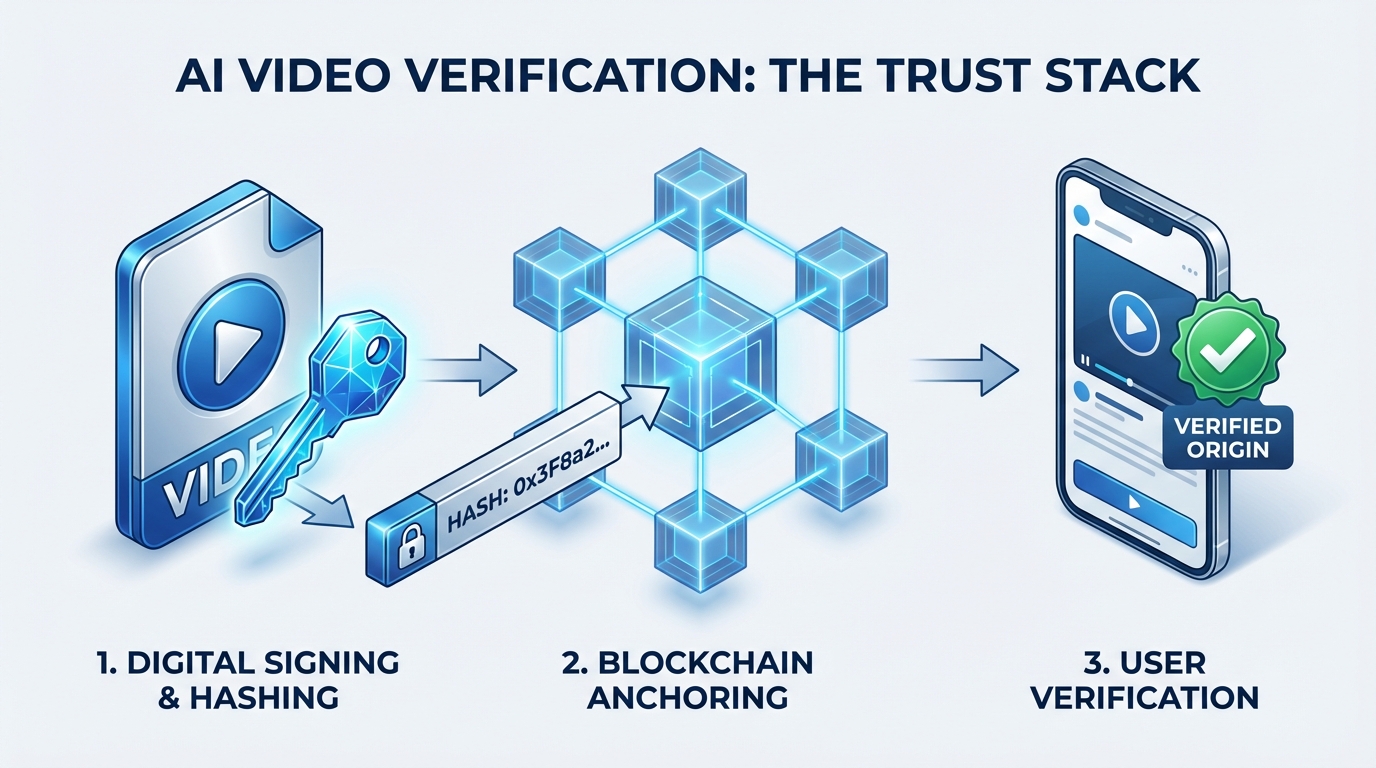
To secure AI celebrity campaigns, enterprises must implement a multi-layered technical architecture. This begins with cryptographic content signing at the point of generation. By using Hardware Security Modules (HSMs) or enterprise Key Management Systems (KMS), brands can sign the video manifest with a private key, ensuring that the identity of the creator and the tools used are permanently linked to the asset.
The next layer involves a blockchain content provenance platform. Instead of storing the entire video on-chain, which is cost-prohibitive and poses privacy risks, enterprises anchor the unique hash of the video manifest to a distributed ledger. This creates a distributed ledger content tracking system that provides an immutable timestamp and a verifiable chain of custody, proving the asset existed in its current form at a specific time.
Finally, decentralized video validation occurs at the point of consumption. When a user views a video on WhatsApp, a mobile app, or a web landing page, a verification SDK checks the C2PA signature against the ledger anchor. If the verification passes, a "Verified Origin" badge is rendered, providing tamper-proof video certification. This end-to-end flow ensures that the integrity of the celebrity endorsement remains intact from the studio to the smartphone.
Key Components of the Trust Stack:
- Cryptographic Content Signing: Binding identity and toolchain metadata using HSM-backed keys.
- Blockchain Content Provenance Platform: Anchoring hashes to a ledger for non-repudiation.
- Distributed Ledger Content Tracking: Maintaining an immutable record of asset versions and approvals.
- Decentralized Video Validation: Real-time verification at the distribution endpoint.
- Tamper-proof Video Certification: Issuing verifiable certificates for audits and regulatory compliance.
Source: Nikon India C2PA Firmware
Source: IndiaAI Provenance Tooling
Rights encoded: Smart contract video rights management and NFT video authentication India
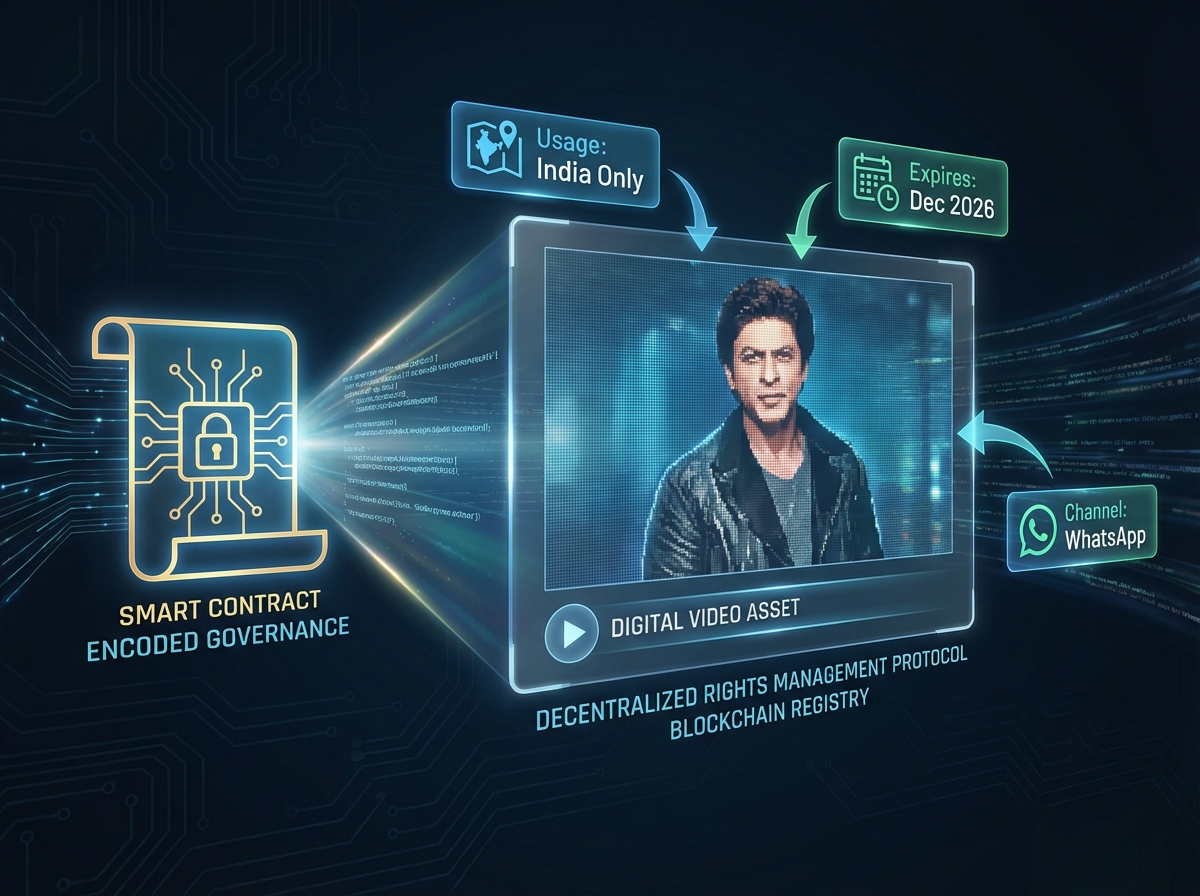
Beyond technical integrity, the governance of celebrity likeness requires sophisticated rights management. Smart contract video rights management allows enterprises to encode usage policies—such as territory restrictions, expiration dates, and channel exclusions—directly into the asset's metadata. These contracts can automatically trigger "pause" or "revoke" signals to distribution networks if a campaign exceeds its licensed window.
In 2026, NFT video authentication India has evolved into a purely functional enterprise tool. Rather than speculative assets, these non-transferable tokens serve as "Master Certificates of Authenticity." They provide a definitive record of the celebrity's consent, the right of publicity agreements, and the specific parameters of the AI generation, creating a robust audit trail for legal and compliance teams.
This approach to Web3 compliance marketing ensures that the brand remains protected against unauthorized use of celebrity assets. By linking the on-chain rights to the cryptographic signatures of the video, CISOs can ensure that only authorized, compliant content is ever served to the public. This level of automation reduces the administrative burden on legal teams while providing 100% certainty in rights enforcement.
Governance Checklist for 2026:
- Consent Artifacts: Digital proof of celebrity consent for specific AI-generated likenesses.
- Usage Windows: Automated expiration of assets via smart contract logic.
- Data Minimization: Ensuring PII is not stored on-chain, only cryptographic hashes.
- Revocation Mechanisms: Ability to instantly invalidate an asset across all channels if a breach is detected.
Activation blueprint with TrueFan AI
Operationalizing these complex technologies requires a partner that understands both the creative and security requirements of the Indian enterprise. TrueFan AI's 175+ language support and Personalised Celebrity Videos are integrated into a SOC 2 and ISO 27001 certified environment, ensuring that security is baked into the creative process from day one.
The activation workflow begins with the generation of personalized content where cryptographic content signing is applied at the template level. As TrueFan AI generates thousands of personalized videos in sub-30 seconds, each asset is automatically embedded with a C2PA manifest. These manifests are then anchored to a ledger, enabling immutable content verification at scale.
Solutions like TrueFan AI demonstrate ROI through the seamless integration of synthetic media trust signals India into omnichannel distribution. Whether the video is delivered via a WhatsApp bot for a telecom renewal or a personalized landing page for a BFSI product, the verification hooks ensure the consumer sees the trust badge. This not only prevents deepfake-related fraud but also significantly boosts the credibility of the personalized message.
TrueFan AI Enterprise Capabilities:
- Scale: Sub-30 second renders for millions of personalized assets.
- Security: SOC 2 Type II and ISO 27001 certification.
- Global Reach: Support for 175+ languages and dialects.
- Integration: Real-time APIs for embedding provenance into existing CRM and MarTech stacks.
KPIs, auditability, and blockchain transparency marketing
Measuring the success of a verified AI strategy requires a shift in marketing analytics. Blockchain transparency marketing dashboards now provide CISOs and CMOs with real-time visibility into the "Trust Health" of their campaigns. Key metrics include the verification pass rate (the percentage of views where the asset was successfully validated) and the provenance coverage (the percentage of assets with valid C2PA manifests).
From a security perspective, the primary KPI is the reduction in impersonation incidents. By providing a clear, verifiable path for authentic content, brands make it significantly harder for malicious actors to successfully deploy deepfakes. The "Time-to-Takedown" for fraudulent content is also reduced, as the absence of a valid tamper-proof video certification allows automated systems to flag and remove unauthorized media instantly.
Ultimately, the goal of immutable content verification is to create an audit-ready environment. In the event of a regulatory inquiry from MeitY or a legal challenge regarding celebrity rights, the enterprise can produce a cryptographically signed, ledger-anchored report proving the authenticity and compliance of every asset served. This level of transparency is the ultimate defense in the 2026 digital economy.
2026 Readiness Roadmap:
- Phase 1 (0-90 Days): Pilot C2PA manifests and decentralized video validation on high-impact campaigns.
- Phase 2 (3-6 Months): Implement smart contract video rights management and NFT video authentication India for master assets.
- Phase 3 (6-12 Months): Expand AI content authenticity certification across all synthetic media and integrate with enterprise audit workflows.
Frequently Asked Questions
What is the difference between watermarking and cryptographic content signing?
Traditional watermarking is often easily removed or bypassed. Cryptographic content signing, as utilized by platforms like TrueFan AI, binds metadata directly to the file's pixels and structure using encryption. This makes any attempt to alter the video immediately detectable, providing a much higher level of security.
How does blockchain video verification India 2026 align with MeitY guidelines?
MeitY's recent advisories emphasize the need for clear labeling and provenance of AI-generated content. Using a blockchain content provenance platform allows brands to meet these requirements by providing a transparent, immutable record of the content's origin and the fact that it is AI-generated, which can be surfaced to users via trust signals.
Does decentralized video validation slow down the user experience?
No. Modern decentralized video validation SDKs are designed for high performance. The verification check happens asynchronously or during the initial buffer, ensuring that the "Verified Origin" badge appears without delaying the video playback.
Can smart contract video rights management prevent unauthorized sharing?
While it cannot stop a user from recording their screen, it ensures that the "official" version of the asset is only valid within the parameters defined in the contract. If an asset is shared on an unauthorized platform, the lack of a valid verification signal will alert users and platforms that the content is not authentic or authorized.
What are the primary costs associated with implementing a blockchain transparency marketing strategy?
The costs include the integration of signing services (KMS/HSM), ledger anchoring fees (which are minimal when using batched commits), and the licensing of verification-enabled distribution tools. However, these costs are typically offset by the reduction in fraud-related losses and the increase in campaign conversion rates driven by higher consumer trust.
Source: DeepStrat Expert Recommendations



