
AI Impact Summit TrueFan 2026: The Enterprise AI Video Platform India CTOs and CMOs Trust for ROI at Scale
Estimated reading time: ~12 minutes
Key Takeaways
- Enterprise-grade AI video is moving from pilots to scaled programs with API-first integrations, SLAs, and DPDP-aligned governance.
- Hyper-personalization at scale enables 1:1 multilingual videos across channels like WhatsApp, email, and apps to boost engagement and conversions.
- Robust architecture and security with cloud-agnostic GPU rendering, near real-time moderation, and ISO 27001/SOC 2 controls is non-negotiable.
- Measurable ROI spans topline growth, engagement quality, and cost efficiency—tracked via lift, WTR, and production savings.
- Operating models with cross-functional CoEs and governed templates accelerate adoption from pilot to scale and beyond.
At the AI Impact Summit TrueFan 2026 in New Delhi, India’s largest enterprises are moving from experimental pilots to scaled, measurable AI-powered marketing transformation with hyper-personalized video. As the digital landscape evolves, the convergence of generative AI and consumer engagement has reached a critical inflection point, demanding a sophisticated blueprint for decision-makers who prioritize enterprise-grade outcomes. This summit serves as the definitive stage where the “People, Planet, Progress” agenda of the IndiaAI initiative meets the practical realities of deploying an enterprise AI video platform India at a massive scale.
For the CTOs and CMOs in attendance, the focus has shifted from the novelty of synthetic media to the rigor of architecture patterns, security guardrails, and the Digital Personal Data Protection (DPDP) Act 2023 compliance. The promise of this new era is not just automation, but the ability to deliver 1:1 humanized experiences to millions of customers simultaneously. Platforms like TrueFan AI enable this transition by bridging the gap between creative vision and technical execution, ensuring that every video generated is a high-fidelity, brand-safe asset that drives tangible business value.
The stakes for Indian enterprises have never been higher. With global tech leaders like Sundar Pichai and Sam Altman highlighting India’s role as a global AI laboratory, the pressure to demonstrate enterprise AI ROI metrics to boards is immense. This guide provides a comprehensive deep dive into the strategies, architectures, and operating models discussed at the AI Impact Summit 2026 TrueFan sessions, offering a roadmap for organizations ready to lead the generative AI marketing India revolution.
Sources:
The Strategic Shift Toward Generative AI Marketing India: Beyond the Pilot Phase
The current momentum in the Indian market, as evidenced by the IndiaAI 2026 agenda, shows a deep commitment to applied AI scaling across diverse industries. We are no longer discussing “what if” scenarios; the conversation has moved to “how fast” and “how securely.” Enterprise AI video personalization is now defined as the programmatic generation of 1:1 videos where talent or brand avatars address each customer by name, context, and preferred language in real-time. This is not a static broadcast but a dynamic interaction triggered by CRM or CDP events, governed by strict SLAs and measurable lift.
NASSCOM’s 2026 reports highlight that generative AI is revolutionizing BPM, sales, and marketing operations across the subcontinent. Indian leadership is prioritizing real outcomes over experimental vanity metrics. The need for repeatable playbooks and seamless integrations has made the role of an enterprise AI video platform India central to the modern marketing stack. AI marketing thought leadership now dictates that personalization must be omnichannel—spanning WhatsApp, email, and in-app notifications—while maintaining a unified brand voice. Explore the WhatsApp catalog video marketing guide for practical examples.
The shift toward this technology is driven by three primary market signals: the democratization of high-compute GPU farms, the maturation of localized LLMs (Large Language Models) for Indian dialects, and the urgent need for brands to cut through the digital noise. As consumers become increasingly immune to generic advertising, the ability to deliver a personalized video message from a trusted celebrity or brand ambassador provides a level of engagement that traditional media cannot match. This is the essence of video personalization thought leadership in 2026: moving from mass communication to mass individualization.
Sources:
Core Capabilities of a Scalable Personalized Video SaaS for the Indian Enterprise
Defining the category of an enterprise AI video platform India requires looking beyond simple video generation. It is an API-first, compliance-ready, multi-tenant SaaS that automates template-based, hyper-personalized video creation across 175+ languages. TrueFan AI’s 175+ language support and personalised celebrity videos exemplify the technical depth required to serve a market as linguistically diverse as India—see this overview of AI celebrity video marketing in India. For a platform to be truly enterprise-grade, it must plug directly into existing CRMs like Salesforce or MAPs like WebEngage and Braze, enforcing consent and brand safety at every step.
The capabilities that distinguish a leader in this space include:
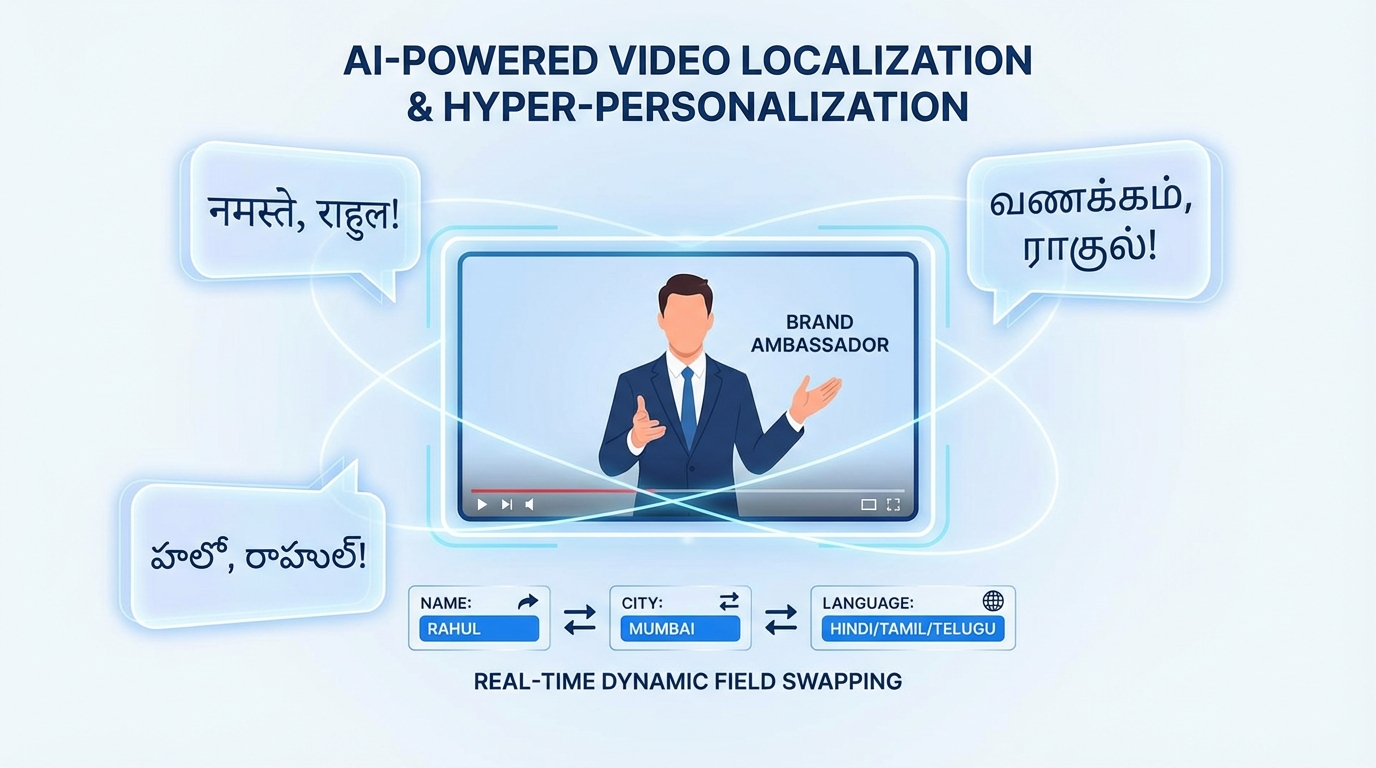
- Hyper-Personalization at Scale: The ability to inject dynamic variables such as name, city, last purchase, and even specific product images into the video render. This ensures that a customer in Bengaluru receives a different visual and auditory experience than one in Lucknow, even if the core message remains the same.
- Virtual Reshoots and AI Editing: Traditional video production is linear and expensive. Modern platforms allow for “virtual reshoots,” where lines or offers can be changed post-production without the talent ever returning to the studio. This allows for rapid A/B testing of creative variants.
- Multilingual Localization: With perfect lip-sync and voice consistency, a single master shoot can be localized into dozens of regional languages. This is critical for the Indian market, where regional language content often outperforms English or Hindi in terms of engagement.
- API-First Integrations: Real-time triggers are the lifeblood of personalized marketing. Whether it is a cart abandonment event or a milestone celebration, the platform must respond within seconds to generate and deliver the video asset.
- Performance and Security: A cloud-agnostic GPU farm is necessary to maintain sub-30-second render-to-delivery targets. Furthermore, compliance with ISO 27001, SOC 2, and the DPDP Act is non-negotiable for handling sensitive customer PII (Personally Identifiable Information).
TrueFan AI has demonstrated these capabilities through record-breaking campaigns, such as delivering 354,000 personalized videos in a single day for Zomato and over 2.4 million greetings for Hero MotoCorp. These benchmarks set the standard for what “scale” looks like in the Indian enterprise context.
Sources:
Architecture Blueprint: Mastering AI Video API Integration and Pipeline Orchestration
To achieve the level of performance required by India’s top-tier brands, the underlying technical architecture must be robust and latency-sensitive. The AI video API integration process is a multi-stage pipeline that begins with event ingestion and ends with deep-funnel measurement. For a CTO, the primary concern is how this pipeline interacts with the existing data warehouse and customer engagement platforms without introducing security vulnerabilities or performance bottlenecks.
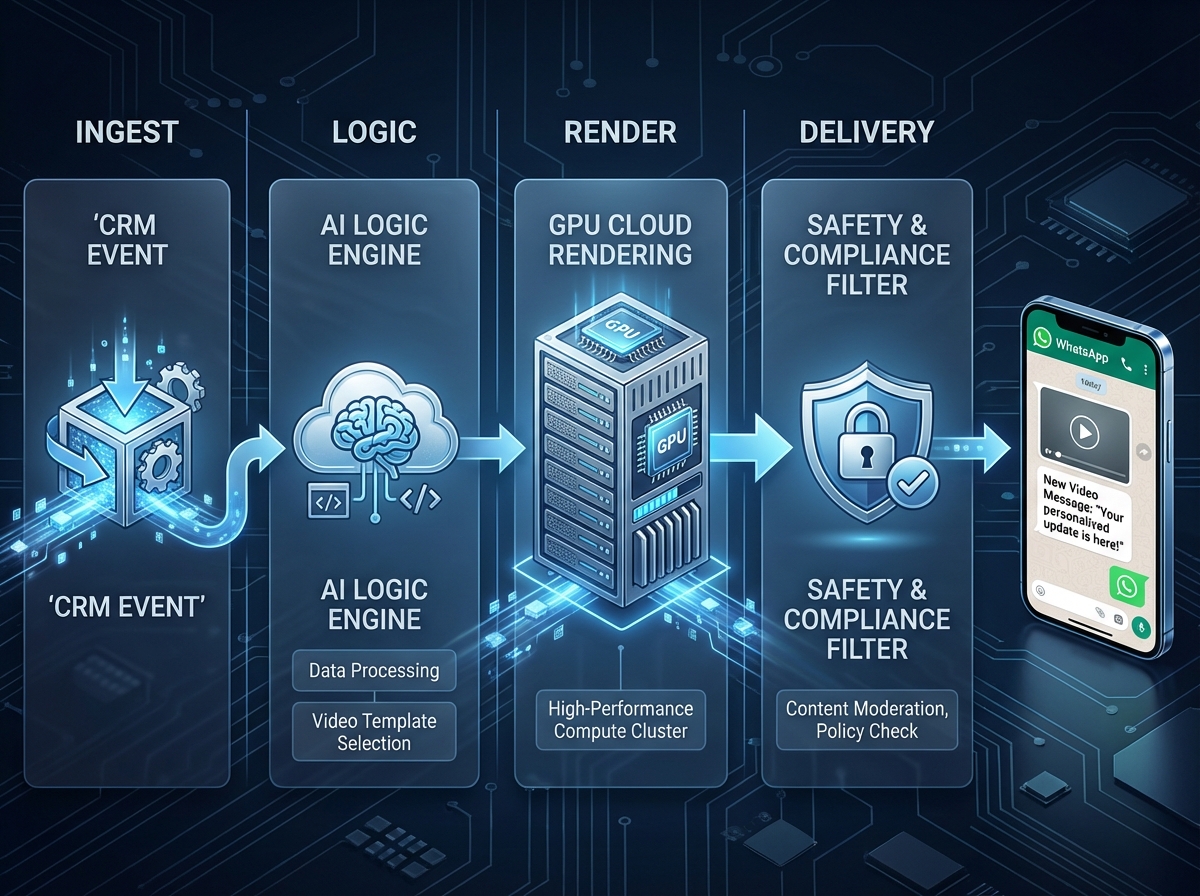
The pipeline stages are precisely defined as follows:
- Event Ingest: A CRM or CDP event (e.g., a high-value customer reaching a loyalty tier) triggers a request. This payload includes PII fields that must be gated by explicit consent flags, ensuring compliance with the DPDP Act’s purpose limitation principles. Refer to the interactive video data capture guide.
- Template Selection and Logic: The system selects the appropriate template ID based on the user’s segment. Variant rules are applied to determine the language, offer tier, and dynamic assets (like a specific product SKU) to be featured.
- Render Orchestration: The personalization payload is sent to a queue on a high-performance GPU cluster. Here, the AI models perform lip-syncing and voice cloning, while a policy moderation pass ensures the content adheres to brand safety standards.
- Delivery and Measurement: Once rendered, a signed URL and thumbnail are generated. These are delivered via WhatsApp, Email, or SMS. Webhooks then track delivery, open, and watch rates, writing this data back to the CDP to close the loop on attribution. Learn more about WhatsApp business commerce automation.
Target Service Level Objectives (SLOs) for an enterprise AI video platform India are stringent. P95 render times must be under 30 seconds to ensure the video is relevant to the “moment of intent.” API uptime must exceed 99.9%, and content moderation must happen in near real-time. Security touchpoints, including encryption at rest and in transit, are mandatory. By aligning with the Digital Personal Data Protection Act 2023, platforms ensure that customer data is handled with the highest level of integrity, providing audit trails that are essential for regulatory compliance.
Sources:
Strategic Use Cases: Driving AI-Powered Marketing Transformation Across the Funnel
The true value of an enterprise AI video platform India is realized through its application across the entire customer lifecycle. From acquisition to retention, personalized video serves as a high-impact tool for driving conversions and building long-term loyalty. Indian brands have been at the forefront of this innovation, utilizing celebrity-led content to create emotional resonance at scale.
In the Acquisition phase, programmatic reach-outs via WhatsApp or Email can feature a celebrity greeting the user in their native tongue immediately after their first site visit. This “wow factor” significantly lowers the cost of customer acquisition (CAC). For example, Zomato’s Mother’s Day campaign utilized this strategy to engage hundreds of thousands of users simultaneously, creating a viral loop of shared personalized content.
For Activation and Conversion, re-engagement videos can be triggered by cart abandonment. Instead of a generic “You forgot something” email, a personalized video showing the specific product and offering a contextual discount can drive a much higher click-through rate (CTR). Goibibo’s use of WebEngage workflows to call video APIs has shown a documented uplift in read and engagement rates, proving that visual personalization is superior to text-based nudges. See more in our note on quick commerce video personalization in India.
Retention and Loyalty use cases are perhaps the most impactful in the Indian context. Lifecycle greetings for festivals like Diwali or personal milestones like birthdays foster a deep connection between the brand and the consumer. Hero MotoCorp’s festive campaign, which delivered 2.4 million personalized greetings, not only increased brand sentiment but also drove measurable footfall to local dealerships. In the B2B sector, companies like Cipla have used personalized videos for Doctor’s Day, providing a high-touch, professional recognition that strengthens HCP (Healthcare Professional) relationships.
Sources:
Measuring Success: The Framework for Enterprise AI ROI Metrics
As enterprises scale their investments, the ability to quantify the impact of generative AI marketing India becomes paramount. Solutions like TrueFan AI demonstrate ROI through a multi-dimensional metrics taxonomy that looks beyond simple view counts. CMOs must track topline growth, mid-funnel efficiency, and bottom-line cost savings to present a holistic view of the technology's value to the board.
The Topline Metrics include incremental revenue, LTV (Lifetime Value) uplift, and churn reduction. A sample ROI calculation for an Indian e-commerce giant might look like this: If a control group has a conversion rate (CVR) of 3.0% and the personalized video group achieves 4.2% on a campaign of 1 million sends with an average order value (AOV) of ₹2,000, the incremental revenue generated is approximately ₹24,000,000. This clear attribution is what makes the business case for AI-powered marketing transformation undeniable.
Mid-funnel Metrics focus on engagement quality. Watch-through rates (WTR) at 25%, 50%, 75%, and 95% provide insights into creative resonance. If users are dropping off at the 50% mark, it signals a need to optimize the script or the placement of the personalized element. Cost Efficiency is the third pillar, measuring the production cost delta. Traditional shoots for a 5-language, 10-product campaign could take six weeks and millions of rupees. With AI virtual reshoots, these updates can be made in a single day, saving thousands of man-hours and shifting production from a CapEx to an OpEx model.
An enterprise AI ROI metrics dashboard should offer filters by campaign, template, language, and persona. This allows marketing teams to identify which segments are responding best to personalization and reallocate budget in real-time. By institutionalizing this data-driven approach, organizations can move away from “spray and pray” tactics toward a highly optimized, high-yield marketing engine.
Sources:
Operating Model and Change Management for Enterprise AI Adoption India
Transitioning to a scalable personalized video SaaS requires more than just technical integration; it necessitates a shift in organizational structure and operating models. The most successful Indian enterprises are establishing “AI Centers of Excellence” (CoE) that bring together the CMO’s growth teams and the CTO’s integration and security squads. This cross-functional approach ensures that creative vision is always aligned with technical feasibility and compliance requirements.
The Content Operations framework must include template governance and approval workflows. Brand and legal teams must pre-approve scripts and placeholder policies to prevent any unauthorized or off-brand content from being generated. Automated moderation filters are essential for blocking profanity or politically sensitive topics, providing a safety net for the brand’s reputation.
When it comes to Enterprise AI Adoption India, the roadmap typically follows a three-stage process:
- Pilot (4–6 weeks): Focus on a single high-impact use case, such as welcome greetings or cart recovery, and establish a baseline against a control group.
- Scale (8–16 weeks): Expand to multiple languages and channels, integrating the video API into the broader warehouse feedback loop for real-time optimization.
- Globalize (Ongoing): Standardize governance templates across different business units and introduce new talent avatars to keep the content fresh and engaging.
The “Build vs. Buy vs. Partner” debate is also central to this transition. While building an in-house solution offers maximum control, the high costs of model training, infrastructure maintenance, and celebrity licensing often make it prohibitive. Buying a proven platform provides faster time-to-value and baked-in compliance. Partnering with an AI marketing agency India can further accelerate results by combining platform capabilities with expert creative storytelling and media orchestration. See these DPDP-compliant personalization strategies.
Sources:
Buyer’s Checklist: Evaluating the Best AI Tech Companies India
Selecting the right partner from the pool of the best AI tech companies India requires a rigorous evaluation process. Marketing and technology leaders must look beyond the user interface and scrutinize the platform’s ability to handle enterprise-scale demands, security protocols, and integration complexities. The following checklist serves as a guide for shortlisting vendors who can truly deliver on the promise of AI-powered marketing transformation.
| Evaluation Dimension | Critical Requirements |
|---|---|
| Integration Depth | Does the platform offer native connectors for Salesforce, WebEngage, and Braze? Are there robust SDKs and a sandbox environment for testing? |
| Scale & Performance | What are the P95 render SLAs? Can the platform handle millions of variants per day? Is there a global CDN strategy for low-latency delivery? |
| Personalization Power | Does it support dynamic scenes, product feeds, and 175+ languages? How accurate is the name pronunciation across diverse Indian dialects? |
| Governance & Security | Is the platform ISO 27001 and SOC 2 certified? Does it align with the DPDP Act 2023? Is there support for SSO/SAML and VPC isolation? |
| ROI Instrumentation | Does the platform provide built-in A/B testing and lift attribution? Is there a dashboard for tracking cost savings and incremental revenue? |
| Consent Management | Are there formal contracts for all celebrity likenesses? Is there a clear workflow for capturing and honoring customer consent? |
As the AI Impact Summit 2026 TrueFan sessions have highlighted, the future of marketing is not just about being “digital-first” but “AI-native.” The organizations that successfully integrate these technologies today will be the ones that define the consumer landscape of tomorrow. By focusing on ROI, security, and scale, Indian enterprises can lead the world in the responsible and impactful use of generative AI.
Sources:
Recommended Internal Links
Frequently Asked Questions
What makes an enterprise AI video platform India different from generic AI tools?
An enterprise AI video platform India is built specifically for the needs of large-scale organizations. Unlike generic tools, it offers API-first integration, guaranteed SLAs for rendering, and robust governance frameworks. It is designed to handle millions of personalized videos while ensuring compliance with Indian regulations like the DPDP Act and maintaining high standards of brand safety and security (ISO 27001/SOC 2).
How does AI video API integration work with Salesforce, WebEngage, or Braze?
The integration works through a seamless event-trigger system. When a specific customer action occurs in Salesforce or WebEngage (like a purchase or a milestone), a payload is sent to the video platform’s API. This payload contains the personalization data. The platform then renders the video using a pre-approved template and delivers it back to the customer via the chosen channel (WhatsApp, email, etc.), while simultaneously sending engagement data back to the CRM. For implementation patterns, see the interactive video data capture primer.
Are personalized videos generated by TrueFan AI DPDP-compliant?
Yes, compliance is a core pillar of the platform. TrueFan AI ensures that all data processing aligns with the Digital Personal Data Protection Act 2023. This includes implementing consent-first workflows, adhering to purpose limitation, providing clear opt-out mechanisms, and maintaining strict data retention and residency policies. Learn more about DPDP-compliant personalization strategies.
What enterprise AI ROI metrics should we track from day one?
Enterprises should focus on a mix of engagement and financial metrics. Key indicators include Click-Through Rate (CTR), Conversion Rate (CVR), and Watch-Through Rate (WTR). From a financial perspective, tracking the reduction in Customer Acquisition Cost (CAC), the uplift in Lifetime Value (LTV), and the production cost savings compared to traditional video shoots is essential for demonstrating value.
How do we compare vendors among the best AI tech companies India?
When evaluating vendors, prioritize those with proven scale (millions of videos delivered), deep integration capabilities, and a strong security posture. Look for companies that offer comprehensive support, from creative onboarding to technical implementation, and those with a clear roadmap for staying ahead of generative AI trends while maintaining regulatory compliance.



