AI Impact Summit TrueFan: The Enterprise AI Video Platform Powering Agentic, LLM‑Agnostic Marketing at Scale
Estimated reading time: ~11 minutes
Key Takeaways
- Enterprise execution over experiments: India AI Impact Summit 2026 emphasized moving from PoCs to API-triggered, integrated video personalization.
- LLM‑agnostic architecture: Neutral orchestration enables cost, latency, and data‑residency optimization without vendor lock‑in.
- Agentic, multi‑agent workflows: Specialized agents with deterministic guardrails and human‑in‑the‑loop deliver reliability and quality.
- Compliance‑by‑design: DPDP‑aligned consent, audit logs, and moderation protect brands while scaling personalization.
- Proven ROI at scale: Sub‑30s rendering, WhatsApp distribution, and multilingual localization drive measurable lifts across industries.
The India AI Impact Summit 2026, held on February 19–20 in New Delhi, served as a definitive turning point for the nation’s digital ecosystem. As over 300 exhibitors from 30+ countries gathered across ten thematic pavilions, the primary focus shifted from experimental generative models to robust, enterprise-grade execution. The AI Impact Summit TrueFan presence highlighted a critical evolution in how CTOs and marketing leaders approach hyper-personalization at a population scale.
For the modern enterprise, the challenge is no longer just generating content, but orchestrating it within a secure, compliant, and highly integrated framework. Platforms like TrueFan AI enable large-scale organizations to bridge the gap between raw LLM capabilities and measurable business outcomes. By focusing on agentic workflows and LLM-agnostic architectures, the summit showcased how India’s flagship AI initiatives are moving toward responsible, high-impact deployment.
As the AWS Gen AI/ML Disruptor of the Year, the insights shared during the summit underscored a new mandate for CTOs: the transition from “pilot purgatory” to integrated, API-triggered video personalization. This shift is essential for maintaining a competitive edge in a market where last-mile adoption and execution speed are the primary differentiators for 2026.
Sources:
What CTOs Learned at the AI Impact Summit from TrueFan
The consensus among technology leaders at the summit was clear: enterprise AI video personalization is officially crossing the chasm. We are moving away from isolated Proof of Concepts (PoCs) toward deeply embedded systems that are triggered by real-time data across CRM, MAP, and CDP platforms. This evolution requires a sophisticated orchestration layer that can handle dynamic data injection—such as names, purchase history, and location—while maintaining sub-30-second rendering speeds.
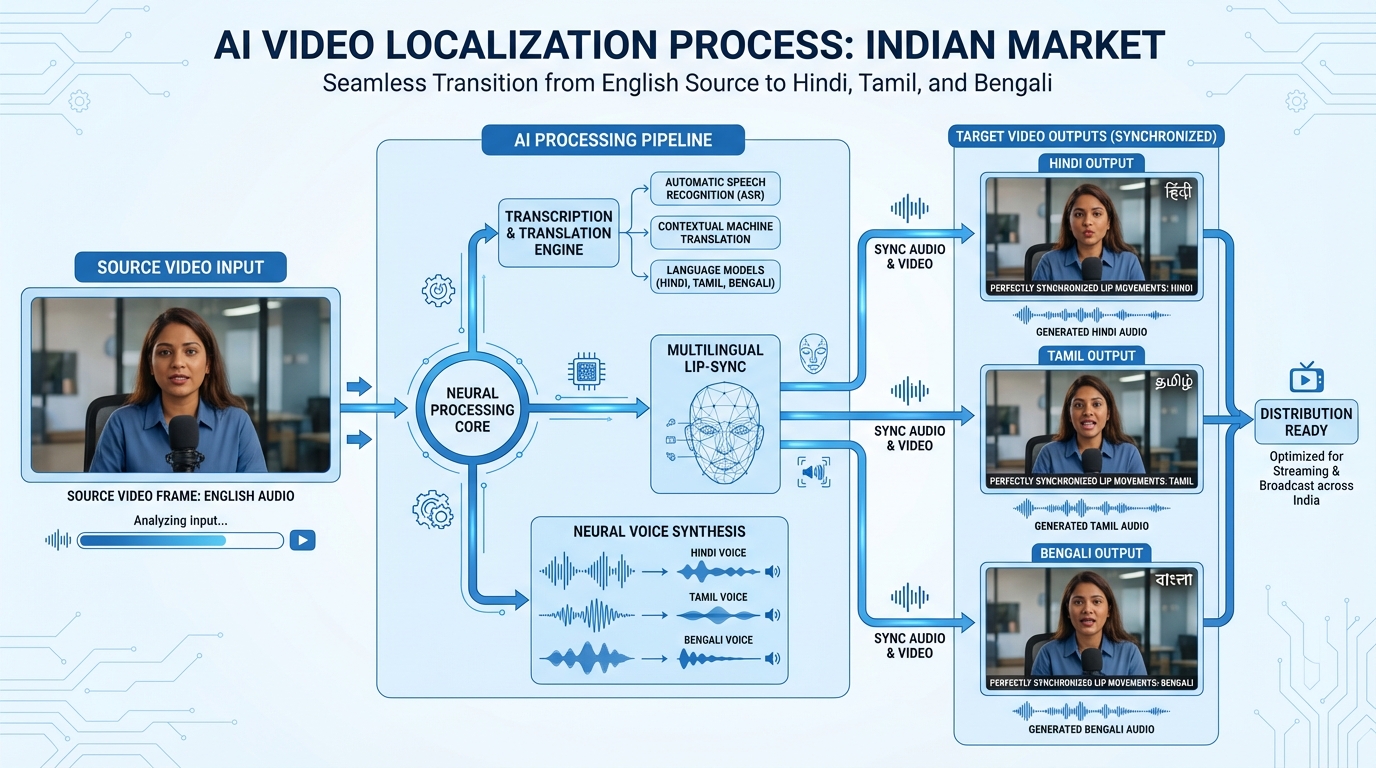
One of the most significant takeaways for an enterprise AI video platform India is the necessity of multilingual localization at scale. In a diverse market like India, “personalization” is incomplete without linguistic relevance. The summit highlighted how the best AI tech companies are now delivering neural voice and lip-sync capabilities that feel native, rather than synthetic. This level of detail is what transforms a standard marketing message into a high-converting, emotionally resonant experience.
Furthermore, the IndiaAI Mission’s emphasis on responsible intelligence has forced a rethink of AI governance. CTOs are now prioritizing “compliance-by-design,” ensuring that every personalized video generated is backed by explicit consent and adheres to the Digital Personal Data Protection (DPDP) Act. The focus has shifted from “what can we build” to “how can we scale responsibly,” with a heavy emphasis on avoiding “agent-washing” in favor of verifiable last-mile value.
Sources:
- IndiaAI Mission Responsible AI
- Agentic AI Last‑Mile Adoption - Analytics India Magazine
- TrueFan AI Blog: Summit Insights
What an Enterprise AI Video Platform in India Must Deliver
To be considered a true enterprise AI video platform India, a solution must offer more than just creative generation; it must provide a secure, API-first stack that integrates seamlessly into existing enterprise architecture. This means moving beyond standalone tools to a comprehensive SaaS model that turns first-party data into compliant, hyper-personalized video experiences. The platform must offer rigorous SLAs for latency, throughput, and availability to support millions of unique renders daily.
A scalable personalized video SaaS must be capable of plugging directly into the messaging rails that dominate the Indian market, particularly the WhatsApp Business API. TrueFan AI's 175+ language support and Personalised Celebrity Videos demonstrate how this scale is achieved by combining high-fidelity AI avatars with robust distribution connectors. This allows enterprises to trigger personalized videos for high-value events, such as cart abandonment or festive greetings, without manual intervention.
Security and governance are the non-negotiable pillars of this delivery. In 2026, the GRC (Governance, Risk, and Compliance) baseline includes ISO 27001 and SOC 2 controls, alongside audience-level consent flags. For enterprises dealing with celebrity likenesses, the platform must ensure a consent-first approach, with audit logs and content moderation filters that prevent the generation of sensitive or off-brand content. This ensures that the brand's reputation is protected while leveraging the power of celebrity-led engagement.
Sources:
Under the Hood: AI Orchestration Layers and LLM‑Agnostic Architecture
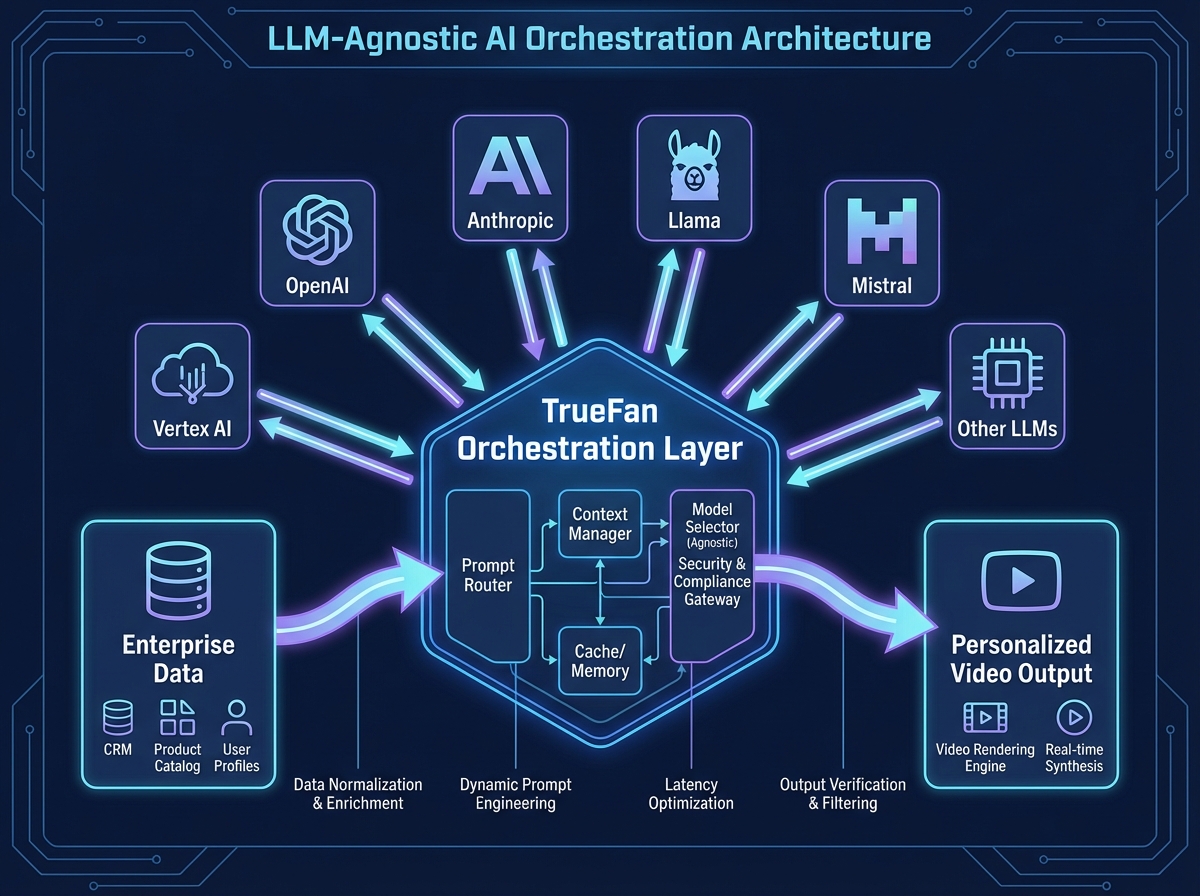
The technical architecture of a modern AI platform must be built on LLM agnostic solutions. This approach prevents vendor lock-in by providing a neutral abstraction layer that can route prompts and generation tasks across multiple model providers—such as OpenAI, Anthropic, or local Llama instances—based on specific requirements for cost, latency, and data residency. This flexibility is crucial for enterprises that need to optimize their AI spend while maintaining high performance.
At the heart of this architecture are AI orchestration layers. These layers manage the complex workflows required for enterprise-grade reliability, including PII handling, Retrieval-Augmented Generation (RAG), and prompt guardrails. By decoupling the business logic from the underlying foundation models, organizations can swap or upgrade models as the technology evolves without rewriting their entire integration stack. This modularity is what separates a “wrapper” from a true enterprise platform.
Multi-agent AI workflows further enhance this reliability by employing specialized agents for different stages of the video production pipeline. For example, one agent might handle script generation based on brand guidelines, while another focuses on QA and pronunciation accuracy, and a third optimizes the creative for specific audience segments. This collaborative approach, governed by deterministic checkpoints and human-in-the-loop overrides, ensures that the final output meets the highest standards of quality and compliance.
Agentic AI marketing represents the next frontier, where autonomous agents not only generate content but also plan, test, and learn from engagement signals. By feeding real-time data—such as watch time and CTR—back into the agent policies, the system can continuously optimize messaging and offers. As an AWS Gen AI disruptor, the focus remains on low-latency GPU rendering and deep observability, ensuring that these agentic systems deliver measurable ROI rather than just technical novelty.
Sources:
Outcomes That Matter: ROI, Scale, and Speed
The true measure of any scalable personalized video SaaS is its ability to deliver tangible business outcomes. Solutions like TrueFan AI demonstrate ROI through significant lifts in engagement and conversion metrics across diverse industries. For instance, during a Mother’s Day campaign, Zomato successfully deployed 354,000 personalized videos in a single day, driving massive emotional virality and a measurable increase in order volume. This level of concurrency is a prerequisite for any enterprise-scale deployment in India.
Similarly, Hero MotoCorp utilized personalized video to send 2.4 million New Year wishes, which directly drove offline service camp visits. This bridge between digital personalization and physical action is a key indicator of best AI tech companies India. Other notable benchmarks include:
- Goibibo: Achieved a 17% higher WhatsApp read rate using personalized celebrity videos compared to standard text-based messages.
- Dainik Bhaskar: Saw a 3.2× increase in contest participation through personalized video invites versus traditional email outreach.
- Operational Efficiency: Enterprises have reported saving over 3,800 creative hours by utilizing virtual reshoots and AI-driven edits, allowing for rapid campaign iterations.
For a CTO, the “Build vs. Buy” decision often hinges on these performance metrics. A checklist for evaluation must include LLM agnosticism, multi-agent reliability, and DPDP-aligned security. The goal is to achieve a 90-day blueprint that moves from a controlled pilot to full-scale orchestration, with clear KPI gates at every stage. By focusing on media substitution economics and faster localization, enterprises can justify the investment through both top-line growth and operational savings.
Sources:
The Road Ahead: AI Marketing Thought Leadership from TrueFan
As we look toward the remainder of 2026 and beyond, AI marketing thought leadership is centering on the convergence of real-time avatars and advanced safety governance. The next generation of synthetic media will feature even stricter consent protocols, including digital watermarking and comprehensive audit trails to prevent misuse. The India AI Impact Summit highlighted that as AI becomes more pervasive, the responsibility of the enterprise to mitigate harm and ensure transparency becomes a core business function.
Preparing for this future requires a strategic approach to data and team structure. Organizations must move toward “PII minimization” while simultaneously enriching their first-party data with consent flags and schema mapping for deep personalization. Teams are also evolving, with the rise of “Creative + Engineering” pods that manage prompt operations and governance councils. This interdisciplinary approach is essential for managing the complexities of agentic systems.
The “Agentic Era” is not just about automation; it is about creating an operating layer for enterprise intelligence. This involves moving beyond the hype of generative AI to focus on pragmatic adoption that solves real-world business problems. Whether it is aiding e-commerce buildouts or automating complex content supply chains, the focus remains on verifiable value and deterministic guardrails.
Sources:
See It in Action
The transition to agentic, personalized marketing is no longer a future concept—it is a current competitive necessity. For CTOs and innovation leaders, the AI Impact Summit TrueFan showcase provided a clear roadmap for integrating these technologies into the enterprise stack. By leveraging a scalable personalized video SaaS that is both LLM agnostic and built on multi-agent AI workflows, organizations can deliver unprecedented value to their customers.
As an AWS Gen AI disruptor, TrueFan AI is uniquely positioned to help Indian enterprises navigate this transformation. Whether you are looking to enhance your CRM triggers or revolutionize your festive outreach, the time to move from pilot to production is now.
Request an enterprise demo and architecture deep-dive today to see how you can personalize your next micro-campaign and measure funnel lift within two weeks.
Sources:
Recommended Internal Links
- Agentic AI Marketing Strategies for Multi-Agent Workflows
- Agentic AI Marketing in India: Enterprise Video ROI
- ONDC Personalized Video Onboarding: 2026 Playbook Guide
- Mother-Child Wellness Marketing 2026: Personalized Videos
- 80C Investment Personalized Videos for March 31 Tax Rush
Frequently Asked Questions
What makes an enterprise AI video platform enterprise-ready in India?
An enterprise-ready platform in India must prioritize security, DPDP Act compliance, and seamless integration with local messaging rails like WhatsApp. It requires a robust AI orchestration layer that ensures low-latency rendering (sub‑30s) and high concurrency to handle millions of videos during peak festive seasons.
How do multi-agent AI workflows improve reliability vs. single-agent tools?
Multi-agent AI workflows distribute tasks among specialized agents—such as scriptwriters, compliance checkers, and QA monitors. This modular approach allows for deterministic guardrails and human-in-the-loop overrides at critical stages, ensuring the output is accurate, on-brand, and compliant, which is often a failure point for single-agent tools.
How does LLM agnosticism reduce vendor lock-in risk?
LLM agnostic solutions provide a layer of abstraction between the application and the foundation model. This allows enterprises to switch between models (e.g., from GPT‑4 to a specialized local model) based on cost, performance, or changing regulatory requirements without having to rebuild their entire marketing automation stack.
What kind of ROI can be expected from TrueFan AI in the first 90 days?
Within the first 90 days, enterprises typically see a significant uplift in engagement metrics, such as a 15–20% increase in CTR or read rates on platforms like WhatsApp. Operational ROI is also realized through the reduction of creative production cycles and the ability to localize content into 175+ languages instantly.
How is consent managed for celebrity likeness in personalized videos?
TrueFan AI employs a consent-first framework where all celebrity likenesses are legally contracted and protected. The platform includes automated moderation and audit trails to ensure that every video generated stays within the pre-approved creative boundaries and respects the rights of the talent.