AI Impact Summit TrueFan: Scaling Enterprise AI Video Personalization in India with Agentic, Multi‑Agent Workflows
Estimated reading time: ~11 minutes
Key Takeaways
- Enterprises can leap from pilot to platform with agentic, multi‑agent workflows that automate end‑to‑end campaign execution.
- LLM‑agnostic architectures future‑proof stacks, optimize cost/latency, and prevent vendor lock‑in.
- Success in India requires vernacular localization (175+ languages), voice retention, and perfect lip‑sync at scale.
- ISO 27001 and SOC 2 compliance with consent-first governance is essential under the DPDP Act.
- Track ROI metrics like CTR/CVR uplift, AOV delta, production savings, and governance adherence for measurable impact.
- Audience: CTOs, innovation heads, and marketing transformation leaders evaluating enterprise-grade, LLM-agnostic video personalization that automates marketing via agentic, multi‑agent AI workflows at scale in India.
- Search Intent: Strategic and technical guidance on transitioning from generative AI pilots to production-scale video personalization within the Indian regulatory and market landscape.
At AI Impact Summit TrueFan, India’s flagship AI gathering in New Delhi (19–20 Feb 2026), enterprise leaders saw how video personalization can leap from pilot to platform. Hosted at Bharat Mandapam under the aegis of the IndiaAI Mission, the summit underscored a national mandate for responsible, multilingual AI that serves a diverse population. With India’s AI market projected to reach $17 billion by 2027, the urgency for enterprise AI adoption India has never been more pronounced for brands seeking a competitive edge.
Why AI Impact Summit TrueFan 2026 matters for enterprise marketing leaders
The AI Impact Summit TrueFan 2026 served as a pivotal junction for the IndiaAI Mission, bringing together over 300 exhibitors and global policy leaders to define the future of sovereign AI. This summit was not merely a showcase of technology but a governance-first forum where the Ministry of Electronics and Information Technology (MeitY) emphasized inclusive and ethical deployment. For marketing leaders, the event signaled a shift from experimental “toy” applications to robust, production-ready systems capable of handling India's massive demographic scale.
The broader ecosystem validation at the summit, including participation from international bodies and multi-stakeholder side events, highlighted the maturity of the Indian AI landscape. Discussions centered on the Digital Personal Data Protection (DPDP) Act and the necessity for localized, vernacular-first communication strategies. This environment provided the perfect backdrop for demonstrating how generative AI marketing transformation is moving beyond text and static images into the realm of hyper-personalized, high-fidelity video.
As enterprise AI adoption India accelerates, the summit highlighted that the primary challenge is no longer the “if” but the “how” of scaling these technologies. Leaders are now prioritizing solutions that offer multilingual excellence and compliance-first architectures to navigate the complexities of the Indian market. The 2026 summit effectively established the blueprint for how enterprises can integrate agentic workflows to drive meaningful customer engagement across millions of touchpoints.
Sources:
- India AI Impact Summit 2026 Overview
- About the Summit and IndiaAI Mission
- NASSCOM-BCG Report on India’s AI Market
Inside an enterprise AI video platform India can scale on today
An enterprise AI video platform India requires must be more than a simple video generator; it must be a secure, API-first ecosystem that integrates seamlessly with existing MarTech stacks. Such a platform enables a brand to take a single approved celebrity or executive shoot and transform it into millions of hyper-personalized assets. Platforms like TrueFan AI enable this transition by offering sub-30 second render latency and horizontal scalability that meets the demands of India’s largest consumer brands.
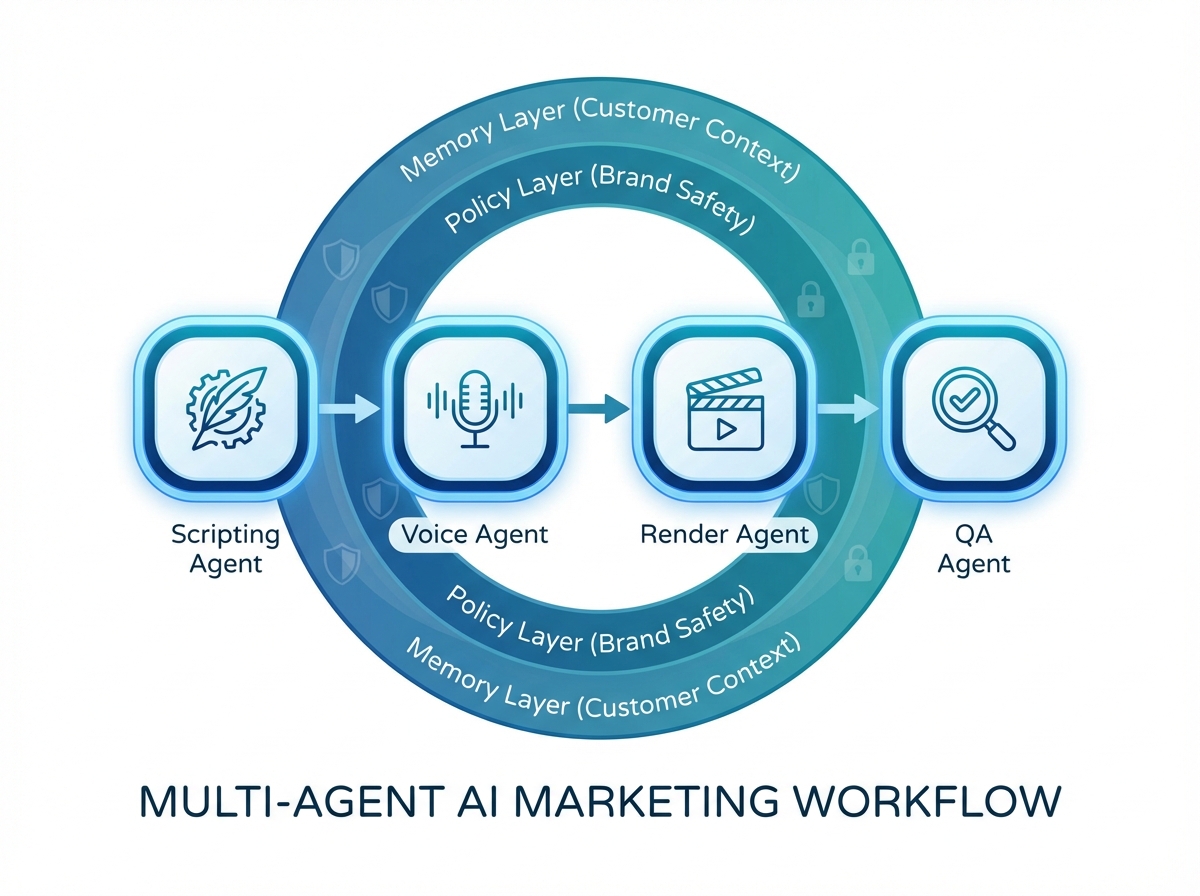
The technical capabilities of a modern enterprise platform include dynamic data injection, where variables such as names, cities, and specific offer codes are woven into the video script in real-time. Beyond text, dynamic overlays allow for the insertion of product images or user-specific photos, creating a “virtual reshoot” environment that eliminates the need for expensive physical production. This agility allows marketing teams to iterate on creative messaging in hours rather than weeks, significantly reducing the time-to-market for complex campaigns.
Localization is the cornerstone of success in the Indian market, requiring support for 175+ languages with native voice retention and perfect lip-sync. A scalable personalized video SaaS must handle these variations while maintaining ISO 27001 and SOC 2 compliance to protect sensitive customer data. By integrating with CRMs like Salesforce or CDPs like Braze and Clevertap, these platforms can trigger personalized video delivery via WhatsApp, email, or microsites the moment a customer interacts with a brand.
Sources:
Agentic AI marketing powered by multi-agent AI workflows
The next frontier of digital transformation is agentic AI marketing, where autonomous or semi-autonomous agents plan and execute complex marketing tasks with minimal human intervention. In this model, a network of specialized agents—ranging from scriptwriters to brand compliance monitors—works in concert to deliver end-to-end campaign execution. This multi-agent AI workflows approach ensures that every video generated meets strict brand guidelines and legal requirements before it ever reaches a consumer.
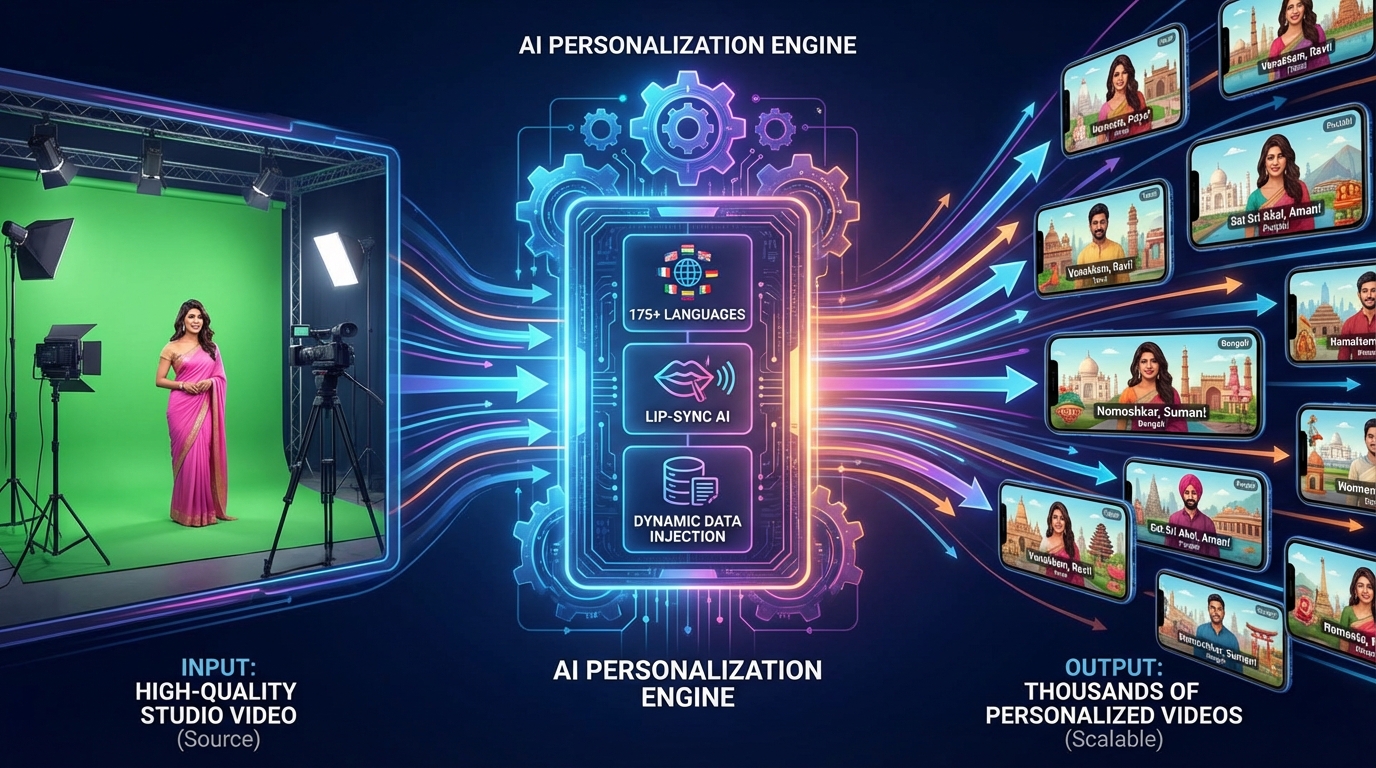
The architecture of these workflows relies on sophisticated AI orchestration layers that manage the policy, memory, and execution phases of a campaign. A “Policy Layer” acts as a deterministic guardrail, ensuring that no generated content violates profanity filters or political blocklists. Meanwhile, the “Memory Layer” draws context from the brand’s CDP, allowing agents to understand a customer’s previous purchase history and preferences to craft a truly unique narrative.
A typical implementation blueprint involves an event trigger, such as a cart abandonment, which activates the agentic chain. A Scripting Agent generates a personalized message, a Voice Agent clones the brand ambassador’s voice with perfect regional dialect, and a Render Agent produces the final video. This entire process is governed by a Quality Assurance Agent that performs a final check against a pronunciation lexicon and brand safety standards, ensuring a closed-loop system of continuous optimization.
Sources:
LLM agnostic video solutions and future‑proof stack design
To avoid vendor lock-in and ensure long-term resilience, enterprises are increasingly adopting LLM agnostic video solutions. This architecture utilizes a routing layer that dynamically selects the most appropriate foundation model for a specific task based on cost, latency, and quality SLAs. For instance, a low-cost model might handle initial script drafts, while a premium model is reserved for high-visibility segments or complex dialect translations.
TrueFan AI's 175+ language support and Personalised Celebrity Videos are built upon this flexible foundation, allowing for rapid upgrades as new models emerge in the market. This routing policy can be risk-aware, ensuring that sensitive data from sectors like BFSI or healthcare is processed only through private, dedicated endpoints. By maintaining model neutrality, enterprises can optimize their token budgets and ensure that their video personalization efforts remain at the cutting edge of generative AI performance.
Infrastructure considerations for such a stack include the ability to deploy within a private VPC or utilize on-premise inference for maximum data residency control. Observability is equally critical, with dashboards tracking latency buckets, hallucination flags, and model performance across different locales. This level of technical rigor ensures that the generative AI marketing transformation is not just innovative but also sustainable and auditable at an enterprise scale.
Sources:
From pilot to platform: Generative AI marketing transformation at scale
Transitioning from one-off AI experiments to an “always-on” personalization fabric requires a fundamental shift in the enterprise operating model. This involves establishing an AI Center of Excellence (CoE) that defines brand guardrails and builds reusable prompt libraries and pronunciation dictionaries. By embedding these agentic policies into the daily workflow, creative and legal teams can move from manual reviewers to strategic governors of the AI system.
Solutions like TrueFan AI demonstrate ROI through a structured 30/60/90 day implementation blueprint designed for rapid value realization. In the first 30 days, the focus is on use-case selection and establishing governance protocols for high-impact journeys like customer onboarding or retention. By day 60, the pilot agentic workflows are launched with A/B testing across multiple channels, and by day 90, the system is fully integrated into the brand’s CRM for automated, large-scale delivery.
The impact of this transformation is visible in the massive scale achieved by Indian market leaders. For example, Zomato’s Mother’s Day campaign generated 354,000 unique videos in a single day, while Hero MotoCorp delivered 2.4 million festive greetings to its customer base. These milestones prove that when generative AI is operationalized correctly, it can save thousands of creative production hours—specifically, an aggregate of 3,888 hours saved across enterprise programs—while driving unprecedented engagement.
Sources:
Measuring impact: Video personalization ROI metrics that matter
To justify the investment in a scalable personalized video SaaS, CTOs must track a specific set of performance indicators that go beyond vanity metrics. The primary measure of success is the CTR uplift, calculated as (CTR_personalized − CTR_control) / CTR_control × 100. In real-world applications, brands like Goibibo have seen a 17% higher WhatsApp read rate when utilizing personalized video nudges compared to standard text-based communications. See the enterprise video ROI metrics guide.
Conversion Rate (CVR) uplift and Average Order Value (AOV) delta are equally critical for measuring the bottom-line impact of personalization. For instance, Dainik Bhaskar observed a 3.2× higher participation rate in reader contests when invitations were delivered via personalized celebrity videos. These results contribute to a faster CAC payback period, which is determined by dividing the total Customer Acquisition Cost by the gross margin per converted user per day.
Beyond direct revenue, production savings and governance adherence rates are vital for operational efficiency. The reduction in time-to-market—often exceeding 80%—allows brands to respond to market trends in real-time. As an AWS Gen AI disruptor, the ability to leverage cloud-native scalability ensures that even during peak festive loads, the cost per video remains optimized, providing a sustainable path for long-term marketing transformation.
Sources:
Security, compliance, and the ISO 27001 certified AI platform
In the era of the DPDP Act, security is not an optional feature but a foundational requirement for any enterprise AI video platform India adopts. An ISO 27001 certified AI platform ensures that information security management systems are in place to handle risk, controls, and continuous improvement. This is further bolstered by SOC 2 Type II compliance, which provides an independent audit of the platform's service controls related to security, availability, and confidentiality.
A robust governance framework must include a “Consent-First” registry, ensuring that every celebrity likeness and user data point is used only with explicit, revocable permission. Content moderation filters must be active at the API level to block unauthorized or harmful content, such as political slogans or defamatory text. These deterministic filters act as a secondary layer of protection, ensuring that the generative output always aligns with the brand’s ethical standards and legal obligations.
Deployment flexibility is another key component of enterprise security, with options for private VPC hosting or on-premise inference for highly sensitive workloads. Role-based access control (RBAC) and SSO integration ensure that only authorized personnel can manage the agentic workflows and access the audit logs. By prioritizing these compliance measures, enterprises can confidently scale their AI video initiatives while mitigating the risks associated with synthetic media and data privacy.
Sources:
Recommended Internal Links
Frequently Asked Questions
What is the typical render latency for a million-scale video campaign?
For an enterprise-grade platform, the target render latency is typically under 30 seconds per video. This is achieved through a cloud-native GPU farm and optimized inference pipelines that allow for horizontal scaling, enabling the generation of hundreds of thousands of unique videos in a single day without performance degradation.
How does the platform handle dialect accuracy across 175+ languages?
The system utilizes LLM-agnostic routing to send translation and voice cloning tasks to the best-performing models for specific regional dialects. This is supplemented by a custom pronunciation lexicon and, in high-stakes scenarios, a human-in-the-loop gating process to ensure linguistic nuances and cultural sensitivities are preserved.
Is the platform compliant with India’s DPDP Act?
Yes. A leading enterprise AI video platform for India is designed with DPDP alignment at its core, including data residency controls, explicit consent management for both talent and end-users, and PII redaction so sensitive information never reaches underlying foundation models during generation.
Can we integrate these agentic workflows with our existing Salesforce or Braze stack?
Absolutely. Solutions like TrueFan AI provide robust APIs and SDKs for seamless integration with major CRMs, CDPs, and Marketing Automation Platforms. This enables real-time triggers, where a customer action in your app can instantly initiate a multi-agent workflow to deliver a personalized video via WhatsApp or email.
How do you ensure brand safety and prevent “hallucinations” in video scripts?
Brand safety is maintained through a multi-layered orchestration approach. A deterministic Policy Layer checks every script against a pre-approved brand dictionary and blocklist. Additionally, a Brand Compliance Agent verifies the final output against visual and textual guardrails before the video is cleared for distribution.