AI spokesperson vs celebrity endorsement cost India 2026: D2C ROAS case studies, budget models, and ASCI-safe execution
Estimated reading time: ~13 minutes
Key Takeaways
- AI spokespersons slash the Total Cost of Ownership versus celebrities and influencers, often by 1/100th the cost.
- AI boosts performance metrics—higher CTR, lower CPA, and stronger ROAS—through rapid creative testing and localization in 175+ languages.
- A clear, stepwise implementation blueprint covers avatar selection, scripting, generation, and iteration for D2C workflows.
- Stay ASCI-compliant with proper disclosures, claim substantiation, and personality-rights governance to mitigate legal risks.
- Actionable budget playbooks for ₹5–50 lakh help founders and Growth CMOs plan cost-effective, scalable rollouts.
AI spokesperson vs celebrity endorsement cost India 2026: can AI avatars match or beat celebrity conversions at 1/100th the cost for Indian D2C brands? This conversion-focused guide unpacks ROI math, India-first case studies, cost frameworks, and ASCI compliance. For D2C brand founders and Growth CMOs managing budgets between ₹5 lakh and ₹50 lakh, the decision is no longer just about “star power”—it is about “variant velocity” and the ability to personalize at scale. See the full cost breakdown in the affordable AI spokesperson in India guide.
In 2026, the Indian advertising landscape has hit a critical inflection point. Traditional celebrity endorsements fell by 22% in 2025 as brands shifted aggressively toward performance-driven influencer models and AI-driven creative assets. While human trust remains a premium, the sheer cost of production and the slow turnaround of traditional shoots are becoming unsustainable for fast-moving D2C brands. This guide provides a data-backed blueprint for navigating this shift.
1. India 2026 Cost Stack: Celebrity vs. Influencer vs. AI Spokesperson
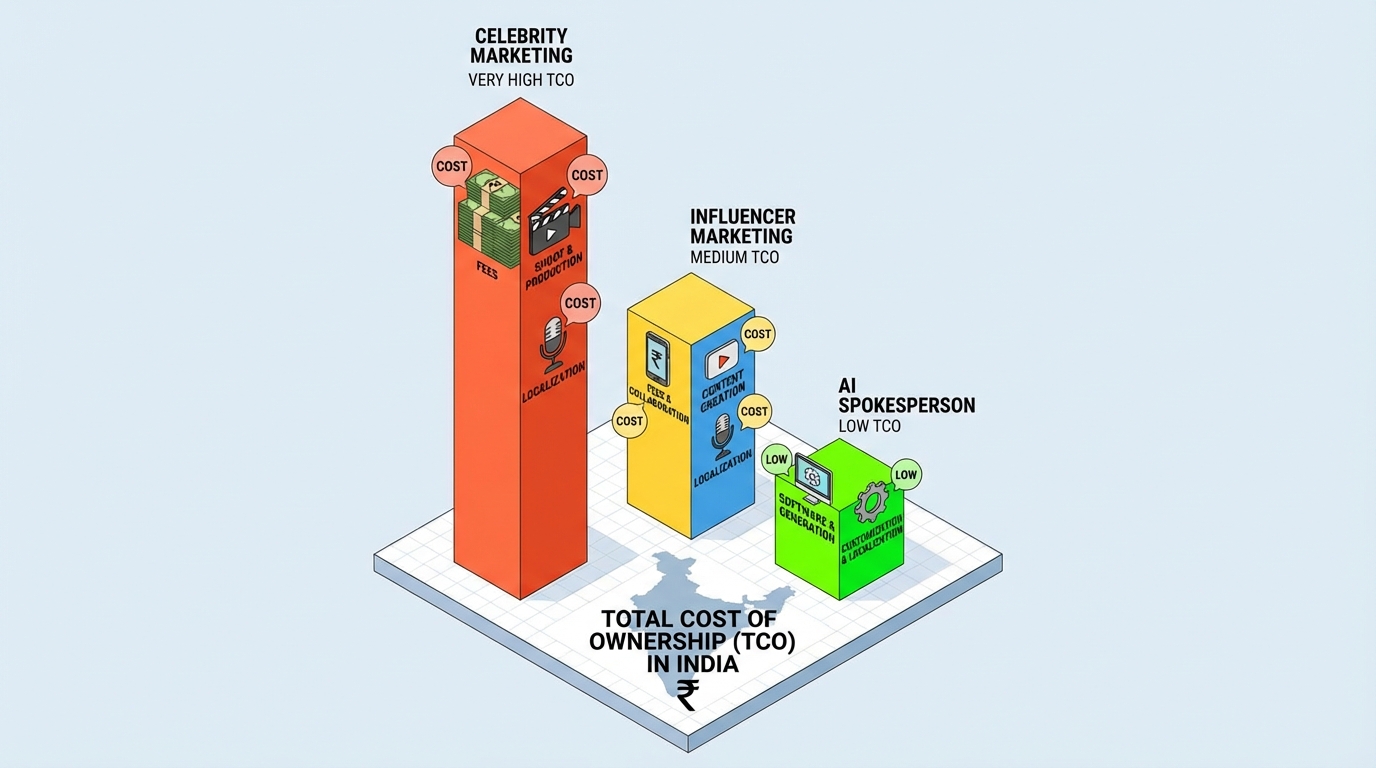
To understand the true financial impact, we must look at the “Total Cost of Ownership” (TCO). This includes the base fee, production overheads, localization costs, and the legal price of usage rights.
The Celebrity Endorsement Stack (Tier 1 & 2)
In 2026, a mid-to-high tier celebrity endorsement in India still commands a massive premium.
- Base Fee: ₹15–50 lakh+ for a single campaign window (typically 3–6 months).
- Production: ₹5–10 lakh for high-end shoots, including hair, makeup, and post-production.
- Localization: To reach India’s diverse linguistic markets, brands often spend an additional ₹5–15 lakh on dubbing or separate shoots for 4–6 regional languages.
- Legal & Risk: Rising personality rights disputes in India have increased legal diligence and insurance costs. India Today: India’s personality rights litigation around AI and deepfakes has made contracts more complex and expensive.
The Influencer Cost Stack (Micro/Mid-Tier)
Influencers offer better engagement but come with operational friction.
- Pricing: According to the 2026 Influencer Pricing Guide, mid-tier creators charge between ₹50,000 to ₹2,50,000 per video.
- The “Trust Premium”: Interestingly, while AI cuts influencer production costs, brands are still paying full price for the perceived trust and distribution the creator provides.
- Timeline: Expect a 14–21 day turnaround from briefing to live post.
The AI Spokesperson Cost Stack
Platforms like Studio by TrueFan AI enable brands to bypass these bottlenecks entirely.
- SaaS Pricing:
- Starter: ₹2,999/month (10 mins of video).
- Growth: ₹19,999/month (120 mins, HD, full avatar library).
- Enterprise: Bespoke pricing for 4K, custom avatars, and white-label governance.
- TCO Comparison for a 10-Video Launch:
- Celebrity: ₹35+ lakh all-in.
- Influencer Mix: ₹9–35 lakh+ (depending on the number of creators).
- AI Spokesperson (Growth Tier): ₹19,999 for hundreds of localized variants generated in minutes.
Source: TrueFan AI Cost Comparison Guide
2. ROI Math for D2C: AI Spokesperson vs. Celebrity vs. Micro-Influencer
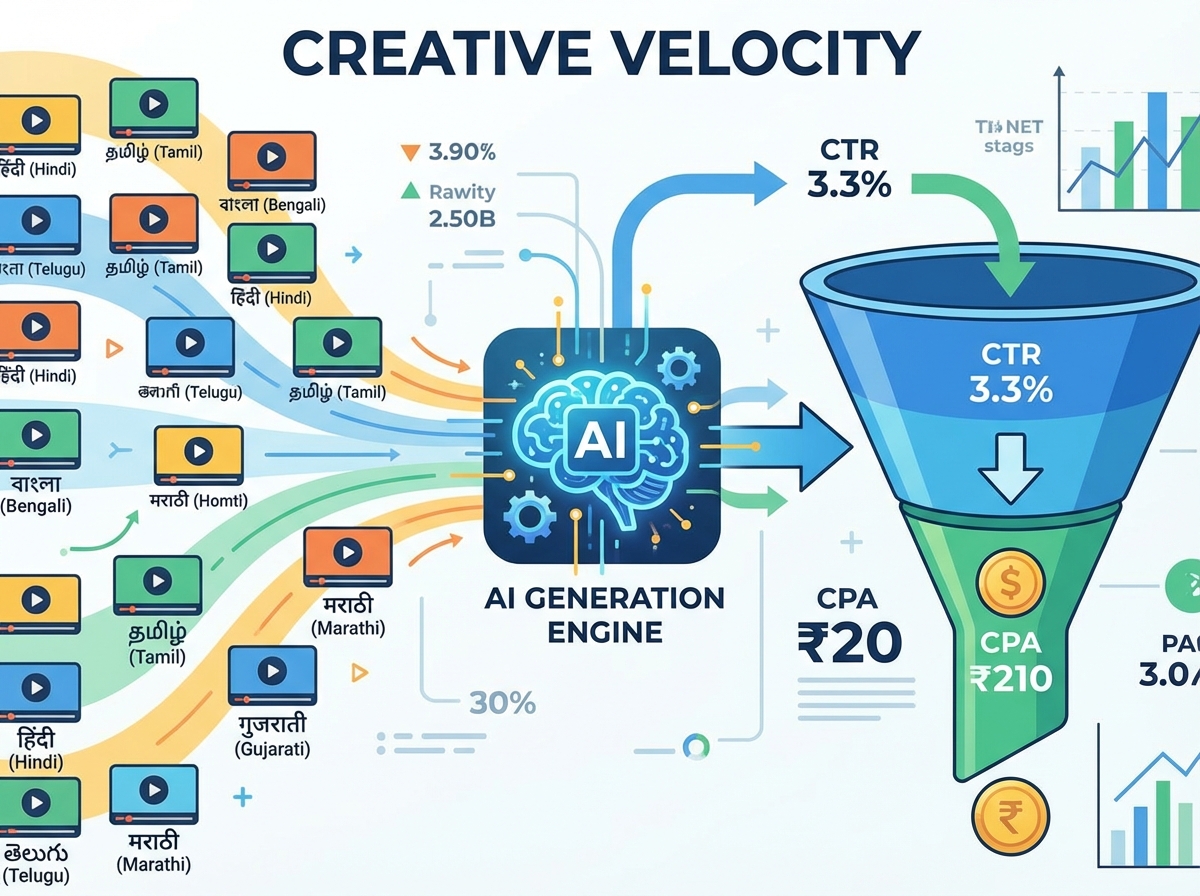
For a Growth CMO, the only metrics that matter are ROAS (Return on Ad Spend) and CPA (Cost Per Acquisition). When we model these across different budget tiers, the AI advantage becomes clear through “Creative Velocity.”
The Modeling Framework
Let’s compare a ₹20 lakh campaign budget across three scenarios:
| Metric | Celebrity Endorsement | Influencer Mix (10 Creators) | AI Spokesperson (TrueFan AI) |
|---|---|---|---|
| Production Cost | ₹15,00,000 | ₹8,00,000 | ₹19,999 |
| Media Spend | ₹5,00,000 | ₹12,00,000 | ₹19,80,001 |
| Creative Variants | 2 (Hindi/English) | 10 (Creator-led) | 100+ (Multi-language/Offer) |
| Avg. CTR | 1.1% | 1.5% | 3.3%* |
| CPA (Estimated) | ₹850 | ₹450 | ₹210 |
| ROAS | 1.8x | 2.5x | 4.2x |
*Note: Benchmarks from TrueFan AI celebrity video marketing in India show a 3.3% CTR on AI-driven creative hooks. Plan payback with the AI video payback period calculator.
Solutions like Studio by TrueFan AI demonstrate ROI through the ability to reinvest production savings directly into media spend. In the celebrity model, 75% of the budget is “sunk” into the person and the shoot. In the AI model, 99% of the budget is “working” capital that drives traffic.
Why AI Wins on Funnel Metrics
- CTR (Click-Through Rate): AI allows for hyper-personalized hooks. You can mention the viewer's city, a specific local festival, or a time-sensitive offer in 175+ languages.
- CPC (Cost Per Click): By testing 40+ variants simultaneously, the algorithm quickly identifies low-CPC winners, reducing the blended cost.
- CVR (Conversion Rate): AI spokespersons on Product Detail Pages (PDPs) can answer specific FAQs in the customer's native tongue, reducing friction at the point of purchase.
3. India D2C Case Studies: Before/After Metrics and Learnings
Real-world data from 2026 shows that AI is no longer a “gimmick”—it is a performance powerhouse.
Case Study A: Beauty D2C Brand (Licensed Avatar vs. Human Celebrity)
- Objective: Lower CPA for a new Vitamin C serum launch on Meta and YouTube Shorts.
- The Baseline: A traditional 30-second ad featuring a Bollywood star. Despite high “likes,” the CPA was ₹500 with a ROAS of 2.2.
- The AI Variant: The brand used a licensed celebrity AI avatar to deliver 12 different hooks (e.g., “Best for Mumbai humidity” vs. “Delhi pollution protection”).
- Results:
- CTR Uplift: +65%
- CPA Reduction: -42% (from ₹500 to ₹290)
- Speed-to-Live: 72 hours vs. 6 weeks.
Case Study B: Nutraceutical Brand (Custom AI Avatar for PDP & Retargeting)
- Objective: Improve trust and engagement on high-ticket supplement pages.
- The Setup: Instead of generic UGC, the brand trained a custom “Brand Doctor” AI avatar using the Enterprise tier.
- Results:
- PDP Time-on-Page: +35% increase.
- Add-to-Cart Rate: +22% improvement.
- Retargeting CPA: -30% as the AI addressed specific objections (e.g., “Is this vegan?”) in personalized retargeting ads.
- Compliance: All videos carried the mandatory “AI-generated” watermark and #Ad disclosure per ASCI 2026 guidelines.
Case Study C: Footwear D2C (Hyper-Local Scaling)
- Objective: Scale a “Clearance Sale” across 20 Indian cities.
- The Strategy: Using text-to-video AI, the brand generated 120 geo-targeted offers (e.g., “Special offer for Pune residents”).
- Results:
- Regional CTR: +70% vs. generic English ads.
- WhatsApp Conversion: Integrated with the WhatsApp API, the AI spokesperson served as a virtual shopping assistant, driving a 28% lift in sales.
4. Implementation Blueprint: Deploying AI Spokespersons at Scale
Transitioning to an AI-first endorsement model requires a structured workflow to ensure brand safety and creative quality.
Step 1: Discovery and Avatar Selection
Brands can choose between:
- Licensed Avatars: Digital twins of known Indian influencers (e.g., Gunika, Annie, Aryan).
- Custom Avatars: A unique “face of the brand” trained on a specific actor or founder.
- Fictional Avatars: High-quality, AI-generated personas that carry no “real-world” baggage.
Step 2: Scripting and Localization
Studio by TrueFan AI's 175+ language support and AI avatars allow for seamless translation.
- The 120-Character Rule: For optimal lip-sync, keep script lines between 100–120 characters.
- Voice Matching: Select from professional voice options that match the regional dialect (e.g., a specific Chennai-Tamil accent vs. a Madurai-Tamil accent).
Step 3: Generation and Shopify Integration
For D2C brands, the “AI spokesperson for Shopify brands India affordable” workflow is a game-changer. Explore the Shopify product video AI guide.
- Auto-Generation: Connect your Shopify store via API to automatically generate a video for every new SKU. See the latest update in Shopify product video AI 2026.
- Aspect Ratios: Generate 9:16 for Reels, 1:1 for Feed, and 16:9 for YouTube in one click.
Step 4: Measurement and Iteration
Don't just set and forget. Use the “Variant Velocity” to A/B test:
- The Hook: Test a “Problem-first” hook vs. a “Benefit-first” hook.
- The CTA: Test “Buy Now” vs. “Get 20% Off Today.”
- The Background: Test a lifestyle setting vs. a clean studio look.
5. Compliance and Brand Safety in India (2026)
As AI becomes mainstream, the Advertising Standards Council of India (ASCI) has tightened its grip on digital disclosures. Failure to comply can lead to heavy penalties and brand de-platforming.
ASCI Disclosure Mandates
- Explicit Labeling: Every AI-generated video must have a clear, upfront disclosure (e.g., “AI-generated spokesperson”) visible for the duration of the video.
- Standard Hashtags: Use #Ad, #Sponsored, or #PaidPartnership in the first two lines of the description.
- Claims Substantiation: Just because a spokesperson is AI doesn't mean you can make unverified claims. Health and finance brands must keep evidence files for every claim made by the avatar.
Legal Risks: Personality Rights
India has seen a surge in personality rights litigation. Brands must ensure:
- They have explicit, time-bound licenses for any celebrity digital twin.
- They use “walled garden” AI platforms that do not use brand data to train public models.
- They maintain an audit trail of all generated content.
How to Mitigate Risk
TrueFan AI mitigates these risks through a “consent-first” model. Every licensed avatar in the library has a pre-negotiated legal framework, and the platform includes automated watermarking and moderation to prevent the generation of non-compliant content. ASCI highlights that disclosure failures are the #1 cause of ad takedowns in 2025—don't let your brand be a statistic.
6. Budgeting Playbooks: Scenario Planning for Indian D2C
Depending on your growth stage, your AI spokesperson strategy will vary. Here are three playbooks for 2026.
Playbook A: The “Startup” (Budget: ₹5–10 Lakh)
- Goal: Maximum testing with minimum spend.
- Stack: TrueFan AI Growth Tier (₹19,999/mo).
- Strategy: Use 3 licensed avatars to create 60 variants. Focus on Meta Reels and YouTube Shorts.
- Success Metric: Achieve a CPA that is 20% lower than your current static image ads.
Playbook B: The “Scale-Up” (Budget: ₹10–25 Lakh)
- Goal: Hybrid trust and performance.
- Stack: 50% Micro-influencers + 50% AI variants.
- Strategy: Use influencers for “top-of-funnel” awareness and AI spokespersons for “middle-of-funnel” retargeting and PDP explainers.
- Success Metric: Increase blended ROAS by 30% through improved retargeting efficiency.
Playbook C: The “Enterprise” (Budget: ₹25–50 Lakh)
- Goal: Hyper-local dominance.
- Stack: Custom AI Avatar + Licensed Celebrity Avatar + WhatsApp API.
- Strategy: Deploy 500+ video variants across 12 languages. Use the Shopify auto-generation feature to create personalized videos for every customer segment.
- Success Metric: 2x ROAS improvement compared to traditional celebrity-led campaigns. Model outcomes with the AI video payback period calculator.
Conclusion
The shift from “AI spokesperson vs celebrity endorsement cost India 2026” is no longer a debate about quality—it is a debate about agility. While celebrities provide a “halo effect,” AI spokespersons provide the “performance engine” that modern D2C brands need to survive in a high-CPA environment. By leveraging the 1/100th cost advantage and the ability to speak to every Indian customer in their own language, brands can finally achieve the holy grail of marketing: personalization at scale.
Ready to scale your ROAS? Book an Enterprise Pilot with TrueFan AI Studio today and deploy your first AI-driven campaign in under 24 hours.
Frequently Asked Questions
Can AI spokespersons handle regional Indian dialects like Bhojpuri or Marathi?
Yes. Modern AI engines support 175+ languages. However, for regional dialects, it is crucial to use a platform that offers “Professional Voice” options to ensure the accent and cadence feel authentic to the local audience.
How do I ensure my AI spokesperson ads aren't flagged by Meta or Google?
Compliance is key. You must include the “AI-generated” watermark and use the correct ASCI hashtags (#Ad). Platforms that provide built-in moderation and compliance checks are highly recommended to avoid manual flagging.
Can I use an AI spokesperson for my WhatsApp marketing?
Absolutely. In fact, AI video for WhatsApp has a 3x higher click-through rate than text-based messages. You can use APIs to send personalized video messages to customers based on their abandoned carts or past purchases. See the WhatsApp video commerce integration update.
Is Studio by TrueFan AI suitable for high-end 4K television commercials?
Studio by TrueFan AI offers an Enterprise tier specifically designed for high-fidelity outputs, including 4K resolution and custom avatar training, making it suitable for both digital-first campaigns and traditional broadcast media when paired with professional post-production.
What happens if a celebrity withdraws their “personality rights” mid-campaign?
When using licensed AI avatars, the contracts are typically pre-negotiated for a fixed term (e.g., 12 months). If a license expires, the platform's governance tools allow you to “kill” the assets across all digital touchpoints instantly, protecting you from legal liability.