AI Video Marketing ROI Calculator India 2026: CFO-Ready Framework
Estimated reading time: ~9 minutes
Key Takeaways
- A finance-grade ROI model combines incremental revenue uplift from personalization with AI production cost savings.
- Vernacular personalization is the growth lever in India 2026, driving higher CTR, CVR, and ROAS across Tier 2/3 markets.
- AI workflows cut production costs by 85–95% vs. traditional shoots, enabling scalable variant testing and faster time-to-market.
- Most enterprises achieve 2.5–4 months payback when running 50+ variants/month with disciplined testing and governance.
- Platforms like Studio by TrueFan AI enable CFO-ready audit trails via experimentation, compliance, and performance telemetry.
The AI video marketing ROI calculator India 2026 is a CFO-ready, India-priced framework that quantifies marketing efficiency by combining production cost savings from AI video generation with the conversion uplift of hyper-personalization. As digital advertising spend in India is projected to cross ₹70,000 Cr by the end of 2026, enterprises are shifting from generic broadcasts to data-driven, localized video assets. Platforms like Studio by TrueFan AI enable these enterprises to produce thousands of personalized video variants at a fraction of traditional costs, ensuring that every marketing rupee is backed by a defendable business case.
For CFOs and CMOs at Indian enterprises, the challenge in 2026 is no longer “if” AI should be used, but how to model its payback period and budget allocation. This guide provides the formulas, benchmarks, and templates required to justify AI video investments, comparing traditional production overheads against the scalability of AI-driven workflows.
1. Video Marketing ROI Framework for CFOs: Methods and KPI Stack
In the 2026 fiscal landscape, a finance-grade ROI methodology must move beyond “vanity metrics” like views and likes. It requires a rigorous audit trail that connects creative production to the bottom line.
The Core ROI Formula
The fundamental calculation for AI video marketing ROI in India is:
ROI (%) = [(Incremental Revenue + Production Cost Savings) – Total AI Program Costs] / Total AI Program Costs × 100
- Incremental Revenue: The delta in revenue generated by personalized AI videos compared to a non-personalized baseline.
- Production Cost Savings: The difference between the cost of producing N variants traditionally versus using AI.
- Total AI Program Costs: Includes platform fees, avatar licensing, labor for prompt engineering, and media spend.
The Enterprise KPI Stack
To build a robust ROI model, Indian enterprises are tracking a specific stack of metrics:
- CPTV (Cost Per Through-Play): The cost of getting a user to watch at least 15 seconds of a video.
- Thumbstop Rate (3s Hold): A critical measure of creative hook effectiveness in a cluttered 2026 social feed.
- CVR (Conversion Rate) by Language: Measuring the performance of Marathi vs. Tamil vs. Hindi variants.
- Content Velocity: The number of unique creative variants launched per week.
- Time-to-Market: The days saved from script approval to campaign launch.
Testing Rigor and Data Integrity
CFOs now demand statistically valid testing. This involves multivariate testing across hooks, regional languages, and avatar personas. According to the TrueFan AI Creative Optimization Framework, a minimum sample size must be reached before declaring a “winning” creative to ensure a 95% confidence interval.
Sources:
2. Video Production Cost Comparison: Traditional vs. AI in India 2026
The most immediate impact of the AI video marketing ROI calculator India 2026 is felt in the production budget. Traditional video production in India remains labor-intensive, involving multiple stakeholders and physical constraints.
Traditional Production Line Items (India 2026)
- Pre-production: Scripting, storyboarding, and project management (₹50,000 - ₹1,50,000).
- Shoot Days: Crew, equipment rental (4K/8K), and studio fees (₹2,00,000 - ₹5,00,000 per day).
- Talent/Celebrity: Fees for actors or influencers, plus travel and logistics (₹1,00,000 - ₹50,00,000+).
- Post-production: Editing, color grading, and VFX (₹75,000 - ₹2,00,000).
- Localization: Reshooting or dubbing for 10+ Indian languages (Adds 40-60% to total cost).
AI Video Production Line Items (India 2026)
- Platform Subscription: Predictable monthly or annual fees.
- Avatar Licensing: Access to pre-licensed photorealistic virtual humans.
- Script-to-Video Generation: Instant rendering of multi-language variants.
- QA & Governance: Human-in-the-loop review for brand safety.
The Cost-Benefit Delta
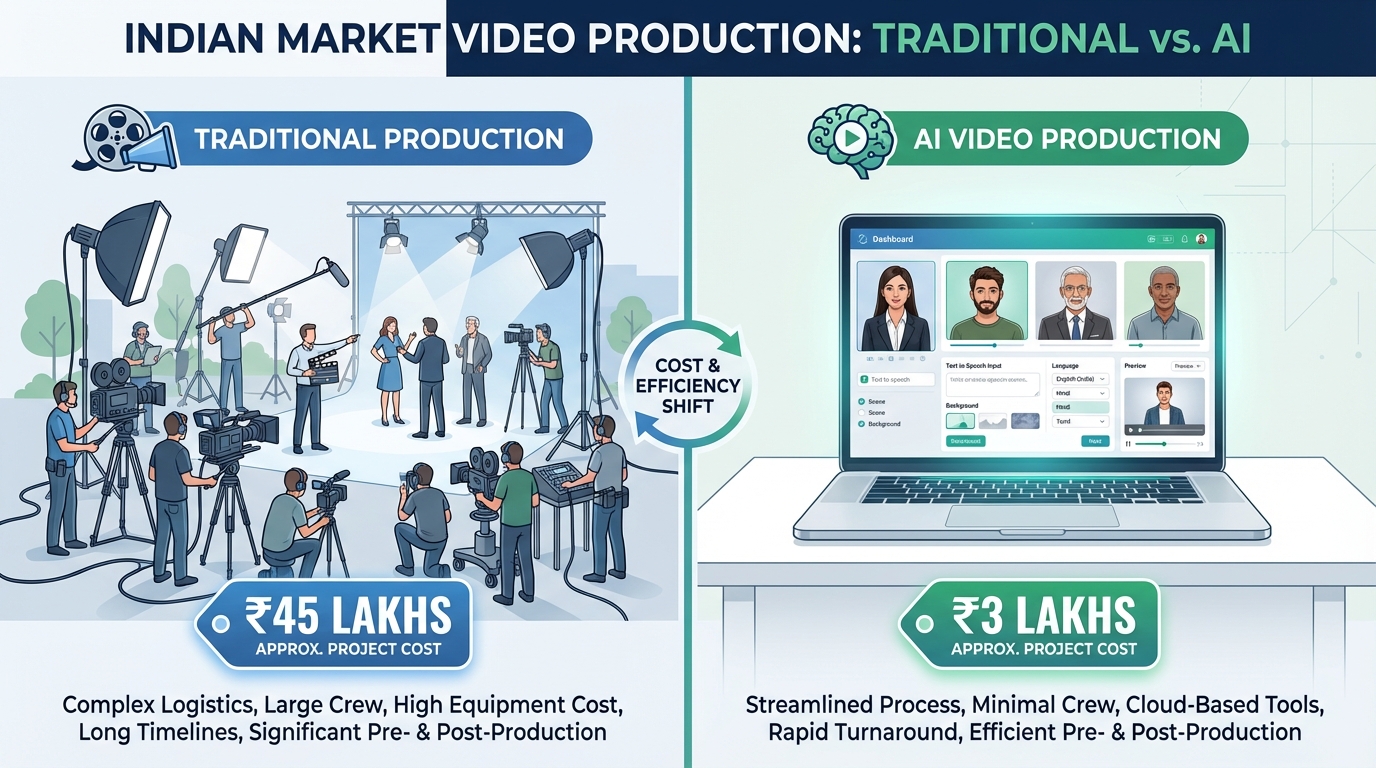
By 2026, data shows that AI video production costs in India are approximately 85-95% lower than traditional shoots for high-volume campaigns. For a campaign requiring 100 personalized variants in 10 languages, a traditional shoot would be financially prohibitive (estimated at ₹45 Lakhs+), whereas an AI workflow brings this down to under ₹3 Lakhs.
Sources:
- TrueFan AI blog: AI Video Production Cost vs Traditional in 2025
- Vidboard: AI vs. Traditional Video Costs (2025)
3. Video Personalization Investment Analysis: The Vernacular Multiplier
In India, “Personalization ROI” is synonymous with “Vernacular ROI.” As of 2026, 90% of new internet users in India prefer consuming content in their native language. Generic English or Hinglish ads no longer deliver the required ROAS (Return on Ad Spend). TrueFan AI agritech guide (AI video in Agritech India 2026)
Uplift Modeling for Indian Audiences
Studio by TrueFan AI’s 175+ language support and AI avatars allow brands to match the speaker’s persona and language to the specific viewer cohort. The ROI model for personalization follows this funnel logic:
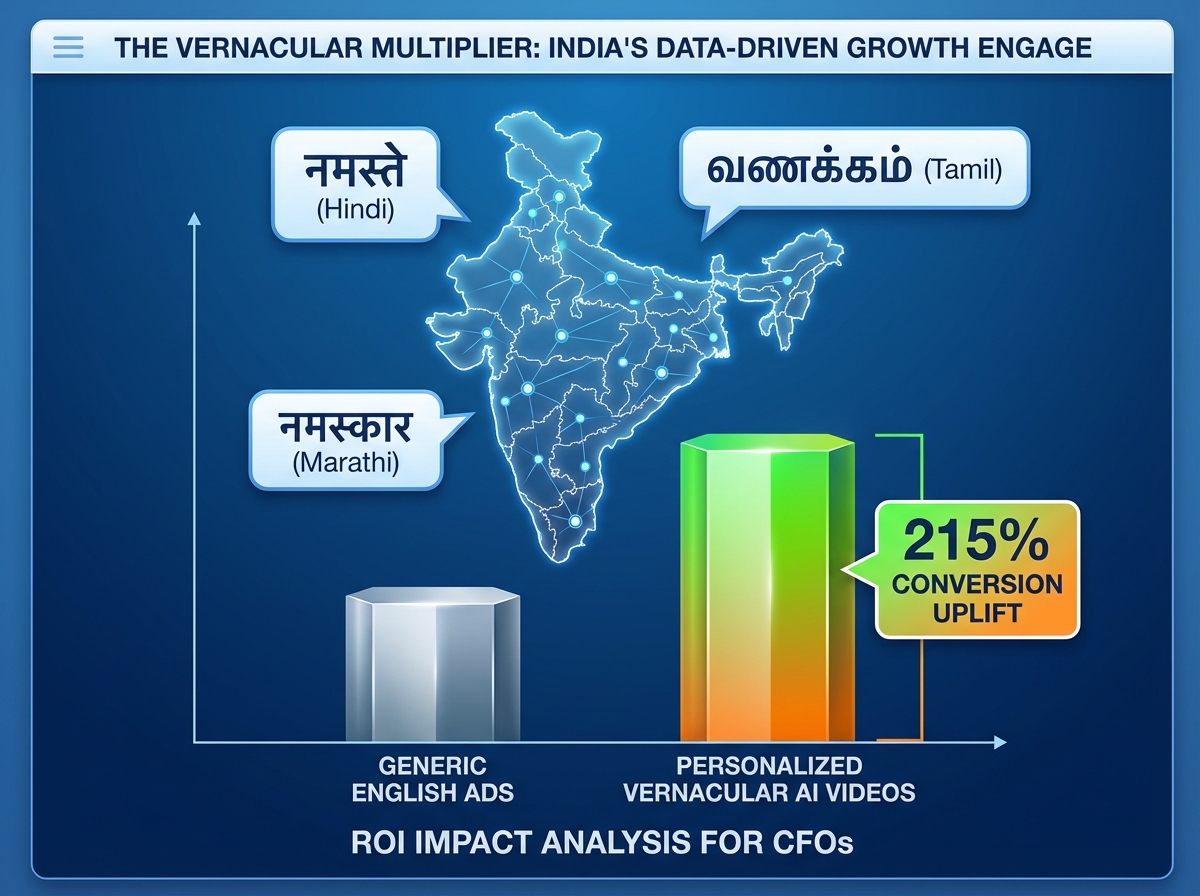
- Baseline: 1,000,000 Impressions → 1% CTR → 2% CVR → 200 Conversions.
- Personalized (Vernacular): 1,000,000 Impressions → 1.8% CTR → 3.5% CVR → 630 Conversions.
This represents a 215% increase in conversion volume without increasing the media budget.
Vertical Benchmarks (India 2026)
- BFSI (Banking & Insurance): Personalized onboarding videos in regional languages have shown a 3.4x higher CTR compared to generic static ads.
- E-commerce: Retargeting with AI-generated videos featuring the specific product viewed by the user has led to a 17% increase in ROAS.
- Telecom: WhatsApp-based video flows for plan renewals in the user’s local dialect have reduced churn by 12%. Personalized video messaging on WhatsApp
Sources:
- Aroscop: Vernacular language uplift in India
- Affle: Vernacular and video strategies (Corporate Presentation)
- WebEngage x Goibibo: Conversion uplift case study
4. The AI Video Marketing ROI Calculator India 2026: Tool Logic
To use the AI video marketing ROI calculator India 2026 effectively, enterprises must input data across three modules: Production, Performance, and Economics. AI video ROI calculator India (how it works)
Module A: Production Savings
- Input: Number of master videos, number of language variants, and average cost of a traditional shoot.
- Output: Absolute INR savings and the “Breakeven Variant Count”—the point where the cost of the AI platform is fully offset by the savings from not doing a traditional shoot.
Module B: Incremental Revenue
- Input: Current baseline CTR/CVR and the expected “Personalization Lift” (typically 15-40% based on 2026 benchmarks).
- Output: Incremental Gross Margin (INR).
Module C: Payback Period
- Formula: Payback (Months) = Initial Setup Costs / Monthly Net Benefits.
- 2026 Benchmark: Most Indian enterprises achieve a payback period of 2.5 to 4 months for their AI video investments, provided they are running at a scale of at least 50 variants per month.
5. AI Video Cost-Benefit Analysis: TCO vs. Benefits
A comprehensive AI video cost-benefit analysis must account for the Total Cost of Ownership (TCO). While the production savings are obvious, the “hidden” costs and strategic benefits define long-term success.
Total Cost of Ownership (TCO)
- Onboarding & Integration: Setting up brand kits and API webhooks (₹50,000 - ₹2,00,000 one-time).
- Ongoing Generation: Monthly subscription or per-minute rendering costs.
- Governance: Content moderation and compliance audits.
Strategic Benefits
Solutions like Studio by TrueFan AI demonstrate ROI through more than just cost reduction; they provide Scale Velocity. In the fast-paced Indian market, the ability to launch a “Holi 2026” campaign across 12 states in 12 different dialects within 48 hours is a competitive advantage that traditional production cannot match.
Case Study: AI Avatar ROI Case Study India
An Indian e-commerce major utilized AI avatars to create personalized “abandoned cart” videos.
- Objective: Recover lost revenue from high-value cart drop-offs.
- Approach: AI avatars addressed the user by name in their regional language, offering a limited-time discount.
- Results: 22% recovery rate (vs. 8% for email/SMS), 4.5x ROI on the AI platform fee within the first 30 days.
Sources:
6. Marketing Video ROI Measurement and Governance
Measuring the ROI of AI video requires a shift in attribution modeling. Because AI allows for a high volume of creative variants, the “last-click” model often fails to capture the full value of the video touchpoint.
Measurement Blueprint
- Media Mix Modeling (MMM): Use MMM to understand how AI video spend correlates with overall sales growth across regions.
- Incrementality Testing: Run “Holdout Groups” where one segment of the audience receives generic ads while the other receives personalized AI videos.
- WhatsApp & CRM Integration: Track the CVR of videos sent via WhatsApp API AI video webhook for WhatsApp Business, which is a dominant channel for Indian consumers in 2026. Automotive WhatsApp video marketing
Procurement and Risk Management
For the CFO, ROI is also about risk mitigation. Enterprise-grade AI video platforms must provide:
- ISO 27001 & SOC 2 Certification: Ensuring data privacy and security.
- Consent-First Avatars: All virtual humans must be fully licensed to avoid legal exposure.
- Content Moderation: Automated filters to prevent the generation of explicit or politically sensitive content.
Conclusion: Building the AI Video Business Case
The AI video marketing ROI calculator India 2026 proves that the transition to AI-driven creative is a financial imperative. By 2026, the “AI gap” in marketing will separate the high-growth enterprises from those burdened by the slow, expensive cycles of traditional production.
To secure budget approval, marketing leaders should present a business case that highlights:
- The 90% Production Saving: Moving from ₹50 Lakhs to ₹5 Lakhs for annual creative.
- The 2x Conversion Uplift: Driven by vernacular and personalized hooks.
- The Risk Mitigation: Using ISO-certified platforms with licensed talent.
Next Steps:
- Request a customized India 2026 ROI model seeded with your specific funnel data.
- Download the AI video business case template India to present to your board.
- Explore the TrueFan AI Creative Optimization Framework to design your first ROI-positive pilot.
Frequently Asked Questions
How does the AI video marketing ROI calculator India 2026 handle different vertical benchmarks?
The calculator uses pre-set industry averages for 2026. For example, BFSI typically sees higher CVR uplift from vernacular trust-building videos, while E-commerce sees higher CTR from product-specific personalization. Users can override these defaults with their own historical data.
What is the average cost reduction for an Indian enterprise switching to AI video?
Most enterprises report a 90% reduction in production costs. A traditional 30-second high-quality ad in India costs between ₹3 Lakhs and ₹10 Lakhs; an AI-generated equivalent costs roughly ₹5,000 to ₹15,000 depending on the volume.
Can I use my own brand spokesperson as an AI avatar?
Yes. Solutions like Studio by TrueFan AI demonstrate ROI through “Custom Avatar Training,” where a brand’s actual CEO or celebrity ambassador is digitized. This allows the brand to scale the celebrity’s presence across thousands of personalized messages without additional shoot days.
How does vernacular video impact ROAS in Tier 2 and Tier 3 cities?
In 2026, vernacular video is the primary driver of ROAS in non-metro India. Campaigns in local languages like Kannada, Telugu, and Marathi typically see a 40-50% lower CPA (Cost Per Acquisition) compared to English-only campaigns.
Is AI video production compliant with Indian advertising regulations?
Yes, provided you use an enterprise-grade platform. Studio by TrueFan AI ensures 100% compliance by using only licensed avatars and maintaining a “walled garden” approach to content generation, which prevents the creation of unauthorized deepfakes.
What is the typical payback period for an AI video platform investment?
For an enterprise producing at least 20-30 videos a month, the payback period is usually under 90 days. The savings from just two traditional shoot days often cover the entire annual cost of an AI video platform.