AI Video Attribution Tracking India 2026: The Enterprise Playbook for Multi-Touch ROI
Estimated reading time: 13 minutes
Key Takeaways
- Cross-platform attribution is essential to measure multi-touch ROI across CTV, mobile, and messaging channels in India’s 2026 landscape.
- Adopt server-side, consent-first architecture with robust identity resolution to stay DPDP-compliant while preserving signal quality.
- Use algorithmic models (Markov + Shapley) for fair, sequence-aware crediting of video touchpoints across the funnel.
- Integrate attribution with CRM (Zoho, LeadSquared) to align attributed revenue and deal stages with creative and channel performance.
- Scale creative testing with Studio by Truefan AI and track personalized video conversion metrics to drive ROAS lifts.
In the rapidly evolving digital landscape, AI video attribution tracking India 2026 has become the cornerstone of performance marketing for high-growth enterprises. As Indian brands shift from generic broadcasting to hyper-personalized engagement, the ability to measure the fractional contribution of every video touchpoint—from a Connected TV (CTV) ad in Mumbai to a WhatsApp video message in Bengaluru—is no longer a luxury; it is a financial imperative. CMOs and CFOs are now demanding a unified view of ROI that transcends platform silos and accounts for the complex, multi-device journeys of the modern Indian consumer.
1. The 2026 Landscape: Why Cross-Platform Video Analytics India is Non-Negotiable
The Indian marketing ecosystem in 2026 is defined by three seismic shifts: the explosion of CTV, the enforcement of the Digital Personal Data Protection (DPDP) Act, and the total fragmentation of the consumer journey. Traditional last-click attribution is effectively dead, as it fails to capture the 82% of internet traffic in India that is now video-based.
The Rise of CTV and Signal Loss
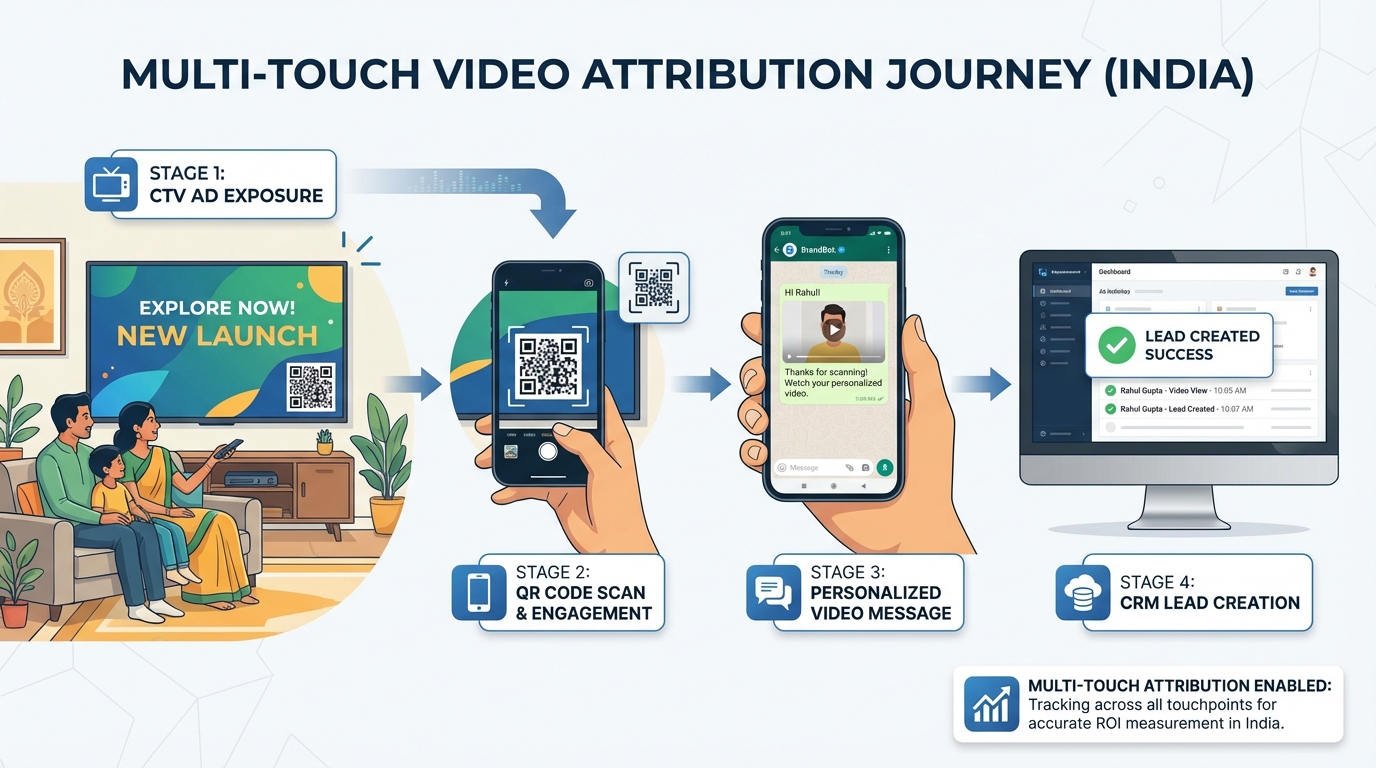
Connected TV ad spend in India is projected to reach $1.2 billion by 2026, creating a massive attribution gap between the living room screen and the mobile purchase. Brands are increasingly using “QR-to-mobile” and server-side event bridging to close this loop. According to recent industry reports, CTV performance marketing in India now requires sophisticated server-side tracking to maintain signal integrity amidst the phase-out of third-party cookies.
The Privacy Mandate: DPDP Act 2023
With the DPDP Act now fully operational, Indian enterprises must navigate strict consent requirements. Non-compliance can result in penalties of up to ₹250 Crore, making “consent-aware” attribution a technical necessity. This shift has forced 70% of Indian enterprises to adopt server-side tracking and first-party data strategies to ensure video performance measurement India remains accurate without violating user privacy.
The Personalization Boom
As AI-driven creative becomes the norm, the volume of video assets has scaled 100x. Platforms like Studio by Truefan AI enable enterprises to generate thousands of personalized video variants in seconds (IPL brand video personalization), but this scale requires an equally scalable attribution framework to identify which specific variant—be it in Hindi, Tamil, or English—is actually driving the bottom line.
2. Foundation: Enterprise Video Analytics Platform Architecture
Building a robust enterprise video analytics platform requires a move away from client-side “pixels” toward a server-to-server (S2S) architecture. This ensures data persistence across devices and platforms like YouTube, Meta, LinkedIn, and WhatsApp.
Event Taxonomy for Video Engagement Conversion Tracking
To achieve granular video engagement conversion tracking, your data schema must capture more than just “views.” In 2026, the standard event taxonomy includes:
- Engagement Milestones:
video_view_25,video_view_50,video_view_75, andvideo_view_complete. - Interaction Events:
cta_click,mute/unmute,replay, andinteractive_element_interaction. - WhatsApp Specifics:
whatsapp_video_play,whatsapp_reply_intent, andwhatsapp_button_click. - CRM Milestones:
lead_created,mql_qualified,sql_opportunity, andclosed_won_revenue.
Identity Resolution and Consent-First Modeling
A multi-channel video analytics dashboard is only as good as its identity graph. In the Indian context, this involves:
- Deterministic Matching: Using hashed email addresses or phone numbers (common in India via WhatsApp and UPI-linked accounts) to link a CTV view to a mobile conversion.
- Probabilistic Modeling: Using IP and household-level data to bridge gaps where deterministic data is missing, especially for top-of-funnel video awareness.
- DPDP Compliance: Every identity link must be backed by a verifiable consent log. Studio by Truefan AI's 175+ language support and AI avatars are often used within a “consent-first” framework, where the video itself asks for permission to personalize future interactions, ensuring a 100% clean compliance record.
3. Choosing the Right AI Video Campaign Attribution Model
The core of AI video attribution tracking India 2026 lies in the mathematical model used to distribute credit. While last-touch is simple, it systematically undervalues the “assist” role that video plays in the awareness and consideration phases.
Algorithmic Models: Markov vs. Shapley
For an AI video campaign attribution model to be effective, it must be algorithmic rather than rules-based.
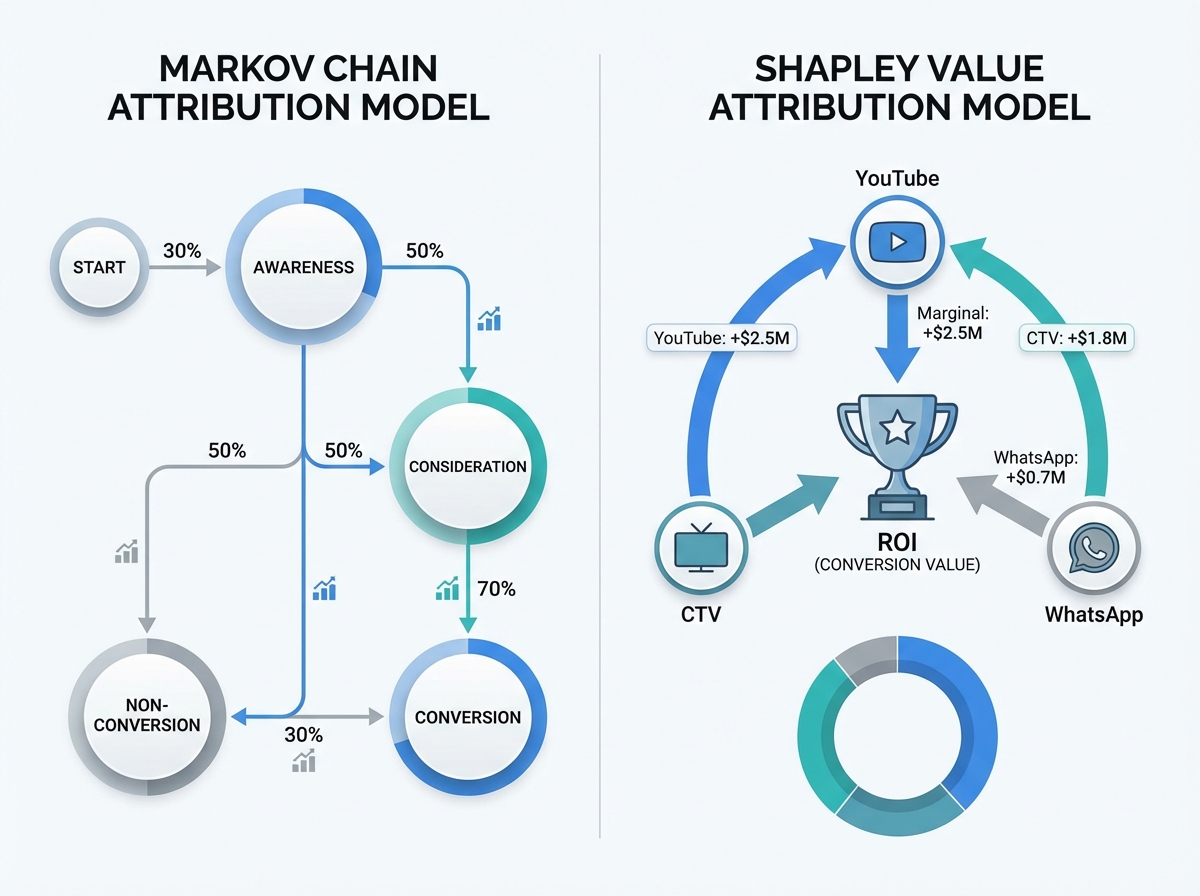
- Markov Chain Models: These models treat the customer journey as a series of states. By calculating the “removal effect” (how much conversion probability drops if a specific video channel is removed), Markov chains provide a dynamic view of channel importance.
- Shapley Value (Game Theory): This model treats each marketing touchpoint as a “player” in a game. It calculates the average marginal contribution of a video across all possible permutations of the customer journey. This is particularly effective for cross-device influencer and video crediting in the Indian market.
Hybrid/Ensemble Approaches
The most advanced Indian enterprises use a hybrid approach: Shapley for fair credit distribution across the entire funnel and Markov for sequence-sensitive optimization. This allows marketers to see, for example, that a LinkedIn video ad followed by a WhatsApp personalized video has a 40% higher conversion lift than either channel alone.
4. The AI Video Analytics Dashboard India: CFO-Ready Metrics
A video marketing ROI dashboard enterprise must speak the language of the boardroom. In 2026, vanity metrics like “likes” and “shares” have been replaced by “Attributed Revenue” and “Incremental Lift.”
Executive KPIs for 2026
- Attributed ROAS (Return on Ad Spend): Calculated using AI models to show the true revenue generated by video investments.
- Video-Assisted Conversion Rate: The percentage of total conversions that had at least one video touchpoint in the journey.
- Marginal ROI: The expected return on the next ₹1 Lakh spent on a specific video creative or channel.
- CAC by Creative Variant: Identifying which AI-generated avatar or script variant delivers the lowest Customer Acquisition Cost.
Personalized Video Conversion Metrics
Data from 2026 shows that AI-driven personalization increases video conversion by 45%. Solutions like Studio by Truefan AI demonstrate ROI through these personalized video conversion metrics, allowing brands to track the performance of 1,000+ localized variants simultaneously. This level of granularity enables “Creative Alpha”—the ability to outperform competitors through superior creative testing and attribution.
5. Martech Stack: Video Attribution Zoho CRM & LeadSquared Integration
To close the loop, your marketing video ROI tracking tools must be deeply integrated with your CRM. This is where the “path-to-revenue” is finally mapped.
Blueprint for Video Attribution Zoho CRM Integration
A successful video attribution Zoho CRM integration requires mapping specific custom fields to capture the “Attribution Intelligence” from your analytics layer.
- Lead Level:
First_Video_Touch,Last_Video_Touch,Video_Assisted_Count. - Deal Level:
Attributed_Revenue_Markov,Attributed_Revenue_Shapley. - Automation: Use Zoho's Marketing Attribution features to trigger workflows when a high-value lead watches more than 75% of a product demo video.
LeadSquared and Factors.ai Integration
For high-velocity sales environments (EdTech, FinTech, Real Estate), integrating LeadSquared with Factors.ai allows for automated multi-touch attribution. This setup captures WhatsApp Business API webhooks—such as video_played or button_clicked—and pushes them directly into the LeadSquared activity timeline, providing sales reps with the exact context of what the lead watched before the call.
The WhatsApp Conversion Surface
In India, WhatsApp is the “final mile” of conversion. Integrating your video attribution with the WhatsApp Business API allows you to track “View-to-Chat” and “Chat-to-Sale” metrics. By using server-side events, you can attribute a sale made in a WhatsApp chat back to the original YouTube video that sparked the interest.
6. Execution Playbook: 30/60/90 Day Roadmap
Implementing AI video attribution tracking India 2026 is a phased process. Enterprises should follow this structured roadmap to ensure data accuracy and stakeholder buy-in.
Day 0–30: Instrumentation and Governance
- Standardize UTMs: Implement a rigid UTM governance framework that includes
video_id,variant_id, andlanguage. - Server-Side Setup: Deploy server-side tagging (GTM Server-Side or similar) to capture events across CTV and mobile web.
- CRM Mapping: Create the necessary custom fields in Zoho or LeadSquared for attribution data back-filling.
Day 31–60: Model Deployment and Dashboarding
- Data Ingestion: Connect your ad platforms (Google, Meta, LinkedIn) and WhatsApp API to your attribution engine.
- Train AI Models: Run your first Markov and Shapley models on historical data to establish a baseline.
- Launch Dashboard v1: Stand up your AI video analytics dashboard India with real-time ROI tracking for the CMO.
Day 61–90: Optimization and Scaling
- Closed-Loop Feedback: Start pushing CRM conversion data (Closed-Won) back to ad platforms via Conversions API (CAPI) to train their algorithms on high-value users.
- Creative Iteration: Use personalized video conversion metrics to retire low-performing variants and scale winners. https://truefan.ai/blogs/best-ai-voice-cloning-software
- Compliance Audit: Conduct a DPDP compliance check to ensure all data processing is backed by valid consent logs.
7. Compliance, Governance, and FAQs
As we look toward the future of performance marketing for Indian brands, the intersection of AI, video, and attribution will only deepen. Ensuring your models are transparent and your data is secure (ISO 27001 & SOC 2) is critical for long-term success.
Frequently Asked Questions
Q1: How does video conversion multi-touch analytics work across WhatsApp and YouTube?
In 2026, this is achieved through identity resolution. When a user clicks a link in a YouTube description, a unique ID (like a GCLID or a hashed phone number) is carried through to the landing page and subsequently to the WhatsApp chat. Server-side webhooks then report these interactions to a central attribution engine that applies a video conversion multi-touch analytics model to assign credit.
Q2: What is the most accurate AI video campaign attribution model for the Indian market?
A hybrid model combining Markov Chains and Shapley Values is considered the gold standard. Markov models excel at understanding the “customer journey flow,” while Shapley Values ensure that top-of-funnel awareness videos (common in India's “discovery” phase) receive fair credit for their role in the eventual sale.
Q3: Can I integrate video attribution with my existing Zoho CRM?
Yes. A video attribution Zoho CRM integration involves using Zoho’s API to push attribution scores (like “Markov Credit”) into custom fields on the Deal or Contact record. This allows you to run native Zoho reports that show revenue by video campaign.
Q4: How does the DPDP Act impact video tracking in 2026?
The DPDP Act requires explicit consent for data processing. Enterprises must use “Consent Management Platforms” (CMPs) that log user permission before any tracking (deterministic or probabilistic) occurs. Attribution models must be designed to work with “anonymized” or “aggregated” data for users who opt out of granular tracking.
Q5: How do I measure the ROI of personalized AI videos?
Studio by Truefan AI and similar platforms provide the scale, but the ROI is measured by comparing the CAC and conversion rates of personalized variants against a “control” (generic) video. Most Indian enterprises see a 30-50% improvement in ROAS when switching to hyper-localized, AI-generated video content.
Sources and External References:
- MeitY - Digital Personal Data Protection Act 2023 Official Gazette
- Zoho Marketing Attribution Feature Overview
- LeadSquared x Factors.ai Integration Blueprint
- Nielsen Media India - CTV Ad Spend Projections 2026
- Suntec India - PPC and AI Automation Trends 2026
2. OTT Video Advertising Automation: The New Production Playbook
The biggest barrier to scaling connected TV video ads 2026 has historically been the cost and time of production. Performance marketing requires constant testing—different hooks, offers, and localizations. Traditional video production cannot keep up with the demand for 50+ variants per week. This is where OTT video advertising automation becomes critical.
The Automated Production Pipeline
In 2026, leading performance agencies have moved to a “feed-based” creative model. Instead of editing individual videos, marketers use an input layer consisting of product feeds, regional pricing, and language matrices.
- Input Layer: Dynamic data points like “Discount %,” “City Name,” or “Festival Offer” are pulled from a central spreadsheet or API.
- Creative Layer: Modular templates are designed with “safe zones” for QR codes and CTAs. These templates are built for 16:9 (CTV) and 9:16 (Mobile) aspect ratios simultaneously.
- Localization: India’s linguistic diversity requires more than just subtitles. Automation tools now handle AI-driven voiceovers https://truefan.ai/blogs/ai-voice-cloning-indian-accents and lip-syncing in Hindi, Tamil, Telugu, Bengali, and Marathi.
- QA Layer: Automated checks ensure that audio levels meet the broadcast standard of -24 LKFS ±2 and that all brand colors are consistent across variants.
Platforms like Studio by Truefan AI enable performance marketers to bypass traditional production bottlenecks by generating hundreds of personalized video variants from a single script or product feed, ensuring that every ad is relevant to the specific viewer's region and language. For production-grade pipelines, see the latest infrastructure guides.
Technical Compliance for India
Unlike social media, CTV and OTT platforms often have stricter technical requirements. Automation must account for:
- VAST/VPAID Compatibility: Ensuring tags work across different SSPs (Supply Side Platforms).
- SSAI (Server-Side Ad Insertion): Preparing creatives that can be seamlessly stitched into the stream to prevent ad-blockers and buffering.
3. Smart TV Ad Campaigns AI: Creative Strategies for High Conversion
Creative is the most significant lever for ROAS in smart TV ad campaigns AI. In 2026, the focus has shifted from high-gloss cinematic ads to “Performance-First” creative that utilizes AI to drive action.
AI-Powered Presenters and Avatars
One of the most effective trends in 2026 is the use of AI avatars https://truefan.ai/blogs/real-time-interactive-ai-avatars-india as on-screen presenters. These virtual humans can deliver personalized instructions—such as “Scan the QR code now to get 20% off in Bengaluru”—with a level of speed and cost-efficiency that human actors cannot match.
Studio by Truefan AI's 175+ language support and AI avatars allow brands to localize campaigns for India’s diverse linguistic landscape, ensuring that a viewer in Chennai sees a Tamil-speaking avatar while a viewer in Lucknow sees a Hindi-speaking one, all within the same campaign flight.
The “Testing” Framework for CTV
To optimize for performance, marketers should run weekly creative learning agendas. Key elements to test include:
- The Hook: Test an “Offer-First” vs. a “Problem-First” opening in the first 3 seconds.
- QR Code Prominence: Experiment with the size, color contrast, and dwell time of the QR code on the screen.
- CTA Phrasing: Compare “Download the App” with “Get Your Exclusive Offer.”
- Vernacular vs. Hinglish: Determine if pure regional language or a mix (Hinglish) performs better for specific urban cohorts.
Performance marketing trends for Indian brands emphasize that AI-powered optimization is no longer optional; it is the only way to manage the complexity of multi-channel performance at scale.
4. Performance Marketing CTV India: KPIs, ROAS, and Attribution Tracking
The “black box” of TV measurement has been cracked. In 2026, CTV attribution tracking India relies on a sophisticated mix of deterministic and probabilistic data to prove the value of every rupee spent. https://truefan.ai/blogs/performance-marketing-ctv-india
Defining the KPI Hierarchy
Performance marketers must look beyond “Impressions” and “Completion Rates.” The new hierarchy includes:
- Primary KPIs: Site visits, App installs (via QR scans), and direct purchases.
- Secondary KPIs: QR scan rate, add-to-cart, and landing page dwell time.
- Derived KPIs: Incremental ROAS and Cost Per Incremental Visit (CPIV).
The Attribution Stack
Tracking a “lean-back” medium like CTV requires a cross-device approach.
- Deterministic Tracking: When a user scans a QR code on their TV using their mobile phone, the UTM-parameterized link provides a direct, 1:1 link between the CTV exposure and the conversion.
- Probabilistic Attribution: Using IP matching and device graphs, platforms can associate a CTV ad exposure at a specific household with a subsequent app install or website visit from a mobile device on the same Wi-Fi network.
- Incrementality Testing: This is the gold standard in 2026. By using “Geo-Holdouts” (e.g., running ads in Mumbai but not in Delhi), brands can measure the true “lift” generated by CTV compared to a baseline.
Solutions like Studio by Truefan AI demonstrate ROI through consistent creative IDs and metadata exports that allow these attribution models to function seamlessly, ensuring that every creative variant is tracked from the moment it is rendered to the moment it converts.
5. Full-Funnel Orchestration: Connected Device Video Strategy
A successful connected device video strategy treats the TV not as an island, but as the “top of the funnel” that feeds the rest of the ecosystem. In 2026, the most successful campaigns use CTV to build high-quality awareness and then use mobile/desktop for the final “nudge.”
The Sequential Storytelling Model
- Phase 1 (CTV): A 30-second high-impact ad introduces the brand and the value proposition on the big screen. The goal is household-level reach and “brand favorability.”
- Phase 2 (Mobile Retargeting): Within 24 hours of the CTV exposure, the same household receives a 15-second “Urgency” ad on their mobile devices (via social or display) with a direct “Shop Now” link.
- Phase 3 (Conversion): If the user hasn't converted, a final personalized video via WhatsApp or SMS—localized in their regional language—provides a final discount code.
Frequency Management across Devices
One of the biggest pitfalls in cross-device video marketing is over-saturation. In 2026, programmatic platforms allow for “Household Frequency Capping.” This ensures that a family isn't bombarded with the same ad 20 times a day across their TV, tablets, and phones, which preserves brand sentiment and reduces wasted spend.
6. Programmatic Video CTV: Buying Routes, Brand Safety, and Fraud Control
As 35% of TV budgets shift to digital, the “how” of buying has changed. Programmatic video CTV campaigns are now the default for performance buyers in India because they offer the targeting and flexibility that direct “bulk” buys lack.
Buying Routes in 2026
- Programmatic Guaranteed (PG): Best for securing “premium” inventory during high-traffic events like the IPL or major Bollywood premieres. You get guaranteed volume with programmatic targeting.
- Private Marketplaces (PMPs): The “sweet spot” for performance. Marketers bid on curated inventory from top broadcasters (Jio, Hotstar) with floor prices, ensuring higher quality than the open auction.
- Open Auction: High risk, high reward. Best for massive reach at low CPMs, but requires stringent brand safety filters.
Brand Safety and Fraud Prevention
The rise of CTV has unfortunately attracted sophisticated ad fraud. In 2026, performance marketers must implement:
- SSAI Log Auditing: Verifying that the ad was actually “stitched” into the content and not just “fired” in the background.
- App-ads.txt & Sellers.json: Only buying from verified sellers to avoid “spoofed” inventory.
- IVT (Invalid Traffic) Filters: Using partners like IAS or DoubleVerify to ensure that “views” are coming from real humans, not bot farms. Brand safety enforcement guide provides more details on AI-driven protection.
7. The 2026 Launch Checklist
To succeed in CTV performance video marketing India, your execution must be flawless. Use this checklist to ensure your campaign is ready for the 2026 market.
- Creative Specs: 16:9 aspect ratio, 4K resolution (where supported), 15–30 second duration.
- Audio Normalization: Audio mixed to -24 LKFS ±2 for broadcast compliance.
- QR Code Optimization: High contrast, placed in a “safe zone” (not too close to the edge), and visible for at least 10 seconds.
- Localization: Voiceover and subtitles in at least the top 3 regional languages for your target market. https://truefan.ai/blogs/voice-cloning-emotion-control-india
- Attribution Setup: UTMs for QR codes, MMP (Mobile Measurement Partner) integration for cross-device tracking.
- Frequency Caps: Set at the household level (e.g., 3 exposures per week).
- Brand Safety: PMP-first strategy with IVT filters enabled.
Conclusion
The era of “spraying and praying” on television is over. CTV performance video marketing India has matured into a data-driven, automated, and highly accountable channel. By moving performance video beyond social media and into the living room, brands can capture the highest quality attention available in the digital age.
Success in this new frontier requires three things:
- AI-driven creative scale to handle localization and testing.
- Cross-device orchestration to turn views into actions.
- Rigorous attribution to prove every rupee of ROAS.
As the Indian consumer continues to upgrade their home entertainment, the brands that master the “big screen” will be the ones that win the market in 2026 and beyond.
Frequently Asked Questions
Which attribution model should we start with?
Begin with a Markov model for quick insights into sequence effects, then layer in Shapley for fair credit across the funnel. Most enterprises run both and compare lift by channel and creative.
How do we stay DPDP-compliant with server-side tracking?
Implement a consent management platform, store verifiable consent logs, and ensure deterministic identifiers are hashed. Offer opt-outs and support aggregated modeling for users who decline granular tracking.
What KPIs matter most to the CFO?
Prioritize Attributed ROAS, Incremental Lift, Marginal ROI, CAC by Creative Variant, and Video-Assisted Conversion Rate. Tie these to revenue stages in Zoho or LeadSquared.
How can we measure CTV impact when QR codes aren’t scanned?
Use probabilistic household matching (IP/device graphs), run geo-holdout tests, and track correlated uplifts in brand and performance metrics within exposed vs. control regions.
How do we scale creative for multiple languages and cities efficiently?
Adopt a feed-based pipeline and leverage Studio by Truefan AI to generate localized variants (voice, subtitles, offers) and track each variant’s performance via consistent creative IDs.