B2B Procurement Video Orchestration 2026: Accelerate Q4–Q1 Enterprise Buying with Role-Specific Journeys and AI
Estimated reading time: ~12 minutes
Key Takeaways
- Replace static pitches with orchestrated, role-specific video journeys to build faster consensus across 10+ stakeholders.
- Use multi-stakeholder decision mapping to align CFO, CTO/CIO, CMO, Procurement, and Legal with tailored narratives.
- Mirror buying stages with early, mid, and late-stage video assets, including RFP response automation and negotiation support.
- Drive adoption with channel choreography across email, LinkedIn, and WhatsApp, triggered by engagement and timing signals.
- Scale personalization and track sales velocity metrics with TrueFan AI to prove ROI and shorten days-in-stage.
The enterprise sales landscape in 2026 has undergone a fundamental shift, moving away from static collateral toward dynamic, synchronized engagement. As organizations enter the critical Q4 budget finalization and Q1 vendor selection windows, the traditional "one-size-fits-all" pitch deck has become a liability rather than an asset. Modern B2B procurement video orchestration 2026 represents the sophisticated coordination of short, role-specific video assets sequenced across the buying journey to address the unique anxieties and requirements of a 10+ member stakeholder committee.
In this high-stakes environment, the ability to build consensus rapidly is the primary differentiator between a closed-won deal and a "no-decision" outcome. Statistics from the 2026 State of GTM Efficiency report indicate that enterprise buying committees have expanded to an average of 11.4 stakeholders, each possessing veto power and distinct evaluation criteria. Platforms like TrueFan AI enable sales organizations to navigate this complexity by delivering hyper-personalized video content that speaks directly to the functional needs of Finance, IT, Marketing, and Procurement simultaneously.
The urgency of the Q4–Q1 transition cannot be overstated. Q4 is characterized by aggressive budget tightening and the reprioritization of "must-have" versus "nice-to-have" solutions. Conversely, Q1 is the season of vendor selection, proof-of-value validation, and final procurement hurdles. Delays during this 180-day window often cascade into missed annual OKRs and the lapse of allocated budgets. By implementing a B2B procurement video orchestration 2026 strategy, enterprises can achieve measurable B2B procurement cycle acceleration 2026, reducing time-to-consensus and eliminating the friction points that typically stall large-scale contracts.
Source: The GTM State of Efficiency Report: 2026 Trends & Insights
Multi-Stakeholder Decision Mapping: Navigating the 2026 Buying Committee
To master B2B procurement video orchestration 2026, sales leaders must first execute rigorous multi-stakeholder decision mapping. This practice involves identifying every individual within the prospect organization who holds decision rights, influence, or veto power. In 2026, the "shadow committee"—members from Legal, Security, and Finance who rarely appear on initial discovery calls—has become more influential than the primary business unit sponsor.
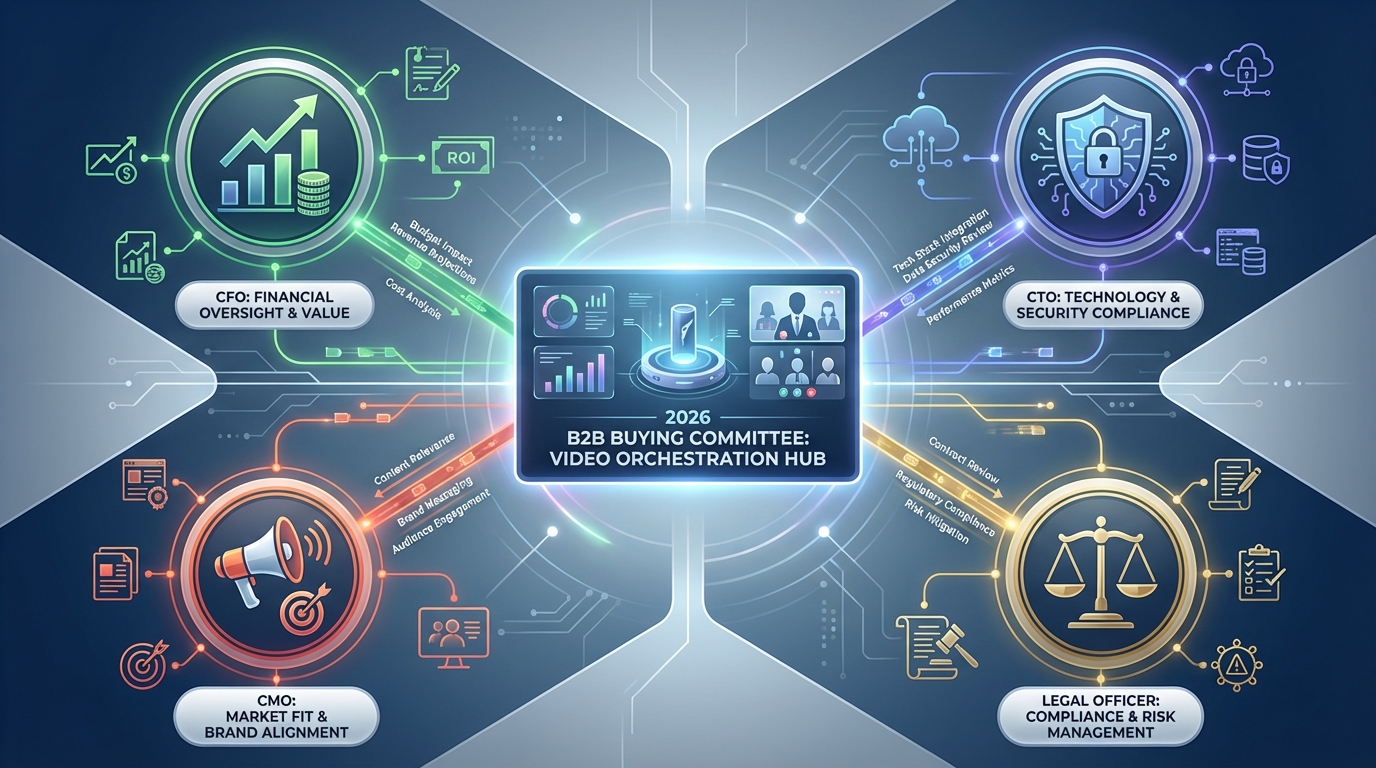
A robust multi-stakeholder decision mapping exercise results in a RACI (Responsible, Accountable, Consulted, Informed) matrix that dictates the content strategy. For instance, the CFO requires data on capital efficiency and internal rate of return (IRR), while the CTO focuses on architecture fit and data sovereignty. Without role-specific orchestration, a technical deep-dive sent to a Finance lead creates confusion, while a high-level ROI summary sent to IT Security creates skepticism.
The stakeholder map for a typical 2026 enterprise deal includes:
- CFO/Finance: Focused on payback periods, cash flow phasing, and total cost of ownership (TCO).
- CTO/CIO/IT Security: Concerned with integration paths, scalability, and SOC 2/ISO 27001 compliance.
- CMO/Marketing: Looking for pipeline impact, brand guardrails, and speed-to-market.
- CPO/Procurement: Prioritizing process transparency, vendor diversity, and risk mitigation.
- Legal: Evaluating liability, data IP, and jurisdictional compliance.
By mapping these roles to specific video touchpoints, sales teams ensure that every stakeholder receives a tailored narrative that addresses their specific "objection profile." This alignment is essential for buying committee consensus building, as it prevents the internal friction that occurs when stakeholders feel their unique risks have not been mitigated.
Source: Mapping the B2B Buying Committee: 10 Roles, Strategies, and Best Practices
Role-Aligned Messaging Frameworks: CFO CTO CMO Aligned Messaging
Effective B2B procurement video orchestration 2026 relies on the precision of the message. General marketing videos are ignored; role-aligned messaging frameworks are consumed. Each video in the orchestration sequence should be 60 to 90 seconds in length, focusing on a single "value pillar" relevant to the recipient's persona. This approach ensures that budget approval stakeholder videos deliver the exact data points required for a "yes" vote.
For the CFO, the script must pivot away from features and toward fiscal outcomes. A 60-second budget approval stakeholder video should highlight the 8–12 month payback period and the shift from CapEx to OpEx if applicable. It must explicitly mention risk controls and governance to satisfy the FP&A (Financial Planning and Analysis) team. In 2026, 82% of C-suite executives report "video fatigue" from generic content, making this level of CFO CTO CMO aligned messaging a prerequisite for engagement.
The CTO and IT Security leads require a different cadence. Their 90-second technical validation videos should feature reference architectures and clear integration plans. Rather than discussing "ease of use," these videos must demonstrate "ease of maintenance" and "security posture." By providing a technical walkthrough of the sandbox-to-production path, the sales team de-risks the implementation phase before the RFP is even finalized.
Procurement and Legal stakeholders are often the final gatekeepers. For these roles, the orchestration should include videos that walkthrough procurement compliance documentation and align with vendor evaluation scorecards. A 45-second video explaining how the vendor meets specific ISO standards or liability requirements can save weeks of back-and-forth email chains. This proactive approach to contract negotiation support videos ensures that the legal review process is a formality rather than a bottleneck.
Source: B2B Buying Behavior in 2026: 57 Stats and Five Hard Truths
Stage-by-Stage Orchestration: Enterprise Vendor Selection Videos
The orchestration of video content must mirror the stages of the enterprise buying journey. In the early stage, the goal is problem identification and consensus formation. Here, enterprise vendor selection videos should be used to frame the "cost of inaction." Competitive differentiation presentations at this stage should not just compare features but highlight the unique methodology and benchmarks that set the vendor apart from the incumbent or other challengers.
As the deal moves into the mid-stage (Evaluation/RFP), the complexity increases. This is where RFP response video automation becomes a critical tool. Instead of a 50-page PDF, vendors can provide a personalized video portal where each section of the RFP is accompanied by a 30-second video explanation. This humanizes the response and allows the procurement team to see the expertise behind the data. During this phase, it is vital to provide an explainer on how the solution fits into the prospect's specific vendor evaluation scorecards.
In the late stage (Approvals/Negotiation), the focus shifts to closing the "certainty gap." Budget approval stakeholder videos are deployed to the executive sponsors to reaffirm the business case. Simultaneously, contract negotiation support videos are sent to the legal team to explain the rationale behind specific clauses or to propose fallback language in a non-adversarial format. This multi-threaded orchestration ensures that no stakeholder is left without the information they need to move to the next gate.
Tactical execution in 2026 involves:
- Early-Stage: Persona-specific landing pages with embedded 60s hooks.
- Mid-Stage: RFP response video automation integrated into proposal portals.
- Late-Stage: Procurement committee engagement explainers and final "Day 1 Value" videos.
Channel Choreography and Enterprise Buying Journey Optimization
The delivery of orchestrated video content is as important as the content itself. In 2026, enterprise buying journey optimization requires a "channel choreography" approach—using email, LinkedIn, WhatsApp Business, and personalized microsites in a synchronized sequence. For Indian enterprises, WhatsApp has become a primary channel for executive-level communication, making it an ideal medium for 30-second "recap" videos after major meetings.
Orchestration logic should be data-driven. If a CFO watches a budget approval stakeholder video twice but does not click the "Schedule Review" CTA, the system should automatically trigger a follow-up video addressing common financial objections or offering a TCO calculator. This level of complex sales personalization ensures that the sales team is always providing the "next best action" based on real-time engagement data.
Governance is the final piece of the optimization puzzle. Large sales organizations must ensure version control and content expiry to maintain a "single source of truth." TrueFan AI's 175+ language support and Personalised Celebrity Videos allow global enterprises to maintain this consistency while localizing content for regional stakeholders. Whether the recipient is a CPO in Mumbai or a CTO in Bangalore, the messaging remains compliant, professional, and perfectly lip-synced in their preferred language.
Key orchestration triggers in 2026:
- Engagement-Based: Triggering technical videos after an IT lead spends >2 minutes on the security page.
- Event-Based: Auto-generating a meeting recap video within 30 minutes of a discovery call.
- Time-Based: Sending a "90-day roadmap" video if the evaluation phase exceeds the median duration.
Source: ABM Video Personalization 2026: Future-Proof Your B2B Pipeline
Implementation Blueprint: Scaling with TrueFan AI
Implementing B2B procurement video orchestration 2026 at an enterprise scale requires a robust technological foundation. Solutions like TrueFan AI demonstrate ROI through their ability to generate millions of personalized videos with minimal manual intervention. For instance, TrueFan AI has powered record-breaking campaigns, such as generating 354,000 unique videos for Zomato in a single day and 2.4 million festive greetings for Hero MotoCorp. This level of scale is essential for B2B sales enablement automation in large-scale organizations.
The implementation blueprint begins with template creation. Sales teams develop persona-specific video templates for the CFO, CTO, CMO, and Procurement leads. These templates use dynamic fields—such as the stakeholder's name, company, and specific ROI targets—to create a "one-to-one" feel. Virtual reshoots and AI editing allow teams to update scripts instantly as market conditions or prospect requirements change, saving thousands of hours in creative production.
Integration with CRM and marketing automation platforms (such as Salesforce or HubSpot) allows for event-triggered rendering. When a prospect moves to the "RFP" stage in the CRM, the system can automatically generate and send a video walkthrough of the procurement compliance documentation. This ensures that the sales team remains agile during the high-pressure Q4–Q1 window, where every day of delay can jeopardize the deal.
Security and ethics are non-negotiable in the enterprise sector. TrueFan AI maintains ISO 27001 and SOC 2 certifications, ensuring that all data handling aligns with global governance standards. Their consent-first model ensures that all celebrity or spokesperson likenesses are used legally, protecting the brand's reputation while delivering cutting-edge engagement.
Measurement Model: Tying Video Orchestration to Sales Velocity
To prove the efficacy of B2B procurement video orchestration 2026, organizations must move beyond "vanity metrics" like views and toward "velocity metrics." The primary KPI should be the reduction in median days-in-stage, particularly for the RFP-to-Shortlist and Shortlist-to-Award transitions. By using vendor evaluation scorecards as a baseline, sales teams can track how specific video assets correlate with higher scores from procurement committees.
A sophisticated measurement model includes:
- Stakeholder-Level Engagement: Tracking which members of the buying committee are consuming content and for how long.
- Consensus Scoring: Measuring the "alignment" of the committee based on their interaction with role-specific videos.
- Conversion Lift: Comparing the win rates of accounts that received orchestrated video journeys versus those that received traditional collateral.
In 2026, data-driven GTM planning involves using these insights to iterate on scripts in real-time. If the data shows that CTOs are dropping off during the "Integration" section of a video, the sales enablement team can use AI to reshoot that specific segment with more relevant technical details. This feedback loop ensures that the orchestration strategy is constantly optimized for the highest possible ROI.
Source: Data-Driven GTM Planning for 2026: Strategic Framework
Conclusion: The 90-Day Sprint to Q1 Success
The transition from Q4 to Q1 is the most volatile period in the enterprise sales calendar. Success requires more than just a strong product; it requires a superior engagement strategy that respects the complexity of the modern buying committee. B2B procurement video orchestration 2026 provides the framework for this engagement, ensuring that every stakeholder—from the CFO to the Legal Counsel—receives a personalized, role-aligned narrative that drives consensus.
By leveraging multi-stakeholder decision mapping, RFP response video automation, and the scale of TrueFan AI, sales organizations can transform their procurement process from a hurdle into a competitive advantage. The result is a faster path to "yes," higher contract values, and a future-proofed sales engine ready for the demands of 2026 and beyond. Launch your 90-day pilot today to accelerate your top-tier enterprise accounts and secure your Q1 revenue targets.
Frequently Asked Questions
How do budget approval stakeholder videos shorten CFO cycles?
Budget approval stakeholder videos shorten cycles by proactively addressing the "fiscal friction" points that CFOs typically raise. By framing the solution in terms of IRR, payback periods, and risk mitigation within the first 60 seconds, these videos provide the CFO with the exact data needed to approve the spend without multiple rounds of clarification.
How can we ensure procurement committee engagement is fair and compliant?
Compliance is maintained by ensuring that all videos reference the organization's specific vendor evaluation scorecards and procurement compliance documentation. By providing a transparent, video-led walkthrough of how the vendor meets each criterion, you reduce the legal and ethical "re-loops" that often stall procurement.
What is the role of AI in B2B procurement video orchestration 2026?
AI allows for the hyper-personalization of video content at a scale that was previously impossible. Platforms like TrueFan AI use generative AI to handle lip-sync, voice cloning, and multilingual localization, allowing a single sales asset to be personalized for thousands of individual stakeholders across different regions and languages.
How do we measure the ROI of video orchestration?
ROI is measured by tracking the reduction in the sales cycle length and the increase in win rates for complex, multi-stakeholder deals. Additionally, engagement metrics such as stakeholder-level watch-through rates and the speed of meeting sets after a video recap provide early indicators of deal health.
Can video orchestration be used for contract negotiations?
Yes, contract negotiation support videos are highly effective for de-escalating redline disputes. A short video from a legal or executive sponsor explaining the rationale behind a clause can provide a more human, collaborative tone than a series of marked-up documents, leading to faster resolutions.