B2B Buying Committee Video Mapping: Q1 Enterprise Playbook to Orchestrate 6–10 Stakeholders
Estimated reading time: ~15 minutes
Key Takeaways
- Use role-based videos to align CFO, CTO, CMO, Procurement, and Champions across the buying committee
- Design multi-stakeholder orchestration with parallel sequences to accelerate complex sales
- Deploy consensus plays like Shared Vision briefs and quantified business case reels to reduce “no decision” risk
- Track a Consensus Health Score and stage velocity to predict deal success and optimize messaging
- Leverage India-first channels like WhatsApp and localized video to boost executive comprehension and sharing
B2B buying committee video mapping has emerged as the definitive strategy for complex sales cycle acceleration in 2026, particularly as enterprise sales teams navigate the high-stakes Q1 budget allocation window. In an era where the typical B2B buying group now includes six to 10 stakeholders, achieving buying committee consensus building requires more than static slide decks and generic email follow-ups.
To secure enterprise-level commitments, account directors must deploy personalized stakeholder engagement that addresses the divergent priorities of the CFO, CTO, CMO, and Procurement. This playbook provides a comprehensive framework for decision maker journey mapping and role-based video messaging to drive enterprise decision maker alignment and deeper B2B account penetration videos, powered by advanced enterprise sales enablement automation.
Recent data from the ET BrandEquity x Ipsos State of Digital Marketing in India 2025–2026 highlights that short-form video content is surging across the digital marketing mix, becoming the preferred medium for executive comprehension. Furthermore, research from Mindtickle indicates that failing to engage the full breadth of the 6–10 person buying committee is the primary driver of deal slippage in Q1.
Sources:
- Mindtickle: 15 Sales Discovery Questions to Help You Fill Your Sales Pipeline
- ET BrandEquity x Ipsos: The State of Digital Marketing in India 2025–26
- Smart Academy India: Digital Marketing Trends 2026
1. Defining the Framework for Decision Maker Journey Mapping
To implement B2B buying committee video mapping effectively, organizations must first establish a rigorous nomenclature for their engagement strategies. This begins with decision maker journey mapping decision maker journey mapping guide, a structured process that identifies, profiles, and sequences role-based video messaging to every member of the buying group.
This mapping is not merely a content schedule; it is a stage-by-stage alignment of required messages, proof points, and calls-to-action (CTAs). The journey typically evolves from initial problem framing and solution evaluation to the critical phases of validation and commercial signature.
Achieving enterprise decision maker alignment is the ultimate objective. This state occurs when economic, technical, and functional stakeholders share a common value narrative and success criteria, expressed in consistent language. In 2026, video has become the default medium for this alignment because it supports faster comprehension and is highly portable across executive communication channels like WhatsApp and LinkedIn.
The growth of localized video and in-language assets is particularly critical in the Indian enterprise context. According to Smart Academy India, GTM strategies increasingly require native video assets to resonate with regional decision-makers and functional owners who prioritize cultural and linguistic relevance in high-value transactions.
Sources:
- ET BrandEquity x Ipsos: The State of Digital Marketing in India 2025–26
- Smart Academy India: Digital Marketing Trends 2026
2. Mapping the Enterprise Buying Center: Role-Specific Video Messaging
Effective B2B buying committee video mapping requires distinct blueprints for each stakeholder. A “one-size-fits-all” video approach often fails because it ignores the specific risk postures and KPIs of different committee members.
The Economic Buyer (CFO)
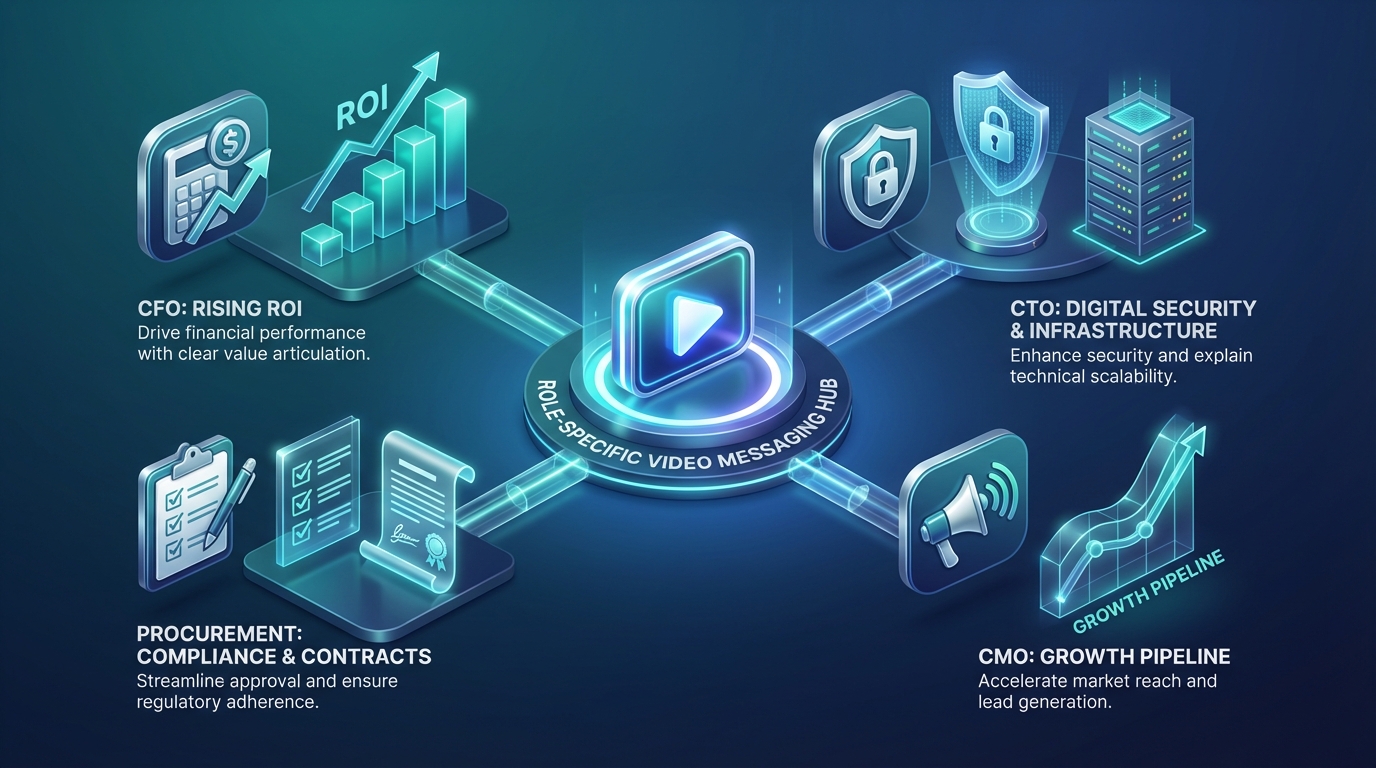
The CFO’s primary concerns are ROI, payback periods, and Total Cost of Ownership (TCO). Economic buyer messaging alignment must quantify the business case with surgical precision. A CFO video blueprint should be 60–90 seconds, leading with a quantified executive summary.
Key components include a 3-year TCO model and a clear payback calculation: Payback = One-time investment / Monthly net benefit. The video should highlight downside protection and risk-adjusted returns to facilitate rapid budget approval during Q1.
The Technical Authority (CTO/CISO)
For the CTO, priorities shift toward security, scalability, and data residency. Technical buyer video content should be more detailed, typically 2–3 minutes, featuring an architecture walkthrough and security posture highlights (e.g., ISO 27001 or SOC 2 compliance).
Demos should focus on SSO/SCIM integration, audit logging, and performance benchmarks. Providing a sandbox walkthrough via video allows the technical team to visualize the implementation without requiring a live session, significantly reducing friction in the evaluation stage.
The Functional Owner (CMO/CXO)
The CMO focuses on business outcomes like pipeline lift, Net Retention Rate (NRR), and change management. CMO video messaging should utilize proof clips from similar verticals and success metrics dashboards.
LinkedIn consumption trends in India suggest that localized B2B video content performs significantly better for functional leaders. A 90-second video recapping pipeline drivers and adoption milestones is essential for maintaining momentum within the user department.
Procurement and Legal Influencers
Often overlooked, procurement influencer videos vendor selection video presentations are vital for clearing the final hurdles of a deal. These 60-second clips should outline data flows, DPA highlights, and SLA tiers. By proactively addressing contractual guardrails, sales teams can prevent the “legal black hole” that often swallows Q1 deals.
End Users and Champions
Champion enablement video tools are designed to help your internal advocate “pitch upstairs.” These should be 30–60 second “forward-ready” clips that the champion can easily share via WhatsApp. These micro-clips should address common internal objections and summarize the “why now” for the broader committee.
Sources:
- PayU India: B2B Marketing Strategies to Drive Sales
- SalesDesign India: LinkedIn Marketing Trends in India 2025–26
3. Multi-Stakeholder Sales Orchestration and Sequence Design
Successful multi-stakeholder sales orchestration involves coordinated, role-based sequences triggered by specific deal stages. A fundamental rule for 2026 enterprise sales is that no deal should move to the next stage without at least three key roles confirming alignment through video engagement.
The orchestration begins in the Discovery stage. While the CMO receives a “Problem Framing” explainer, the CTO is simultaneously sent a “Security Posture” micro-clip. This parallel processing ensures that all stakeholders are educated at the same rate, preventing the technical team from vetoing a solution that the functional team has already fallen in love with.
During the Evaluation stage, the sequence intensifies. The CFO receives a value reel with a direct link to a dynamic ROI spreadsheet, while the Procurement team is sent a compliance checklist video. This level of personalized stakeholder engagement creates a “surround sound” effect within the account, making the vendor's presence felt across all departments.
Committee member personalization is achieved through dynamic variables such as the stakeholder’s name, function, and specific industry overlays. Platforms like TrueFan AI enable this level of personalization at scale, allowing one-to-one role-based videos to be rendered in under 30 seconds via API integrations with CRMs like Salesforce or HubSpot.
In the Indian market, the choice of channel is as important as the content. While email remains the formal standard, WhatsApp is the primary engine for internal committee forwarding. Providing subtitle-heavy, vertical videos (9:16) ensures that content is consumable on the go, which is essential for busy Indian executives.
Sources:
- ET BrandEquity x Ipsos: The State of Digital Marketing in India 2025–26
- Smart Academy India: Digital Marketing Trends 2026
4. Building Consensus to Accelerate the Complex Sales Cycle
The most difficult part of an enterprise deal is not selling to the champion; it is buying committee consensus building. When 6–10 people are involved, the risk of “no decision” increases exponentially. To counter this, sales teams must deploy “Consensus Plays.”
The “Shared Vision Video Brief” is the cornerstone of this strategy. This is a 90-second narrative designed for the entire committee. It recaps the “Why Now,” the primary value levers, risk mitigation strategies, and the implementation timeline. It serves as a single source of truth that prevents internal miscommunication.
Another critical asset is the “Quantified Business Case Reel.” This CFO-friendly video presents three scenarios—base, expected, and stretch—alongside a sensitivity analysis. By aligning these scenarios to Q1 budgeting windows, the sales team speaks the language of the finance department, removing the ambiguity that often stalls complex deals.
Complex sales cycle acceleration is further supported by a “Risk Mitigation Clip Series.” These are three 45-second shorts, each addressing a top objection: security, integration complexity, and user adoption. By proactively “killing the objections” before they are even raised in a formal meeting, the sales team builds immense trust and authority.
Finally, providing champion enablement video tools—such as pre-written WhatsApp templates to accompany the videos—empowers the internal advocate to navigate the internal political landscape. This reduces the burden on the champion and ensures the vendor's narrative remains intact as it is passed from the CMO to the CFO.
Sources:
- Mindtickle: 15 Sales Discovery Questions to Help You Fill Your Sales Pipeline
- SalesDesign India: LinkedIn Marketing Trends in India 2025–26
5. The Q1 Deployment Playbook: A Timeboxed Rollout
To capture Q1 budgets, the implementation of B2B buying committee video mapping must be disciplined and timeboxed. A six-week rollout is the standard for high-performing enterprise teams.
Weeks 1–2: Data Readiness and Journey Mapping
The first phase involves extracting all known stakeholders from the CRM and enriching their profiles with title, function, and regional nuances. Sales teams must identify gaps in the committee—if you don’t have a technical contact, now is the time to find one. This phase concludes with storyboarding role-based scripts that incorporate industry-specific overlays.
Weeks 3–4: Launching Role-Based Sequences
In this phase, the production of CFO, CTO, and CMO videos begins. Using enterprise sales enablement automation, these videos are personalized with dynamic fields. Distribution is multi-channel: a LinkedIn DM to the CTO, an email to the CFO, and a WhatsApp catalog video marketing guide message to the functional champion.
Weeks 5–6: Executive Alignment and Finalization
The final weeks focus on the “Shared Vision” video and the final ROI model. A video from the vendor’s VP or SVP is sent to the prospect’s executive sponsor to signal commitment. This phase aims to secure the final decision meeting, with all committee members already briefed and aligned via their personalized video journeys.
For India-specific deployments, prioritizing Hindi and English variants, along with regional languages where applicable, significantly increases the “warmth” of the outreach. This localized approach demonstrates a level of commitment that generic, global competitors often lack.
Sources:
- ET BrandEquity x Ipsos: The State of Digital Marketing in India 2025–26
- Smart Academy India: Digital Marketing Trends 2026
6. Measurement, Governance, and Enterprise-Grade Execution
To manage a B2B buying committee video mapping program, organizations need sophisticated KPIs. The most critical metric is the Consensus Health Score (0–100). This is a weighted score based on role importance: CFO (30%), CTO (25%), CMO (20%), Procurement (15%), and Champion (10%).
The score is calculated by tracking if a stakeholder watched ≥75% of a video (20 points), replied (30 points), accepted a meeting (30 points), or shared the video internally (20 points). A Consensus Health Score above 70 by day 30 of the sequence is a strong predictor of deal success.
Other essential metrics include the multi-contact watch rate, stage velocity (median days between stages), and the meeting conversion rate. These data points allow sales leadership to isolate which variables—such as mentioning a stakeholder's name in the first 5 seconds—are driving the best outcomes.
Governance is equally important. All video content must undergo brand and legal reviews, especially when making ROI claims for the CFO. Data privacy guardrails must be in place to ensure that PII is handled according to ISO 27001 and SOC 2 standards.
TrueFan AI's 175+ language support and Personalised Celebrity Videos offer a unique way to break through the noise of a crowded inbox, providing a level of engagement that traditional sales tools cannot match. Solutions like TrueFan AI demonstrate ROI through increased stage velocity and higher opportunity-to-close rates, making them indispensable for the modern enterprise GTM stack.
By automating the creation of B2B account penetration videos, teams can focus on strategy rather than production. The ability to perform “virtual reshoots” to iterate messaging without needing the original speaker to re-record content is a game-changer for Q1 agility.
Conclusion: Orchestrating Q1 Success
The transition to B2B buying committee video mapping represents a fundamental shift in how enterprise deals are won in 2026. By moving away from generic outreach and toward a structured, role-based video strategy, sales teams can navigate the complexity of 6–10 stakeholders with unprecedented clarity.
The integration of decision maker journey mapping decision maker journey mapping with high-velocity video production allows for a level of personalized stakeholder engagement that was previously impossible at scale. As you execute your Q1 playbook, remember that the goal is not just to be seen, but to build the consensus necessary for a definitive “Yes.”
By leveraging the right metrics—like the Consensus Health Score—and the right technology, enterprise organizations can ensure that their value proposition resonates with every member of the buying committee, from the CFO's office to the end-user's workstation.
Primary CTA: Book a Q1 enterprise workshop to set up your B2B buying committee video mapping framework and role-based templates for your top 50 target accounts.
Secondary CTA: Download our comprehensive decision maker journey mapping worksheet and champion enablement video tools pack to start accelerating your sales cycles today.
Frequently Asked Questions
How does video mapping help in reducing the sales cycle?
By delivering role-specific information (ROI for CFO, Security for CTO) simultaneously, you eliminate the “serial” nature of traditional sales where each department is briefed one after the other. This parallel engagement is the core of complex sales cycle acceleration.
Is it difficult to personalize videos for 10 different stakeholders?
Not with modern enterprise sales enablement automation. Tools allow you to use a single master template and dynamically swap out names, company logos, and specific value points, rendering hundreds of personalized videos in minutes.
What is the ideal length for a B2B committee video?
It varies by role. CFOs and Procurement prefer 60–90 second executive summaries. CTOs and technical leads often require 2–3 minutes to grasp architecture and security details. Champions benefit from 30–60 second “forwardable” clips.
How do we handle data privacy when using personalized video?
Enterprise-grade platforms like TrueFan AI are ISO 27001 and SOC 2 certified. They use consent-first models and built-in moderation to ensure that all personalized content meets strict corporate governance and data residency requirements.
Which channels are most effective for distributing these videos in India?
While email is the record of truth, WhatsApp has become the primary channel for internal committee sharing in India. LinkedIn DMs are also highly effective for reaching CTOs and CMOs who are active in professional communities.
Can we use these videos for existing account expansion?
Absolutely. B2B account penetration videos are highly effective for cross-selling to new departments within an existing enterprise client, as they allow you to leverage your current success stories in a personalized format.