
B2B procurement acceleration 2026: Personalizing stakeholder videos to speed Q4 approvals
Estimated reading time: ~9 minutes
Key Takeaways
- Asynchronous, role-specific videos reduce alignment delays across buying committees and keep Q4 deals moving.
- Vendor evaluation automation standardizes scorecards, removes subjectivity, and cuts time-to-shortlist by up to 40%.
- CFO/CTO/CMO-aligned narratives deliver tailored ROI, security, and growth messages within a unified business case.
- Compliance-first evidence packs (ISO 27001/SOC2, data residency) accelerate InfoSec reviews and legal approvals.
- WhatsApp and CRM-triggered delivery ensure the right asset reaches the right stakeholder at the decisive moment.
The final quarter of the fiscal year represents the most volatile period for enterprise sales teams. As organizations race to utilize remaining budgets, the complexity of the enterprise buying journey often leads to significant bottlenecks that threaten deal closure.
B2B procurement acceleration 2026 is defined as the strategic integration of AI-enabled personalization and automated evaluation workflows designed to compress buying cycles. This approach focuses on aligning multi-stakeholder decision committees through asynchronous, role-specific video communication and standardized vendor scoring. See the TrueFan AI guide on B2B procurement cycle acceleration 2026.
In the current landscape, Indian enterprises are leading the charge in procurement modernization. By leveraging digitized ecosystems like the Government e-Marketplace (GeM), organizations are increasing decision-making velocity through high-transparency, tech-led frameworks.
Platforms like TrueFan AI enable sales teams to navigate these complex environments by delivering hyper-personalized content that addresses the specific concerns of CFOs, CTOs, and procurement leads simultaneously. This ensures that the momentum gained in the discovery phase is maintained through the final approval gates.
Why Q4 deals stall in enterprise buying committees (and where video helps)
Enterprise deals frequently encounter “the Q4 stall,” where promising opportunities vanish into the black hole of procurement governance. This phenomenon is rarely due to a lack of interest but is instead a byproduct of systemic friction within the buying committee.
Multi-stakeholder complexity remains the primary barrier to B2B procurement cycle acceleration. A typical enterprise purchase now involves 6 to 10 stakeholders, each possessing unique KPIs and veto powers. When these individuals cannot meet synchronously, the decision-making process defaults to the slowest common denominator. Explore the buying committee video mapping framework.
Procurement compliance and audit requirements further extend these timelines. In 2026, the demand for rigorous audit trails and evidence packs has intensified, often requiring manual verification of security postures and legal terms.
Subjective vendor scoring also drags out shortlisting. When evaluation criteria are inconsistent, committees spend weeks debating qualitative differences rather than moving toward a selection. Standardizing these scorecards is essential for maintaining velocity.
Role-specific, short-form videos serve as the ultimate friction-reducer. By delivering tailored messages that answer specific objections asynchronously, teams can bypass the need for endless “alignment meetings.” This keeps the deal moving forward even when key stakeholders are unavailable for live calls. See examples of vendor selection video presentations.
Sources:
Multi-stakeholder decision mapping for B2B procurement acceleration 2026
To achieve B2B procurement acceleration 2026, sales leaders must move beyond traditional account planning and embrace multi-stakeholder decision mapping. This involves the structured identification and sequencing of every role influencing the purchase. Review the buying committee video mapping approach.
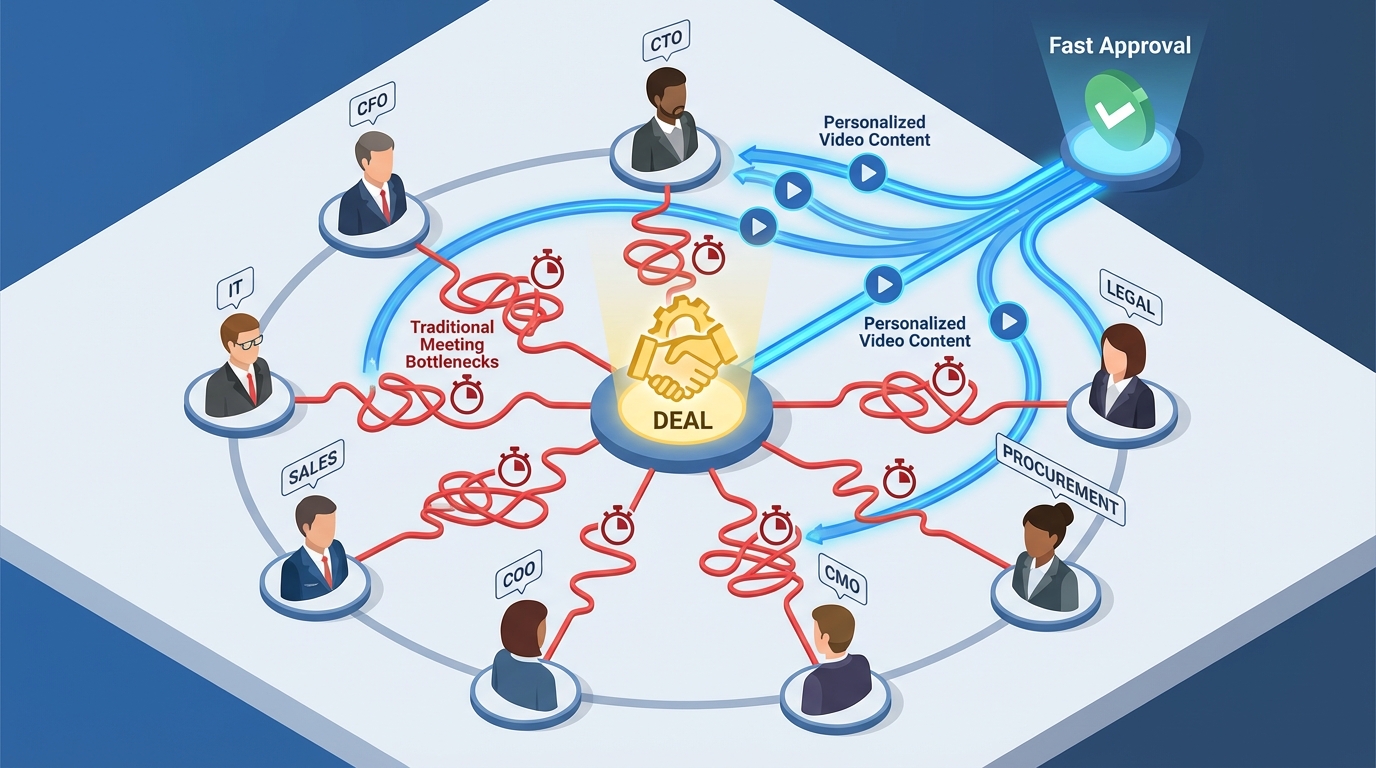
The mapping process begins by identifying the economic buyer, the technical approver, compliance officers, and end-users. Each of these roles operates within a specific “approval gate” that must be cleared before the next stage of the procurement journey can begin.
For the CFO, the primary KPIs are payback period, Internal Rate of Return (IRR), and the impact on Opex versus Capex. Their objections usually center on total cost of ownership and budget window constraints. The necessary artifact here is a budget approval video featuring a dynamic ROI calculator.
The CTO and CISO focus on security posture, data residency, and integration complexity. Their objections are rooted in technical risk and SLA reliability. They require procurement compliance videos that walk through architecture one-pagers and provide ISO 27001/SOC2 evidence.
The CMO or Business Unit head is driven by growth impact and speed-to-market. They fear execution risk and low adoption rates. For them, competitive differentiation presentations with real-world use cases and 30/60/90-day activation plans are the most effective tools.
Finally, the Procurement Lead seeks compliance, savings, and vendor risk mitigation. They are often the gatekeepers of the RFP process. Providing them with vendor evaluation automation outputs and personalized RFP response videos ensures that your solution is scored accurately and quickly.
Sources:
CFO CTO CMO messaging alignment: Constructing the unified narrative
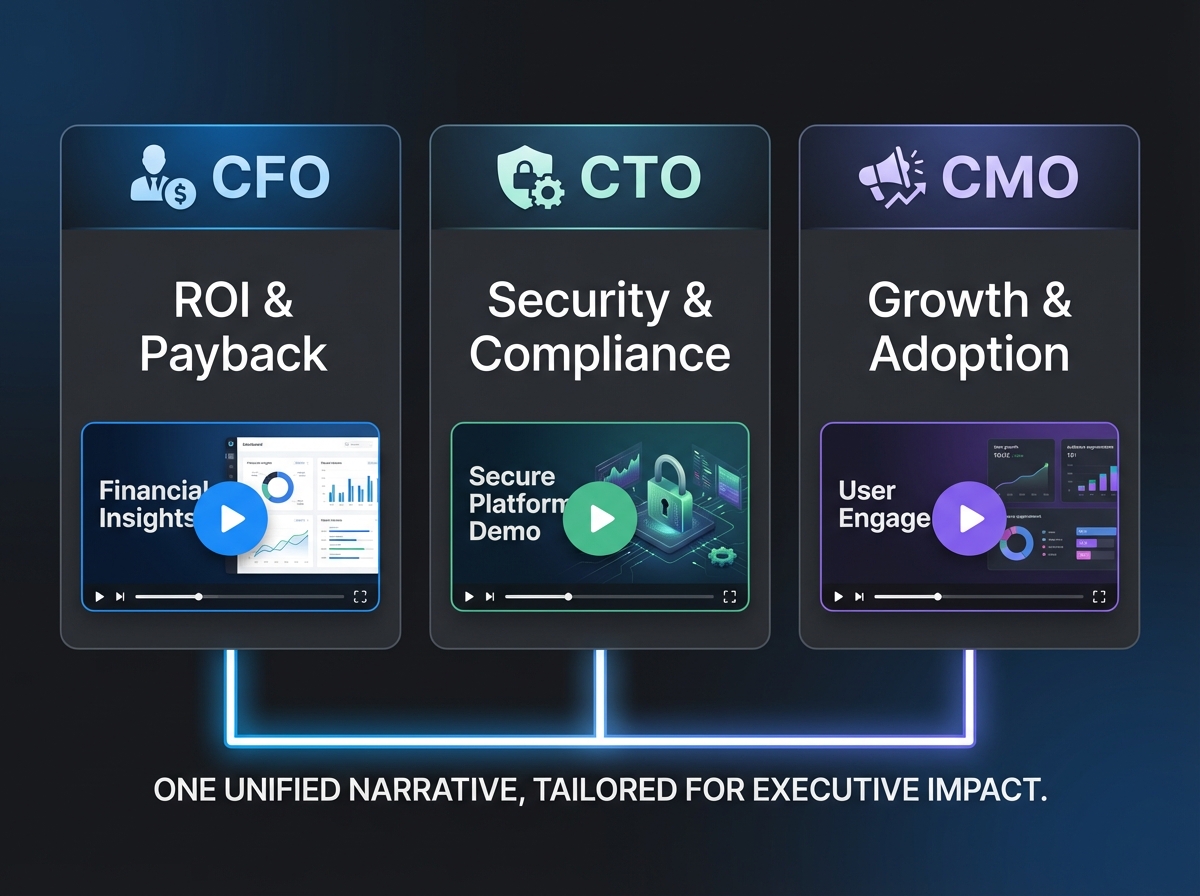
Achieving CFO CTO CMO messaging alignment requires a sophisticated content strategy that delivers three parallel but consistent arguments. While the core value proposition remains the same, the delivery must be tuned to the specific frequency of each executive.
The CFO’s video should present three ROI scenarios: base, optimistic, and conservative. It must clearly outline the payback timeline in quarters and provide a finance-ready ROI pack. The goal is to provide the CFO with the exact data they need to defend the expenditure to the board.
The CTO’s video must prioritize transparency. It should detail data flow diagrams, SSO/SCIM capabilities, and DLP posture. By including a direct link to a security and integration brief, you reduce the back-and-forth between your engineering team and their IT department.
The CMO’s video should be high-energy and outcome-oriented. It needs to highlight competitive deltas and provide a clear vision of how the solution will differentiate their brand in the marketplace. This video should include a call-to-action to “See category-specific wins.”
TrueFan AI's 175+ language support and Personalised Celebrity Videos allow these messages to be localized for global stakeholders, further reducing friction in regional decision units. Whether the stakeholder is in Mumbai, London, or New York, the message is delivered in their preferred language and context.
By linking these persona-specific videos to a single, quantified business case, you ensure that even though stakeholders are viewing different content, they are all moving toward the same conclusion. This unified narrative is the bedrock of buying committee consensus building. Explore the B2B procurement acceleration 2026 guide.
Sources:
The enterprise video system: Asset-by-asset breakdown
To operationalize B2B procurement acceleration 2026, organizations must deploy a structured suite of video assets. These are not generic marketing materials but targeted sales enablement tools designed for specific stages of the enterprise buying journey.
Enterprise vendor selection videos are 2–3 minute assets that provide side-by-side deltas between your solution, the status quo, and top competitors. These should be standardized against the client's specific RFP criteria and distributed via low-friction channels like WhatsApp or dedicated microsites. View example vendor selection video presentations.
RFP response video personalization involves creating 60–120 second clips for each major section of an RFP. Instead of a procurement officer reading a dry PDF, they watch a video of your subject matter expert explaining how you meet criterion X. This humanizes the response and clarifies complex technical points instantly. See how to personalize RFP response videos.
Budget approval videos are perhaps the most critical Q4 asset. These are 2-minute, CFO-ready summaries that frame the purchase as a strategic investment rather than a cost. They should auto-generate a finance appendix, making it easy for the economic buyer to hit “approve” within the current budget cycle.
Contract negotiation support videos address the “last mile” of the deal. When legal teams get stuck on liability caps or IP clauses, a 60-second video explainer can unblock the stalemate. By explaining the rationale behind a redline position and offering pre-approved fallback options, you can shave weeks off the legal review process.
These assets, when integrated into a B2B sales enablement framework, create a self-sustaining momentum that guides the buying committee from initial interest to final signature without the need for constant manual intervention.
Sources:
Operationalizing acceleration with vendor evaluation automation
The most significant innovation in B2B procurement acceleration 2026 is the rise of vendor evaluation automation. This involves using AI-assisted scorecards and automated routing to remove subjectivity and delays from the shortlisting process. Learn from these vendor selection video presentation examples.
The workflow begins by ingesting RFP criteria and generating a weighted scorecard. This scorecard is then mapped to specific stakeholders. For example, the security criteria are routed to the CISO, while the financial criteria are routed to the CFO.
Automation ensures that these stakeholders receive the relevant videos and documents simultaneously. The system enforces SLA-bound reminders, ensuring that no single reviewer becomes a bottleneck. As stakeholders provide their scores, the system assembles an audit-ready trail in real-time.
The impact of this approach is measurable. Standardized scoring and automated routing can reduce the time-to-shortlist by up to 40%. This is particularly vital in Q4, where a one-week delay can mean the difference between a closed deal and a deferred budget.
Solutions like TrueFan AI demonstrate ROI through their ability to integrate with these automated workflows. By providing low-latency renders and CRM-triggered video delivery, they ensure that the right content reaches the right stakeholder at the exact moment it is needed for evaluation.
Furthermore, the analytics provided by these systems allow sales leaders to identify “consensus deltas.” If the CTO and CMO are misaligned on a specific feature, the system flags this, allowing the sales team to deploy a targeted “alignment video” to bridge the gap before the final committee meeting.
Sources:
Playbooks for Q4 budget finalization: The 30/60/90-day sprint
To successfully navigate the Q4 crunch, enterprise teams must execute a disciplined 90-day sprint. This playbook focuses on procurement committee engagement and the strategic deployment of video assets to clear final approval gates.
In the first 30 days, the focus is on mapping stakeholders and assembling evidence. Sales teams should cut their six core videos: Executive Summary, CFO ROI, CTO Security, CMO Growth, Procurement/RFP, and Legal/Contracting. These assets should be connected to CRM triggers to launch as soon as an account moves to the “Evaluation” stage.
By the 60-day mark, the strategy shifts to addressing late-stage blockers. This is where procurement compliance videos and regional language localizations become essential. A/B testing on CFO intros can help determine which ROI framing—risk mitigation vs. growth—is resonating more effectively with the economic buyer.
The final 30 days (the 90-day mark) are dedicated to the “close plan.” This involves deploying budget approval videos and contract negotiation support assets. If a deal is stuck in legal, an executive-to-executive video outreach can provide the necessary nudge to prioritize the final signature.
In the Indian context, leveraging the WhatsApp Business API for the distribution of these assets is highly effective. The immediacy of WhatsApp, combined with multilingual personalization, reduces the friction often found in traditional email-based procurement communication. Learn more about WhatsApp catalog video marketing.
This structured approach ensures that by the time December 31st arrives, every stakeholder has the information, evidence, and confidence they need to approve the purchase, effectively achieving B2B procurement acceleration 2026.
Sources:
Measurement, Security, and FAQ for B2B procurement acceleration 2026
To sustain a strategy of B2B procurement acceleration 2026, organizations must implement rigorous measurement and security standards. Tracking the right KPIs allows for continuous optimization of the sales process.
Core KPIs include the cycle-time to budget approval and stage conversion lifts. Organizations should target a 20–40% reduction in time-to-shortlist by using aligned videos and automated scorecards. Additionally, “consensus velocity”—the median time for all stakeholders to watch and score an asset—is a leading indicator of deal health. See this guide to buying committee video mapping.
Security is paramount in enterprise procurement. Any video system must adhere to ISO 27001 and SOC2 standards. Data residency options and consent-first content creation models are non-negotiable for InfoSec teams, especially when dealing with sensitive financial or technical data.
Sources:
Frequently Asked Questions
How does B2B procurement acceleration 2026 differ from traditional sales enablement?
Traditional enablement focuses on general content, whereas 2026 acceleration uses AI to create hyper-personalized, role-specific videos and automated evaluation workflows that directly address the individual KPIs of the entire buying committee.
Can personalized video really speed up the legal and contracting phase?
Yes. By using contract negotiation support videos to explain complex clauses and offer pre-approved fallback positions, teams can reduce the back-and-forth between legal departments, often cutting redline cycles by 50%.
What role does TrueFan AI play in this ecosystem?
TrueFan AI's 175+ language support and Personalised Celebrity Videos allow enterprise teams to deliver high-impact, localized content at scale, ensuring that every stakeholder in a global buying committee receives a message that resonates with their specific cultural and professional context.
Is vendor evaluation automation suitable for all deal sizes?
While most effective for complex enterprise deals with 6+ stakeholders, the principles of standardized scoring and automated routing can be applied to mid-market deals to ensure consistency and audit readiness.
How do we ensure data privacy when sending personalized videos to executives?
Enterprise-grade platforms prioritize security through ISO 27001/SOC2 compliance, consent-first models, and robust data processing agreements (DPA), ensuring that all stakeholder data is handled with the highest level of integrity.



