AI video co-working spaces India 2026: Virtual tours, testimonial automation, and multilingual promos at national scale
Estimated reading time: ~9 minutes
Key Takeaways
- 2026 is the breakout year for co-working video marketing in India, driven by hybrid work expectations and immersive discovery.
- AI virtual tours and amenity showcases scale localized content across 50+ cities with real-time overlays and multilingual voiceovers.
- Automated testimonial workflows deliver consent-first, QA-checked authenticity at national scale.
- Social-first performance with Reels/TikTok-style edits turns views into tours with A/B-tested hooks and dynamic captions.
- AI cuts cost by ~90% and 10x’s output, replacing traditional production while maintaining brand safety and governance.
The landscape of commercial real estate in India is undergoing a seismic shift. As we navigate through 2026, the mandate for national-scale video in the flex space market has moved from a “nice-to-have” to an operational necessity. AI video co-working spaces India 2026 represents the next frontier of digital discovery, where managed office virtual tour AI and co-working amenity showcase AI are no longer futuristic concepts but daily tools for growth. Platforms like Studio by TrueFan AI enable operators to scale this content across 50+ cities without the logistical nightmare of dispatching on-ground film crews for every new center launch.
The scale of this opportunity is staggering. India’s flexible office supply is projected to hit 125 million sq ft by 2027, according to IBEF’s co-working supply forecast. Furthermore, reports from Cushman & Wakefield (Hindustan Times coverage) indicate that flexible office space in India will cross the 100 million sq ft mark within 2026. This growth is fueled by a “digital-first” buyer persona—enterprises and startups alike now evaluate spaces through immersive video before even booking a physical tour. Industry leaders like WeWork India have already set the benchmark with virtual tours for locations like Manyata Redwood in Bengaluru and Lightbridge in Mumbai, proving that video-led discovery is the primary driver of high-intent leads.
1. Why 2026 is the Breakout Year for Co-working Space Video Marketing in India
The year 2026 marks a turning point where “co-working space video marketing” has evolved into a sophisticated, data-driven engine. It is no longer just about pretty drone shots; it is about short-form and mid-form video content (15–120 seconds) that dynamically showcases locations, amenities, and community vibes across web, listings, and social channels.
Several key trends are converging to make this the breakout year:
- Immersive Expectations: As hybrid collaboration becomes the standard, immersive virtual workspaces are raising the bar for rich media previews. According to Zoapi India’s hybrid collaboration outlook, the future of hybrid work relies heavily on high-quality digital representations of physical spaces.
- Wellness and Productivity Links: Workplace trends in 2026 emphasize flexibility and sustainability, which correlate with an 84% improvement in physical health outcomes for employees, as noted by ET HRME’s workplace trends report. Video is the only medium capable of conveying these “soft” benefits—like natural lighting, ergonomic design, and wellness rooms—to remote decision-makers.
- Tech-Enabled Operations: In tech hubs like Bangalore, the 2026 coworking stack highlights AI and automation as core operational pillars. Marketing is following suit, moving away from manual production toward automated content workflows that integrate with IoT and management software.
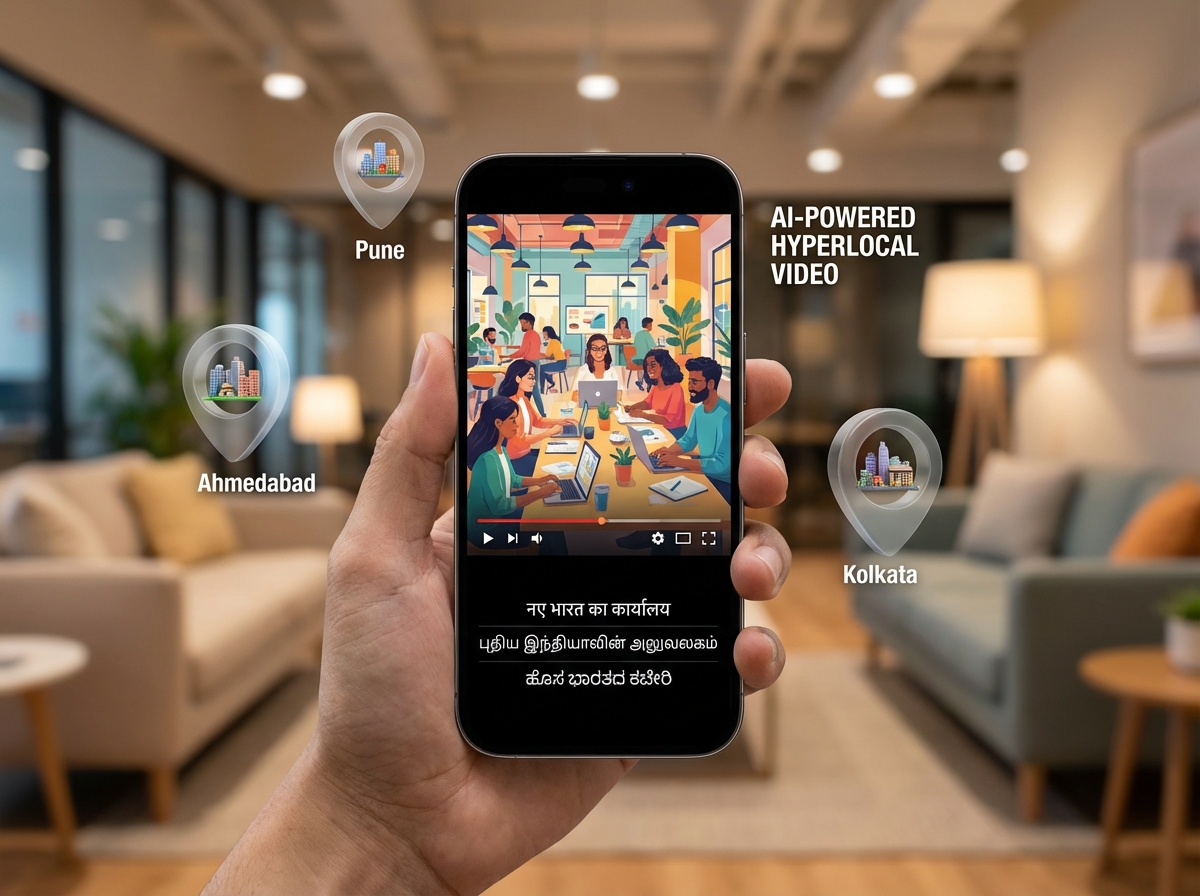
- Hyperlocal Expansion: As operators expand into Tier-2 and Tier-3 cities, the need for scalable, multilingual content has exploded. National brands can no longer rely on English-only marketing if they want to resonate in markets like Ahmedabad, Pune, or Kolkata.
Source: Cushman & Wakefield India Market Maturity Report
2. Managed Office Virtual Tour AI: Scaling Walkthroughs Across 50+ Cities
The traditional method of creating a virtual tour—hiring a crew, flying them to a city, spending three days shooting, and two weeks editing—is dead. In 2026, “managed office virtual tour AI” allows operators to launch walkthroughs city-by-city using a centralized master asset kit.
The Technical Blueprint for 2026
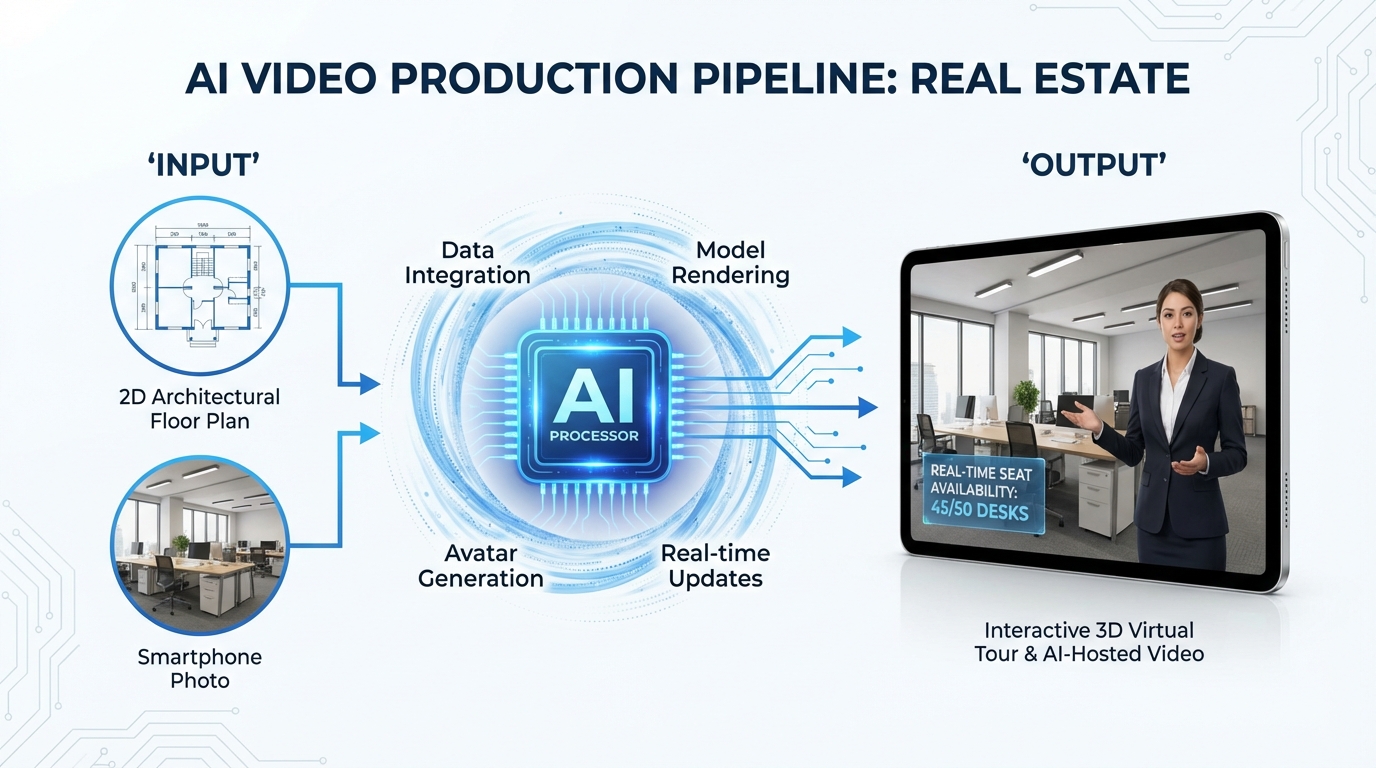
To achieve this at scale, operators are utilizing an AI-driven video pipeline. This involves taking existing B-roll, high-resolution photos, and CAD floor plans and feeding them into a script engine.
- Input Layer: Center name, micromarket (e.g., Koramangala, BKC), target persona (GCC vs. SME), and specific amenity lists.
- Dynamic Scripting: A prompt library uses slot variables like [City], [Landmark], and [Commute Time] to create a unique narrative for every location.
- Avatar Integration: An AI avatar host—often a digital twin of the brand’s community manager—delivers the narration. Studio by TrueFan AI’s 175+ language support and AI avatars allow these hosts to speak perfectly in the local dialect of the target city, ensuring a “boots-on-the-ground” feel without the travel. AI voice cloning for Indian accents
- Visual Assembly: The AI stitches together B-roll with animated floor plan overlays. A critical 2026 innovation is the API-driven availability overlay, which shows real-time seat availability and pricing ranges directly on the video screen.
Production SOP
A 1-hour asset intake process can now lead to the batch generation of 10 to 200 variants. This allows a national marketing team in Delhi to produce a localized walkthrough for a new center in Hyderabad or Chennai in under 24 hours. These videos are then placed above-the-fold on location pages, significantly increasing the “Click-to-Tour” conversion rate.
Source: Uncubate India Tech Trends
3. Co-working Amenity Showcase & Multilingual Localization: The Hyperlocal Edge
In a crowded market, amenities are the differentiators. However, a static list of “high-speed internet” and “free coffee” no longer converts. “Co-working amenity showcase AI” turns these features into high-conversion video assets.
The Anatomy of a 2026 Amenity Video
- The Hook (0–3s): A bold claim tied to a specific persona pain point. For example: “Stop taking client calls in the hallway—our soundproof pods are 100% acoustic-rated.”
- The Visual Beat (3–12s): High-definition B-roll of the amenity in use, overlaid with technical specs (e.g., “24x7 access,” “App-based booking”).
- The Localization Layer: This is where co-working multilingual video content becomes a competitive advantage. By automatically generating subtitles and voiceovers in Hindi, Marathi, Tamil, Bengali, Kannada, and Telugu, operators can target specific micromarkets with precision.
Hyperlocal Tokenization: A Content Gap Filled
While competitors often stick to generic city-level targeting, elite operators in 2026 use hyperlocal tokenization. This means a video for a center in Bengaluru isn’t just “Bengaluru-focused”—it’s “Indiranagar-focused,” mentioning specific landmarks like the 100 Feet Road or proximity to the Purple Line Metro. This level of detail, delivered via AI avatars, builds instant rapport with local prospects.
Source: Exospace Top Coworking Brands 2026
4. Member Testimonial Automation: Building Trust Through Scalable Authenticity
Authenticity is the currency of 2026. Member testimonial automation co-working is the process of capturing, cleaning, and variantizing real member stories across hundreds of locations.
The Consent-First Workflow
A major sub-topic often omitted by competitors is the consent-first automation workflow. In 2026, data privacy and likeness rights are paramount.
- Remote Capture: Members receive a link to record a short video on their phone based on a prompt kit (e.g., “How has the community here helped your startup grow?”).
- AI Processing: The system automatically cleans the audio, removes “umms” and “ahhs,” and adds brand-safe frames.
- Compliance Audit: A digital consent form is automatically tagged to the video file, creating an audit trail for legal teams.
- Varianting: The AI takes a single 60-second testimonial and creates a 15-second “Hook” version for Instagram Reels and a 30-second “Deep Dive” for LinkedIn.
By automating this, a co-working brand can showcase 50 different testimonials from 50 different industries across 50 different cities, creating a “wall of love” that is impossible to replicate with traditional video production.
5. Social-First Performance: Mastering Office Space Instagram Reels AI
Instagram and LinkedIn have become the primary discovery engines for flex spaces. Office space Instagram Reels AI involves creating automated 9:16 edits that are tailored specifically for the 2026 algorithms.
The 2026 Creative System
- The 7-Shot Rule: High-performing reels now use rapid 1–2 second cuts to maintain a 50%+ retention rate. Instagram Reels opening seconds tips
- Music Matching: AI tools now automatically sync the visual transitions to trending audio tracks that are licensed for commercial use.
- Dynamic Captions: On-screen captions are delivered at 90–110 words per minute, ensuring that even “sound-off” viewers get the full message.
- A/B Hook Testing: Operators generate five different “hooks” for the same center tour to see which one drives the most “Book a Tour” clicks. Opening seconds testing framework
This social-first approach ensures that “flex workspace promotional videos AI” aren’t just seen—they are acted upon. By integrating these videos with WhatsApp API links, operators can move a prospect from an Instagram Reel to a scheduled tour in under three clicks.
Source: HubSpot 2026 Marketing Statistics
6. The ROI Blueprint: Replacing Traditional Production with AI Efficiency
The shift to AI is driven by a simple mathematical reality. Solutions like Studio by TrueFan AI demonstrate ROI through a drastic reduction in both “Cost per Asset” and “Time to Market.”
The ROI Math: Traditional vs. AI
Consider an operator with 50 centers across India:
- Traditional Production:
- Cost: ₹1,50,000 per location (crew, travel, editing).
- Total: ₹75,00,000.
- Time: 4–6 months to cover all locations.
- Output: 2–3 videos per location.
- AI-Driven Production:
- Cost: Amortized license + rendering costs (approx. ₹15,000 per location).
- Total: ₹7,50,000.
- Time: 14 days to generate all assets.
- Output: 20+ variants per location (multilingual, persona-specific, social-cutdowns).
The result is a 90% reduction in costs and a 10x increase in content volume. This allows for “AI video for WeWork Awfis competitors” to not just match the industry leaders but to flood the market with more relevant, hyperlocal content than the giants can produce manually.
Source: Venture X India ROI & Automation Report
7. Implementation & Governance: A 30-Day Roadmap for Indian Operators
Transitioning to an AI-first video strategy requires a structured approach. For enterprise-level operators, this involves balancing speed with brand safety.
The 30-Day Pilot Blueprint
- Days 1–7 (Asset & Strategy): Define your core personas (e.g., “The Tech Founder,” “The GCC Lead”). Collect your “Master Asset Kit”—high-quality B-roll of your flagship centers and your brand guidelines.
- Days 8–14 (Template & Avatar Creation): Lock in your video templates for tours, amenities, and testimonials. Create or select your AI avatar host.
- Days 15–21 (Batch Generation): Use the API to generate content for your first 10 centers. This includes localizing into the top 3 languages for those regions.
- Days 22–30 (Distribution & Optimization): Deploy the videos to your website and social channels. Track the “Tour-to-Lead” conversion lift and iterate on the hooks.
Governance and Brand Safety
In the Indian market, maintaining “commercial real estate video AI” quality means strict adherence to brand safety. This includes:
- AI Labeling: Transparently disclosing the use of AI avatars to maintain trust.
- Watermarking: Ensuring all generated content is traceable to prevent unauthorized deepfakes.
- Human-in-the-Loop: A final QA check by local community managers to ensure that pronunciations of local areas (like “Madiwala” or “Gachibowli”) are phonetically perfect.
Conclusion
The era of AI video co-working spaces India 2026 is here. By integrating managed office virtual tour AI, co-working amenity showcase AI, and member testimonial automation co-working, Indian operators can achieve national-scale visibility with hyperlocal relevance. The ability to produce thousands of high-quality, multilingual video variants in days rather than months is the ultimate competitive advantage in the 125M sq ft flex market of 2027.
Pilot your strategy today—launch your first 10 centers in 30 days and redefine how India discovers its next workspace.
Frequently Asked Questions
How does AI video improve the lead-to-tour conversion rate?
AI video provides a more immersive and “honest” look at a space than static photos. By showing real-time availability and localized narration, it answers the prospect's questions before they even ask, leading to higher-intent tour bookings.
Can we use our own employees as AI avatars?
Yes. Enterprise solutions allow you to create a “Digital Twin” of your actual community managers or CEOs. This maintains the human connection of your brand while allowing that person to “speak” 175 languages and be in 50 cities at once.
Is AI video content compliant with Indian real estate regulations?
As long as the videos accurately represent the physical space and include necessary disclosures regarding AI-generated hosts, they are fully compliant. Using a “walled garden” approach for content generation ensures that no misleading information is produced.
How do I maintain brand consistency across 500+ videos?
Using Studio by TrueFan AI ensures that every video follows a locked template. Your brand colors, fonts, logos, and music beds are hard-coded into the generation process, so a video for a center in Kochi looks and feels exactly like one for a center in Gurgaon.
What is the minimum asset requirement to start?
You don't need a professional film. High-quality smartphone B-roll, 5–10 professional photos, and a clear floor plan are enough for the AI to generate a high-production-value walkthrough.
How does multilingual video impact SEO for co-working spaces?
Search engines in 2026 heavily prioritize localized content. By having video descriptions and transcripts in regional languages (like Kannada for Bengaluru-based pages), you capture “near me” searches that competitors using only English will miss.



