Voice commerce vernacular India 2026: A CTO blueprint to launch Hindi, Tamil, Bengali conversational shopping for Tier-2/3 growth
Estimated reading time: ~9 minutes
Key Takeaways
- Tier-2/3 growth will be unlocked by vernacular, voice-first journeys across Hindi, Tamil, and Bengali by 2026.
- A resilient stack blends Indic ASR/TTS, NLU for code-mixed inputs, RAG, and a product graph with low-latency delivery.
- Localized playbooks must reflect dialects, colloquialisms, and festival calendars to lift discovery and conversion.
- Dialect-specific shopping videos and automation across WhatsApp/RCS bridge trust and accelerate checkout via UPI 123PAY.
- Track a voice assistant marketing ROI model and follow a 180-day roadmap, expanding to smart speakers for end-to-end coverage.
The landscape of digital retail is undergoing a seismic shift as voice commerce vernacular India 2026 becomes the primary interface for the next 200 million shoppers. For Chief Technology Officers and innovation leaders, transitioning from a "type-and-search" model to a voice-first, natural language commerce framework is no longer a peripheral experiment but a core growth mandate. This blueprint outlines the architectural requirements and strategic playbooks necessary to capture the burgeoning Tier-2 and Tier-3 markets through localized conversational AI.
1. Executive Summary and the 2026 Market Outlook
The fundamental friction in Indian e-commerce has long been the cognitive load of typing in regional scripts on small mobile screens, often exacerbated by fragmented dialects and low-bandwidth environments. By 2026, the shift toward voice-activated shopping in native languages will unlock unprecedented growth in Tier-2 and Tier-3 cities, where "Bharat" users prefer the fluidity of speech over the rigidity of text. This transition leverages the convergence of high-speed 5G penetration and sophisticated Indic Large Language Models (LLMs) to bridge the digital literacy gap.
The opportunity sizing for 2026 is immense, with the vernacular internet user base projected to expand from 540 million to over 650 million active participants. Market insights suggest that voice assistants will be utilized by more than half of all Indian internet users for discovery and transaction-led queries. As regional language voice shopping matures, the ability to process complex, code-mixed inputs like "Hinglish" or "Tanglish" will define the competitive edge for enterprise retail platforms.
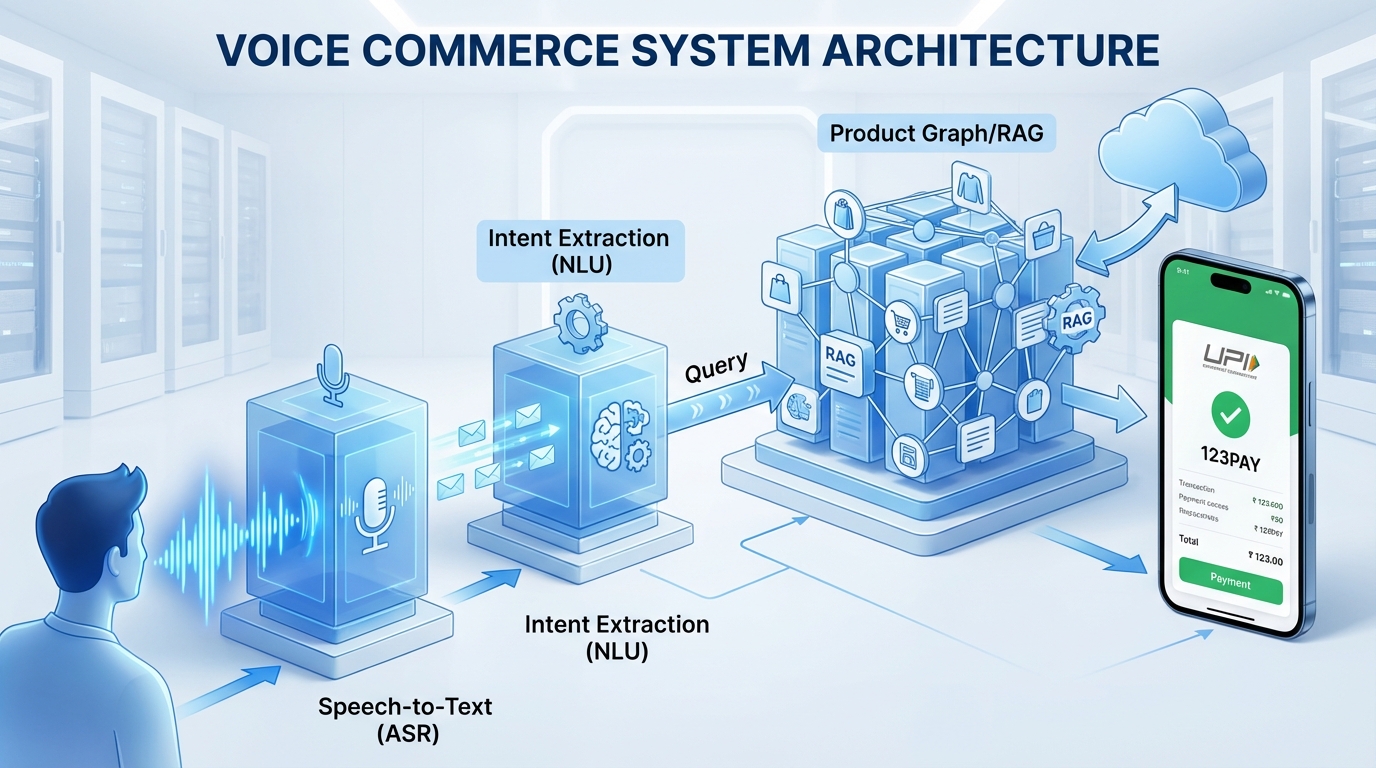
Technological architecture for this era requires a robust integration of Automatic Speech Recognition (ASR), Text-to-Speech (TTS), and Natural Language Understanding (NLU) layers, grounded by a product graph and RAG-based retrieval systems. This stack must interface seamlessly with localized payment rails such as UPI 123PAY to ensure a frictionless checkout experience for feature-phone and smartphone users alike. By deploying these systems across high-engagement channels like WhatsApp and Android, brands can achieve a scalable ROI model that prioritizes first-intent resolution and customer lifetime value.
2. Technical Architecture for Natural Language Commerce
Building a system for natural language commerce requires an end-to-end pipeline where users complete shopping journeys using conversational speech. The process begins with an ASR layer that converts spoken audio into text, specifically optimized for the phonetic nuances of Hindi, Tamil, and Bengali. This is followed by an NLU engine that extracts specific intents and entities—such as brand names, quantities, and price constraints—from the transcribed text to drive the logic of the commerce engine.
The core stack must prioritize Indic ASR/TTS models that are robust against environmental noise and dialectal variations common in Tier-2 regions. CTOs should leverage the Bhashini model catalogs to benchmark Word Error Rates (WER) and fine-tune models on specific regional corpora to ensure high accuracy. Deploying these models on-device or via low-latency edge computing is critical for maintaining the "instant" feel required for conversational shopping, especially in areas with fluctuating network stability.
Beyond transcription, the NLU layer must handle code-mixed inputs where users blend regional languages with English terms, a behavior prevalent across India. Slot-filling algorithms must be trained to recognize attributes like "sawa kilo" (1.25 kg) or "naalaikku" (tomorrow) to ensure the product graph retrieves the correct items. Retrieval-Augmented Generation (RAG) further enhances this by grounding the AI’s responses in factual product data, preventing hallucinations during complex Q&A sessions about product specifications or shipping policies.
3. Regional Playbooks: Hindi, Tamil, and Bengali Optimization
A successful voice commerce vernacular India 2026 strategy requires localized playbooks that account for the unique linguistic and cultural nuances of each major region. For Hindi voice search optimization, the focus must be on aligning metadata and NLU models with colloquial long-tail phrases and local entity names. This includes implementing Speakable schema and FAQ schema in Hindi to ensure that search engines and voice assistants can accurately parse and read aloud product information.
In the Hindi heartland, users often employ synonyms for retail intents, such as "sasta" or "sabse sasta" when looking for the best deals. Prompt templates like "Mujhe [brand] ka [category] ₹[price] ke andar dikhao" should be used to train NLU models to recognize price caps and brand preferences instantly. Dialectal variations between Western UP, Bihar, and Rajasthan must be mapped to ensure that the ASR layer does not fail when faced with regional accents or specific vocabulary choices.
Tamil conversational commerce AI presents a different set of challenges, particularly regarding honorifics and the frequent use of "Tanglish" (Tamil-English code-switching). The NLU must be adept at mapping slot-filling for traditional measures like "padi" alongside standard metric units like "litre." Effective prompt templates for this region often include location-based queries such as "Enakku [area]-la [category] ku offer irukka?", requiring the system to integrate real-time inventory and offer data with geographic precision.
Bengali voice-activated offers should be strategically timed with the cultural calendar, focusing on major festivals like Durga Puja and Poila Boishakh. These offers are triggered by recognized voice intents, such as a user asking for "kom dame" (lower price) or "offer ache?" (is there an offer?). The workflow involves capturing a voice note via WhatsApp, processing the intent through NLU, and immediately serving a voice-triggered video offer that leads to a single-click UPI payment or a Cash-on-Delivery (COD) confirmation.
4. Content Accelerators: Dialect-Specific Video & Automation
To maximize conversion in Tier-2 and Tier-3 markets, brands must move beyond static text and embrace dialect-specific shopping videos. These are short, localized explainer or offer videos that use the user’s native dialect and may even feature celebrity or brand ambassador voices for increased trust. Platforms like TrueFan AI enable enterprises to generate these personalized video assets at scale, providing the reassurance needed for first-time shoppers to complete a transaction.
Multilingual voice marketing automation serves as the connective tissue between voice discovery and final conversion. This involves setting up automated, event-driven campaigns—such as abandonment recovery or reorder reminders—that are triggered by specific voice intents. TrueFan AI's 175+ language support and Personalised Celebrity Videos allow brands to deliver these messages through WhatsApp, RCS, or App push notifications, ensuring the content is culturally and linguistically relevant to the recipient.
5. Voice SEO and Smart Speaker Integration Strategies
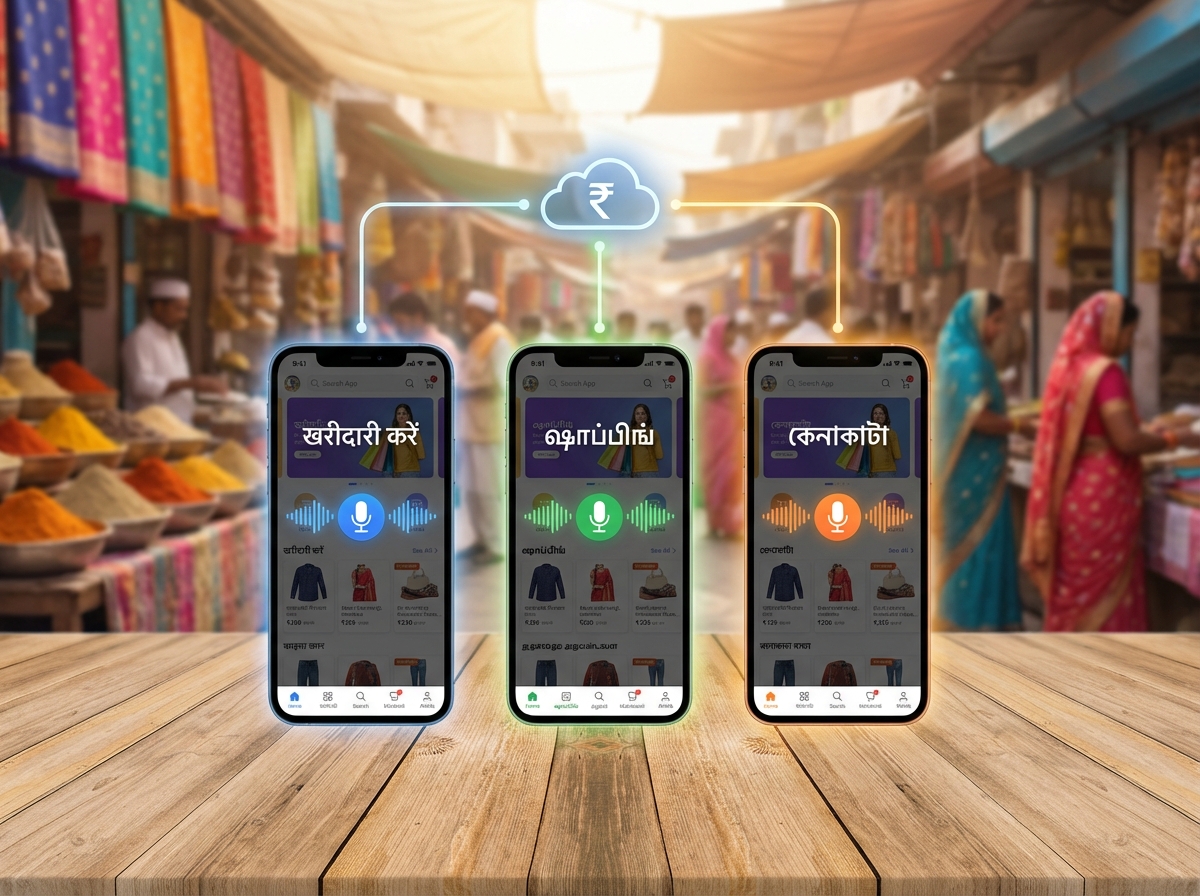
Voice SEO regional optimization is the process of tailoring digital content and metadata to satisfy the specific requirements of voice-activated discovery. This involves building vernacular FAQ hubs in Hindi, Tamil, and Bengali that provide concise, conversational answers to high-intent queries. Implementing Speakable schema and LocalBusiness schema with vernacular names ensures that when a user asks "mere paas wali dukaan" (the shop near me), your brand is the one the assistant recommends.
Smart speaker integration in India is expanding beyond simple music playback to become a vital retail touchpoint for reorders and price checks. Devices like the PhonePe SmartSpeaker are already providing audible payment confirmations in merchant settings, creating a "voice in the wild" presence that builds consumer familiarity. For CPG brands, developing localized skills for Alexa or Google Home that allow for hands-free grocery list management and order status updates is a critical step in capturing the home-based shopping segment.
On the merchant side, smart speakers can be used to deliver real-time upsell prompts and audible inventory alerts, further integrating voice into the physical retail ecosystem. However, these integrations must account for device constraints such as battery life and the need for 4G fallback in areas with inconsistent Wi-Fi. By creating a seamless loop between the consumer's smart speaker at home and the merchant's device in-store, brands can create a unified voice commerce environment that spans the entire purchase lifecycle.
6. Measurement: Building the Voice Assistant Marketing ROI Case
Defining a clear voice assistant marketing ROI model is essential for securing long-term investment in vernacular voice initiatives. This model should measure incremental revenue and cost efficiencies realized from voice-first journeys compared to traditional text-based touchpoints. Key performance indicators (KPIs) must be tracked across the entire funnel, starting from discovery metrics like the percentage of sessions initiated via voice and the accuracy of the ASR/NLU intent matching.
In the consideration phase, CTOs should monitor product findability via voice and the watch-through rates of dialect-specific shopping videos. High engagement with these localized assets often correlates with a higher add-to-cart rate, providing a clear signal of the effectiveness of the personalization strategy. Conversion metrics are the ultimate proof of value, focusing on the success rate of voice-led checkouts and the uplift in Average Order Value (AOV) when voice-triggered offers are applied.
7. Implementation Roadmap, Risks, and FAQ
The implementation of a voice commerce strategy should follow a structured 180-day roadmap to ensure technical stability and market alignment. The first 30 days focus on discovery and prototyping, identifying the top 10 shopping intents in Hindi and standing up a baseline ASR/NLU stack using Bhashini models. This phase also involves instrumenting analytics to track early user interactions and mapping how voice notes will be ingested via the WhatsApp Business API.
Between days 31 and 90, the focus shifts to a pilot in Hindi, launching voice-activated offers and integrating UPI 123PAY for feature-phone users. This is the period to run A/B tests on different voice prompts and dialect-specific videos to identify which variants drive the highest conversion. By day 180, the system should be scaled to include Tamil and Bengali, with the addition of smart speaker use cases and full-scale marketing automation across all regional segments.
Frequently Asked Questions
What is the primary driver for voice commerce vernacular India 2026?
The primary driver is the massive influx of 650 million vernacular users from Tier-2 and Tier-3 cities who find typing in regional scripts difficult. Voice provides a natural, low-friction interface that mirrors their offline shopping habits, making digital commerce more accessible.
How does TrueFan AI help in the voice commerce journey?
TrueFan AI enables the creation of dialect-specific, personalized shopping videos that are triggered by voice intents. This adds a layer of visual trust and celebrity-led engagement that significantly boosts conversion rates for regional language users.
What is UPI 123PAY and why is it important for voice commerce?
UPI 123PAY is an RBI-backed payment system that allows users to make digital payments via IVR or voice flows without needing an internet connection. It is crucial for reaching the millions of feature-phone users in rural India who are part of the voice commerce wave.