
Digital India Compliance Marketing 2026: A Privacy-First Video and Automation Playbook for DPDP Act Alignment
Estimated reading time: ~13 minutes
Key Takeaways
- Operationalize DPDP compliance with video-first notices and multilingual consent journeys for transparent user engagement.
- Adopt granular consent management and preference centers to improve valid consent rates and ROAS.
- Automate privacy policy explainers and trust signals to reduce friction at critical conversion points.
- Build a privacy-first architecture with Consent Managers, Evidence Stacks, and Policy Engines to scale safely.
- Be crisis-ready with breach communication protocols aligned to CERT-In and DPDP timelines.
Digital India compliance marketing 2026 represents the critical intersection of regulatory rigor and consumer trust within the world’s most dynamic digital economy. As the Digital Personal Data Protection (DPDP) Act of 2023 moves into full enforcement, Indian technology companies must transition from passive legal adherence to proactive, privacy-first engagement strategies. This shift necessitates a fundamental redesign of how brands communicate data practices, moving away from dense legalese toward transparent, multilingual, and automated video-centric journeys.
The core thesis of modern digital governance is that a privacy-first marketing automation stack, centered on data privacy transparency videos and digital consent management campaigns, operationalizes DPDP Act requirements while simultaneously improving trust and conversion rates. By 2026, the Indian market will be defined by a “vernacular-first” digital population where 90% of new internet users prefer consuming information in their native tongue. Consequently, regulatory compliance is no longer just a legal hurdle; it is a strategic differentiator that leverages first-party data and granular consent to build sustainable brand equity.
1. DPDP Act Video Communication and Notice Essentials
The implementation of the DPDP Act has fundamentally altered the “Notice” requirement for every Data Fiduciary operating in India. A DPDP Act video communication serves as a high-impact, accessible medium to fulfill the Section 5 obligations, which mandate that every request for consent must be accompanied or preceded by a notice. These videos translate complex legal requirements into plain language, ensuring that the Data Principal—the user—fully understands what they are agreeing to before any processing occurs.
To achieve full compliance, these data privacy transparency videos must explicitly detail the purpose of data processing and the specific categories of personal data being collected. Furthermore, they must outline the lawful basis for processing, which, under the DPDP framework, is heavily centered on explicit consent. Platforms like TrueFan AI enable enterprises to automate the creation of these notices, ensuring that every user journey begins with a clear, auditable explanation of their rights and the fiduciary’s responsibilities. Interactive video data capture
Beyond the basic purpose, these videos must provide clear instructions on how a user can exercise their rights, including the right to withdraw consent and the process for grievance redressal. In the 2026 landscape, accessibility is a legal mandate; therefore, notices must be delivered in English and relevant Eighth Schedule languages to cater to India's diverse linguistic demographic. By integrating regulatory compliance videos India-wide, brands can ensure that Tier-2 and Tier-3 users are not marginalized by language barriers, thereby fulfilling the inclusive vision of the Digital India program.
Special attention must be paid to children’s data, where the DPDP Act sets a significantly higher bar for “verifiable parental consent.” Video communications targeting minors or mixed audiences must incorporate safety-by-design principles and explicit calls-to-action for parents or guardians. These videos should be strategically placed at key lifecycle moments, such as pre-permission UX prompts, onboarding sequences, and major feature launches, to ensure that consent is never an afterthought but a core component of the user experience.
Sources:
2. Digital Consent Management Campaigns and Preference Centers
By 2026, the “all-or-nothing” approach to data consent will be obsolete, replaced by sophisticated digital consent management campaigns. These campaigns are designed to obtain, refresh, and manage granular, purpose-specific permissions across multiple touchpoints, including web, mobile apps, OTT platforms, and WhatsApp. The goal is to move away from dark patterns—manipulative UI designs that trick users into sharing more data than intended—and toward a transparent, user-centric model that respects individual autonomy. Nudge theory video implementation
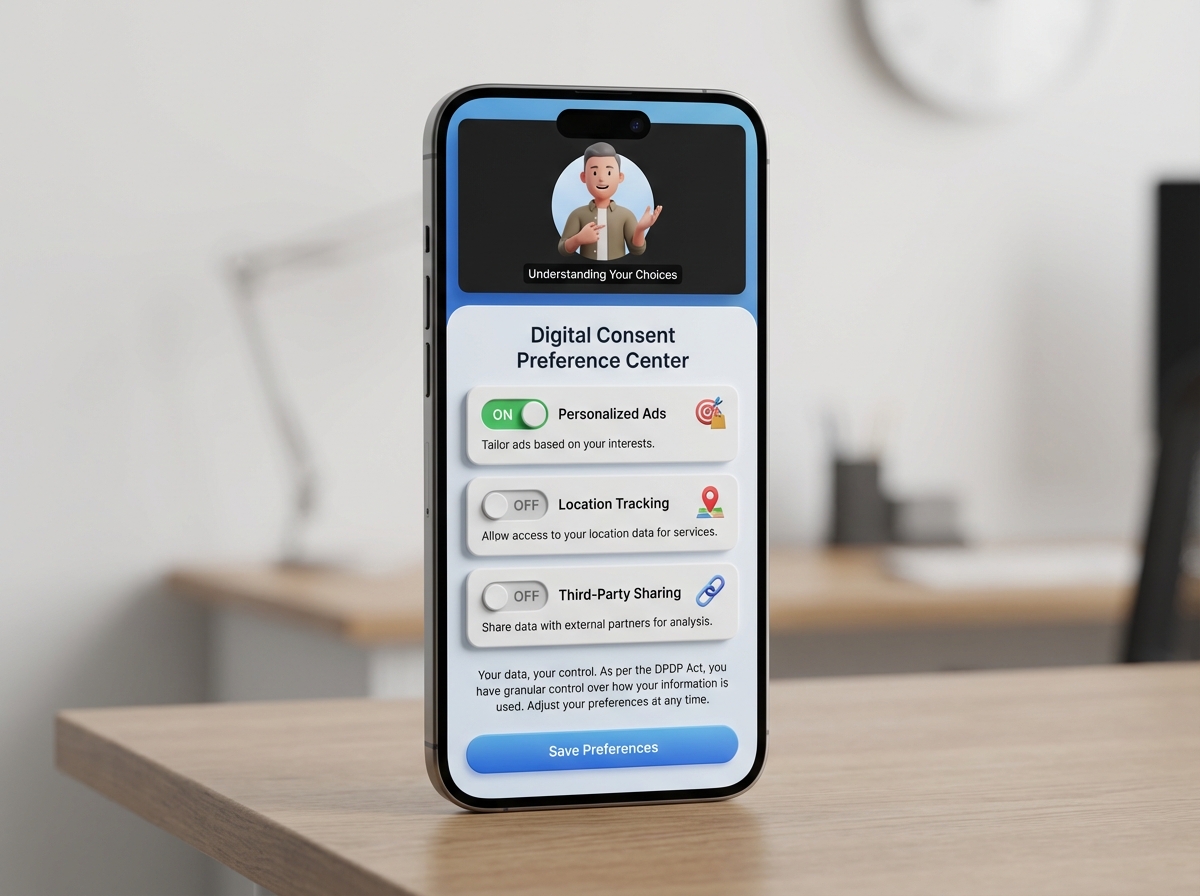
A critical component of this strategy is the deployment of consent preference center videos. These are short, embedded explainers that guide users through a live preference center, showing them how to opt-in to specific data uses, “opt-down” to reduced data processing levels, or withdraw consent entirely. This granular approach is essential for maintaining high engagement; users are more likely to stay with a brand if they can control exactly how their data is used, such as opting out of third-party sharing while remaining opted-in for personalized service updates. Interactive video data capture guide
The technical implementation of these campaigns must align with the emerging “Consent Manager” regime under the DPDP Rules 2025. Consent Managers are entities registered with the Data Protection Board that act as intermediaries, allowing Data Principals to manage their consents through a single interface. Marketing teams must ensure their automation stacks are interoperable with these managers, maintaining auditable logs of every notice served and consent received. This level of transparency is not just a legal safeguard; it is a performance driver that protects Return on Ad Spend (ROAS) by ensuring that marketing efforts are directed only at users who have provided valid, informed consent. Implementation considerations for consent capture
Measurement of these campaigns should focus on the “valid consent rate uplift” and the retention of users who choose to opt-down rather than opt-out. By 2026, industry data suggests that brands utilizing interactive, video-led consent journeys see a 40% higher re-consent completion rate compared to those relying on static text. This data-driven approach ensures that privacy-first marketing automation becomes a tool for growth, rather than a constraint on digital reach.
Sources:
- MediaNama: Consent Managers Explained
- Social Beat: Digital Marketing Trends 2026
- MeitY Guidelines on Consent Management
3. Privacy Policy Explanation Automation and Trust Signals
The traditional privacy policy is a static document that few users read and even fewer understand. In 2026, leading Indian enterprises are adopting privacy policy explanation automation to transform these dense legal texts into segmented, role-based video explainers. These 45–90 second clips are auto-generated to reflect the specific audience—whether it be a general consumer, a parent, or an SME administrator—and are updated in real-time whenever policy changes occur.
Each automated explainer should follow a structured format: a “TL;DR” summary of the policy, a clear breakdown of what has changed, a description of the user’s controls, and a direct link to the grievance redressal mechanism. To maintain an audit trail, each video must feature a version code and timestamp on-screen. This ensures that the Data Fiduciary can prove exactly what information was presented to a user at any given time, a crucial requirement for defending against potential compliance disputes before the Data Protection Board.
Complementing these explainers are trust signal video campaigns. These are short, high-production-value clips that highlight a company’s security posture, such as ISO 27001 or SOC 2 certifications, and their commitment to consent-first practices. Placing these videos near high-friction points—such as payment gateways, account creation forms, or data-intensive feature requests—significantly reduces user hesitation. These trust signals serve as “compliance certification marketing,” turning technical security achievements into powerful brand assets that resonate with increasingly privacy-conscious Indian consumers.
The ability to update these assets rapidly is paramount. When a regulatory change is announced or a new processing purpose is added, brands cannot afford the weeks-long lead times of traditional video production. Automation allows for “virtual reshoots,” where scripts are updated and new multilingual versions are rendered in minutes. This agility ensures that the brand’s communication always remains in lockstep with the latest legal requirements, maintaining the integrity of the privacy-first marketing automation ecosystem.
Sources:
- TrueFan AI: Enterprise Capabilities and Security
- Ipsos: The State of Digital Marketing in India 2025/2026
- India Digital Advertising: Trends for 2026
4. Data Protection Customer Education and Rights Awareness
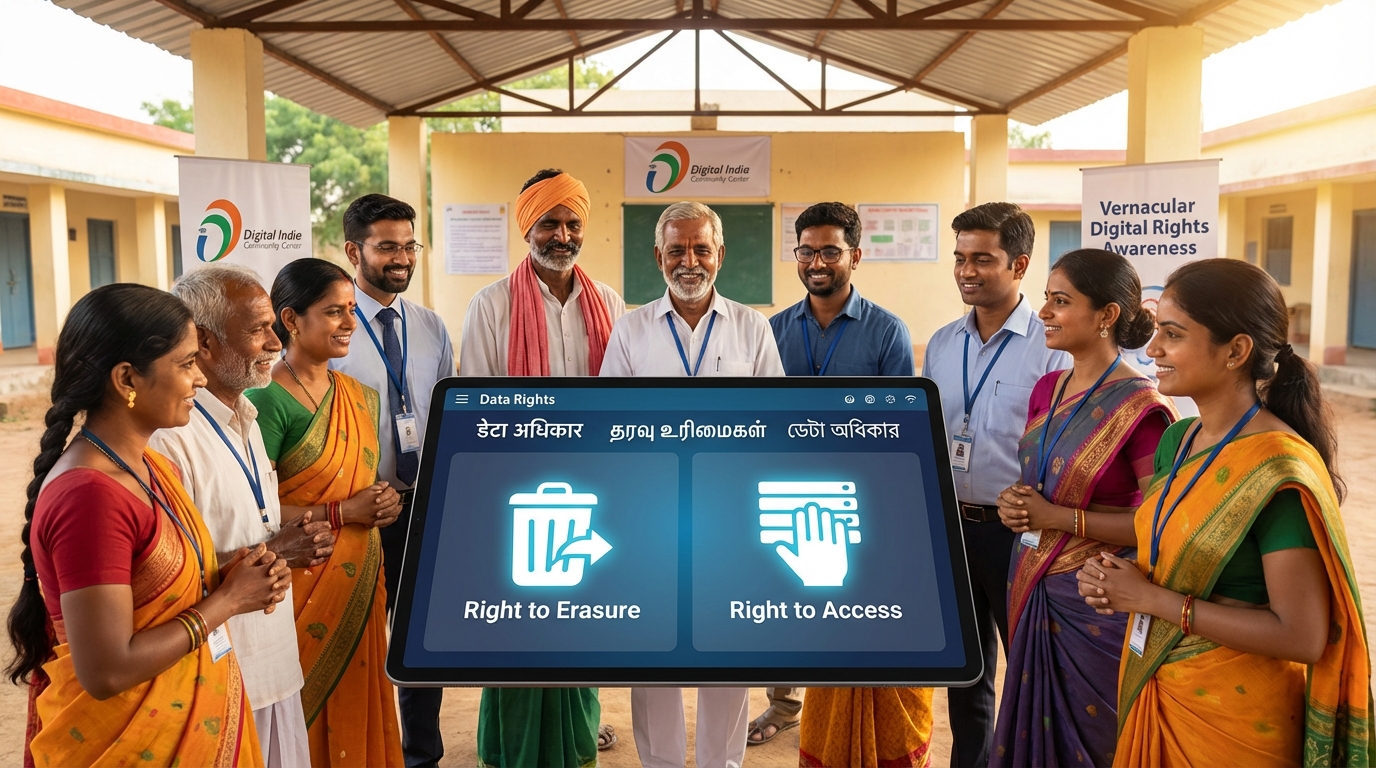
A cornerstone of the Digital India initiative is the empowerment of citizens through digital literacy. In the context of the DPDP Act, this translates to data protection customer education. Brands must move beyond mere compliance and actively educate their users on their digital rights, including the right to access their data, the right to correction and erasure, and the right to nominate a representative in the event of death or incapacity.
Digital rights awareness campaigns should be designed as vernacular-first outreach programs. By using regional languages and culturally relevant examples, brands can normalize the usage of self-service rights portals among Tier-2 and Tier-3 populations. TrueFan AI's 175+ language support and Personalised Celebrity Videos can be leveraged to create highly engaging educational content that feels personal rather than corporate. For instance, a micro-video in Marathi or Tamil explaining how to withdraw consent can significantly reduce the burden on customer support teams by empowering users to manage their own data settings. Multilingual voice marketing automation
The program blueprint for rights education should include an “always-on” library of micro-videos, such as a “Your Data, Your Rights” playlist. These should be integrated into push cadences, such as post-onboarding emails, quarterly privacy refreshers, and WhatsApp drip series. By making rights-management a seamless part of the user journey, brands demonstrate a level of transparency that builds deep, long-term loyalty. This is particularly effective in the Indian market, where trust is a primary driver of platform stickiness.
Furthermore, these educational efforts must be inclusive. Accessibility features like high-contrast visuals, clear captions, and simplified language are essential for reaching users with varying levels of digital proficiency. By aligning customer education with the broader values of the Digital India program, technology companies can position themselves as responsible stewards of the nation’s digital future, rather than just commercial entities harvesting data.
Sources:
- Digital India: Citizen-Centric Governance
- CERT-In: Cybersecurity Directions and FAQs
- Social Beat: Vernacular Marketing Trends
5. Data Breach Communication Protocols and Regulatory Updates
In the unfortunate event of a data breach, the speed and transparency of communication are the only ways to mitigate reputational and legal damage. The 2026 regulatory environment in India is characterized by the CERT-In 6-hour reporting rule, which requires entities to report cybersecurity incidents to the Indian Computer Emergency Response Team within a very tight window. Simultaneously, the DPDP Act mandates that Data Fiduciaries notify the Data Protection Board and every affected individual in the event of a personal data breach.
Establishing robust data breach communication protocols is therefore a non-negotiable requirement. These protocols must be templated and ready for immediate deployment. A three-phase video strategy is often most effective: Phase 1 involves an immediate acknowledgment of the incident with clear safety steps for users; Phase 2 provides a mitigation update as more facts are known; and Phase 3 offers a final remediation report, including any credit monitoring or protective measures being provided to the users.
Regulatory update notifications are the proactive counterpart to breach communications. Whenever there is a change in the DPDP Rules or a shift in the company’s data processing scope, users must be notified through multilingual micro-videos and in-app banners. These updates should be timestamped and archived in a public changelog, providing a clear history of the company’s compliance journey. This “regulatory compliance videos India” approach ensures that the brand is never seen as hiding behind fine print.
The integration of these protocols into the broader marketing automation stack allows for rapid, multi-channel distribution. In a crisis, the ability to blast a captioned, localized video notification via WhatsApp and in-app stories can prevent the spread of misinformation and demonstrate that the company is taking decisive action. This level of preparedness is what separates enterprise-grade organizations from those that will struggle under the weight of DPDP enforcement.
Sources:
- CERT-In 6-Hour Reporting Directions
- DPDP Act Section 8(6): Breach Notification Obligations
- MediaNama: DPDP Rules 2025 Context
6. Architecture for Privacy-First Marketing Automation
To execute these strategies at scale, enterprises require a robust architecture for privacy-first marketing automation. This is not a single tool but an orchestrated ecosystem where legal policy and user consent dictate every automated action. The architecture must be built on the principles of data minimization and purpose limitation, ensuring that personal data is only collected and processed for the specific reasons the user has agreed to. Micro-moments marketing automation 2026 guide
The reference architecture begins with a Consent Manager and Preference Center integration. Every user interaction—whether a click, a form fill, or a video view—must be gated by the user's current consent state. This requires server-side tagging and real-time event processing to ensure that marketing messages are never sent to a user who has withdrawn consent. Solutions like TrueFan AI demonstrate ROI through their ability to integrate directly with these consent engines, delivering personalized, compliant video content that respects the user's boundaries.
An “Evidence Stack” is another critical component. This is an immutable log of every notice served, every consent receipt generated, and every language variant delivered. In the event of an audit by the Data Protection Board, this stack provides the necessary proof of compliance. Furthermore, the architecture must include a “Policy Engine” that maps specific processing purposes to allowed communication channels and frequency caps, preventing the “coercive nudging” that the DPDP Act and consumer protection laws seek to eliminate.
Finally, the security layer must be enterprise-grade, featuring role-based access controls, PII (Personally Identifiable Information) vaulting, and automated data retention controls. By 2026, the most successful Indian brands will be those that have embedded these privacy-first principles into their technical DNA. This architecture does not just ensure compliance; it creates a foundation for “zero-party data” collection, where users willingly share their preferences in exchange for a more transparent and valuable digital experience.
Sources:
- TrueFan AI: API and CRM Integration for Enterprise
- Ipsos India: Digital Landscape and Trust Data
- Digital India: Infrastructure for Data Protection
Conclusion
Digital India compliance marketing 2026 is the new frontier for brands that value longevity and user trust. By moving beyond the minimum requirements of the DPDP Act and embracing a video-first, transparent communication strategy, Indian enterprises can turn regulatory necessity into a powerful competitive advantage. The integration of data privacy transparency videos, digital consent management campaigns, and automated policy explainers creates a resilient marketing ecosystem that respects the user while driving measurable business performance. As we move further into this privacy-centric era, the brands that lead with clarity and inclusivity will be the ones that define the future of the Indian digital economy.
Research and Citation Index:
- DPDP Act Official PDF (MeitY)
- CERT-In 6-Hour Reporting Directions
- Consent Managers under DPDP Rules 2025 (MediaNama)
- Digital India Program Portal
- 2026 India Marketing Trends (Social Beat)
- TrueFan AI Enterprise Solutions
Frequently Asked Questions
What is DPDP Act video communication and what must it include?
A DPDP Act video communication is a short, multilingual video that serves as a formal notice to users before data collection. According to the MeitY DPDP Act PDF, it must include the purpose of processing, the categories of data collected, the user's rights (access, correction, erasure), and details for grievance redressal. It must be clear, concise, and available in English and Eighth Schedule languages to ensure informed consent.
How fast must we notify authorities and users after a data breach in India?
Under the CERT-In directions, cybersecurity incidents must be reported within 6 hours of being noticed. Simultaneously, Section 8(6) of the DPDP Act requires Data Fiduciaries to notify the Data Protection Board and each affected individual about a personal data breach. Using automated templates for these notifications is essential for meeting these aggressive timelines.
Do Indian brands need a Consent Manager in 2026 and how do we integrate?
Yes, the DPDP Rules 2025 introduce a formal Consent Manager regime. These entities help users manage their permissions across different platforms. Brands must integrate their marketing automation stacks with these managers via APIs to ensure that consent records are synchronized and that users can easily exercise their right to withdraw consent through a centralized interface. Read the interactive video data capture guide
How do vernacular transparency videos improve consent quality and ROAS?
Vernacular videos ensure that users in Tier-2 and Tier-3 cities fully understand the value exchange of their data. When users understand why their data is being collected, they are more likely to provide high-quality, granular consent. This reduces “accidental” opt-ins and subsequent complaints, leading to a more engaged audience and a higher Return on Ad Spend (ROAS) for privacy-first campaigns. Explore vernacular voice SEO strategies
How does TrueFan AI help with DPDP compliance?
TrueFan AI provides an enterprise-grade platform for generating personalized, multilingual, and compliant video content at scale. With support for 175+ languages and ISO 27001/SOC 2 certifications, it allows brands to automate privacy policy explainers, consent journeys, and breach notifications, ensuring that every communication is auditable and aligned with the latest Digital India standards. Learn about interactive video data capture