Voice Commerce Optimization India 2026: A CTO Playbook for Vernacular-First Growth
Key Takeaways
- India’s e-retail is shifting to voice–vernacular–video, demanding end-to-end voice shopping journeys.
- Winning stacks blend ASR, NLU, policy orchestration, and NLG/TTS tuned for code-switching and dialects.
- Voice-triggered personalized video offers build trust and boost conversions in Tier-2/3 markets.
- Measure success with WER, intent accuracy, first-intent completion, and assisted conversion value.
- A 90-day roadmap de-risks rollout: foundation, pilot in Tier-2 clusters, then multi-language scale with SEO optimization.
The digital landscape in India is undergoing a seismic shift as we approach 2026, driven by the convergence of artificial intelligence and linguistic diversity. For Chief Technology Officers (CTOs) and digital transformation leaders, voice commerce optimization India 2026 is no longer a peripheral experiment but a core pillar of enterprise growth strategy. As the next billion users enter the digital economy, the ability to facilitate seamless, multilingual voice shopping experiences will define market leadership in the subcontinent’s hyper-competitive e-retail sector.
This transition is fueled by the rapid maturation of Natural Language Processing (NLP) and the increasing dominance of Tier-2 and Tier-3 cities in the e-commerce ecosystem. To capture this value, enterprises must move beyond basic voice search and implement sophisticated, end-to-end voice-activated shopping journeys that respect the nuances of Indian dialects and cultural contexts.
1. India’s 2026 Voice Commerce Landscape: Size, Adoption, and Readiness
By 2026, the Indian voice commerce market will have transitioned from early adoption to mainstream utility. Current projections indicate that the India voice commerce market revenue, which stood at approximately USD 1,568.0 million in 2024, is on a trajectory to reach USD 7,469.5 million by 2030. This explosive growth is underpinned by a fundamental shift in consumer demographics; approximately 7 out of 10 online shoppers in India now originate from Tier-2+ cities.
For these users, the traditional text-based interface often represents a barrier rather than a bridge. The “voice–vernacular–video” triad has become the primary framework for digital discovery and transaction. Tier-2 voice commerce adoption is accelerating because voice interfaces bypass literacy hurdles and offer a more natural, conversational mode of interaction that mimics traditional Indian retail experiences.
Enterprise readiness for this shift is remarkably high. Recent data suggests that 48% of Indian businesses are already running Generative AI pilots, many of which focus on enhancing customer-facing interfaces. Furthermore, smart speaker commerce integration has become more robust as hardware manufacturers improve acoustic models to handle the noisy environments typical of Indian households. CTOs must now prioritize Hindi and Tamil voice journeys, ensuring that mobile voice entry points—particularly within apps and via WhatsApp—are optimized for low-friction, high-intent commerce.
Source: Grand View Research (India) Voice Commerce Outlook
Source: Bain & Company, How India Shops Online
Source: Think with Google, Year in Search India
Source: iThink Logistics, AI Statistics & E-commerce Trends
2. The Vernacular Edge: NLP Architecture and Assistant Integration
To achieve true voice commerce optimization India 2026, the underlying technical stack must be tuned for the linguistic complexity of the region. This requires a sophisticated natural language processing commerce pipeline that handles not just pure Hindi or Tamil, but the “code-switching” (Hinglish/Tanglish) common in daily conversation.
Reference Architecture for Multilingual Voice
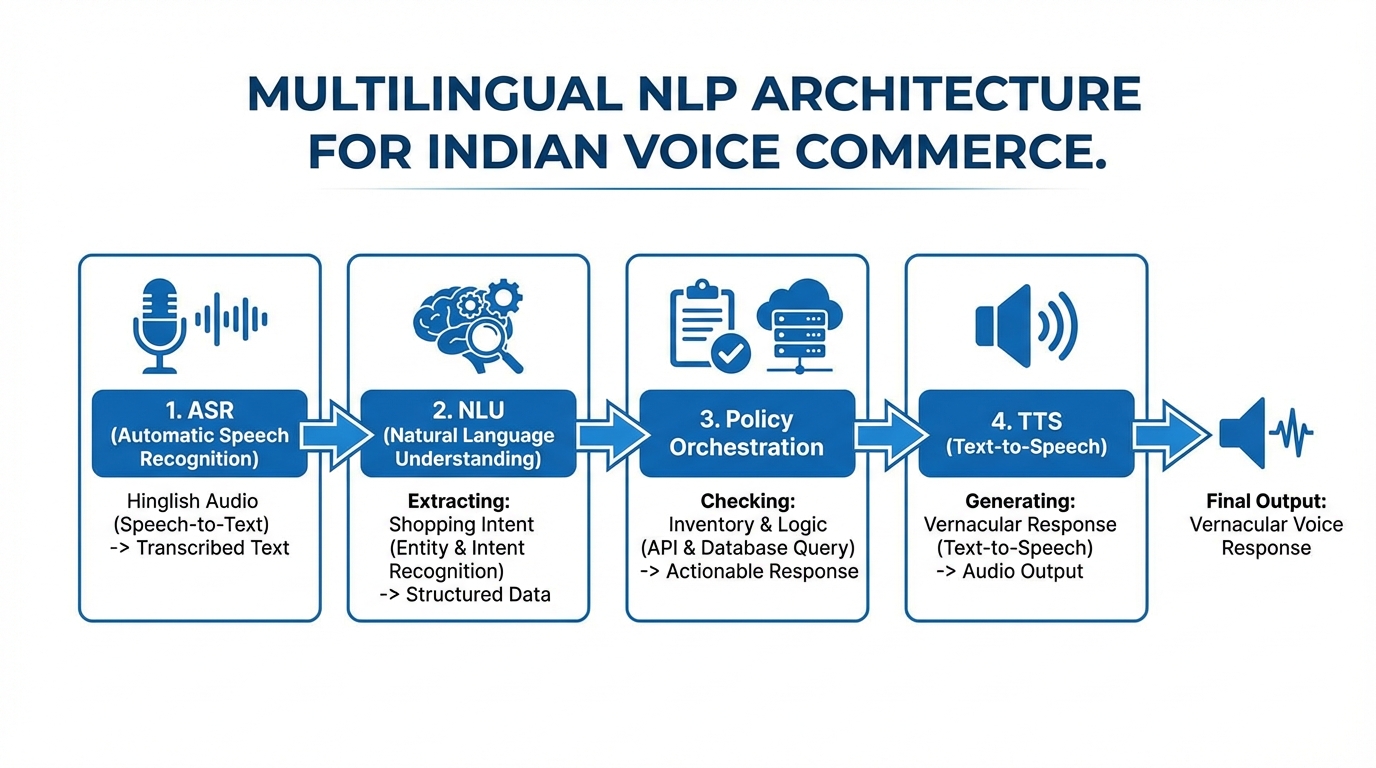
A robust voice commerce stack follows a specific sequence:
- ASR (Automatic Speech Recognition): Converting audio to text with high tolerance for regional accents and ambient noise.
- NLU (Natural Language Understanding): Extracting intent and entities (e.g., “Order 5kg Aashirvaad Atta”) while managing disambiguation.
- Policy Orchestration: Checking inventory, applying promotions, and verifying user eligibility.
- NLG & TTS (Natural Language Generation & Text-to-Speech): Generating a localized, culturally resonant response in a persona-appropriate voice.
Hindi Tamil voice search marketing strategies must include extensive utterance libraries that account for dialectal variations. For instance, a user in Lucknow might use different phrasing for a grocery order than a user in Delhi, despite both speaking Hindi. Similarly, dialect-specific shopping experiences in Tamil Nadu must account for variations between Chennai and Tirunelveli linguistic patterns.
Alexa and Google Assistant Shopping Integration
For many enterprises, Alexa Google Assistant shopping integration serves as the primary gateway. This involves implementing OAuth for account linking, utilizing address and payment tokens for friction-free checkout, and leveraging Cart APIs to synchronize voice-added items with the user’s mobile app. CTOs should design for “channel orchestration,” where a session might start on a smart speaker but transition to a mobile device for final payment confirmation via UPI, ensuring security and user confidence.
Source: Rock Technolabs, E-commerce Trends 2026
Source: MMA Voice Playbook for NBU
3. Designing Multilingual Campaigns and Voice-Triggered Video Offers
The transition from “voice search” to “voice commerce” requires a strategic approach to campaign design. Multilingual voice shopping campaigns must be architected around the user’s journey, from initial discovery to post-purchase retention. Platforms like TrueFan AI enable enterprises to bridge the gap between audio interaction and visual confirmation, which is critical for building trust in vernacular markets.
Voice-Activated Personalized Offers
In 2026, personalization is driven by real-time intent. When a user queries a voice assistant about a product, the system should trigger voice-activated personalized offers based on the user’s loyalty tier, location, and previous purchase history. For example, a “Gold” tier customer in Coimbatore asking for “detergent” should immediately receive a Tamil-language offer for their preferred brand, delivered with a sense of urgency and exclusivity.
The Power of Voice-Triggered Video Offers
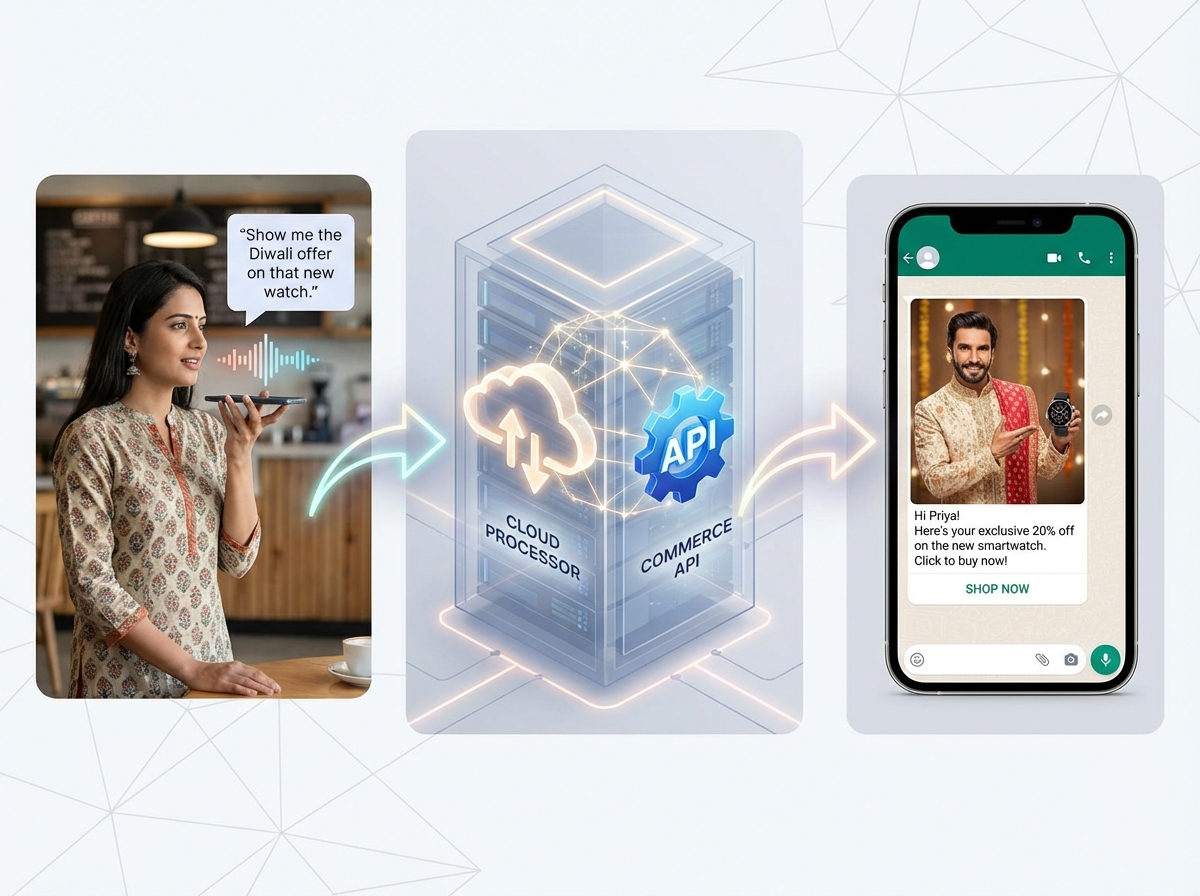
One of the most significant innovations in this space is the use of voice-triggered video offers. When a voice intent is captured, the system can automatically render and deliver a hyper-personalized video—often featuring a celebrity or brand ambassador—confirming the offer in the user’s native dialect. This visual reinforcement is vital for Tier-2 shoppers who may feel hesitant about purely auditory transactions. These videos can be distributed via WhatsApp or SMS, providing a tangible record of the interaction and a clear “Click to Buy” path.
This approach addresses three critical coverage gaps often missed by competitors:
- Visual Confirmation: Reducing the “cognitive load” of remembering voice-only details.
- Linguistic Trust: Using regional dialects and familiar faces to validate the transaction.
- Low-Literacy Accessibility: Ensuring that users who struggle with text can still navigate complex offers through video and audio.
4. TrueFan Enterprise: Scaling Voice-to-Video Commerce
For the modern CTO, the challenge lies in scaling these personalized experiences across millions of users without exploding content production costs. TrueFan AI’s 175+ language support and Personalised Celebrity Videos provide the infrastructure necessary to automate this at an enterprise level.
The Trigger-to-Video Workflow
The integration of TrueFan Enterprise into the commerce stack follows a high-performance event-driven model:
- Intent Capture: The voice assistant or in-app mic captures a specific commerce intent.
- API Webhook: A webhook is sent to the TrueFan API containing personalization metadata (name, product, city, language).
- Real-Time Rendering: The platform renders a high-fidelity video with perfect lip-sync in under 30 seconds.
- Omnichannel Delivery: The video is pushed to the user via WhatsApp or the app inbox.
- Attribution: Analytics callbacks track view rates and conversion events, feeding back into the CRM.
This level of conversational shopping funnel optimization ensures that drop-offs are minimized. By replacing generic error messages or text confirmations with a personalized video from a trusted spokesperson, brands can see a significant uplift in conversion rates. Solutions like TrueFan AI demonstrate ROI through reduced customer acquisition costs (CAC) and increased average order value (AOV) by effectively upselling through these personalized video touchpoints.
Source: TrueFan Enterprise Executive Documentation (Internal Product Intelligence)
Source: iThink Logistics, GenAI Adoption in India
5. ROI Measurement and Vernacular Voice SEO Strategies
A data-driven approach to voice commerce ROI measurement is essential for justifying the investment in these technologies. CTOs must look beyond simple “click-through” rates and analyze the entire conversational funnel.
Key Performance Indicators (KPIs) for Voice Commerce
- ASR Word Error Rate (WER): Measuring the accuracy of speech-to-text across different Indian dialects.
- NLU Intent Accuracy: The percentage of times the system correctly identifies the user’s shopping goal.
- First-Intent Completion Rate: How often a user successfully completes a task in a single “turn.”
- Assisted Conversion Value: The revenue generated from users who interacted with a voice-triggered video offer.
Vernacular Voice SEO Strategies for 2026
To ensure discoverability, brands must implement advanced vernacular voice SEO strategies. This includes:
- Schema Markup: Using FAQ and HowTo schema in Hindi and Tamil to capture “position zero” in voice search results.
- Transliterated Keywords: Optimizing for how users actually type and speak (e.g., “atta order kaise karein” instead of just the formal Hindi script).
- Utterance Mapping: Maintaining a dynamic library of regional phrases and slang that users might use when searching for specific SKUs.
By aligning SEO efforts with voice assistant regional marketing, enterprises can ensure they are the first recommendation when a user asks their device for a product or service in their local language.
Source: IJIP, Voice Commerce Adoption Drivers (India SLR)
Source: Think with Google, India Search Pillars
6. Security, Compliance, and the 90-Day Implementation Roadmap
As voice data involves PII (Personally Identifiable Information) and biometric markers (voiceprints), security is paramount. CTOs must ensure that their conversational AI marketing vernacular tools are compliant with India’s Digital Personal Data Protection (DPDP) Act.
Governance and Safety
Enterprise-grade solutions must include:
- Consent-First Models: Explicit opt-ins for voice recording and personalized video generation.
- Toxicity Filtering: Ensuring that NLU models do not respond to or generate inappropriate content in any regional language.
- ISO 27001/SOC 2 Certification: Verifying the data handling practices of third-party vendors like TrueFan.
90-Day Implementation Roadmap
For CTOs ready to lead in 2026, a phased rollout is recommended:
- Days 0–30 (Foundation): Identify high-frequency use cases (e.g., grocery reorders). Build initial Hindi/Tamil utterance libraries and set up assistant integrations.
- Days 31–60 (Pilot): Launch in 2–3 Tier-2 clusters. Integrate voice-triggered video offers to test conversion uplift against a control group.
- Days 61–90 (Scale): Expand to 5+ additional languages. Optimize SEO based on pilot data and scale the automated video rendering pipeline.
This structured approach allows for iterative learning and ensures that the technical infrastructure can handle the load of a national rollout.
Frequently Asked Questions
How does voice commerce optimization India 2026 differ from traditional SEO?
Traditional SEO focuses on text-based keywords and desktop/mobile browsing. Voice commerce optimization requires focusing on long-tail, conversational utterances, regional dialects (vernacular), and structured data that voice assistants can easily parse. It also involves optimizing for “eyes-free” or “visual-assist” journeys where the response is spoken or delivered via video.
Can voice commerce handle complex product configurations?
While simple reorders are the “low-hanging fruit,” complex configurations are managed through progressive disclosure. The voice assistant handles the initial intent, and a voice-triggered video offer or a companion mobile link provides the visual interface needed for complex choices, ensuring a high completion rate.
What are the primary barriers to Tier-2 voice commerce adoption?
The main barriers are accent recognition, lack of trust in digital payments, and linguistic nuances. Modern NLP models are overcoming accent issues, while personalized video confirmations from platforms like TrueFan AI help build the necessary trust for users in Tier-2 and Tier-3 cities to complete transactions.
How do I measure the ROI of voice-activated personalized offers?
ROI is measured by tracking the conversion rate of users who interact with voice prompts versus those who don’t. Specifically, you should look at the “lift” in AOV and the reduction in cart abandonment when a personalized video is used as a confirmation or recovery tool.
Is it possible to integrate voice commerce with existing UPI payment flows?
Yes. The most effective pattern in India is Voice-to-UPI. The user initiates the order via voice, and the system triggers a UPI intent request or a payment link via WhatsApp, allowing the user to authorize the payment securely on their mobile device.
How does TrueFan AI ensure the security of celebrity-led video offers?
TrueFan AI utilizes a consent-first model with strict contractual controls over celebrity likeness. The platform is built on enterprise-grade infrastructure with ISO 27001 and SOC 2 certifications, ensuring that all generated content is moderated and secure.
Conclusion
The future of Indian e-retail is vocal, vernacular, and visual. Achieving voice commerce optimization India 2026 requires a sophisticated blend of NLP architecture, assistant integration, and hyper-personalized content delivery. By focusing on the unique needs of Tier-2 shoppers and leveraging advanced vernacular voice SEO strategies, CTOs can unlock unprecedented growth. Integrating tools that provide voice-triggered video offers ensures that these interactions are not just functional, but deeply engaging and trustworthy. As the market moves toward a USD 7.4 billion valuation, the time to build the foundation for voice-first commerce is now.