Enterprise AI video platform: An API-first buyer’s guide for CTOs and MarTech leaders in 2026
Estimated reading time: ~11 minutes
Key Takeaways
- API-first platforms unlock agentic AI workflows with modular Template, Render, Assets, and Analytics APIs.
- Deep CRM/MAP integrations with Salesforce, HubSpot, and WebEngage automate personalized video generation and write-back.
- Governance and security require ISO 27001/SOC 2 alignment, RBAC, auditability, PII minimization, and regional data residency.
- Omnichannel delivery with a WhatsApp Business API edge in India drives higher engagement than text-only messaging.
- 90-day roadmap moves from POC to enterprise rollout with localization, SLO baselining, and measurable ROI.
An enterprise AI video platform is defined as an API-first, ISO 27001/SOC 2–aligned, CRM-connected system designed for generating and delivering hyper-personalized videos at scale across web, email, WhatsApp, and in-app channels. In the 2026 landscape, these platforms serve as the backbone for agentic AI orchestration, allowing organizations to move beyond static content into dynamic, real-time visual communication.
The shift toward video-first customer experiences is no longer optional for Indian and APAC enterprises. As of early 2026, India’s AI adoption index indicates that 87% of enterprises are actively integrating AI into their core operations, with a specific focus on governance-by-design and measurable ROI. Platforms like TrueFan AI enable these organizations to bridge the gap between high-level AI strategy and tactical execution through robust API frameworks and deep integration with existing MarTech stacks like Salesforce, HubSpot, and WebEngage.
1. The 2026 Enterprise AI Video Landscape: Why API-First Matters
The maturity of the Indian enterprise market in 2026 has led to a fundamental shift in how technology is procured. CIOs and CTOs are moving away from monolithic, creative-only tools toward modular, scalable personalized video SaaS solutions that prioritize interoperability. This transition is driven by the need for “Agentic AI” integration, where AI agents autonomously trigger video generation based on real-time customer behavior.
2. Architecture and API Surface: Building Blocks for Engineering Teams
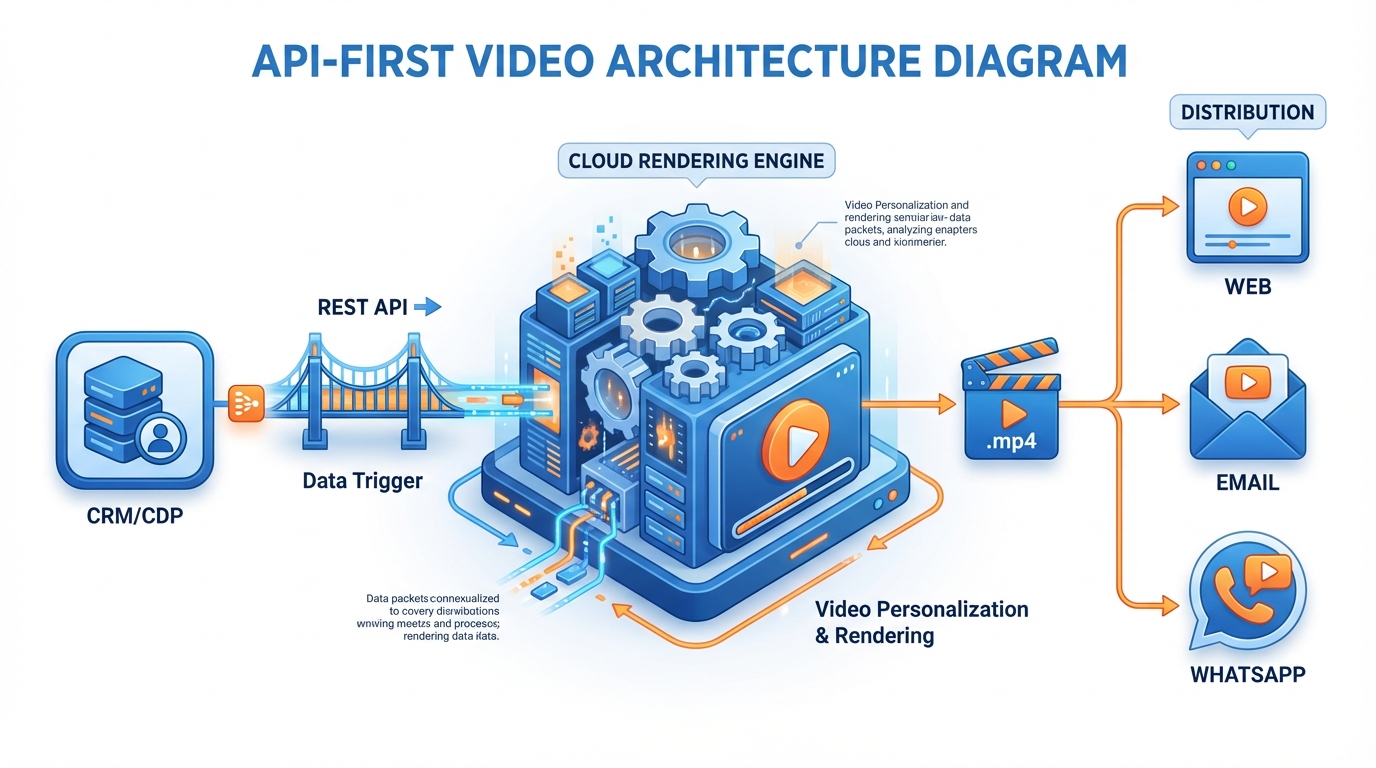
Engineering leaders evaluating an enterprise AI video platform must look beyond the user interface and scrutinize the underlying API architecture. A robust system provides a multi-layered API surface that includes Template, Render, Assets, and Analytics APIs. This modularity ensures that developers can build custom workflows without being constrained by the platform's native UI.
The Template API should offer full CRUD (Create, Read, Update, Delete) functionality for managing video templates, scenes, and data tokens. In 2026, semantic versioning for templates is a mandatory requirement, allowing teams to pin specific campaigns to immutable versions of a video asset. This prevents breaking changes in production when creative teams update a template for a future campaign.
The Render API is the engine's core, where POST requests containing template IDs and payload tokens are processed. To ensure reliability at scale, the API must support idempotency keys, preventing duplicate renders in the event of network retries. Additionally, the inclusion of a callback_url or webhook for status updates is essential for asynchronous processing, allowing the enterprise stack to remain responsive while the video is being generated in the cloud.
Reliability in 2026 is measured through observability and error budgets. An enterprise-grade platform provides structured logs and trace IDs that integrate with tools like Datadog or New Relic. This level of transparency allows engineering teams to monitor p95 render times and failure rates, ensuring that the marketing automation video API meets its Service Level Objectives (SLOs) during high-traffic events like the festive season or major product launches.
Key Technical Requirements:
- Auth: OAuth2 or Signed HMAC for server-to-server communication.
- Concurrency: Per-tenant rate limits and burst handling policies.
- Transcoding: Automatic generation of MP4/H.264, WebM/VP9, and GIF fallbacks.
- Webhooks: Real-time events for job.status, template.updated, and asset.ready.
3. CRM and Marketing Automation Connectivity: Salesforce, HubSpot, and WebEngage
The true value of enterprise AI video marketing is realized when it is deeply embedded within the CRM. For CTOs, this means establishing seamless data contracts between the video platform and systems like Salesforce and HubSpot. These integrations allow for automated video generation triggered by specific lifecycle events, such as a lead status change or an upcoming renewal date.
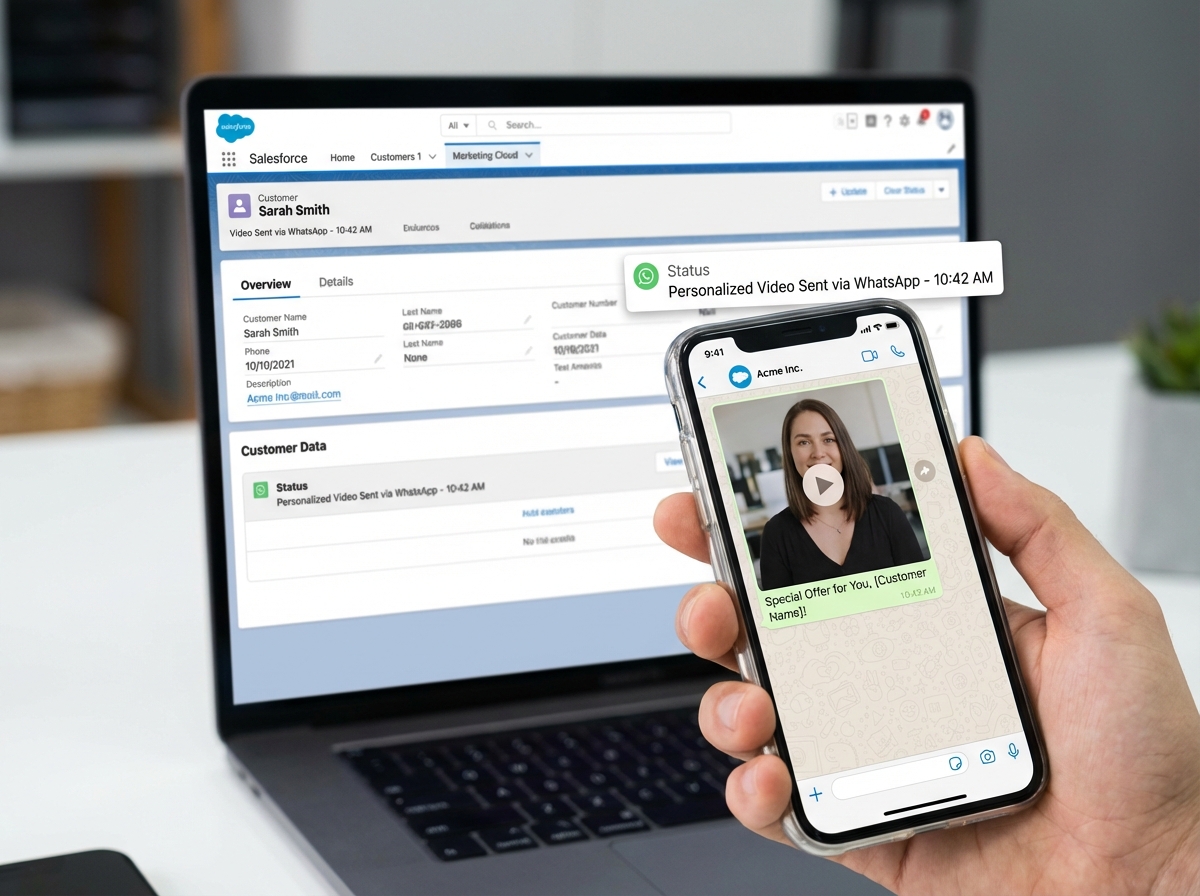
In a Salesforce video integration, technical teams typically utilize Flow Orchestrator or Apex Queueable classes to make signed POST requests to the video API. By using Named Credentials, developers can securely manage authentication while ensuring that the video_url and last_render_status are written back to the Lead or Opportunity record. This enables sales teams to send personalized videos directly from the Salesforce interface, with all engagement data synced back for multi-touch attribution.
For organizations using HubSpot AI video workflows, the integration is often driven by Webhook actions within the HubSpot Workflow builder. When a contact meets specific enrollment criteria—such as a high NPS score or a custom behavioral event—HubSpot triggers a render request. Once the video is ready, the platform updates the contact properties, which in turn triggers a personalized email or WhatsApp message through a connected MAP.
In the Indian context, WebEngage has emerged as a dominant player for omnichannel orchestration. Integrating an enterprise AI video platform with WebEngage involves setting up event-triggered journeys that leverage the WhatsApp Business API video capabilities. By using approved templates and media_id uploads, brands can deliver high-quality video nudges that significantly outperform text-only communication. For instance, Goibibo utilized personalized WhatsApp video nudges to drive a 17% increase in read rates compared to traditional text messages.
Sources:
- WebEngage WhatsApp documentation
- Goibibo case study on personalized video nudges
- Rich media support for WhatsApp Business API
4. Personalization, Localization, and Governance at Scale
As enterprises expand across diverse linguistic regions, especially in a market like India with 22 official languages, localization becomes a primary differentiator. TrueFan AI's 175+ language support and Personalised Celebrity Videos provide a blueprint for how brands can achieve regional relevance without the overhead of traditional production. This requires a platform that can handle not just translation, but also brand-approved voices and pronunciation dictionaries.
Corporate video personalization tools must offer sophisticated scene logic and conditional branching. This allows a single video template to adapt its content based on the viewer's data—changing the offer, the background imagery, or even the call-to-action based on the user's segment. For example, a BFSI brand might show a different investment portfolio visualization to a HNI (High Net Worth Individual) versus a first-time saver, all within the same automated workflow.
Governance is the final pillar of enterprise-grade personalization. In 2026, B2B AI video solutions must include robust Role-Based Access Control (RBAC) and template approval workflows. This ensures that creative assets are vetted by legal and brand teams before they are made available for API-driven generation. Furthermore, the platform must manage talent rights and usage windows, automatically deprecating assets when licenses expire to prevent legal exposure.
Localization Checklist for 2026:
- Voice Synthesis: Neural voices with regional accents and emotional inflection.
- Subtitling: Automated VTT/SRT generation in multiple languages.
- Legal Lines: Region-specific disclaimers dynamically injected into the video.
- Accessibility: Support for descriptive audio tracks and high-contrast captions.
Localization efforts begin here, with the addition of regional languages video SEO and brand-approved voices.
5. Security, Privacy, and Compliance: The Enterprise Gold Standard
For the CTO, security is non-negotiable. An enterprise AI video platform must be an ISO 27001 certified platform and demonstrate a SOC 2 compliant video processing workflow. These certifications provide the necessary assurance that the platform adheres to global standards for information security, availability, and confidentiality. In 2026, procurement teams also demand detailed DPIA (Data Protection Impact Assessment) support and evidence of regular third-party penetration testing.
Data protection in the age of AI requires a “PII minimization” strategy. Instead of passing raw PII (Personally Identifiable Information) to the video API, enterprises use secure tokens. The video platform then maps these tokens to the necessary personalization fields without ever storing sensitive customer data at rest. Additionally, configurable data retention windows and on-demand deletion APIs are essential for compliance with regional regulations like India’s DPDP Act (interactive video data capture guide).
AI safety and brand protection are equally critical. The platform must implement strict moderation queues and watermarking to prevent the creation of unauthorized or harmful content. Consent-first talent usage is a cornerstone of ethical AI video; every avatar or voice used must have a verifiable chain of consent. For sensitive verticals like BFSI and Healthcare, a “human-in-the-loop” option for high-value video renders adds an extra layer of security before the asset is delivered to the end-user.
Security Architecture Components:
- Identity: SSO via SAML/OIDC and SCIM provisioning for automated user management.
- Encryption: TLS 1.2+ in transit and AES-256 at rest with KMS-backed keys.
- Auditability: Comprehensive audit logs exportable to enterprise SIEM (Security Information and Event Management) systems.
- Residency: Options for local data residency to comply with sovereign data laws.
6. Omnichannel Deployment and the WhatsApp Advantage in India
The final stage of the enterprise AI video marketing workflow is delivery. While email remains a staple, the 2026 enterprise must master the nuances of the WhatsApp Business API video. In India, where WhatsApp is the primary communication channel, the ability to deliver video content directly within the chat interface is a massive competitive advantage.
Successful WhatsApp video campaigns require a deep understanding of WSP (WhatsApp Service Provider) constraints. Platforms must optimize video assets for specific codecs, durations, and file sizes to ensure smooth playback across a variety of mobile devices. Using media_id based uploads—where a video is uploaded once to the WhatsApp servers and reused across thousands of messages—is a critical technique for maintaining high throughput and reducing latency.
Beyond WhatsApp, the platform must support a player SDK for web and in-app placements. This SDK should provide deep analytics hooks, capturing engagement metrics like play rate, completion rate, and interaction points. These events are then written back to the Analytics API, allowing for real-time journey stitching. Solutions like TrueFan AI demonstrate ROI through these integrated analytics, proving the lift in conversion rates across every touchpoint in the omnichannel funnel.
India-Specific Deployment Insights:
- WSP Integration: Native support for Karix, AiSensy, and Gupshup.
- Template Strategy: Use of 'Marketing' and 'Utility' categories with dynamic placeholders.
- Throughput Planning: Staggering batches to align with messaging tiers and quality ratings.
- DND Compliance: Integration with national Do-Not-Disturb registries and opt-out management.
Sources:
7. Implementation Roadmap: The First 90 Days
Transitioning to a scalable personalized video SaaS model requires a structured approach. A 90-day implementation roadmap ensures that the organization can move from a pilot phase to full enterprise rollout with minimal friction.
Days 0–30: The Foundation (POC)
The first month focuses on technical readiness and security alignment. This includes a thorough review of the ISO 27001/SOC 2 documentation and the enablement of SSO. Engineering teams provision sandbox API keys and establish the initial connection between the video platform and the CRM (Salesforce or HubSpot). By the end of day 30, the team should have 2–3 core templates built and a basic webhook endpoint established for testing.
Days 31–60: Scaling the Workflow
In the second month, the focus shifts to expanding the integration. This involves setting up complex triggers, such as automated renewal nudges or upsell offers. Localization efforts begin here, with the addition of regional languages and brand-approved voices. The team also baselines SLOs for render times and delivery rates, ensuring the system can handle the projected volume of the full rollout.
Days 61–90: Enterprise Rollout
The final phase involves expanding the platform's use to other business units and hardening the procurement artifacts (2026 digital transformation budget planning). A full WhatsApp template catalog is established, and incident runbooks are finalized for the on-call engineering teams. By day 90, the enterprise is capable of running high-volume, omnichannel campaigns that leverage the full power of the AI video API for enterprises.
ROI and Measurement KPIs:
- CTR (Click-Through Rate): Expected 2–3x increase over static image/text.
- CVR (Conversion Rate): Significant uplift in bottom-of-funnel actions.
- AHT (Average Handle Time): Reduction in support time through personalized video explainers.
- Pipeline Velocity: Faster movement of leads through the Salesforce/HubSpot stages.
Frequently Asked Questions
How is an enterprise AI video platform different from creative-only tools?
Unlike creative-only tools designed for manual editing, an enterprise platform is built for programmatic scale. It features robust APIs, enterprise-grade governance (RBAC/SSO), guaranteed SLAs, and deep integration with CRM/MAP systems. It is designed to be a part of the automated tech stack rather than a standalone creative suite.
What does a secure deployment look like for a BFSI or Healthcare brand?
A secure deployment involves an ISO 27001 certified platform with SOC 2 Type II compliance. It utilizes PII tokenization to ensure sensitive data never leaves the enterprise perimeter, supports local data residency, and includes human-in-the-loop moderation for high-stakes communications.
How do Salesforce and HubSpot integrations actually work in practice?
Integrations work through event-driven triggers. In Salesforce, an Apex trigger or Flow makes a call to the video API when a record is updated. In HubSpot, a workflow webhook sends data to the platform. Once the video is rendered, the platform uses a write-back mechanism to update the CRM record with the unique video URL and engagement data.
What are the best practices for WhatsApp Business API video in India?
Use approved templates with clear variables, optimize media for mobile networks (low bitrate, high quality), and leverage media_id for high-volume sends. Honor DND settings and manage opt-ins strictly to maintain a high sender quality rating.
How does TrueFan AI ensure the quality of its 175+ language support?
TrueFan AI’s 175+ language support and Personalised Celebrity Videos utilize advanced neural synthesis and brand-specific pronunciation dictionaries. This ensures technical or industry-specific terms are pronounced correctly across regional dialects, maintaining brand authority globally.
How do we measure the ROI of personalized video campaigns?
ROI is measured through integrated analytics that track play rates, completion rates, and downstream conversions. Using A/B testing—comparing a personalized video segment against a control group—enterprises can calculate lift in revenue and CLV (predictive churn prevention with personalized videos).