Corporate training video AI: Automating onboarding and continuous learning at enterprise scale
Estimated reading time: ~12 minutes
Key Takeaways
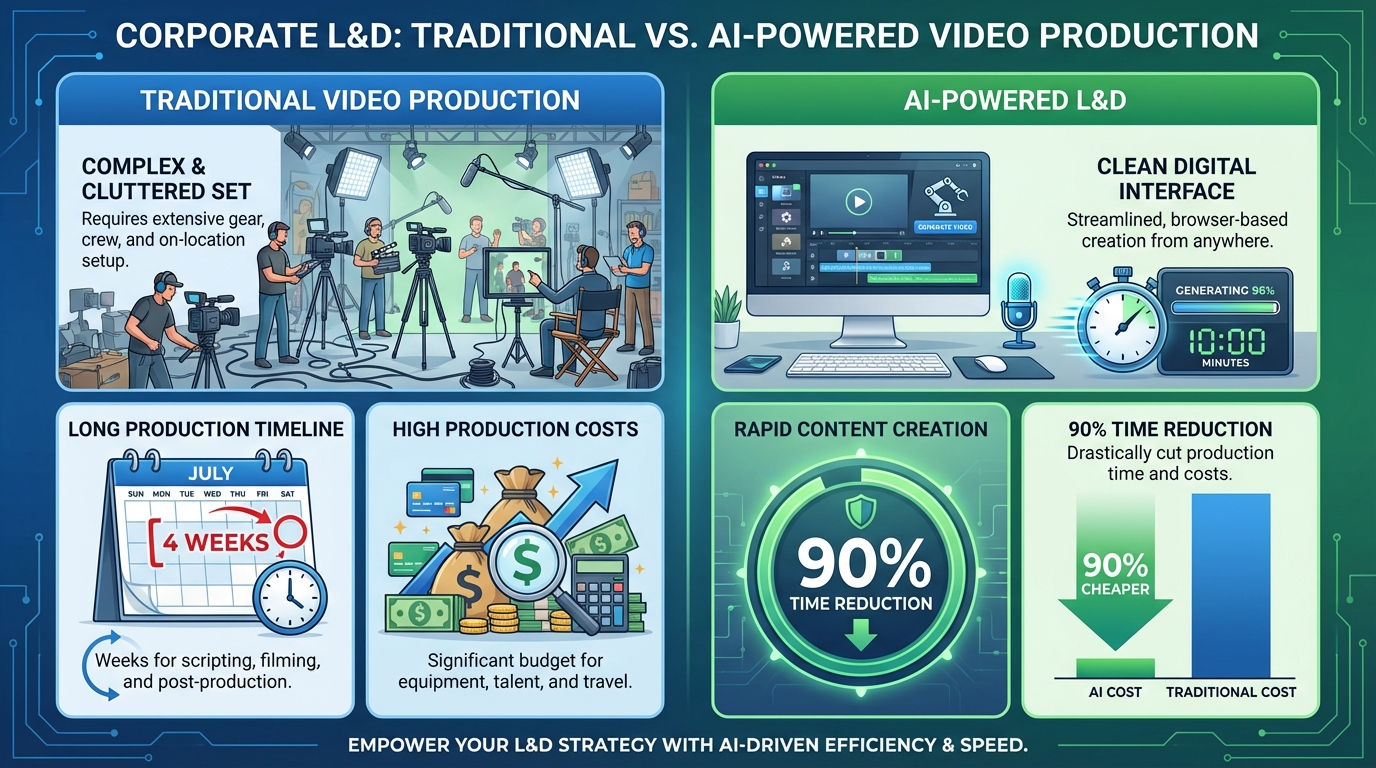
- AI-powered L&D delivers a 90% time reduction versus traditional video production through templates, virtual reshoots, and automation.
- Personalized onboarding and event-driven microlearning integrate with HRIS/LMS to trigger just-in-time content.
- Virtual instructor AI and performance coaching AI scale high-touch guidance and practice with rubric-aligned feedback.
- Multilingual and compliant training scales globally with 175+ languages, audit trails, and governance for regulatory readiness.
- Enterprise-grade architecture with SSO, RBAC, encryption, and API-first design connects data sources to distribution for measurable ROI.
Target Audience: CHROs and L&D leaders seeking enterprise-grade automation for onboarding and continuous upskilling.
Core Challenges: Scaling personalized content, outdated training materials, high translation overhead, compliance risks, and the pressure to prove training ROI measurement.
Expected Outcomes: Significant time-to-productivity gains, consistent global onboarding, enhanced employee engagement, auditable compliance, and analytics linking learning to performance.
Corporate training video AI uses generative and automation technologies to create, personalize, localize, and distribute training videos across HRIS/LMS workflows at enterprise scale. See the corporate training video AI overview. As we move into 2026, the traditional model of manual video production is being replaced by an AI-powered L&D platform that treats content creation as a scalable factory process. This shift allows organizations to move from static, one-size-fits-all modules to automated employee onboarding videos and microlearning video automation that adapt to individual learner needs.
By integrating virtual instructor AI and performance coaching AI, enterprises can now provide high-touch guidance without the logistical constraints of human trainers. Furthermore, the ability to generate multilingual training content in over 175 languages ensures that global workforces receive consistent, localized instruction. This guide explores how these technologies drive a 90% time reduction training and provide robust governance for compliance training videos.
According to research from People Matters, L&D in 2026 is defined by agility and a focus on measurable capability building, where AI is central to organizational resilience. Platforms like TrueFan AI enable this transition by bridging the gap between raw data and engaging, high-fidelity video content.
1. The Evolution of Corporate Training Video AI in 2026
Corporate training video AI is the application of generative AI, speech synthesis, and AI avatars to plan, script, produce, and deliver training videos programmatically. Unlike traditional video tools, this technology is integrated directly with HRIS and LMS platforms to trigger content generation based on specific employee lifecycle events. In the current 2026 landscape, the focus has shifted from mere experimentation to operationalizing AI within core business workflows.
For the modern enterprise, “corporate training video AI” must meet rigorous technical standards, including API-first architecture, enterprise AI video platform SSO (SAML/OIDC) integration, and ISO 27001/SOC 2 alignment. These systems are designed to handle sensitive employee data while maintaining strict audit logs and data minimization practices. The goal is to create a seamless pipeline where a new hire’s data automatically triggers the creation of a personalized welcome series.
The Indian market, in particular, is seeing a massive surge in agentic AI adoption within L&D operations. Organizations are no longer just “learning about AI”; they are building “L&D factories” that produce repeatable, governed, and scalable content. This maturity is essential for Global Capability Centers (GCCs) that require high-throughput content operations to support thousands of employees across diverse geographies.
Sources:
- People Matters: L&D 2026—AI is central to agility
- ETHRWorld: The AI paradox—experimentation vs. scale
2. Quantifying the Enterprise Business Case and 90% Time Reduction Training
The primary driver for adopting an AI-powered L&D platform is the measurable impact on the bottom line. Traditional video production involves weeks of scripting, filming, and post-production, often costing thousands of dollars per finished minute. In contrast, corporate training video AI delivers a 90% time reduction training by utilizing templates, virtual reshoots, and batch rendering.
To calculate the training ROI measurement, enterprises must look at both cost savings and productivity gains. The ROI formula involves subtracting the total platform and implementation costs from the combined benefits of reduced production expenses, faster time-to-productivity, and lowered compliance risk. For instance, reducing the “time-to-proficiency” for a sales hire by just three days can result in significant revenue increases across a large organization.
Localization is another area where the business case is undeniable. Traditional agencies charge per language and per minute, leading to astronomical costs for global rollouts. With AI, generating multilingual training content in 175+ languages happens in hours, not months. This speed ensures that regional teams are not left behind when new products or policies are launched.
NASSCOM’s 2025 landscape reports indicate that the maturation of the GenAI ecosystem in India has made these efficiencies accessible to mid-market and large enterprises alike. Solutions like TrueFan AI demonstrate ROI through these accelerated production cycles and the ability to update content instantly without scheduling new film shoots.
Sources:
- NASSCOM 2025: India Generative AI Startup Landscape
- People Matters: AI readiness and talent gaps in 2026
3. Orchestrating Automated Employee Onboarding Videos and Microlearning
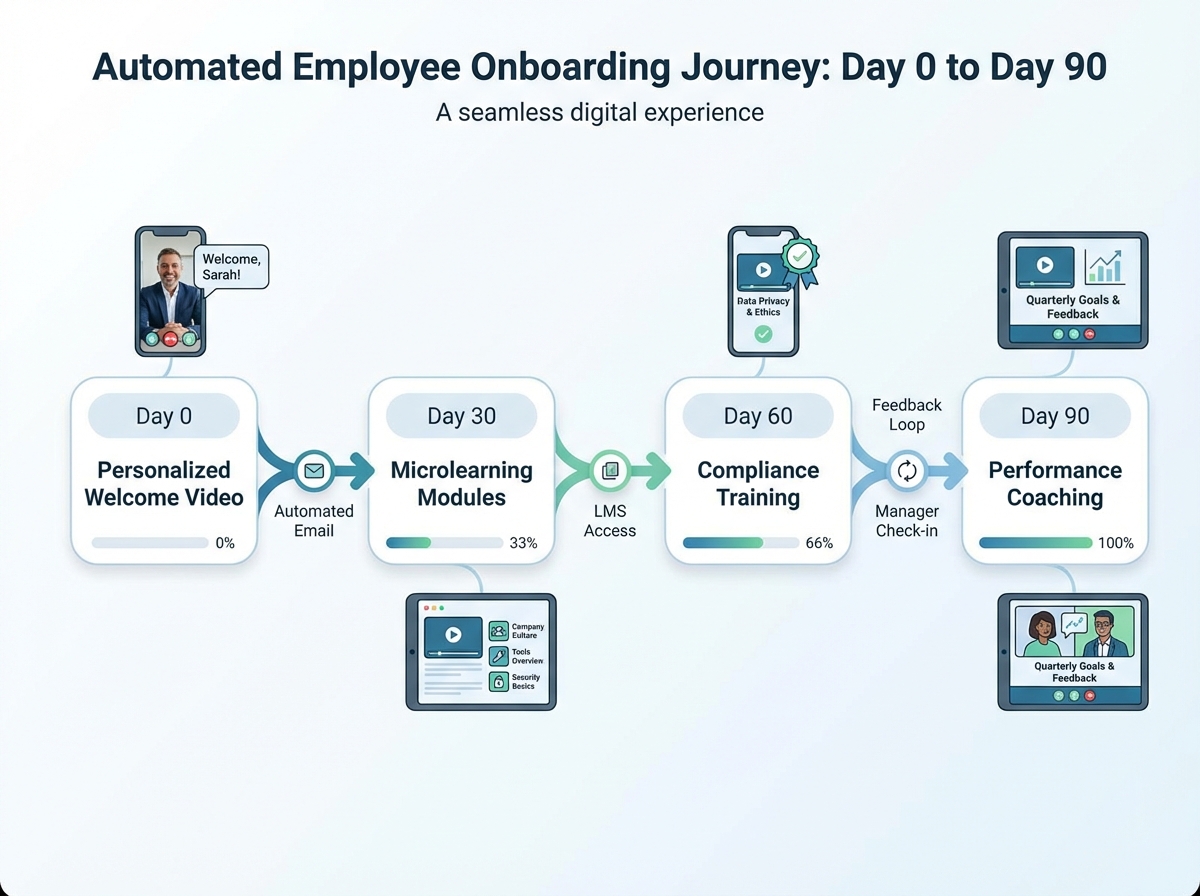
The first 90 days of an employee’s tenure are critical for retention and long-term performance. Automated employee onboarding videos allow HR teams to deliver a personalized journey that begins the moment a “hire” event is triggered in systems like Workday or SAP SuccessFactors. These videos can dynamically include the employee’s name, their manager’s welcome message, and specific details about their local office or department.
A structured AI-driven onboarding workflow typically follows a Day 0 to Day 90 cadence. On Day 0, the focus is on culture and high-level compliance. By Day 30, the system triggers microlearning video automation corporate training video AI guide focused on specific software tools or standard operating procedures (SOPs). This “just-in-time” approach ensures that information is delivered when it is most relevant, preventing cognitive overload.
Microlearning is particularly effective when it is event-driven. If an employee struggles with a specific task in the CRM, the AI-powered L&D platform can automatically assign a 2-minute “how-to” video. These personalized learning videos are far more effective than generic training because they address the immediate needs of the worker within their daily flow of work.
Governance is maintained through template versioning and legal sign-offs. Every video generated is logged, providing an auditable record of what was shown to whom and when. This level of employee training automation ensures that even as content is personalized, it remains within the boundaries of corporate policy and brand guidelines.
Sources:
- People Matters: The future of L&D—skills agility and outcome-centric onboarding
- TrueFan AI: Corporate Training Video AI Guide
4. Advancing Skill Transfer with Virtual Instructor AI and Performance Coaching AI
The introduction of virtual instructor AI has revolutionized the “human” element of digital learning. These AI avatars act as brand spokespersons, delivering content with synchronized voice and lip movements that feel natural and engaging. Unlike static videos, these virtual instructors can be programmed to respond to learner questions via embedded Q&A modules, creating a more interactive experience.
Performance coaching AI takes this a step further by providing a safe environment for behavioral practice. For example, a sales representative can practice objection handling with an AI coach that provides immediate, rubric-aligned feedback on their tone, phrasing, and compliance. This type of employee engagement videos ensures that high-stakes skills are honed before the employee interacts with a real customer.
The ethical use of this technology is paramount. Enterprises must ensure consent-based likeness use for any internal leaders turned into avatars. Furthermore, moderation filters must be in place to prevent the generation of unapproved or harmful content. When implemented correctly, these tools provide a level of coaching that was previously impossible to scale across a global workforce.
In 2026, agentic AI is being embedded directly into these coaching workflows. The AI doesn’t just deliver a video; it analyzes the employee’s performance data and recommends the next specific module to bridge a identified skill gap. This creates a continuous loop of learning and application that drives real-world business impact.
Sources:
5. Scaling Multilingual Training Content and Compliance Training Videos
For global organizations, compliance training videos are a non-negotiable requirement. However, managing jurisdictional variants—such as different POSH (Prevention of Sexual Harassment) regulations across Indian states or GDPR in Europe—is a logistical nightmare. Corporate training video AI allows L&D teams to maintain a master template and automatically swap legal references and languages based on the viewer’s location.
TrueFan AI’s 175+ language support and Personalised Celebrity Videos technology allow for the retention of a speaker’s original voiceprint while achieving perfect lip-sync in regional languages like Hindi, Tamil, Telugu, and Marathi. This ensures that the message is not just translated, but localized with the correct cultural nuances and terminology. Explore multilingual voice marketing automation for deeper insights.
Accessibility is another critical component of modern compliance. AI-powered platforms automatically generate captions, audio descriptions, and even sign-language avatar tracks. This ensures that compliance training is inclusive and meets WCAG-AA standards, reducing the risk of legal challenges related to accessibility.
The governance framework for these videos includes an “evidence pack” for every employee. This pack contains the record of assignment, completion timestamps, quiz scores, and the specific version of the policy the employee attested to. This level of detail is invaluable during regulatory audits, providing a clear trail of compliance across the entire organization.
Sources:
6. Enterprise Architecture, Security, and Employee Training Automation
Integrating corporate training video AI into an existing tech stack requires a robust architectural approach. The system must act as a bridge between data sources (HRIS, CRM, ATS) and distribution channels (LMS, Slack, Microsoft Teams). An API-first design enterprise AI video platform guide allows for seamless triggers; for instance, when a salesperson’s status changes in Salesforce, the system can automatically generate a training video on a new product feature they now need to sell.
Security is the cornerstone of enterprise employee training automation. Platforms must support SSO via SAML or OIDC to ensure that only authorized employees can access sensitive training materials. Data residency is also a key concern, especially for organizations operating in multiple jurisdictions with strict data sovereignty laws. Encryption in transit and at rest, combined with regular VAPT (Vulnerability Assessment and Penetration Testing), is mandatory.
The distribution of these videos must be as frictionless as the creation. Modern platforms provide secure, trackable links that can be embedded in email, SMS, or collaboration tools. For formal learning, SCORM or xAPI packages are generated and pushed to the LMS, ensuring that completion data is centralized. This interconnectedness is what allows for the “L&D factory” model to function at scale.
Finally, the measurement of success is handled through a centralized analytics lakehouse. This allows CHROs to view dashboards that correlate training completion with business KPIs, such as a reduction in safety incidents or an increase in customer satisfaction scores. This data-driven approach transforms L&D from a cost center into a strategic driver of organizational performance.
Sources:
7. Strategic Implementation and Why TrueFan AI Leads the Market
Implementing corporate training video AI is a journey that begins with a focused pilot. Organizations should identify 2–3 high-impact roles and develop a series of 10–15 automated videos to test the workflow. Success criteria should be clearly defined, focusing on metrics like completion rates and the reduction in time-to-productivity. Once the pilot proves successful, the organization can scale by building a comprehensive template library and automating the QA process.
A successful rollout also requires a dedicated governance council. This group, comprising leaders from L&D, IT Security, and Legal, ensures that all AI-generated content meets brand and regulatory standards. Change management is equally important; employees need to understand the role of AI avatars and how these tools are designed to support, not replace, their professional development.
TrueFan AI stands out in the enterprise market by offering hyper-personalization at a scale that traditional production cannot match. With the ability to perform virtual reshoots, L&D teams can update a single policy or product detail across hundreds of videos in minutes. This agility is essential in the fast-paced business environment of 2026.
By choosing a partner that prioritizes security, provides deep integration capabilities, and supports a vast array of global languages, enterprises can future-proof their learning strategy. The transition to an AI-powered L&D platform is not just a technological upgrade; it is a fundamental shift in how organizations build and maintain the skills of their workforce.
Sources:
Frequently Asked Questions
How does corporate training video AI integrate with our HRIS/LMS?
Corporate training video AI platforms utilize robust APIs and webhooks to connect with systems like Workday, SAP SuccessFactors, and Cornerstone. When a specific event occurs—such as a new hire being added or a role change—the HRIS sends a trigger to the AI platform. The platform then generates the relevant personalized learning videos and pushes them back to the LMS or a communication channel like Slack for the employee to access via SSO. Learn more in the enterprise AI video platform overview.
Can we achieve 90% time reduction training without compromising quality?
Yes, the 90% time reduction training is achieved by eliminating the most time-consuming parts of traditional production: scheduling, filming, and manual editing. By using high-fidelity AI avatars and pre-approved templates, you can generate professional-grade video in minutes. Quality is maintained through automated QA checks and the ability to perform “virtual reshoots” to instantly correct or update content without a new production cycle.
How do virtual instructor AI and performance coaching AI improve skill transfer?
Virtual instructor AI provides a consistent, engaging presence that can interact with learners, while performance coaching AI offers a sandbox for practicing complex skills. By receiving immediate, data-driven feedback on their performance in simulated scenarios, employees can correct mistakes in a low-stakes environment. This active participation leads to higher retention and better application of skills on the job compared to passive video watching.
How do you ensure compliance training videos are audit-ready?
Compliance training videos are made audit-ready through rigorous version control and detailed tracking. Every video is mapped to a specific policy version, and the platform generates an “evidence pack” for every learner. This pack includes the date of assignment, time spent watching, quiz scores, and a digital attestation, providing a complete and immutable record for regulatory bodies.
What’s the best approach to multilingual training content and regional nuances?
The most effective approach is to use an AI platform that supports native-level translation and lip-syncing. Rather than just adding subtitles, the AI should adapt the speaker’s voice and mouth movements to the target language. It is also vital to use a platform that allows for regional review loops, ensuring that technical terms and cultural nuances are accurately represented in all 175+ supported languages. Explore multilingual voice marketing automation for details.
How do you measure ROI from employee training automation?
Training ROI measurement involves tracking both direct cost savings (reduced production and translation fees) and indirect productivity gains. Key metrics include the reduction in “time-to-proficiency” for new hires, higher completion rates for compliance modules, and the correlation between training and performance KPIs like sales targets or safety incidents.
What governance and security controls are in place?
An enterprise-grade AI-powered L&D platform includes SOC 2 Type II and ISO 27001 certifications, SAML-based SSO, and role-based access controls (RBAC). Governance features include moderation filters to prevent unauthorized content generation, consent-management for avatar likenesses, and comprehensive audit logs that track every action within the system.
Why TrueFan AI for corporate learning vs traditional production?
TrueFan AI offers a level of scalability and personalization that traditional production cannot match. While a traditional shoot might take weeks to produce one video, TrueFan AI can generate thousands of personalized versions in the same timeframe. Additionally, the ability to update content instantly via virtual reshoots and support for 175+ languages makes it the superior choice for global enterprises looking to optimize their L&D budget and impact. Learn more in the corporate training video AI overview.