
AI Video Duplicate Detection Faceless YouTube India 2026: The Enterprise Guide to Monetization-Safe Automation
Estimated reading time: ~10 minutes
Key Takeaways
- AI duplicate detection on YouTube India targets near-duplicates using pHash, LSH, and audio fingerprinting—risking monetization for faceless channels.
- Adopt a 6-stage originality pre-flight (script, voice, visual, scoring, audit trail) before upload to protect YPP eligibility.
- Ensure substantive commentary (40–60%), unique editing structures, and regional localization to pass “Reused Content” checks.
- Build a safe-by-design pipeline with consent-first avatars, watermarking, and forced variation—platforms like Studio by TrueFan AI streamline compliance.
- Use clear trust signals and appeal bundles (scripts, licenses, provenance) to reverse false-positive moderation decisions.
The landscape of digital content in India has undergone a seismic shift. As we navigate 2026, the Indian creator economy is projected to contribute over $1.2 billion to the national GDP, with faceless channels leading the charge in scalable automation. However, this growth comes with a caveat: AI video duplicate detection faceless YouTube India 2026 protocols have become the primary gatekeepers for monetization. For enterprise-level creators managing portfolios of 50+ channels, the challenge is no longer just “making” content—it is ensuring that every frame passes the rigorous, AI-driven “Reused Content” filters that YouTube India has tightened over the last 24 months.
In this guide, we break down the technical architecture of modern duplicate detection, the legal nuances of “Fair Dealing” in India, and the exact pre-flight workflow required to secure your YouTube Partner Program (YPP) status in an AI-first era.
1. India 2026 Reality Check: Policy, Platform, and Moderation Shifts
In 2026, YouTube’s moderation is almost entirely agentic. According to recent industry data, YouTube India’s AI-driven moderation accuracy reached a staggering 98.4% in Q1 2026, specifically targeting “near-duplicate” visual patterns. This crackdown isn't just about copyright; it’s about the YouTube channel monetization policies on reused content, which define prohibited material as anything that “adds little to no value” or lacks a “significant original perspective.”
The “Reused Content” Trap in India
For Indian creators, the scrutiny is particularly high. Following the 2025 crackdown on repetitive content, where thousands of channels were demonetized overnight, the platform now uses “likeness transparency” labels. If your faceless channel uses AI avatars or synthetic voices without a clear “originality signature,” you risk immediate rejection.
- Policy Anchor: YouTube defines reused content as material that is not original or adds little value, such as clips with minimal commentary or repeated templates. (Source: YouTube Monetization Policies)
- India Context: The Economic Times recently highlighted that YouTube CEO Neal Mohan’s 2026 plan places AI at the heart of moderation, specifically targeting deepfake safety and likeness detection. (Source: Economic Times: AI priorities for 2026)
Fair Dealing vs. Platform Enforcement
A common misconception among Indian creators is that “Fair Use” (a US legal doctrine) protects them. In India, we operate under Section 52 of the Copyright Act, 1957, known as “Fair Dealing.” This is much narrower, covering specific exceptions like criticism, review, or reporting current events. Even if your content technically falls under Fair Dealing, YouTube’s automated Content ID system may still flag it. Platforms like Studio by TrueFan AI enable creators to navigate this by providing licensed assets that bypass these automated hurdles from the start.
2. Duplicate Detection Fundamentals: The Tech Behind the Scenes
To beat the algorithm, you must understand how it “sees” your video. YouTube doesn't just look for identical files; it looks for near-duplicates.
Perceptual Hashing (pHash)
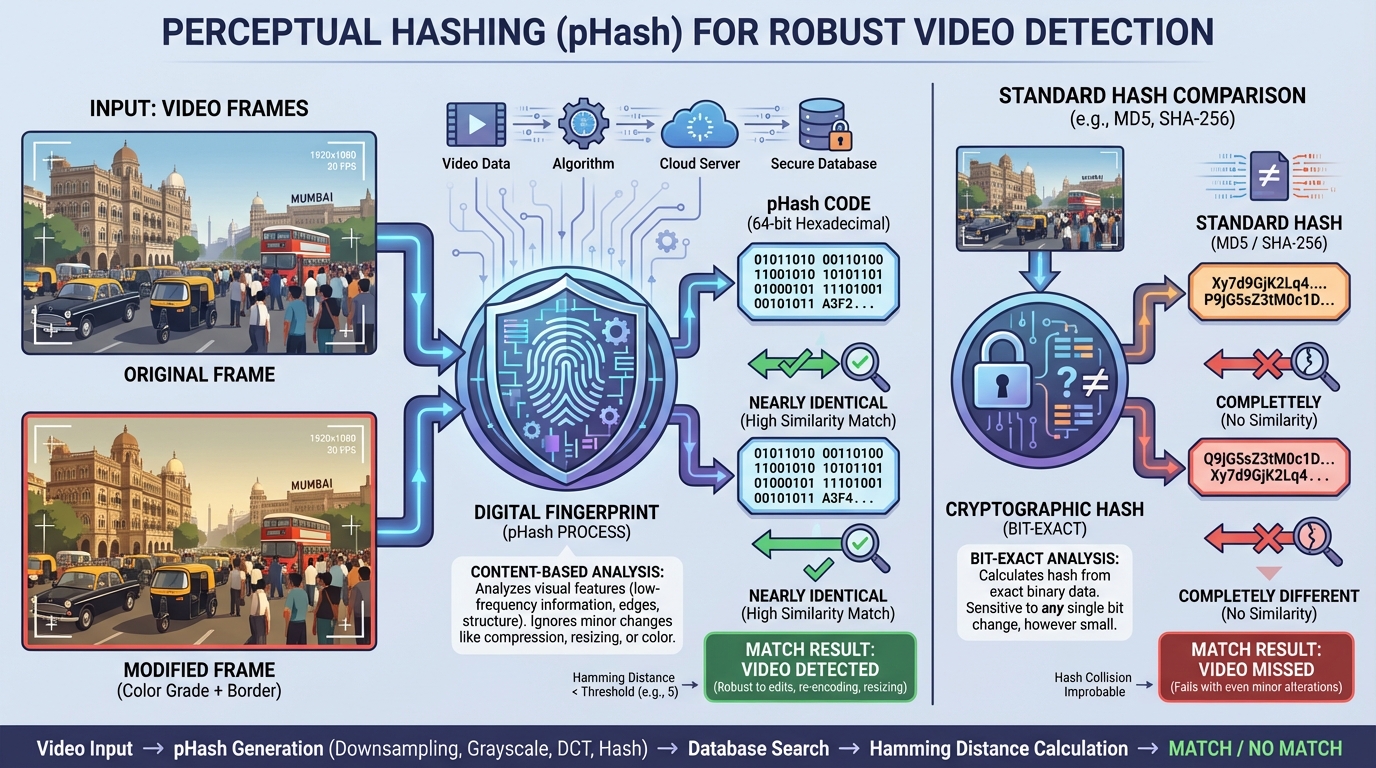
Unlike a standard cryptographic hash (where changing one pixel changes the whole hash), a perceptual hash creates a “fingerprint” of the visual content. If two videos look similar to the human eye—even if one has a different border or slightly different color grading—their pHashes will be nearly identical.
- Thresholds: In 2026, enterprise workflows use a 3-stage pipeline. If a video has a Hamming distance of ≤ 8 bits per frame compared to an existing catalog, it is flagged as a high-risk duplicate. (Source: MDPI: Perceptual hashing overview)
Locality-Sensitive Hashing (LSH) for Scene Clustering
YouTube uses LSH to cluster similar shots across its entire corpus. If you use the same stock footage of a “busy Mumbai street” that 500 other channels have used, the LSH algorithm will group your video into a “low-originality” cluster. This is why original content verification AI is now a mandatory step in the production pipeline.
Audio Fingerprinting
It’s not just about the visuals. YouTube’s “Chroma-based” audio features can detect if your AI voiceover uses the same cadence and pitch as other channels. If you are using generic, free TTS (Text-to-Speech) tools, you are likely triggering these audio duplicate signals.
3. Originality Pre-Flight: The 6-Stage Verification Workflow
To ensure faceless YouTube monetization approval, enterprise creators must implement a “Pre-Flight” check. This is an automated audit conducted before the video is ever uploaded to YouTube.
- Stage 0: Asset Labeling: Every clip, image, and audio track must be tagged. Is it Original, Licensed, or UGC?
- Stage 1: Script Similarity Check: Run your script through a plagiarism detector. In 2026, a script similarity score of > 20% against existing YouTube transcripts is a red flag.
- Stage 2: Voiceprint Analysis: Compare your AI voice’s mel-spectrogram against your own channel’s history. Ensure you aren't repeating the exact same “voice template” across 100 videos without variation.
- Stage 3: Visual pHash Scan: Run frame-level scans against your own catalog and public databases. Studio by TrueFan AI’s 175+ language support and AI avatars are designed to provide unique visual signatures that help avoid these common “template reuse” flags.
- Stage 4: Composite Scoring: Assign weights—Visual (50%), Audio (30%), Script (20%). If the total “Originality Score” is below 75%, the video must go back for transformation.
- Stage 5: Audit Trail Generation: Export a PDF report detailing the licenses used and the transformations made. This is your “insurance policy” for manual appeals.
4. The Reused-Content “Fix” Playbook: Transforming Risky Inputs
If your pre-flight check flags a video as a “near-duplicate,” you don't need to delete it. You need to transform it. In 2026, “transformation” has a specific technical definition on YouTube India.
Substantive Commentary (The 40/60 Rule)
To pass as “original,” at least 40–60% of your video’s runtime should feature substantive commentary. This isn't just reading a script; it’s providing data-backed insights, local Indian context, or unique criticism. For example, if you are making a video about the “Future of EVs in India,” don't just show stock footage of cars. Overlay a chart showing Tata Motors' 2026 market share projections and provide a voiceover analysis of that specific data.
Unique Editing Structures
- Scene Graph Variation: Change the order of shots. Avoid the “Intro -> Stock Clip A -> Stock Clip B -> Outro” formula.
- Data Overlays: Use on-screen graphics that are unique to your brand.
- Regional Localization: Instead of a generic “How to Save Money” video, create “How to Save Money on UPI Transactions in Bangalore.” The local context acts as a powerful originality signal.
What NOT to do:
- Adding “AI Subtitles” alone does not count as transformation.
- Applying a “sepia filter” or “mirroring the video” no longer fools pHash algorithms in 2026.
- Using stock footage compilations without a central, original narrative will lead to monetization denial. (Source: Storyboard18: Crackdown on repetitive content)
5. Safe Generation Workflows: Copyright-Free AI Video Generation in India
For enterprises, the goal is to build a “Safe-by-Design” pipeline. This means using tools that have compliance baked into their DNA. Solutions like Studio by TrueFan AI demonstrate ROI through enterprise monetization benchmarks and their ability to generate thousands of unique, compliant variants without the risk of “Reused Content” strikes.
The Enterprise Compliance Stack
- Consent-First Avatars: Only use AI avatars where the original actor has given explicit consent for synthetic reproduction. This is a major focus of the Internet Freedom Foundation (IFF) in 2026, as they advocate against “digital likeness theft.” (Source: IFF on copyright and AI)
- Watermarking and Provenance: Every video generated should have a hidden (or visible) digital watermark that proves its origin. This helps in “Anti-Theft” detection if someone else tries to re-upload your content.
- Automated Variation Constraints: Set your AI generator to “Force Variation.” For example, require that every 3rd video in a series uses a different background, a different avatar outfit, and a different background music track.
ROI of Compliance
In 2026, the cost of a “Monetization Pause” for an enterprise channel is estimated at ₹5,00,000 per month in lost ad revenue. Investing in a YouTube-safe faceless content creator workflow isn't just an operational choice; it’s a financial necessity.
6. Monetization Trust Signals and the Appeal Workflow
Even with a perfect workflow, “false positives” happen. YouTube’s AI might flag your original content as reused. When this happens, you need a professional appeal strategy.
Embedding Trust Signals
- The First 30 Seconds: Include a lower-third graphic that says, “This video features licensed media and original analysis by [Channel Name].”
- The Description Box: Don't just put keywords. Include a “Transparency Statement” and a list of license IDs for your music and avatars.
- The “About” Page: Link to your channel’s official Content Policy page.
The Manual Review “Audit Bundle”
If your channel is rejected for monetization, your appeal video must be a “behind-the-scenes” look at your production.
- Show the Script: Show the original research and the “diff” between your script and existing sources.
- Show the Pipeline: Record a screen-share of your original content verification AI dashboard.
- Show the Licenses: Display the invoices or certificates for your AI avatars and stock footage.
- Map the Transformation: Explicitly state, “At 02:15, I added original commentary regarding the Indian Union Budget 2026, which is not present in the source footage.”
Final Checklist for 2026 Compliance
- Script Originality Score ≥ 80%
- Visual Duplicate Score (pHash) < 40%
- AI Avatar Consent/License Verified
- Substantive Commentary covers > 40% of runtime
- Synthetic Media Transparency Label applied
- Audit PDF generated and stored for appeal
Ready to scale your faceless empire without the risk of demonetization? Book an enterprise demo with TrueFan AI today to embed automated originality pre-flights and rights governance directly into your production pipeline.
Sources:
- YouTube Monetization Policies
- Economic Times: YouTube CEO’s 2026 AI content and safety priorities
- MDPI: Perceptual Hashing Research Overview
- Internet Freedom Foundation: Copyright, AI, and free speech
- Storyboard18: YouTube crackdown on repetitive content
- The Reporters’ Collective: YouTube copyright disputes in India
Recommended Internal Links
- Faceless YouTube formats, niches, and automation playbooks relevant to strategy and originality
- Monetization benchmarks, RPM/CPM ranges, and ROI modeling for faceless channels in 2026
- Consent-first AI avatars, deployment considerations, and compliance best practices for India
Frequently Asked Questions
What is “reused content” in 2026 and how do faceless channels avoid it?
Reused content refers to any video that lacks a significant original contribution. In 2026, this includes AI-generated videos that use generic templates or low-effort stock footage loops. Faceless channels avoid this by ensuring their AI-generated content includes unique data overlays, regional Indian context, and a high percentage of original commentary. Explore formats and strategy ideas via faceless YouTube channel ideas.
How much commentary is “enough” to be transformative in India?
While not a hard rule, the enterprise standard in 2026 is 40–60% of the runtime. This commentary must add value—explaining complex topics, providing local perspectives, or critiquing the visuals shown.
Do AI avatars or AI clones risk my channel’s monetization?
Not if used correctly. Use licensed, consent-first avatars and disclose synthetic media per YouTube’s 2026 transparency guidelines. Platforms like Studio by TrueFan AI and its AI avatars approach ensure unique, authorized likenesses that reduce detection flags.
Can I use the same AI voice across 50 different channels?
This is high risk. YouTube’s audio duplicate detection can identify “voice clusters.” If many channels use the same voice with the same cadence, they may be flagged as a network. Vary pitch, speed, and persona across channels.
How do I protect my original AI content from being stolen in India?
Use digital watermarking and periodic pHash crawls of YouTube. If you find a clone, use your production “Audit Bundle” as evidence for takedowns. A provable provenance trail is often the fastest path to resolution per Indian reporting on platform disputes.



