Quick commerce video personalization for Holi in India: hyperlocal, inventory-aware campaigns that convert in minutes
Estimated reading time: ~10 minutes
Key Takeaways
- Hyperlocal, inventory-aware videos at the pincode level drive instant Holi conversions with same-hour fulfillment.
- Pair location-based urgency triggers with platform-exclusive festival deals to maximize ROI.
- Distribute across Blinkit, Zepto, ONDC, and WhatsApp with real-time inventory alerts and swap logic.
- Build a hyperlocal delivery marketing automation stack that connects dark-store data to creative while enforcing SLAs and fallbacks.
- Scale to Tier-2 markets with vernacular localization, supply-chain realism, and scientific measurement frameworks.
Meta Description: Turn Holi spikes into instant sales with hyperlocal video, ONDC + WhatsApp flows, and same-hour festival fulfillment.
For Holi, quick commerce video personalization that’s inventory-aware and geo-fenced at the pincode level converts in minutes. Brands must pair location-based urgency triggers with platform-exclusive festival deals, deliver instant shopping conversion videos across Blinkit, Zepto, ONDC, and WhatsApp, and orchestrate same-hour festival fulfillment via dark store inventory videos and real-time inventory alerts. As the Indian retail landscape shifts toward operational precision in 2026, the ability to synchronize creative messaging with granular supply-chain data has become the definitive competitive advantage for enterprise marketers.
The 2026 fiscal year marks a pivotal transition where quick commerce enters its most competitive phase, expanding aggressively beyond metros into Tier-2 and Tier-3 cities. During high-velocity festivals like Holi, consumer expectations have evolved from mere speed to absolute reliability and relevance. Recent data indicates that Holi surges drive unprecedented demand for colors, sweets, and apparel, often leading to rapid stockouts that render static advertisements obsolete. By implementing quick commerce video personalization India strategies, brands can ensure that every impression is backed by live inventory, preventing wasted ad spend and consumer frustration.
Key Definitions for the Hyperlocal Era
- Quick Commerce Video Personalization: The programmatic generation and delivery of 1:1 or cohort-level video creatives inside quick-commerce funnels. These assets adapt content based on viewer pincode, nearest dark store inventory, time-of-day, festival slot, and platform context (Blinkit/Zepto/Instamart/ONDC/WhatsApp) to drive instant, same-hour purchases.
- Hyperlocal Delivery Marketing Automation: A sophisticated rules-and-API orchestration layer that monitors inventory levels, pricing, Service Level Agreements (SLAs), and geographic signals (pincode/lat-long) to trigger, render, and route personalized videos to the appropriate channel and neighborhood within seconds.
Sources:
- Holi 2024/2026 Sales Surges: Storyboard18; Economic Times
- 2026 Quick Commerce Trends: Inc42; Fortune India
Why Holi Demands Quick Commerce Video Personalization in India
Holi is characterized by a high-velocity, short-window demand spike where the window for conversion is measured in minutes rather than days. Consumers increasingly expect a seamless 10–30 minute discovery-to-delivery experience, making 10-minute commerce Holi optimization essential for brand survival. In 2026, platforms have moved beyond the novelty of speed toward a focus on assortment depth and profitability, necessitating inventory-aware creatives that reflect real-time SKU availability.
During the Holi weekend, quick-commerce giants like Blinkit and Zepto have reported record-breaking sales of gulal, pichkaris, gujiya, and white T-shirts. However, the volatility of these categories often leads to localized stockouts. A static video ad promoting a specific thandai mix is counterproductive if the nearest dark store is out of stock. Quick commerce video personalization India solves this by dynamically swapping featured products based on what is actually available in the user's specific neighborhood.
Furthermore, AI-native personalization has become the operating norm in 2026. Enterprise marketing stacks must now connect real-time data to creative output to maintain relevance. Instant shopping conversion videos that utilize inventory-aware logic significantly increase Click-Through Rates (CTR) and Conversion Rates (CVR) by displaying exactly-available SKUs with countdown urgency. This level of precision ensures that the "same-hour festival fulfillment" promise is met, building long-term consumer trust during the year's most chaotic shopping period.
Sources:
- Holi Peak Sales Data: Moneycontrol; Business Standard
- AdTech 2026 Evolution: Mediabrief
Architecting the Hyperlocal Delivery Marketing Automation Stack
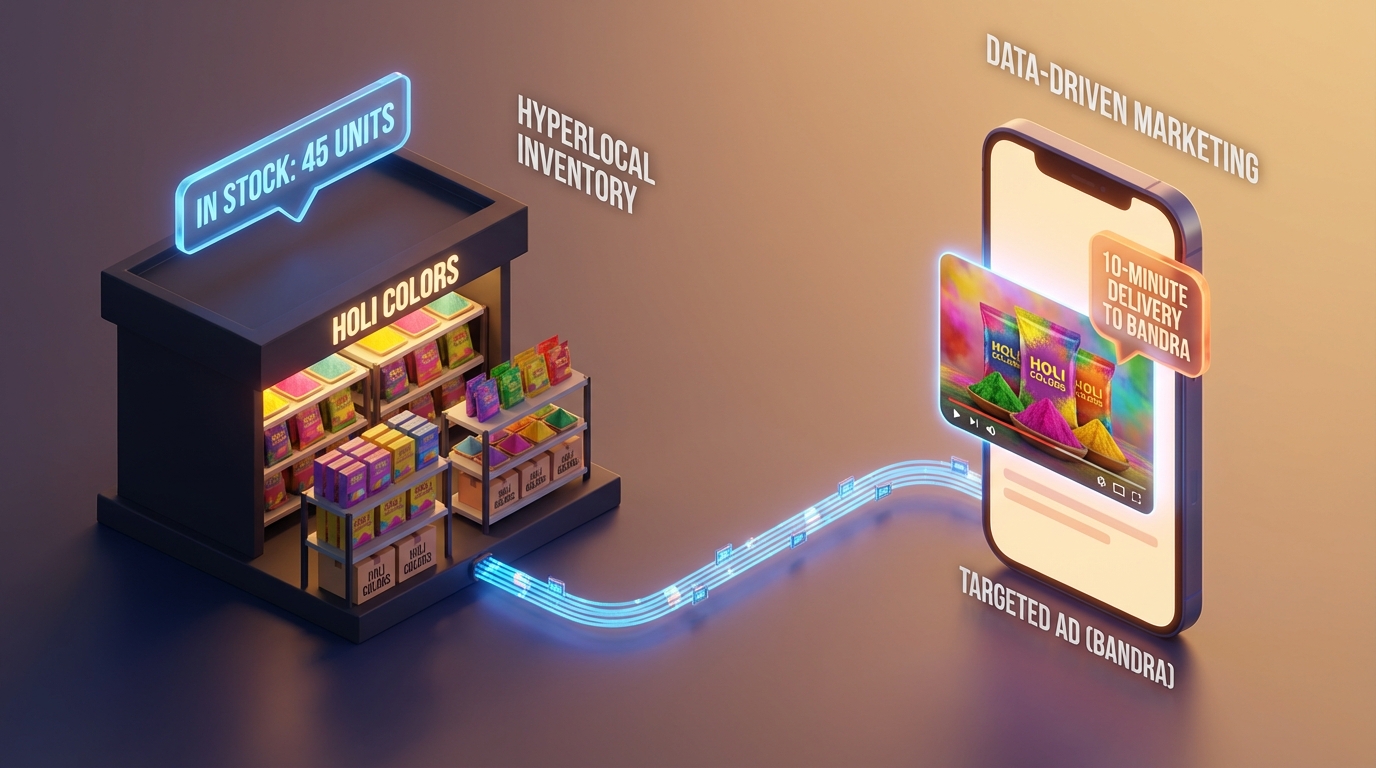
Building a robust hyperlocal delivery marketing automation stack requires the seamless integration of data signals, creative rendering, and distribution logic. The foundation of this architecture is real-time inventory data per dark store. Marketers must ingest SKU counts, replenishment ETAs, and price/promo flags at a granular level. When combined with user context—such as pincode, preferred language, and platform engagement—this data triggers the generation of dark store inventory videos.
Platforms like TrueFan AI enable brands to synchronize these complex data points with high-quality video production at scale. The process begins with an event trigger, such as a "Holi Eve" flash sale or a specific stock threshold being reached. A webhook from the inventory management system sends a signal to the video render API. Within a sub-30 second window, a personalized video is composed, featuring the user's locality (e.g., "Andheri West") and the exact number of items remaining in the nearest dark store.
Location-based urgency triggers are then layered onto the creative. These include dynamic countdowns and proximity badges that adapt to the buyer’s neighborhood and the platform’s current delivery SLA. For instance, a video might state, "Deliver before gulal runs out in Bandra—12 mins away." If a product goes out of stock during the render process, the system must employ fallback logic, automatically swapping the featured item for the nearest alternative SKU bundle to preserve the conversion opportunity.
Neighborhood flash sales automation further enhances this stack. By identifying pincodes where supply exceeds demand, brands can auto-trigger localized price drops or "Buy 2 Get 1" offers. These platform-exclusive festival deals are rendered into unique creatives for Blinkit, Zepto, or Swiggy Instamart, ensuring that the offer is tailored to the specific platform's user base and inventory allocation.
Sources:
- Real-time Video Personalization Frameworks: TrueFan AI Blog
- Enterprise Automation Capabilities: TrueFan AI
Navigating the Quick Commerce Ecosystem: Blinkit, ONDC, and WhatsApp
The distribution of personalized video requires a multi-channel approach that leverages established partnerships and emerging marketplaces. Blinkit Zepto partnerships are central to this strategy. For Holi 2026, brands like Dulux have demonstrated the power of these collaborations by distributing branded gulal in miniature paint buckets, supported by inventory-aware video ads. These campaigns use "delivered in 10–20 mins" CTAs that are verified against real-time rider availability.
ONDC marketplace video integration represents the next frontier for multi-platform reach. By syndicating video assets and metadata via APIs to ONDC sellers and buyer apps, brands can ensure consistent, inventory-aware creatives at the last mile. The process involves mapping seller catalogs to video templates and attaching deep-links to ONDC-compliant buyer apps. This ensures that even smaller regional players can offer the same level of sophisticated quick commerce video personalization as major platforms.
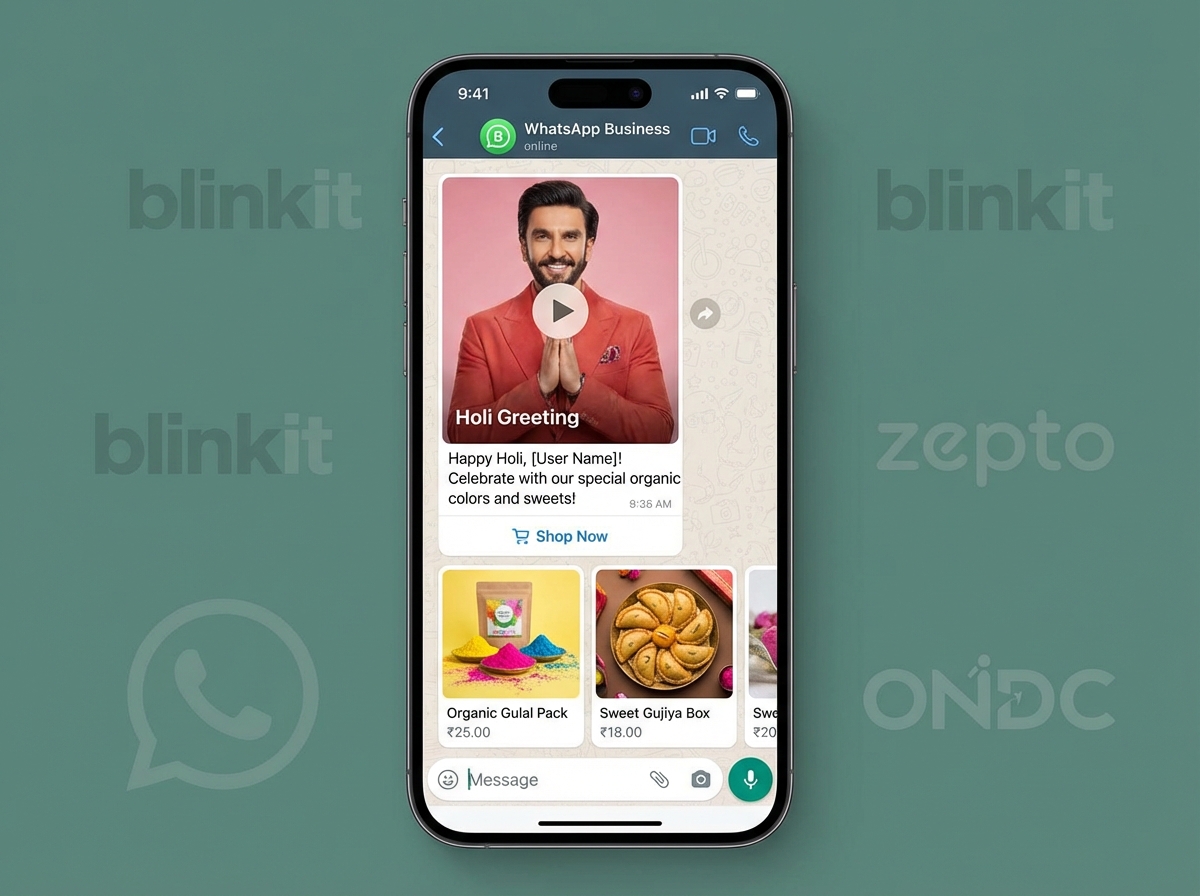
WhatsApp commerce integration serves as the primary driver for 1:1 festival conversions. The journey typically begins with a Click-to-WhatsApp ad that triggers a personalized video greeting. Using WhatsApp Flows, brands can guide the user through a purchase journey—from SKU selection to payment via UPI intent—without the user ever leaving the chat. If a chosen item is out of stock, real-time inventory alerts can automatically recommend substitutes with updated delivery ETAs, maintaining the momentum of the "instant shopping conversion."
Sources:
- Dulux x Blinkit Case Study: BW Marketing World; Business Standard
- WhatsApp Flows and Commerce: Gupshup; WhatsApp Business
- ONDC Overview: ONDC.org
Strategic Holi Playbooks: From 10-Minute Optimization to Flash Sales
To maximize ROI during the festival, enterprise marketers should deploy ready-to-run blueprints that address specific consumer behaviors and supply-chain realities.
Playbook 1: 10-Minute Commerce Holi Optimization
This playbook focuses on micro-templates for high-demand categories like pichkaris and white T-shirts. By overlaying locality-specific SLA badges (e.g., "15-min delivery in Vashi"), brands can capitalize on last-minute "panic buying" in the hours leading up to Rangwali Holi. The KPI focus here is the latency between the video view and the "Add to Cart" action, which should ideally be under 120 seconds.
Playbook 2: Neighborhood Flash Sales Automation
When inventory levels at a specific dark store exceed a certain threshold, this playbook triggers a localized flash sale. The video creative is dynamically updated to say, "Only in [Pincode] till 3 PM," creating a sense of hyper-local exclusivity. If the uptake is lower than targeted, the system can automatically cascade price drops and update the video assets in real-time to reflect the new offer.
Playbook 3: Platform-Exclusive Festival Deals
Brands should build unique bundles for different quick-commerce partners to avoid direct price wars and manage inventory allocations. For example, a "Blinkit Exclusive Holi Party Kit" might feature a different celebrity intro than a "Zepto Holi Essentials Pack." These platform-exclusive festival deals use dynamic QR codes or deep-links to drive users directly to the specific partner's app, ensuring a frictionless path to same-hour festival fulfillment.
Playbook 4: Real-Time Inventory Alerts + Swap Logic
This is a critical recovery playbook. If a user clicks on a video for a product that has just gone out of stock, the system sends an automated WhatsApp push with a personalized video featuring an alternative bundle in the same category and price band. This preserves the urgency timer and provides a fresh delivery ETA, significantly reducing cart abandonment rates during peak traffic periods.
Scaling to Tier-2 Markets: Localization and Supply-Chain Realism
The tier-2 quick commerce expansion is a defining trend of 2026. However, scaling to these markets requires more than just logistical expansion; it demands deep creative localization. TrueFan AI's 175+ language support and Personalised Celebrity Videos allow for hyper-localized greetings and vernacular captions that resonate with diverse regional audiences. A Holi campaign in Lucknow should feature Hindi dialects and culturally nuanced greetings that differ significantly from a campaign in Coimbatore or Indore.
Supply-chain realism is equally vital in Tier-2 and Tier-3 cities, where dark-store footprints may be smaller and replenishment cycles longer. Marketers must stagger flash sales based on local supply and use video to guide consumers toward available substitutes. Same-hour festival fulfillment in these regions often relies on managing expectations through dynamic SLA bands displayed directly within the video creative.
Measurement in these markets must be adjusted for local conditions. Brands should track uplift in Tier-2 cities compared to metros, often finding that personalized vernacular content drives higher engagement despite lower overall bandwidth. Compressing video assets for low-data conditions while maintaining high visual quality is a technical necessity for successful quick commerce video personalization India at a national scale.
Sources:
- Digital Marketing Trends India 2026: India Digital Advertising
- Tier-2 Expansion Insights: Inc42
Enterprise Execution and Scientific Measurement Frameworks
Executing these campaigns at an enterprise level requires an API-first video pipeline that can handle the massive concurrency of a national festival. Webhooks must ingest thousands of inventory updates per minute, triggering renders that are delivered across WhatsApp, SMS, and platform ad slots. Security and compliance are paramount; systems must align with the Digital Personal Data Protection (DPDP) Act and maintain ISO 27001 and SOC 2 certifications to ensure brand safety and data integrity.
Solutions like TrueFan AI demonstrate ROI through a scientific conversion framework. Leading indicators include video completion rates in the first five seconds and the "add-to-cart latency." However, the ultimate outcome metrics are the CVR uplift from inventory-aware vs. static video and the percentage of orders that meet the SLA of under 60 minutes. Experiment design is crucial; brands should conduct A/B tests on urgency copy variants and platform-exclusive vs. cross-platform deals to refine their strategy for future festivals.
Operational SLAs must be strictly enforced. Peak render latency should remain under 30 seconds to ensure that the "real-time" aspect of the inventory data remains accurate. If an API timeout occurs, robust backoff and fallback logic must be in place to prevent the delivery of broken or outdated content. This level of technical rigor ensures that the instant shopping conversion videos delivered to consumers are always accurate, relevant, and ready to convert.
Sources:
- Enterprise Security and Compliance: TrueFan AI
- AI-Native Marketing Precision: Fortune India
Conclusion: The Future of Festival Commerce
As we look toward the 2026 retail landscape, the integration of creative and commerce is no longer optional. Quick commerce video personalization represents the pinnacle of this evolution, offering a way to navigate the complexities of the Indian market during its most vibrant and volatile festival. By leveraging hyperlocal delivery marketing automation, brands can turn the logistical challenge of Holi into a massive opportunity for growth, engagement, and same-hour festival fulfillment.
Ready to dominate Holi 2026?
Book a Holi quick commerce video personalization workshop and launch a 10-day pilot across Blinkit, Zepto, and ONDC with integrated WhatsApp Flows. See a live demo of how real-time inventory alerts power instant shopping conversion videos in 175+ languages to drive unprecedented ROI.
Recommended Internal Links
- Quick Commerce Festival Marketing 2026: Personalization Wins
- Quick Commerce Festival Marketing 2026: Instant Wins
- Live Commerce Personalization India 2026: Real-Time Wins
- Live Commerce Personalization India 2026: Real-Time Guide
- AI Celebrity Video Marketing India: Scalable, Personalized Endorsements
Frequently Asked Questions
How does quick commerce video personalization handle rapid stockouts during Holi?
The system uses real-time inventory alerts and webhooks from dark stores. If a product goes out of stock, the video render engine automatically swaps the creative to show a "Sold Out" message with an alternative recommendation or removes the ad from circulation within seconds to prevent wasted clicks.
Can these personalized videos be used across different platforms like Blinkit and Zepto simultaneously?
Yes. The hyperlocal delivery marketing automation stack can render platform-specific versions of the same campaign. Each version includes the correct platform logo, exclusive bundle pricing, and deep-links that open the respective app directly to the product page.
What is the role of ONDC in Holi quick commerce campaigns?
ONDC marketplace video integration allows brands to reach consumers across a variety of buyer apps. It ensures that inventory and pricing data from local sellers are reflected in the video creatives, democratizing high-end personalization for all participants in the ONDC ecosystem.
How does TrueFan AI handle high-concurrency rendering during Holi peaks?
TrueFan AI utilizes an API-first, distributed rendering architecture designed for massive scale. It can generate thousands of personalized, inventory-aware video variants in sub-30 second cycles, ensuring that even during the highest traffic spikes on Holi morning, every user receives a relevant video.
Is WhatsApp commerce integration compliant with the DPDP Act?
Absolutely. Enterprise-grade solutions ensure that all WhatsApp commerce integration flows include explicit opt-ins and adhere to data minimization principles. Personalization is achieved using non-sensitive identifiers, and all data processing is conducted within secure, ISO-certified environments.
What are the primary KPIs for measuring the success of these campaigns?
The most critical metrics are the CVR uplift compared to static assets, the reduction in "add-to-cart latency," and the fulfillment success rate (SLA adherence). Brands also track the "OOS fallback rate" to see how effectively the system recovered potential lost sales.