Live commerce personalization India 2026: How AI-driven real-time video shopping will boost revenue for Indian enterprises
Estimated reading time: 13 minutes
Key Takeaways
- India’s live commerce is accelerating toward 2026, with AI-driven personalization turning video streams into high-conversion storefronts.
- A three-tier architecture—Data Plane, Decisioning Layer, and Render & Delivery—enables real-time, shoppable overlays at scale.
- Mid-funnel tactics like shoppable chapters, vernacular support, and UPI one-tap flows reduce friction and lift CVR by double digits.
- Enterprises need an interactive video commerce platform with consent-first governance to align with India’s DPDP and brand safety needs.
- A 90-day roadmap moves teams from pilot to scale with measurable gains in AOV, watch time, and conversion.
Live commerce personalization India 2026 is moving from pilot to profit center at an unprecedented velocity. Indian retailers that blend AI with social commerce live streaming and real-time video shopping experiences are seeing faster paths to conversion and significantly higher Average Order Values (AOV). As the digital landscape matures, the shift from static product grids to dynamic, interactive video environments is no longer a luxury but a strategic imperative for enterprise survival.
The momentum is backed by staggering market proof. According to RedSeer and IBEF, India’s live commerce industry is projected to reach US$4–5 billion by 2025, with fashion and Beauty & Personal Care (BPC) leading the charge. This trajectory provides a powerful tailwind as we head into 2026. Major players are already validating this shift; Flipkart recently reported that users spent over 2 million hours video shopping on their platform, with 75 million users engaging with video commerce offerings in the first half of 2024 alone.
For Indian enterprises, the goal for 2026 is to move beyond generic broadcasts. The future lies in the “segment of one,” where every viewer experiences a unique stream tailored to their loyalty status, geographic location, and real-time intent. This guide provides the architectural blueprint, campaign playbooks, and live commerce conversion tracking frameworks necessary to dominate the interactive video commerce platform landscape.
The India 2026 moment for live commerce: Market drivers and the personalization pivot
The fundamental shift in live commerce personalization India 2026 is driven by the convergence of high-speed connectivity, UPI-native payment behaviors, and a transition in advertising philosophy. By 2026, mobile commerce is expected to account for approximately 59% of global retail e-commerce. In India, this mobile-first behavior is even more pronounced, creating a fertile ground for social commerce live streaming to become the primary discovery engine for Gen Z and Millennial cohorts.
The most significant evolution is what industry experts call the “2026 pivot.” Indian advertising is moving from “knowing the user” (static demographic data) to “reading the moment” (dynamic intent signals). This means personalization is no longer about what a customer bought last month, but what they are signaling right now through chat interactions, dwell time on specific product frames, and even local weather or event context.
AI-powered personalization is the critical unlock for revenue growth in this environment. By integrating streaming context with Customer Data Platforms (CDP) and real-time inventory feeds, enterprises can render personalized overlays and offers in-session. This level of relevance is projected to deliver a 15–25% lift in conversion rates compared to generic streams. Furthermore, the integration of UPI-native one-tap flows within the video interface reduces the friction that typically plagues mobile commerce, effectively turning social engagement into immediate transactional success.
Sources
Source: IBEF
Source: Brand Equity (ET)
Source: Inc42
Source: exchange4media
Source: ConvertCart
Source: Razorpay
Designing real-time video shopping experiences that convert
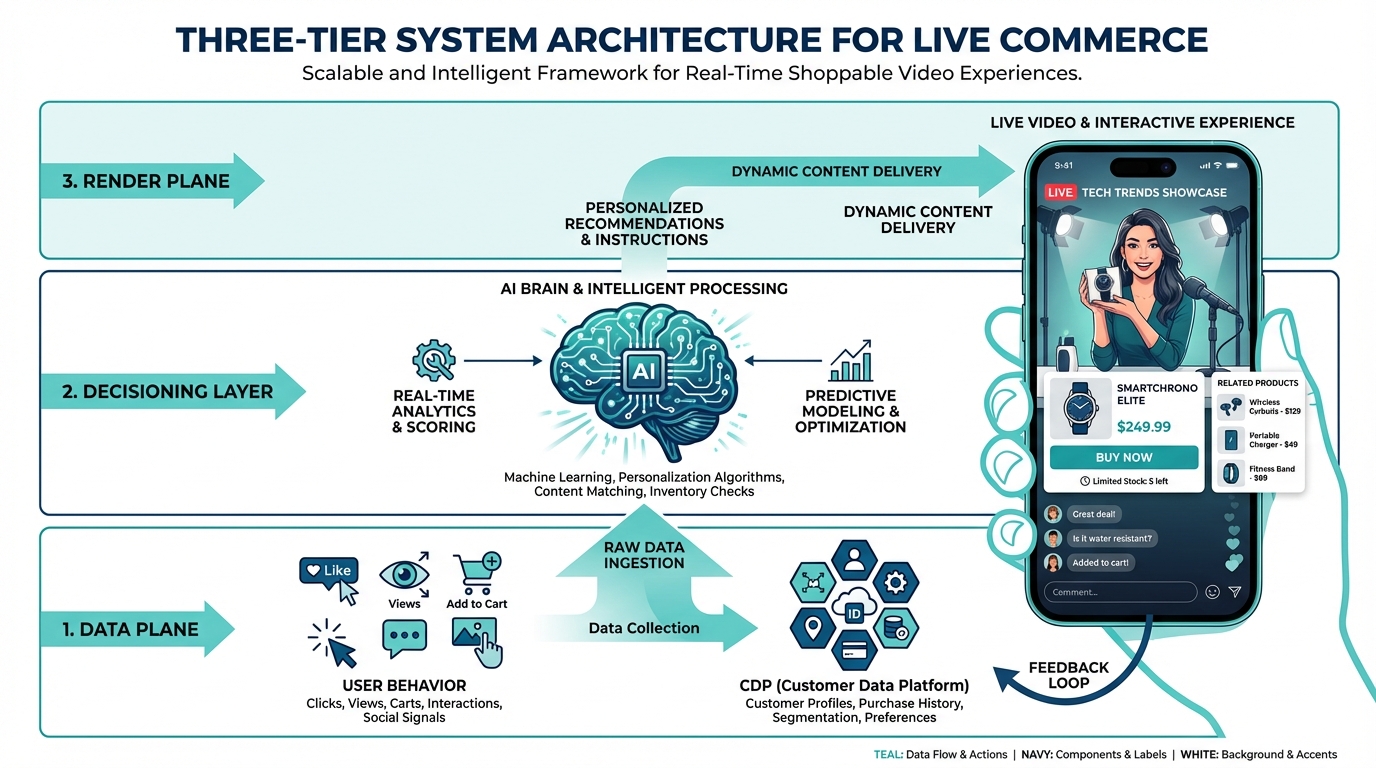
To deliver truly immersive real-time video shopping experiences, enterprises must adopt a sophisticated three-tier system architecture. The first tier is the Data Plane, which ingests first-party behavioral events such as watch time, chat sentiment, and clickstream data. This is coupled with identity resolution from the CDP to ensure the system recognizes a “Gold Tier” loyalty member the moment they join the stream.
The second tier is the Decisioning Layer. Here, session-based recommendation models evaluate the incoming data against the product catalog and business rules. For instance, if a viewer asks, “Is this waterproof?” in the chat, Natural Language Processing (NLP) detects the intent and queues a relevant demo segment or triggers a real-time product recommendation video highlighting the technical specifications. This layer also manages price elasticity, ensuring that live streaming personalized offers are optimized for both the user's propensity to buy and the brand's margin requirements.
The final tier is the Render and Delivery Plane. This is where the magic happens: low-latency personalized scenes and shoppable overlays are rendered in near real-time. Whether the viewer is on a dedicated app, a web microsite, or a WhatsApp Business thread, the interactive video commerce platform must deliver a seamless experience. Platforms like TrueFan AI enable this level of sophisticated, low-latency rendering that is essential for maintaining the “live” feel of the commerce experience.
Real-time inventory sync videos are a crucial component of this architecture. By integrating with the Order Management System (OMS), the video overlays can reflect sub-minute updates on stock levels. If a specific SKU begins to run low, the system automatically triggers “Only 5 left” badges or “High Demand” alerts. In the Indian context, where hyperlocal fulfillment is becoming a standard, these videos can even show “Delivery in 30 mins to Indiranagar” based on the viewer's geo-location, significantly boosting trust and intent.
Sources
Source: Webkul
Source: iThink Logistics
From engagement to purchase: Optimizing the funnel with data-driven triggers
Optimizing the journey from a “view” to a “purchase” requires a rigorous focus on live shopping engagement metrics. Enterprises must move beyond vanity metrics like total views and focus on high-intent indicators: average watch time per session, interaction rates with hotspots, and the add-to-cart (ATC) rate from within the video interface. Flipkart’s success, with 75 million engaged users, demonstrates that the Indian consumer is ready for deep interaction, provided the content is relevant.
To bridge the gap between engagement and conversion, interactive shopping video campaigns must utilize mid-funnel optimizations. This includes shoppable chapters that allow users to jump to products they care about, product comparison toggles, and guided sizing tools. Multilingual captions and vernacular audio are non-negotiable in the Indian market, ensuring that the content resonates across Tier 2 and Tier 3 cities where the next wave of e-commerce growth is concentrated.
Instant purchase video triggers are the ultimate friction-killers. By implementing one-click “Buy Now” buttons and UPI deep links directly inside the stream, brands can capitalize on the impulse-buy nature of live commerce. These triggers should be synchronized with timed scarcity elements, such as countdown timers for a personalized flash sale. If a payment intent fails, the system should have an automated failover to the cart with a recovery prompt, such as a 15-second demo video of the product's key benefit to keep the user engaged. Learn more in our post-purchase engagement automation guide.
Finally, a robust live commerce conversion tracking framework is essential. Every interaction—from a hotspot click to a successful purchase—must be attributed to the specific host, the offer variant, and the overlay type. This granular data allows for continuous A/B testing of recommendation strategies, such as comparing content-based filtering against collaborative filtering, to determine what drives the highest incremental lift in AOV for different audience segments.
Sources
Source: Brand Equity (ET)
Source: Inc42
Campaign playbooks for 2026: Repeatable formats tied to results
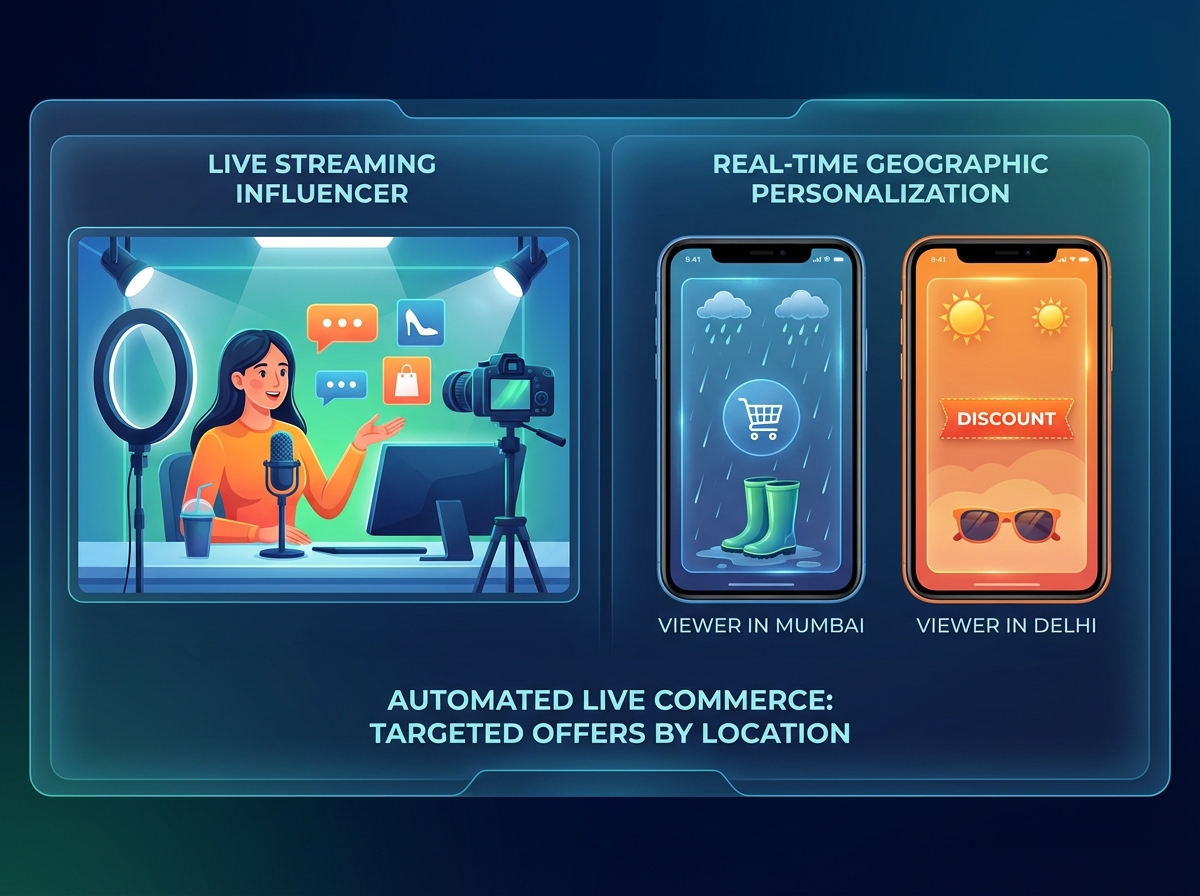
As we look toward 2026, successful enterprises will move away from one-off events toward influencer live commerce automation. Explore the Gen Z creator automation 2026 guide. This involves creating templated, data-fed show flows where host scripts and product callouts are programmatically personalized. For example, a creator might be streaming to 50,000 people, but the AI ensures that viewers in Mumbai see monsoon-ready footwear while viewers in Delhi see summer essentials, all within the same broadcast.
Personalized flash sale videos are another high-impact format. These are micro-segmented clips delivered via WhatsApp or app notifications that feature a personalized price and a unique countdown timer for the recipient. By coordinating these with festival retention strategies and prime-time slots in specific regions, brands can create a sense of individual exclusivity that traditional “site-wide” sales cannot match. This format is particularly effective for clearing inventory in specific geographic hubs.
The live auction personalization platform is a burgeoning format for high-demand drops and luxury goods. In these scenarios, bidding eligibility can be tied to loyalty scores or KYC status, with bid nudges delivered based on the user's past bidding behavior. This requires a highly secure and compliant interactive video commerce platform that can handle real-time credit checks and maintain an audit trail of all bids, ensuring fairness and transparency in a high-stakes environment.
Social commerce live streaming must be orchestrated across multiple platforms—Instagram, YouTube, and Flipkart Live—with deep links that lead back to a unified, high-conversion checkout experience. Indian retailers are already scaling these formats, with some beauty brands running 100-hour live streams during major sale events. The key to success in 2026 will be the ability to maintain a consistent, personalized experience across these fragmented touchpoints while centralizing the data for holistic analysis.
Sources
Source: Business Standard
Source: Brand Equity (ET)
The interactive video commerce platform your enterprise needs: Requirements and governance
Choosing the right interactive video commerce platform is a foundational decision that will dictate an enterprise's agility in 2026. The platform must offer core capabilities including real-time decisioning APIs, a robust SDK for shoppable overlays, and seamless connectors for OMS and product catalogs. Scalability is paramount; the system must be capable of handling over 100,000 concurrent viewers with a sub-30 second SLA for personalization-to-render cycles.
Governance and security are equally critical, especially with the implementation of India's Digital Personal Data Protection (DPDP) Act. Enterprises must ensure that their personalization efforts are consent-first. This involves clear role-based access controls, verifiable audit trails for data usage, and automated content moderation to maintain brand safety during live interactions. Trust is the currency of 2026, and a platform that prioritizes data provenance and user privacy will outperform those that take a “growth at all costs” approach.
Furthermore, the platform must support the “reading the moment” philosophy by providing real-time analytics that go beyond simple clicks. It should offer insights into sentiment analysis from chat logs and heatmaps of video engagement. This allows marketing teams to pivot their strategy mid-stream—for instance, if a particular product is receiving negative sentiment in the chat, the AI can automatically de-prioritize its overlay in favor of a better-received alternative.
The integration of vernacular support is not just about translation; it is about cultural relevance. The platform should be able to dynamically switch overlays and even audio tracks based on the viewer's preferred language, ensuring that the commerce experience feels local and personal regardless of where the viewer is located in India. This level of sophistication is what separates a standard video tool from a true enterprise-grade commerce engine.
Sources
Source: exchange4media
Source: Webkul
How TrueFan AI Enterprise powers live commerce personalization
TrueFan AI Enterprise is specifically engineered to meet the rigorous demands of the Indian market in 2026. The platform’s real-time personalization engine allows for hyper-personalization at scale, incorporating the viewer's name, city, and specific product context into the video stream. TrueFan AI's 175+ language support and Personalised Celebrity Videos provide a unique edge, allowing brands to leverage celebrity IP in a consent-first, highly localized manner that resonates deeply with Indian consumers.
The integration patterns offered by TrueFan AI are designed for enterprise-level complexity. By connecting directly to your CDP and CRM via API, the platform can trigger personalized video content based on specific user traits or behavioral milestones. For example, a cart abandonment event on your website can trigger an instant purchase video trigger delivered via WhatsApp, featuring a personalized message and a limited-time discount to win back the customer.
Solutions like TrueFan AI demonstrate ROI through a comprehensive analytics suite that tracks the full funnel of live shopping engagement metrics and live commerce conversion tracking. Brands can gain script-level insights, such as discovering that a name mention in the first 5 seconds of a video lifts watch-through rates by 30%. This data-driven approach allows for the constant refinement of video assets and offer strategies, ensuring that every marketing rupee spent is optimized for conversion.
Security and compliance are baked into the TrueFan AI architecture. With ISO 27001 and SOC 2 certifications, the platform provides the security posture required by large-scale Indian enterprises. Built-in content moderation and consent workflows ensure that all personalized interactions remain within the bounds of brand safety and regulatory requirements, providing peace of mind as you scale your live commerce operations.
Sources
Source: TrueFan AI Blog: Live Commerce Personalization India 2026
90-day rollout roadmap for Indian enterprises: From pilot to scale
Implementing a world-class live commerce strategy requires a structured approach. In the first 15 days, the focus should be on Strategy and Stack. Define your primary KPIs—specifically targeting Conversion Rate (CVR), AOV, and watch time. Select one or two flagship categories, such as Fashion or BPC, which have shown the highest propensity for video commerce in India. During this phase, map out your CDP and OMS integrations and establish clear guidelines for your creators and hosts.
Days 16 through 45 are dedicated to the MVP Live Series. Launch a series of 3–4 episodes designed to test different interactive elements. This is the time to experiment with instant purchase video triggers, personalized flash sale videos, and real-time product recommendation videos. Use geo-split or audience-split testing to measure the incremental lift provided by personalization versus a control group. This phase is critical for tightening your moderation workflows and ensuring the technical stack performs under real-world conditions.
In the final 45 days, the objective is to Scale and Automate. Expand your influencer live commerce automation across multiple languages and regions to capture the full breadth of the Indian market. Introduce more advanced formats like a live auction personalization platform for high-demand product drops. By the end of this 90-day period, you should have a fully functional dashboard providing live commerce conversion tracking and engagement scorecards to leadership, proving the ROI of your investment.
This roadmap ensures that the enterprise doesn't just “do live commerce” but builds a sustainable, data-driven revenue engine. By 2026, the brands that have successfully navigated this 90-day transition will be the ones setting the pace for the entire Indian retail sector, turning every live stream into a high-performance storefront.
Live Commerce Conversion Tracking and Compliance Standards — Additional Notes
- C2PA Manifests: Ensuring every AI-edited or generated video segment carries a cryptographic signature to prove its origin and prevent brand safety issues. See the Content Credentials Video Marketing Guide.
Frequently Asked Questions
What tools are needed to implement live commerce personalization in India by 2026?
To succeed, enterprises need a stack comprising a Customer Data Platform (CDP) for identity resolution, an AI-driven decisioning engine, and a low-latency video rendering platform. Integration with a robust Order Management System (OMS) for real-time inventory sync and a payment gateway supporting UPI-intent flows is essential. Platforms like TrueFan AI enable the seamless orchestration of these components to deliver personalized video at scale.
How do we measure live shopping engagement metrics and tie them to ROI?
ROI is measured by tracking the full funnel: from average watch time and interaction rates (polls, Q&A) to add-to-cart and final purchase rates. By using live commerce conversion tracking, you can attribute revenue to specific personalization triggers, such as a personalized discount overlay, and compare the performance against non-personalized segments to determine incremental lift.
How do instant purchase video triggers work with cart optimization?
These triggers use one-click payment deep links (like UPI intent) embedded directly in the video. If a user clicks but doesn't complete the purchase, the system can trigger a “cart recovery” prompt—such as a personalized video nudge or a limited-time free shipping offer—to reduce drop-offs and optimize the final checkout flow.
How do we integrate real-time inventory sync with live streams?
Integration is achieved via APIs or webhooks between your OMS and the interactive video commerce platform. The platform polls the inventory feed at sub-minute intervals. If a product goes out of stock, the AI automatically updates the shoppable overlay to show “Out of Stock” or suggests the nearest available alternative in real-time.
Is live commerce personalization compliant with India's DPDP Act?
Yes, provided the platform uses a consent-first architecture. This means users must explicitly opt-in for personalized experiences, and the data used for rendering overlays must be handled according to strict data processing standards. Enterprise-grade platforms ensure all personalization is based on consented first-party data and maintain full audit trails for compliance.