ONDC hyperlocal commerce marketing 2026: Vernacular Video, WhatsApp Journeys, and ROI for Democratic Marketplaces
Estimated reading time: ~14 minutes
Key Takeaways
- ONDC’s democratic marketplace positioning enables transparent discovery and trust across buyer apps.
- Vernacular video education and personalized onboarding remove barriers for MSMEs and new-to-digital users.
- WhatsApp journeys streamline seller enablement and buyer discovery via conversational flows.
- Geofenced local campaigns activate neighborhood commerce with hyperlocal personalization.
- Measure impact with cohort-based ROI: activation, discovery CTR, repeat purchase, and watch-through rates.
The landscape of ONDC hyperlocal commerce marketing 2026 is defined by a fundamental shift from closed-loop platforms to a transparent, open-network protocol that empowers the smallest of merchants. As India’s digital commerce ecosystem matures, the challenge is no longer just about connectivity but about solving the MSME onboarding gaps and building buyer trust in Tier-2 and Tier-3 markets.
By leveraging democratic marketplace positioning and digital retail democratization videos, brands and network participants can finally bridge the literacy gap for new-to-digital users. This playbook explores how small merchant enablement marketing and vernacular ONDC education videos are becoming the primary drivers of hyperlocal discovery and sustainable ROI in the 2026 economy.
Audience and Intent Alignment
This guide is designed for Digital Commerce Leaders and SME Enablement Teams who are tasked with driving ONDC adoption across diverse Indian geographies. The goal is to provide a practical framework for:
- Executing personalized seller onboarding at scale.
- Deploying conversational WhatsApp journeys for buyer education.
- Activating neighborhood commerce through geofenced discovery.
- Measuring ROI through granular cohort analytics.
1. Why Democratic Marketplace Positioning Matters in ONDC
Democratic marketplace positioning is the strategic foundation of the Open Network for Digital Commerce. Unlike traditional e-commerce models where a single entity controls discovery, pricing, and logistics, ONDC functions as a protocol-driven level playing field. In this environment, any compliant seller can be discovered across any buyer app, ensuring that transparency and portability are the primary competitive advantages.
For MSMEs, this means they are no longer beholden to the high commissions or opaque algorithms of “walled garden” platforms. However, this freedom requires a new kind of marketing—one that focuses on building buyer trust through verified-seller signals and clear dispute resolution policies. Content must translate complex network roles into plain-language, vernacular visuals that reassure the consumer.
In 2026, the ONDC network has expanded beyond simple retail into mobility, logistics, and financial services, creating a unified digital layer for the Indian economy. To succeed, participants must move beyond generic ads and embrace digital retail democratization videos. These videos explain the “openness” of the network, showing buyers that they can use their preferred app to buy from a local kirana store that was previously invisible online.
Building this trust requires a commitment to transparency. Marketing campaigns must highlight the ONDC trust remit, emphasizing that returns, refunds, and grievance redressal are governed by standardized SLAs across the network. By positioning ONDC as a government-backed initiative for digital retail democratization, brands can tap into a sense of national pride and local empowerment.
Sources:
2. MSME Seller Onboarding Automation and WhatsApp ONDC Integration Marketing
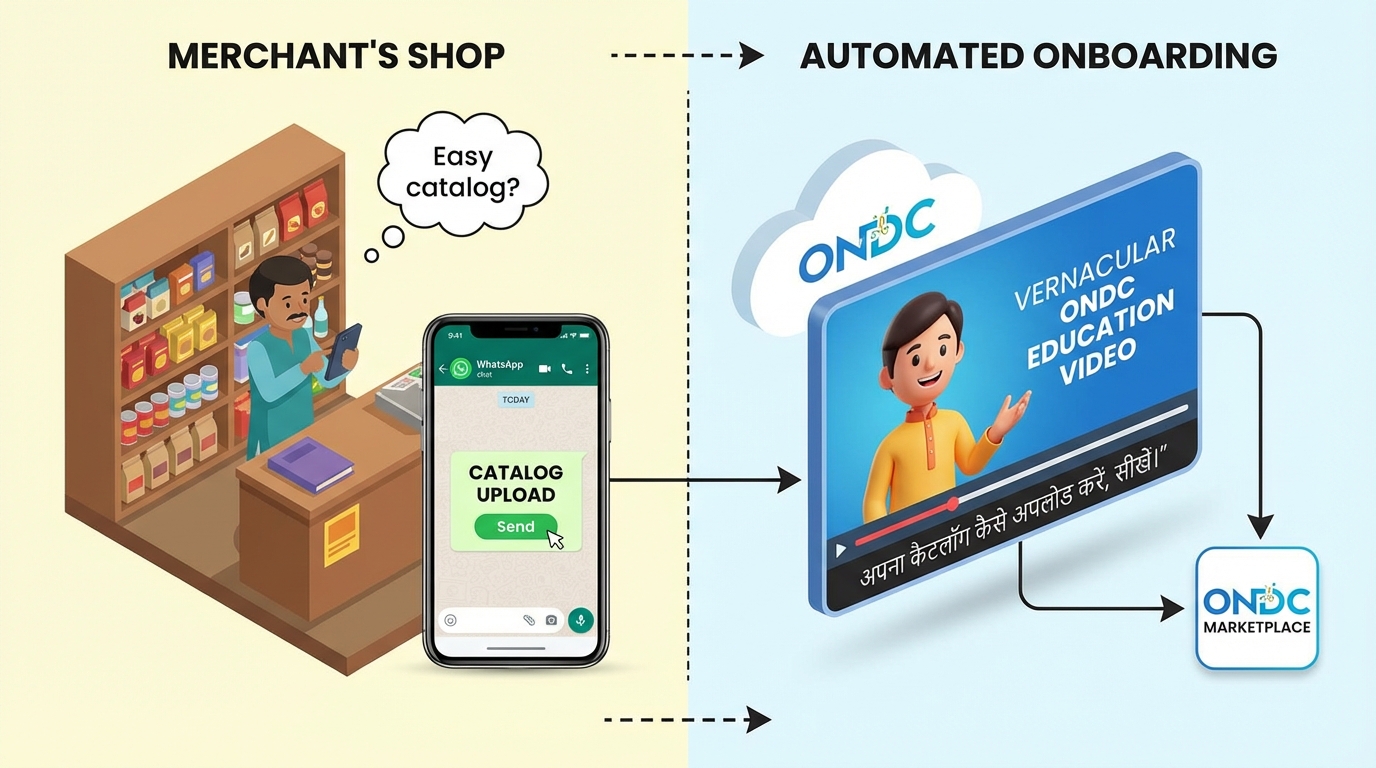
The success of ONDC hyperlocal commerce marketing 2026 hinges on the speed and quality of seller onboarding. MSME seller onboarding automation uses template-driven video journeys to guide merchants through the complexities of KYC, cataloging, and inventory sync. These journeys are personalized by the seller’s name, city, and product category, making the transition to digital commerce feel supported rather than overwhelming.
Platforms like TrueFan AI enable the creation of these personalized onboarding videos at a scale previously thought impossible. By automating the production of vernacular ONDC education videos, network participants can provide a 24/7 digital coach for every merchant. This reduces the burden on ground teams and ensures that every seller receives the same high-quality training on packaging SLAs and settlement timelines.
WhatsApp ONDC integration marketing serves as the conversational glue for these journeys. For the seller, WhatsApp is the primary interface for receiving order alerts, uploading catalog images via simple chat prompts, and watching 60-second “how-to” primers. For the buyer, it is a discovery tool where they can share a location pin to see nearby inventory or reorder essentials with a single click.
A typical automated onboarding flow might include:
- Day 0: A personalized welcome video explaining the benefits of ONDC.
- Day 1: A step-by-step KYC guide with a direct link to the document upload portal.
- Day 3: A “Cataloging 101” video showing how to take high-quality product photos.
- Day 5: A walkthrough of the order lifecycle, from acceptance to delivery pickup.
This conversational approach addresses a major coverage gap: the “fear of the unknown” among traditional merchants. By using WhatsApp—a tool they already use daily—and providing information in their mother tongue, the barrier to entry is significantly lowered. This is small merchant enablement marketing at its most effective, turning a complex technical process into a series of simple, actionable steps.
Sources:
- ONDC Hyperlocal Promise
- WhatsApp Sahayak Multilingual Support
- Gupshup Multilingual Chatbots for Buyer Apps
3. Local Merchant Discovery Campaigns and Neighborhood Commerce Activation
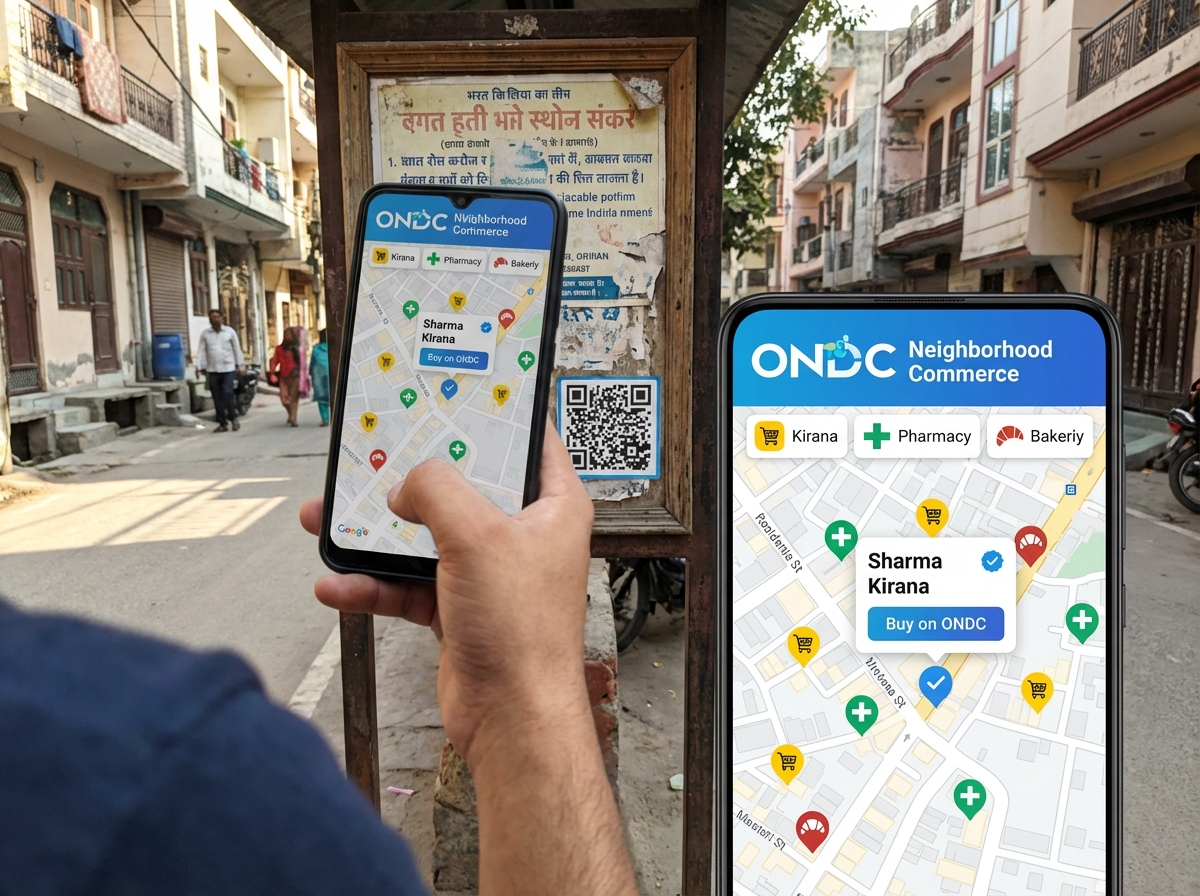
Hyperlocal commerce is not just about delivery; it is about the digital revival of neighborhood economies. Local merchant discovery campaigns use geofenced video content to connect buyers with the shops they already pass on their way to work. These campaigns move beyond generic “buy online” messaging to highlight specific local landmarks and store names, creating a sense of community-driven commerce.
Neighborhood commerce activation involves a “phygital” strategy—blending physical presence with digital ease. This includes setting up QR-code-enabled kiosks in Resident Welfare Associations (RWAs) or kirana clusters. When a resident scans the QR code, they are taken to a WhatsApp journey that shows them all the ONDC-enabled sellers in their immediate vicinity, often with exclusive “neighborhood-only” deals.
Hyperlocal delivery personalization is the final piece of the discovery puzzle. In 2026, buyers expect to know exactly when their order will arrive based on their specific locality. Marketing assets must dynamically display delivery windows like “Order by 4 PM for same-day delivery in Indiranagar.” This level of transparency builds immediate trust and differentiates ONDC from national players who may struggle with local logistics nuances.
To maximize impact, these campaigns should leverage:
- Geo-segmented Video Ads: Mentioning specific neighborhoods (e.g., “Now buy from your favorite Lucknow Chowk shops on ONDC”).
- SHG Activations: Partnering with Women’s Self-Help Groups to drive ground-level awareness and merchant onboarding.
- Offline-to-Online Bridges: In-store posters with QR codes that lead to a “verified seller” badge and a digital catalog.
By focusing on the “local” aspect, ONDC participants can tap into the 2026 trend of “conscious consumerism,” where buyers prefer to support local businesses if the digital experience is seamless. This strategy addresses the coverage gap of “last-mile discovery,” ensuring that the smallest merchant is just as visible as a large retail chain.
Sources:
4. Tier-2 City ONDC Expansion and ONDC Seller Success Stories
The real growth engine for ONDC in 2026 lies in Tier-2 and Tier-3 cities like Indore, Coimbatore, and Nagpur. Tier-2 city ONDC expansion requires a localized playbook that respects regional festivals, dialects, and shopping habits. A “one-size-fits-all” approach fails in these markets; instead, brands must deploy region-specific content packs that align with local calendars like Pongal, Onam, or Ganeshotsav.
TrueFan AI’s 175+ language support and Personalised Celebrity Videos provide a powerful tool for this expansion. Imagine a local hero or a trusted regional influencer explaining the benefits of ONDC in the local dialect. This not only drives awareness but also provides a “stamp of approval” that is critical for building trust in new-to-digital cohorts.
ONDC seller success stories are the most potent form of social proof. These are short, UGC-style videos where a local merchant—perhaps a spice seller from Jaipur or a weaver from Kanchipuram—shares their journey. They talk about how their orders increased by 40% after joining ONDC and how they can now reach customers across multiple buyer apps without managing multiple inventories.
These success stories should follow a structured format:
- The Challenge: “I had a great product but no way to reach customers outside my street.”
- The Solution: “I joined ONDC through a simple WhatsApp-based onboarding process.”
- The Result: “Now, I get orders from across the city, and my payments are settled on time.”
- The Call to Action: “Scan this QR code to start your digital journey today.”
By humanizing the technology, these stories overcome the skepticism that often plagues government-backed initiatives. They transform ONDC from a “protocol” into a “growth partner” for the MSME. In 2026, where video marketing in quick commerce is projected to exceed $5.5 billion, these authentic, vernacular narratives are the key to capturing market share in India’s heartland.
Sources:
5. Buyer Trust-Building Campaigns and ONDC ROI Measurement Campaigns
In an open network, trust is the currency. Buyer trust-building campaigns must systematically address concerns regarding product quality, delivery reliability, and refund security. This involves creating “Government marketplace adoption videos” that explain the grievance redressal mechanism in simple terms. If a buyer knows they can resolve a dispute via a 3-step WhatsApp flow, they are far more likely to take the leap and purchase from an unknown seller.
These campaigns should highlight:
- Verified Seller Badges: What they mean and how the network ensures quality.
- Ratings Portability: Explaining that a seller’s good reputation follows them across all buyer apps.
- Refund Timelines: Clear, visual explainers showing “Refund within T+2 days of pickup.”
Simultaneously, network participants must focus on ONDC ROI measurement campaigns. In 2026, e-commerce success is defined by execution capacity and the ability to scale systems efficiently. ROI is no longer just about “Cost Per Acquisition” but about “Cost Per Activated Seller” and “Lifetime Value of a Hyperlocal Buyer.”
Key KPIs to track include:
- Seller Activation Rate: The percentage of sellers who complete KYC and upload their first catalog.
- Discovery CTR: How often local sellers are clicked on within various buyer apps.
- Watch-Through Rate by Language: Measuring the effectiveness of vernacular education videos.
- Repeat Purchase Rate: Tracking how many buyers return to the same neighborhood seller within 30 days.
By using cohort analytics, brands can A/B test different personalization elements. For example, does a video that mentions the buyer's specific locality by name result in a higher conversion rate than a generic city-wide video? This data-driven approach ensures that marketing budgets are allocated to the most effective vernacular and hyperlocal strategies.
Sources:
6. Implementing ONDC Hyperlocal Commerce Marketing 2026 with TrueFan AI
The technical implementation of a 2026 ONDC strategy requires a partner that can handle the massive scale of personalization required for India’s diverse market. Solutions like TrueFan AI demonstrate ROI through their ability to generate thousands of personalized, high-fidelity videos in minutes, ensuring that every seller and buyer feels seen and heard.
The integration blueprint for an ONDC-focused brand involves connecting the seller registry and buyer cohort data to an automated video rendering engine. This allows for event-triggered flows: as soon as a seller starts their KYC, they receive a personalized video via WhatsApp encouraging them to finish. If a buyer abandons a cart, they receive a vernacular nudge highlighting the “verified” status of the local merchant they were considering.
The 90-Day Rollout Blueprint:
- Phase 1 (Weeks 1-3): Identify top categories (Grocery, F&B, Pharmacy) and map onboarding gaps. Create 15+ vernacular video templates.
- Phase 2 (Weeks 4-6): Pilot in 3 Tier-2 cities. Launch local merchant discovery campaigns and collect initial UGC seller success stories.
- Phase 3 (Weeks 7-9): Optimize based on watch-through rates. A/B test personalization depth (e.g., name vs. city vs. category).
- Phase 4 (Weeks 10-12): Scale to 10+ cities. Roll out festival-specific regional calendars and finalize the ROI dashboard.
The governance of these campaigns is equally critical. In 2026, data privacy and brand safety are paramount. Implementation must include ISO 27001/SOC2 compliance and robust moderation filters to ensure that UGC and automated content remain professional and policy-compliant. By combining the protocol-level power of ONDC with the creative automation of AI, brands can finally achieve the promise of truly democratic digital commerce.
Sources:
- TrueFan Enterprise Internal Documentation (Zomato/Hero MotoCorp Case Studies)
- ONDC Ecosystem Growth
Recommended Internal Links
Frequently Asked Questions
How does ONDC help MSMEs compete with large e-commerce players?
ONDC provides a level playing field by unbundling the e-commerce value chain. MSMEs can use specialized seller apps for cataloging and logistics providers for delivery, ensuring they aren't forced to use a single platform's expensive ecosystem. This democratic marketplace positioning allows them to be discovered by any buyer on the network.
Why is vernacular video essential for ONDC adoption in Tier-2 cities?
Many MSMEs and buyers in Tier-2 markets are “new-to-digital.” Vernacular ONDC education videos simplify complex concepts like GST compliance or digital payments in their local language, reducing the friction of adoption and building immediate trust.
Can I automate the creation of personalized videos for thousands of sellers?
Yes. Platforms like TrueFan AI are designed for this exact purpose. They can generate personalized onboarding and marketing videos at scale, using API triggers to include specific details like the seller's name, shop name, and city in the local dialect. Explore personalized ONDC video onboarding to see how it works.
How do I measure the ROI of my ONDC marketing campaigns?
Measure ROI with cohort-based metrics such as seller activation rates, discovery CTRs, watch-through by language, and repeat purchase behavior. See this guide on ONDC ROI measurement campaigns for a practical framework.
What role does WhatsApp play in the ONDC ecosystem?
WhatsApp acts as the primary conversational interface for both buyers and sellers. It powers automated onboarding journeys, order notifications, and local merchant discovery, making it ideal for small merchant enablement marketing. Learn more in the WhatsApp catalog video marketing playbook.
How do I ensure buyer trust when they are purchasing from a new local seller?
Build trust through transparency and standardized SLAs. Highlight verified-seller badges, ratings portability, clear return/refund policies, and simple grievance redressal flows—delivered through concise, vernacular content.