Board Exam Results Marketing 2026: The Enterprise Guide to Empathetic Student Retention
Estimated reading time: ~13 minutes
Key Takeaways
- Lead with empathy: Prioritize wellness-first messaging during results week to reduce anxiety and build trust.
- Dual-track communication: Synchronize student guidance with parent communication automation for higher conversion and lower friction.
- Personalized journeys: Use score-band data to power career path mapping, recovery plans, and scholarship guidance.
- Execution rigor: Prepare a T-14 to T0 crisis playbook with sentiment triggers, WhatsApp workflows, and on-demand video generation.
- Compliance-first ROI: Align with India’s DPDP rules, track behavioral KPIs, and optimize message archetypes for impact.
The high-stakes window of the Indian academic calendar is shifting. As we approach the board exam results marketing 2026 season, enterprise EdTech leaders face a pivotal choice: continue with high-pressure sales tactics or pivot toward an empathy-first, data-driven retention strategy. With the CBSE Class X and XII exams scheduled for February and March 2026, the subsequent results period between April and June represents the most volatile emotional corridor for millions of Indian households.
For CMOs and Student Retention Specialists, this period is no longer just about lead generation; it is about result day crisis management. In an era where 2026 projections suggest that over 35% of Indian students experience significant clinical anxiety during results week, the brands that provide genuine support will be the ones that secure long-term loyalty. This guide outlines how to transform anxiety into structured enrollment journeys using personalized guidance and automated communication at scale.
The 2026 Result Day Landscape: Navigating the Crisis with Empathy
The 2026 academic cycle is defined by a staggered announcement schedule across various state and central boards. According to the official CBSE 2026 date sheet, main examinations conclude in late March, setting the stage for a high-tension results window in early May. This period is characterized by an “emotional baseline” of extreme stress, where traditional marketing often feels intrusive or tone-deaf.
Research from the Indian Journal of Psychiatry highlights a meaningful prevalence of anxiety among school-going adolescents, particularly during transition years. For an EdTech enterprise, ignoring this psychological reality leads to high churn and brand erosion. Instead, board exam results marketing 2026 must prioritize “academic stress relief content” that validates student feelings before presenting commercial solutions.
By integrating mental wellness student retention strategies, brands can triage students based on their emotional state. High-performers need celebration and “stretch” goals, while those in the mid-to-low bands require immediate stabilization. This segmentation ensures that your communication is perceived as a lifeline rather than a sales pitch, fostering a sense of trust that is essential for conversion in the 2026 landscape.
Sources:
- CBSE 2026 Official Date Sheet (Oct 2025)
- Indian Journal of Psychiatry: Anxiety prevalence among Indian students
Strategic Support Pillars: Integrating Parent Communication Automation
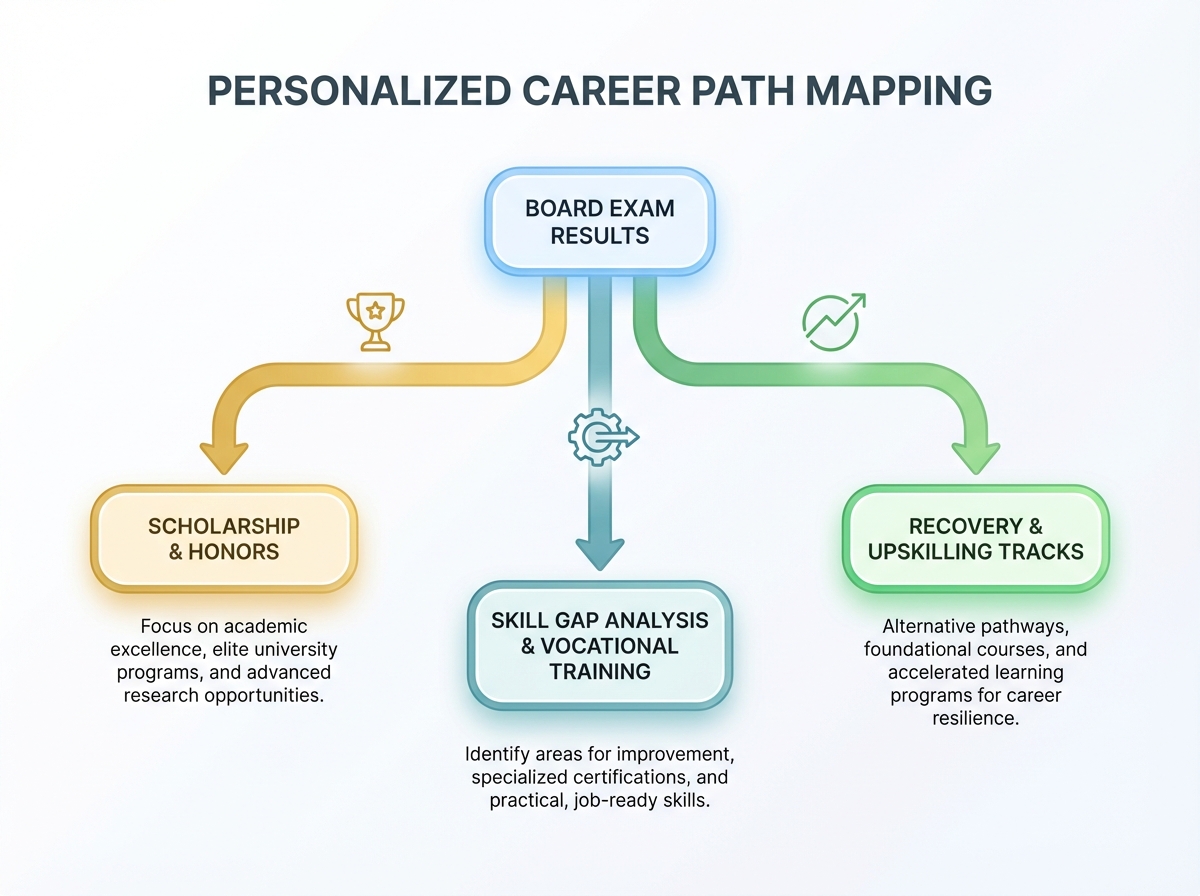
The student is the user, but in the Indian context, the parent is the primary decision-maker and financier. Effective board exam results marketing 2026 requires a dual-track communication strategy that synchronizes the narrative between the student and the guardian. This is where parent communication automation becomes a critical competitive advantage for enterprise EdTech firms.
Platforms like TrueFan AI enable marketing teams to deliver these dual-track messages with a level of personalization previously impossible at scale. For the student, “student anxiety support videos” can be triggered via WhatsApp the moment results are self-reported. These 30–60 second clips, featuring counselor-approved scripts, can teach immediate coping mechanisms like the 4-7-8 breathing technique or cognitive reframing, helping to de-escalate the immediate “result day crisis.”
Simultaneously, automated workflows should reach parents to counter misinformation and reduce household friction. By providing concrete pathways—whether it is a celebration of high marks or a recovery plan for lower scores—you position your brand as a partner in the family’s success. Utilizing the WhatsApp Business API, which has become the staple channel for Indian education marketing, allows for 1:1 engagement that feels personal but is powered by robust backend automation.
Sources:
Personalized Career Path Mapping: Converting Data into Direction
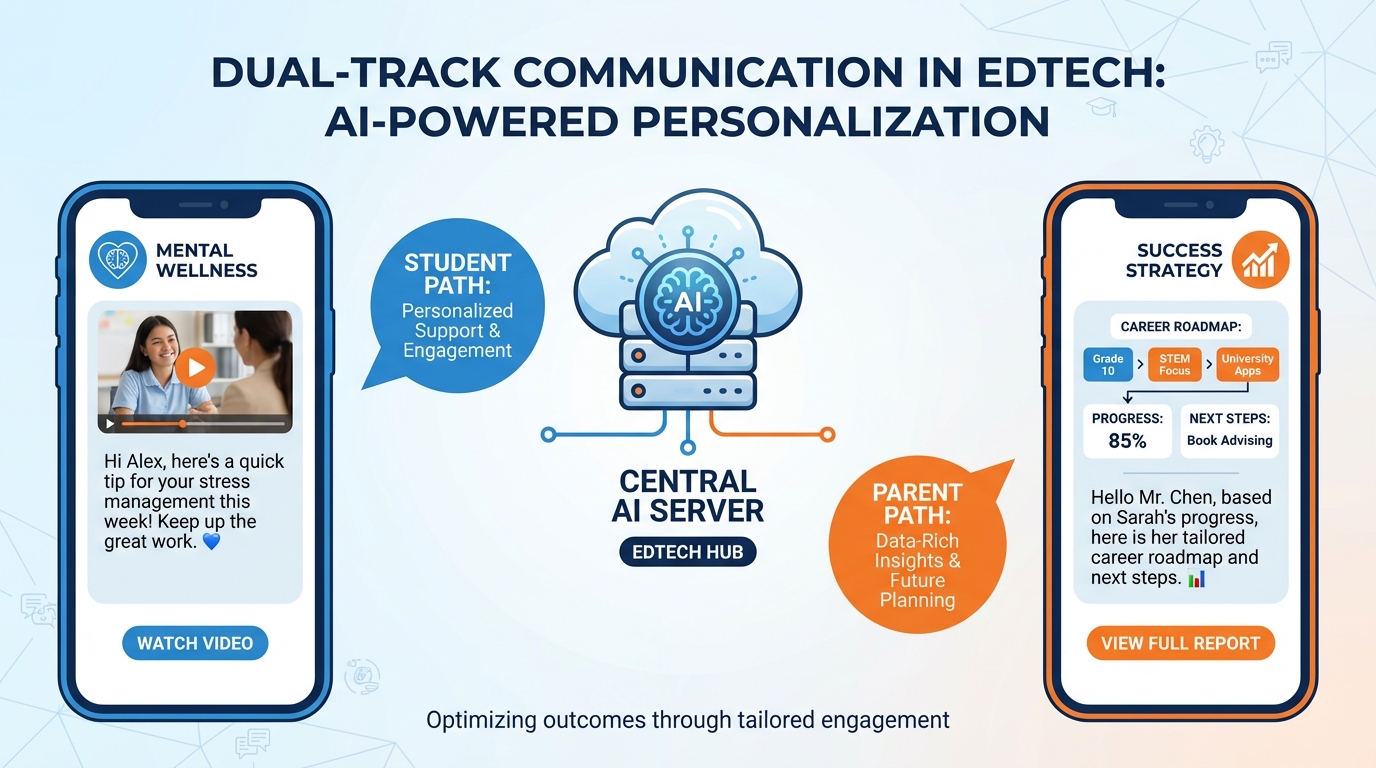
Once the initial emotional peak of result day passes, the focus shifts to “what next?” This is the “decision-ready” phase where personalized career path mapping becomes the primary driver of enrollment. In 2026, generic course recommendations are no longer sufficient; students expect a “skill gap analysis personalization” that accounts for their specific score band, stream, and long-term aspirations. (EdTech career counseling videos 2026)
Enterprise EdTechs must leverage “career counseling automation EdTech” to deliver branching journeys. If a student’s score falls below a certain threshold, the system should automatically route them toward recovery tracks or skills-first alternatives. This is often delivered through “course recommendation AI videos” that explain why a specific path fits the student’s current aptitude and the projected ROI of that career choice in the 2026–2030 job market.
Furthermore, “college admission guidance videos” can walk students through the complex eligibility and timeline requirements of various institutions. For those seeking financial aid, “scholarship opportunity videos” can spotlight state and central schemes, directly linking to the National Scholarship Portal. This level of detail transforms a marketing interaction into a high-value advisory service, significantly increasing the likelihood of enrollment.
Sources:
The 7-Day Execution Playbook for Result Day Crisis Management
Executing a high-impact board exam results marketing 2026 campaign requires a rigorous orchestration of data and content. Enterprise teams cannot afford to be reactive; they must have a pre-built infrastructure ready to trigger the moment the first board announces its results.
T-14 to T-7: The Preparation Phase
The focus here is on data and content readiness. Marketing teams should import score predictions and prior intent data into their CRM, ensuring all “consent flags” for minor data are verified. This is also the time to record master footage for your brand ambassadors. TrueFan AI's 175+ language support and Personalised Celebrity Videos allow you to create a single master shoot that can be localized into regional dialects, ensuring your “student anxiety support videos” resonate across the diverse Indian landscape.
T-6 to T-1: Orchestration and QA
During this window, build your branching journeys. Define the “triage rubric” for mental health escalations—if a student uses specific distress keywords in a WhatsApp chat, the system must immediately provide the Tele MANAS helpline and alert a human counselor. Test all automated flows for “parent communication automation” to ensure that the tone is supportive and the delivery is low-latency. (Sentiment-driven crisis prevention 2026 guide)
T0: Results Day Operations
When results go live, the “result day crisis management” system activates. Real-time triggers—whether via API from a partner school or a self-report portal—should deploy the first wave of 1:1 videos. These videos must be contextual, addressing the student by name and providing immediate booking links for counseling slots. Speed is of the essence; the first brand to provide a clear path forward often wins the enrollment. (AI crisis communication tools and strategies)
Sources:
Recovery and Alternate Pathways: Turning Setbacks into Comebacks
A significant coverage gap in traditional EdTech marketing is the “failure recovery” segment. Most brands focus exclusively on the top 10% of scorers, leaving a massive market of students who feel abandoned by the system. In 2026, “failure recovery support campaigns” represent a major growth opportunity for retention-focused brands.
These campaigns should normalize reattempts and promote “entrance exam preparation marketing” for exams like CUET, JEE Main, or NEET. For students who choose not to pursue traditional degrees, “upskilling pathway marketing” can align them with industry-recognized credentials in data, healthcare, or design. By providing a 30–90 day structured “reset plan,” you help the student rebuild their confidence while keeping them within your ecosystem.
Solutions like TrueFan AI demonstrate ROI through these recovery journeys by delivering personalized “comeback” stories from celebrities or mentors. When a student who has failed a subject receives a personalized message from an icon they admire, the psychological impact is profound. It shifts the narrative from “I am a failure” to “I have a plan,” which is the ultimate goal of any student retention strategy.
Sources:
Compliance, ROI, and the Future of EdTech Marketing
As enterprise EdTech moves toward hyper-personalization, the ethical handling of student data becomes paramount. The Digital Personal Data Protection (DPDP) landscape in India requires explicit parental consent for processing the data of minors. Your board exam results marketing 2026 strategy must include granular opt-out options and secure, role-based access for sensitive mental health indicators. (Digital India compliance marketing 2026) (Interactive video data capture guide)
Measuring the success of these empathetic campaigns requires a shift in KPIs. Beyond simple enrollment numbers, CMOs should track “behavioral KPIs” such as video completion rates, the reply rate to parent communications, and the “show-up rate” for counseling sessions. A/B testing different message archetypes—such as “Supportive” vs. “Celebratory”—will allow for real-time optimization of the campaign’s emotional resonance.
Ultimately, the future of EdTech marketing lies in the intersection of AI-driven scale and human-centric empathy. By automating the logistical and emotional heavy lifting of result day, brands can focus on what truly matters: guiding the next generation of Indian students toward their full potential, regardless of the numbers on their mark sheet.
Final Strategic Note: The 2026 results season will be won by the brands that listen as much as they speak. By deploying a sophisticated mix of “student anxiety support videos,” “parent communication automation,” and “personalized career path mapping,” your enterprise can move beyond the noise of traditional advertising. You aren't just selling a course; you are providing a roadmap through one of the most stressful periods of a young person’s life. That is the hallmark of a market leader in the modern EdTech era.
Frequently Asked Questions
How can we ensure our “board exam results marketing 2026” doesn't add to student stress?
The key is to lead with “academic stress relief content” rather than sales pitches. Use the first 48 hours post-results to provide wellness support and validation. Only after the initial emotional peak has passed should you transition into “personalized career path mapping” and course recommendations.
What is the most effective channel for “parent communication automation” in India?
WhatsApp remains the dominant channel. Using the WhatsApp Business API allows for automated, multilingual updates that parents can easily access. Integrating personalized videos into these messages significantly increases read rates and engagement compared to standard SMS or email.
How does “career counseling automation EdTech” handle different score bands?
The system uses branching logic. High scorers are routed to “honors” tracks and scholarship opportunities. Mid-band students receive “skill gap analysis personalization” to find the best-fit courses. Low scorers or those who failed are placed into “failure recovery support campaigns” that focus on reattempts and upskilling. (Career counseling videos 2026)
Is it possible to personalize video content for millions of students simultaneously?
Yes, using enterprise-grade AI. TrueFan AI's infrastructure is designed for this exact scenario, capable of rendering hundreds of thousands of unique, personalized videos in under 30 seconds. This allows for real-time response to result announcements across multiple boards.
What are the compliance requirements for handling minor data during these campaigns?
In 2026, compliance with India's data protection laws is non-negotiable. You must obtain explicit parental consent, ensure data minimization, and provide clear opt-out mechanisms. Sensitive data, such as mental health flags, must be stored separately with restricted access to ensure student privacy and safety. (Digital India compliance marketing 2026)



