Tax saving urgency marketing 2026: The BFSI playbook to win March 31
Estimated reading time: 13 minutes
Key Takeaways
- March 31 creates a unique urgency window where up to 65% of retail tax-saving investments occur in the last 45 days.
- Personalized calculators, deadline messaging, and 1-click eKYC reduce friction and drive last-mile conversions across ELSS, NPS, and insurance.
- Adopt a four-week sprint: educate, reveal personalized gaps, remove technical friction, and finish with hard countdowns.
- Compliance and retention wins matter: instant proofs, audit-ready journeys, and renewal nudges cut churn by up to 50%.
- Use segment-specific plays (HNIs, corporates, CA referrals) with concierge flows and payroll-synced reminders for higher conversion.
The final quarter of the Indian financial year is not merely a period of accounting; it is a high-stakes race where BFSI enterprises compete for the remaining wallet share of millions of taxpayers. As the March 31 deadline looms, tax saving urgency marketing 2026 has evolved into a sophisticated discipline that blends behavioral psychology, real-time data, and hyper-personalized content to drive last-mile action. For banks, mutual funds, and insurance providers, the window between March 1 and March 31 represents the Super Bowl of customer acquisition and retention.
In 2026, the stakes are higher than ever. With the Union Budget 2026 introducing significant shifts in TDS simplification and middle-class tax relief expectations, consumers are seeking clarity amidst complexity. Tax saving urgency marketing 2026 focuses on accelerating conversions for Section 80C instruments like ELSS, maximizing NPS enrollments under Section 80CCD(1B), and automating insurance purchases. By leveraging deadline messaging, interactive calculators, and personalized video nudges, BFSI leaders can remove friction from the decision-making process and ensure compliance while maximizing fiscal year-end revenue.
Tax saving urgency marketing 2026 — why March 31 is your Super Bowl
The March 31 deadline is a statutory hard stop that creates a unique psychological environment for the Indian investor. In the BFSI sector, urgency is driven by the immediate need for documentation, proof submission for tax claims, and the rigid market cut-offs for ELSS NAV applicability. In 2026, data suggests that over 65% of retail tax-saving investments are still made in the final 45 days of the financial year, making this period the primary driver of annual targets.
Behavioral science plays a pivotal role in these campaigns. Marketers utilize urgency triggers—stimuli designed to compress the decision cycle. These include scarcity (time remaining), authority (validation from tax experts or CAs), social proof (benchmarking against peers), and loss aversion (the pain of forfeiting hard-earned deductions). A successful 2026 strategy maps these triggers to a tactical cadence: starting with educational awareness in early March and escalating to hard countdowns in the final 72 hours.
March 31 investment campaigns that convert (calendar and orchestration)
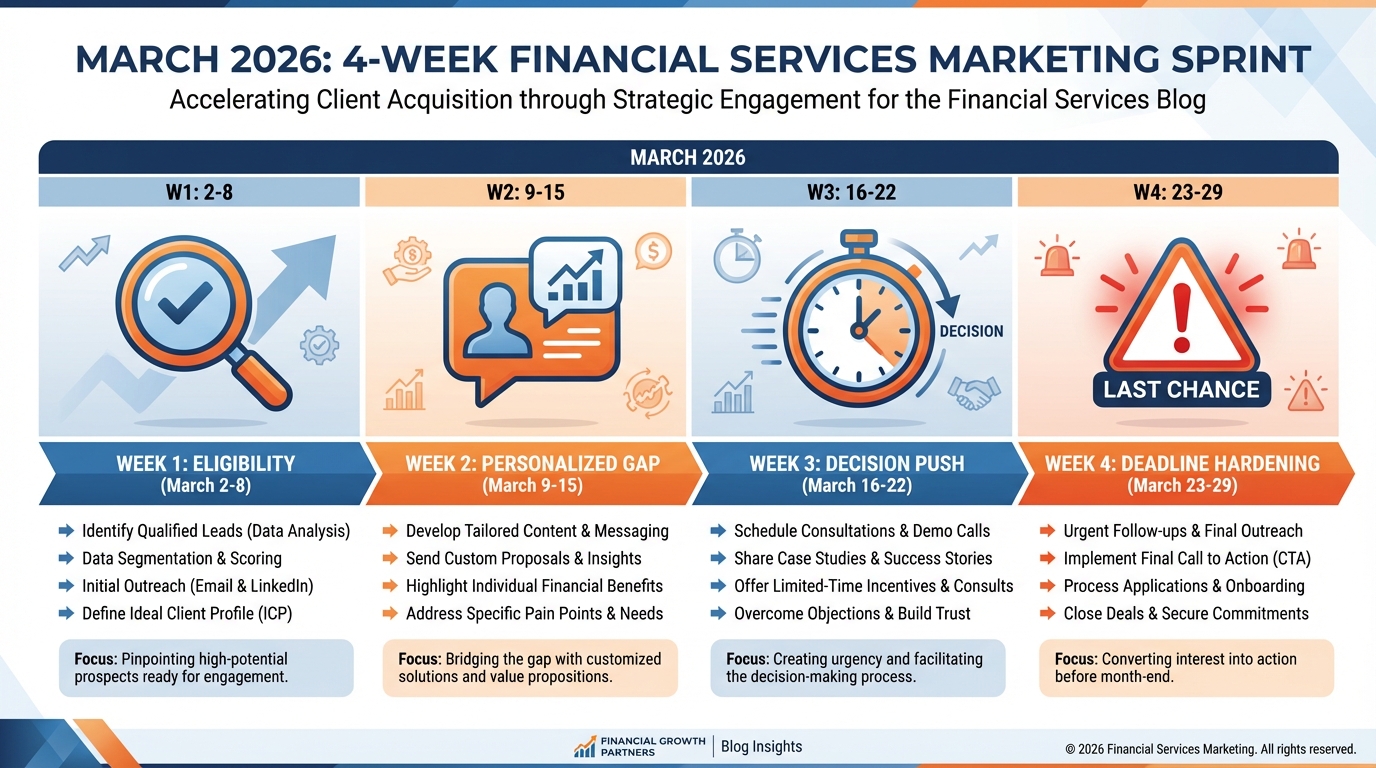
Orchestrating a winning March 31 investment campaign requires a phased approach that mirrors the consumer's escalating anxiety. In 2026, the most effective campaigns are broken down into a four-week sprint that moves from education to execution.
Week 1 (March 1–7): The Eligibility Phase
The focus here is on Know Your Gap. Campaigns should deliver personalized messages detailing the user’s current 80C utilization versus the ₹1.5 lakh limit. This is the ideal time for ELSS primers, explaining the 3-year lock-in advantage, and NPS explainers for the additional ₹50,000 deduction under 80CCD(1B).
Week 2 (March 8–14): The Personalized Gap Reveal
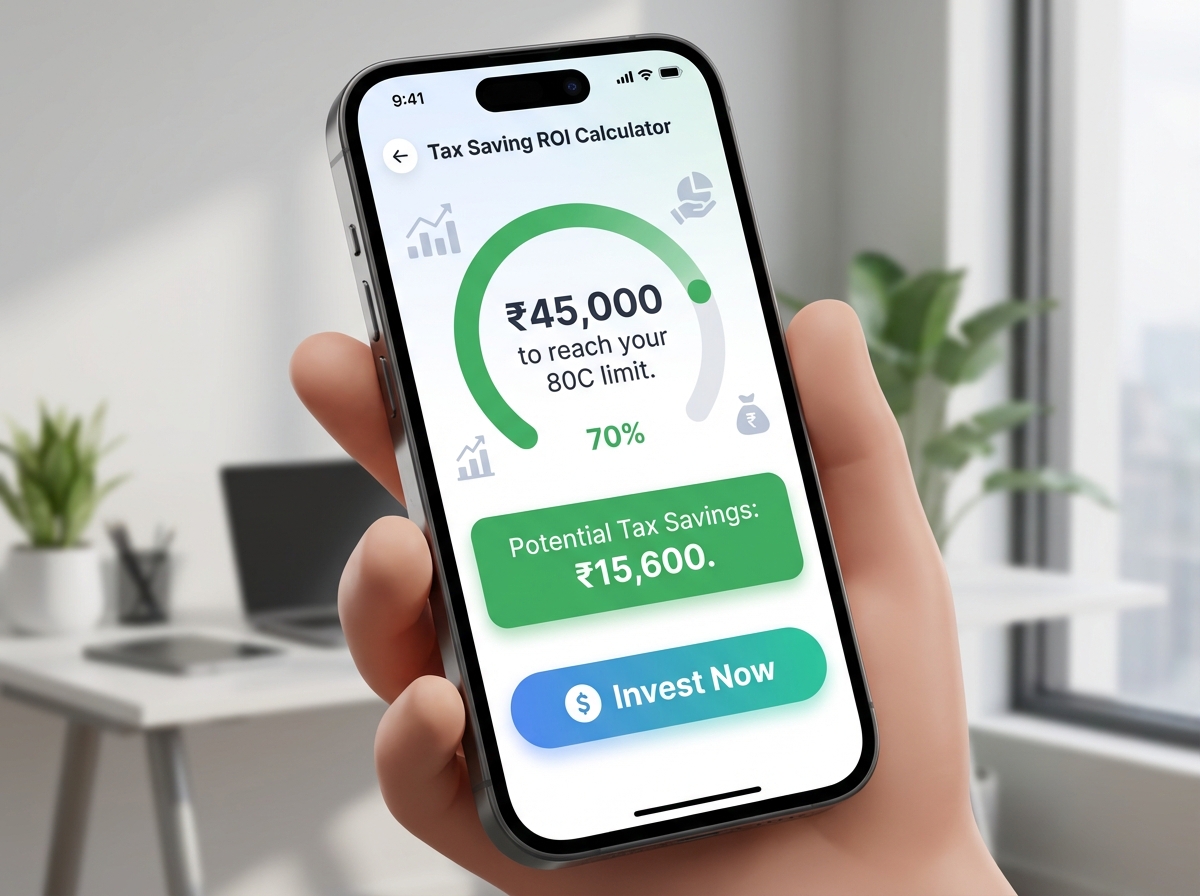
During this week, the messaging shifts to specific rupee values. "Hi Rahul, you are ₹45,000 away from maximizing your tax savings" is far more effective than a generic "Save Tax Now" banner. Use 80C ELSS personalized calculators to show the exact tax saved based on the user’s income slab.
Week 3 (March 15–24): The Decision Push
This is the window for removing technical friction. Offer 1-click eKYC, pre-filled forms, and assisted booking via financial advisory video consultations. Start deploying investment deadline countdown videos that highlight the shrinking window for NAV applicability.
Final Window (March 25–31): Deadline Hardening
The final 7 days require a D-Minus strategy. It is critical to advise users to invest by March 28 to account for banking cut-offs and settlement timings. In 2026, 40% of last-minute failures are due to payment gateway congestion on March 31; hence, the invest by March 28 narrative is a service to the customer as much as a marketing tactic.
Product-specific tactics that close the gap
80C ELSS personalized calculators + tax saving ROI calculators
In 2026, interactive tools are the primary drivers of high-intent leads. 80C ELSS personalized calculators allow users to pull their transaction data via account aggregators to see their real-time 80C status. These tools should provide clear outputs: the deduction applied, the net tax saved (Deduction × slab rate), and the projected corpus after the 3-year lock-in.
Furthermore, tax saving ROI calculators should be used to compare different instruments. For instance, comparing the net-of-cost returns of ELSS versus NPS or traditional insurance helps the user make an informed choice. TrueFan AI's 175+ language support and Personalised Celebrity Videos can be integrated directly into these calculators, where a celebrity explains the results of the calculation to the user, significantly increasing the trust factor and completion rates.
NPS enrollment deadline marketing
NPS remains an underutilized tool for the additional ₹50,000 deduction under Section 80CCD(1B). NPS enrollment deadline marketing should focus on the extra nature of this benefit. A powerful script for 2026 would be: "You’ve already exhausted your 80C, but you can still save tax on an additional ₹50,000. Complete your NPS top-up in 3 minutes to save up to ₹15,600 in taxes."
Last-minute insurance purchase automation
For health (80D) and life insurance (80C), the barrier is often the medical check-up or lengthy underwriting. Last-minute insurance purchase automation involves pre-filled term or health flows with instant risk triage. By automating the issuance of the e-policy and the immediate delivery of the tax-saving receipt via WhatsApp, BFSI brands can capture the panic buyer who needs a proof of investment within minutes.
Segment plays and conversion channels
HNI wealth management campaigns
High-Net-Worth Individuals (HNIs) require a white-glove approach. HNI wealth management campaigns in 2026 utilize RM-led concierge flows. Instead of a standard call, RMs can send personalized video invitations for a 1-on-1 tax optimization session. These sessions often cover advanced topics like tax-loss harvesting and NPS Tier II allocations, which are coverage gaps often missed in retail-focused marketing.
Corporate employee tax drives
Partnering with HR departments allows BFSI brands to sync with payroll cut-offs. Corporate employee tax drives include co-branded microsites and bulk personalized videos that mirror the employer's internal proof submission deadlines. In 2026, 30% of corporate employees miss their tax-saving window simply because they confuse the employer deadline with the statutory deadline. Clearing this confusion via payroll-synced reminders is a high-conversion tactic.
Tax consultant referral programs
Collaborating with Chartered Accountants (CAs) provides the ultimate authority trigger. Tax consultant referral programs involve co-branded content where the CA validates the investment instrument. Financial advisory video consultations can be embedded into these referral flows, allowing the user to book a same-day slot with a certified advisor to finalize their March 31 investment campaigns.
Year-end compliance marketing and retention
Year-end compliance marketing is about more than just selling; it is about ensuring the customer's journey is audit-proof. This involves communicating the necessity of PAN/Aadhaar linking and providing a clear checklist of what qualifies under 80C/80D. In 2026, providing instant proof is a competitive advantage. Automated workflows that deliver ELSS statements or NPS acknowledgments within seconds of the transaction reduce buyer's remorse and compliance anxiety.
Retention is equally critical. BFSI March retention strategies focus on saving lapsing policies or maturing FDs. A personalized rescue video can remind a customer that renewing their health insurance premium before March 31 is the only way to retain their Section 80D benefit for the current year. Solutions like TrueFan AI demonstrate ROI through these retention lifts, as personalized nudges have shown to reduce churn by up to 50% in the final weeks of the fiscal year.
Asset and automation blueprint for March 2026
To execute a 2,500-word strategy effectively, BFSI brands must build a robust asset library. This blueprint ensures that the tax saving urgency marketing 2026 plan is scalable and data-driven.
Video Assets:
- Investment deadline countdown videos: Three variants (D-7, D-3, D-1) that dynamically insert the user's name and their specific 80C gap.
- Tax planning reminder videos: Weekly educational snippets that adapt to the user's current portfolio status.
- HNI Concierge Invitations: High-production value videos for wealth management segments.
Interactive Assets:
- 80C ELSS personalized calculators: Tools that show Utilized vs. Remaining with a 1-click Invest button.
- Tax saving ROI calculators: Comparison engines that highlight the net-of-tax benefits of different 2026 investment options.
- 1-Click Booking Widgets: For instant financial advisory video consultations.
Automation Flows:
- NPS Drip: Eligibility check > eKYC > Top-up > Proof delivery.
- Insurance Automation: Pre-filled forms > Instant underwriting > E-policy issuance.
- Corporate Microsites: Payroll-synced countdowns and HR-approved investment guides.
Conclusion — your 21‑day sprint for tax saving urgency marketing 2026
Winning the March 31 deadline requires more than just a large media spend; it requires a strategic alignment with the consumer's psychological state. By mapping fiscal planning urgency triggers to hyper-personalized product flows, BFSI enterprises can capture the significant volume of last-minute investments that define the financial year.
The 2026 playbook is clear: start with education, reveal the personalized gap, remove technical friction through automation, and use the final 72 hours for a hard countdown. Whether it is through 80C ELSS personalized calculators or NPS enrollment deadline marketing, the goal is to make the tax saving experience as rewarding as the tax saving itself. As you prepare for the final sprint, remember that in a crowded market, the brand that speaks most personally to the customer—and does so with the most clarity—will always win the March 31 race.
Frequently Asked Questions
Navigating Tax Saving Urgency Marketing 2026
1. What is the most effective channel for March 31 investment campaigns in 2026?
While email and SMS remain foundational, WhatsApp and in-app personalized videos are seeing the highest conversion rates. Hyper-personalized video content that addresses the user by name and mentions their specific tax gap (using tools like TrueFan AI) significantly outperforms static text.
2. Why is the March 28 deadline emphasized for ELSS and NPS?
To receive the tax benefit for the current financial year, the funds must be credited and the NAV must be allotted. Banking holidays, settlement cycles (T+1 or T+2), and payment gateway delays mean that investing on March 30 or 31 is risky. March 28 is the safe cut-off for most BFSI products.
3. How do 80C ELSS personalized calculators improve conversion?
These calculators remove the math friction. By showing a user exactly how much tax they will save in rupees (e.g., Save ₹46,800 today), the benefit becomes tangible. When this is coupled with a 3-year lock-in explanation, it builds immediate trust.
4. Can last-minute insurance purchase automation really issue policies instantly?
Yes. In 2026, many BFSI providers use straight-through processing (STP) for standard term and health plans. If the user meets the basic health criteria, the policy and the tax-saving receipt can be issued in under 5 minutes.
5. What are the key Budget 2026 changes affecting tax-saving marketing?
The primary focus is on the increased standard deduction and the simplification of TDS. Marketers should focus on Tax Certainty, helping users navigate whether the Old or New Tax Regime is more beneficial for their specific income level after the 2026 updates.