

URL to Video AI Generator: 10x E-commerce Product Videos with API-Driven Automation in 30 Seconds
Estimated reading time: ~9 minutes
Key Takeaways
- Programmatically convert product URLs into ad-ready videos to achieve 10x content velocity without increasing headcount.
- Hit a ~30-second rendering target via parallel processing and GPU-accelerated scheduling.
- Seamlessly deploy Shopify and Amazon-compliant listing videos at scale with automation.
- Unlock REST API personalization and CSV bulk generation for 1:1 and 1:many creative variants.
- Enterprise-grade governance, SSO, and audit logs ensure brand safety and operational control.
The adoption of a URL to video AI generator has become the definitive competitive advantage for performance marketers seeking to dominate the 2026 digital landscape. By programmatically converting a standard product or landing page URL into a high-conversion, ad-ready video, enterprise teams are effectively bypassing the traditional bottlenecks of production. This technology crawls the target page, extracts critical assets—including titles, pricing, high-resolution imagery, and customer reviews—and synthesizes them into a structured storyboard for immediate rendering.
In an era where content velocity dictates market share, web content video automation allows brands to achieve a 10x increase in creative output without expanding their headcount. Automated video creation from URL ensures that every SKU in a catalog, whether on Shopify or Amazon, is supported by dynamic, multi-format video assets. With an enterprise-grade API-driven video creation pipeline, the transition from a live web link to a finished 9:16 Reel or 16:9 product explainer now targets a 30-second rendering time benchmark, enabling same-day creative iteration at a global scale.
The Strategic Shift: Why Performance Marketers Prioritize Web Content Video Automation
Performance marketing in 2026 is no longer a game of high-spend brute force; it is a game of creative relevance and rapid testing. The core objective for growth teams is to increase Click-Through Rates (CTR) and Conversion Rates (CVR) while simultaneously reducing the Cost Per Acquisition (CPA). Achieving this requires a constant stream of fresh e-commerce product videos generated directly from live URLs to combat ad fatigue. When a creative asset’s performance begins to decay, the ability to trigger a new variant via a URL to video AI generator ensures that the sales funnel remains saturated with high-performing media.
The Indian e-commerce market provides a compelling lens for this necessity. As we move into 2026, Indian brands are facing unprecedented multi-channel complexity, requiring them to reach diverse audiences across various vernacular languages and regional preferences. According to industry outlooks, the shift is moving beyond “easy growth” toward managing complexity through sophisticated AI deployment. Brands are now prioritizing smarter AI integration for their catalogs, feeds, and Product Detail Pages (PDPs) to maintain a competitive edge in a crowded marketplace.
Web content video automation directly addresses the most persistent pain points in the industry: slow production cycles, fragmented media management, and the high overhead of localization. By utilizing dynamic content generation, marketers can instantly transform a static product page into a localized video that speaks to specific regional demographics. This automation ensures that the media gallery of a PDP is never static, but rather a living asset that reflects real-time pricing, promotions, and social proof.
Sources:
Deconstructing the URL to Video AI Generator: From Raw Data to Ad-Ready Assets
A URL to video AI generator is not merely a video editor; it is a sophisticated programmatic engine that converts structured web data into motion graphics. The process begins with deep crawling and parsing of the page’s HTML or JSON-LD schema. The engine identifies specific attributes such as the product name, current price, hero images, secondary gallery assets, and unique selling propositions (USPs). By understanding the semantic structure of the page, the AI can distinguish between a primary benefit and a technical specification, ensuring the most persuasive elements are prioritized in the final video.
Once the data is extracted, the system applies a scene template or storyboard mapping. This is where the “intelligence” of the generator shines. It doesn't just place images on a timeline; it synthesizes assets into a logical flow: a hook to capture attention, a body to demonstrate value, social proof to build trust, and a clear Call to Action (CTA). This automated video creation from URL workflow includes the addition of on-brand motion graphics, dynamic captions, and AI-generated voiceovers that can be tailored to the brand's specific tone of voice.
For enterprise organizations, this pipeline must be supported by robust infrastructure. This includes governance features such as Role-Based Access Control (RBAC), Single Sign-On (SSO) integration, and comprehensive audit logs. Furthermore, the system must handle high-concurrency requests through rate-limited APIs, ensuring that even during massive catalog updates, the video generation remains stable and secure. Observability and Service Level Agreements (SLAs) are non-negotiable, as the video assets are critical to the revenue-generating functions of the business.
Sources:
The 2026 Growth Lever: Scaling E-commerce Product Videos with API-Driven Video Creation
The mainstream adoption of URL-to-video patterns has fundamentally changed what marketers expect from their tech stack. In 2026, the expectation is a one-click conversion of product pages into high-fidelity ads. Platforms like TrueFan AI enable this transition by providing the infrastructure needed to bridge the gap between static web content and immersive video experiences. As AI budgets expand across the global commerce ecosystem, the focus has shifted toward reducing the “time-to-first-variant.” What used to take weeks of coordination between photographers, editors, and copywriters now takes minutes.
The outcome of this shift is 10x content velocity. By leveraging API-driven video creation, brands can execute aggressive A/B/C testing strategies that were previously cost-prohibitive. For instance, a brand can generate five different versions of a video for a single SKU, each testing a different hook or a different background music track. This level of granularity allows for the optimization of e-commerce product videos based on real-time performance data, ensuring that only the most effective creatives receive significant ad spend.
Furthermore, the integration of these tools into the short-video ecosystem—such as Instagram Reels, YouTube Shorts, and TikTok—is vital. The ability to automatically format videos into 9:16, 1:1, and 16:9 aspect ratios ensures that the brand maintains a consistent presence across all touchpoints. This multi-format capability, combined with localized storytelling, allows brands to scale their reach without sacrificing the personal touch that modern consumers demand. Live commerce personalization in India 2026
Sources:
Technical Architecture: How a Product Page Video Converter Achieves 30-Second Rendering Time
The technical prowess of a product page video converter lies in its ability to execute complex media synthesis in a fraction of the time required by traditional software. To achieve a 30-second rendering time, the architecture utilizes parallel processing and GPU-accelerated scheduling. The process starts with the “Crawl and Extract” phase, where the system pulls schema.org/Product data and OpenGraph tags. This ensures that the most accurate and up-to-date information—such as a flash sale price or a new five-star rating—is captured and reflected in the video.
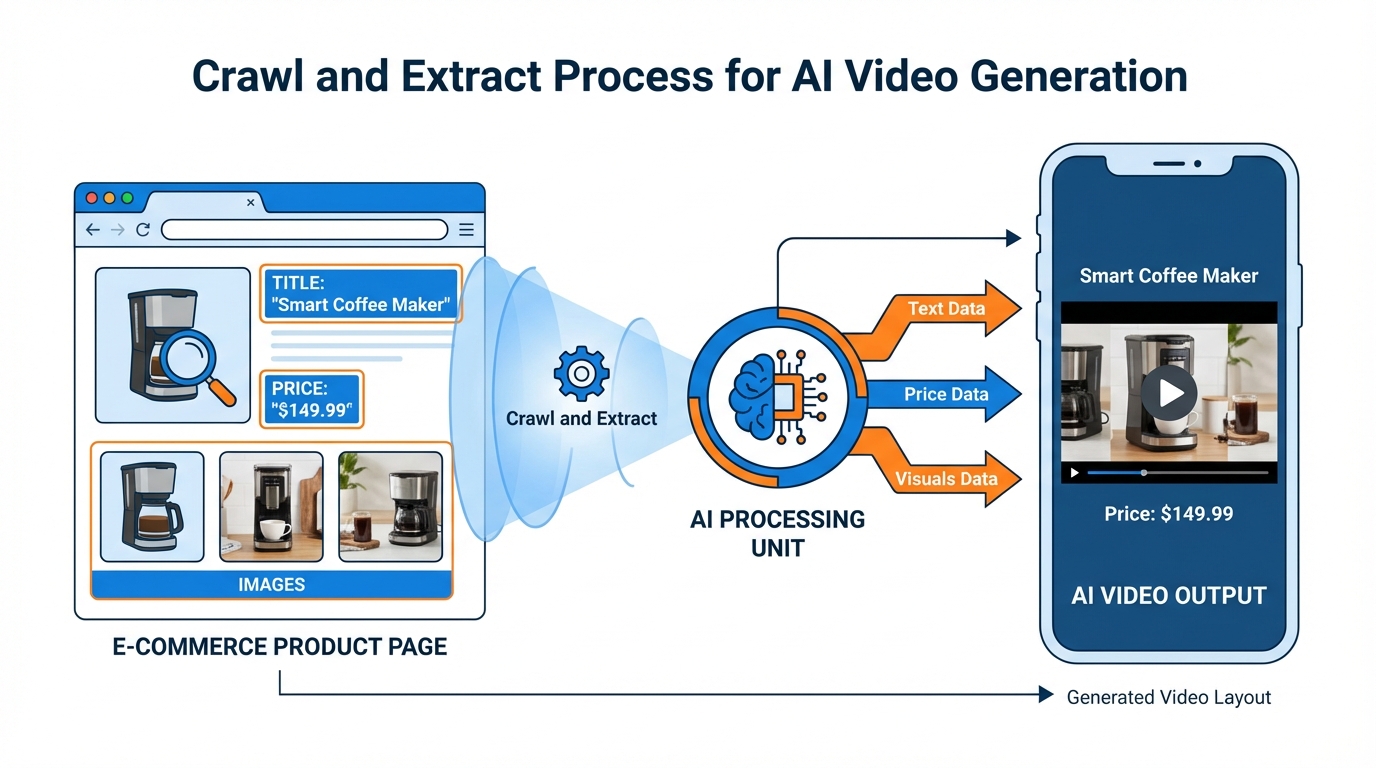
The “Auto-Storyboard” phase follows, where the extracted fields are mapped to a pre-defined scene structure. A typical high-performance storyboard might look like this:
- Scene 1 (The Hook): Product hero image paired with a bold value proposition.
- Scene 2 (Benefits): A quick-cut montage of the product's top three features.
- Scene 3 (Social Proof): Dynamic display of customer ratings and a featured review snippet.
- Scene 4 (Urgency): Current price, discount percentage, and any limited-time offers.
- Scene 5 (The Close): A strong CTA with a Shopify Buy Button or a direct URL overlay.
Media synthesis occurs simultaneously, where motion templates apply brand-specific lower thirds, transitions, and overlays. If the brand requires multi-language support, the AI voiceover engine generates the audio track in the target language during this phase. Finally, the multi-format render engine produces the necessary variants for different platforms. The finished assets are then delivered via CDN links or direct upload hooks to the brand's Digital Asset Management (DAM) system or directly to platforms like Amazon and Shopify.
Sources:
Enterprise Ecosystems: Mastering Shopify Video Integration and Amazon Listing Videos
For e-commerce giants, the utility of a URL to video AI generator is maximized when it integrates seamlessly with existing platforms. Shopify video integration is a prime example. By utilizing Shopify’s product media APIs, developers can automate the placement of generated videos directly into the product media gallery. This ensures that when a customer lands on a PDP, they are immediately greeted by a high-quality video that demonstrates the product in action. Best practices for Shopify include mapping video assets to specific variant IDs, ensuring that if a customer selects a “Blue” version of a product, the video reflects that specific choice.
In the Indian marketplace, Amazon listing videos are a critical component of the “Evaluation” phase of the customer journey. Amazon India encourages sellers to upload at least one video per listing, noting that it significantly improves customer trust and conversion. However, these videos must comply with strict content policies. They must accurately represent the product without prohibited claims or excessive text overlays. A product page video converter can be configured to produce “Amazon-compliant” variants that follow these rules automatically, ensuring that the brand’s listings are never flagged or suppressed.
Beyond the PDP, these videos should be aligned with A+ Content strategies. By integrating video into the enhanced brand content sections, sellers can create a more immersive storytelling experience. This is particularly important for complex products that require more than a few seconds to explain. The ability to programmatically generate these videos from a URL means that even a catalog with thousands of SKUs can be fully optimized for Amazon India within days, rather than months.
Sources:
- Shopify Developer Docs: Manage product media
- Amazon India Seller Central: Images and videos guide
- Amazon India: PDP rules and policies
- Amazon India: A+ Content reference

The Scale Playbook: CSV to Video Bulk Generation and REST API Video Personalization
When dealing with enterprise-scale catalogs, manual URL entry is insufficient. This is where CSV to video bulk generation becomes essential. Marketers can upload a single CSV file where each row represents a product and each column maps to a template variable—such as product name, price, discount, hero image URL, and a specific review excerpt. The system then processes these rows in batches, applying retry semantics and validation checks to ensure every video is rendered perfectly. This allows a brand to refresh the creative for 500 SKUs in a single afternoon.
For even deeper engagement, REST API video personalization allows for 1:1 creative variants. By submitting variables such as a customer's first name, their city, or a recently viewed product to the API, the generator can produce a video tailored specifically to that individual. This is particularly powerful for CRM-triggered journeys, such as “Price Drop” alerts or “Abandoned Cart” reminders sent via WhatsApp or email. TrueFan AI's 175+ language support and Personalised Celebrity Videos further enhance this capability, allowing brands to deliver messages that resonate on a deeply personal level across diverse global audiences.
The technical implementation of this involves authenticating via an API key, submitting a POST request with the data payload, and then polling a status endpoint to retrieve the final asset URL. This API-driven video creation model is designed for low-latency environments where real-time triggers are necessary. By using idempotency keys, developers can prevent duplicate renders, ensuring that the system remains efficient and cost-effective even at a scale of millions of videos.
Sources:
Implementation and Governance: Deploying Automated Video Creation from URL at Scale
Deploying an automated video creation from URL strategy requires a balance between speed and control. For a quick-start, no-code approach, the workflow is simple: paste the URL, verify the extracted fields, pick a template, and render. However, for enterprise-grade operations, the focus shifts to security and governance. This includes ISO 27001 and SOC 2-grade controls to ensure data integrity. In the Indian context, moderation filters are also vital to ensure brand safety and compliance with local advertising standards. DPDP-compliant personalization strategies
Governance also extends to how assets are approved and distributed. Enterprise systems should include content approval workflows where a creative director can review a random sample of a bulk batch before they are pushed live. Audit logs provide a transparent record of who generated which asset and when, which is crucial for large, distributed teams. Interactive video data capture solutions like TrueFan AI demonstrate ROI through these streamlined workflows, reducing the manual labor involved in creative production while maintaining a high bar for brand consistency and security.
Finally, the measurement of success must be data-driven. KPIs such as watch-through rates (3s, 50%, 100% completion), PDP dwell time, and ROAS should be tracked via a centralized dashboard. This analytics loop allows marketers to see which templates or personalization elements are driving the most revenue, feeding those insights back into the template design process. By treating video production as a continuous, automated cycle rather than a series of one-off projects, enterprise brands can sustain a 10x content velocity that keeps them ahead of the competition.
Sources:
Frequently Asked Questions
What is a URL to video AI generator?
A URL to video AI generator is an enterprise-grade software solution that programmatically converts a web URL—such as a product detail page or landing page—into an ad-ready video. It achieves this by crawling the page, extracting key assets like images and text, and mapping them to a storyboard for automated video creation from URL without the need for manual filming or editing. Learn more about URL to video AI generators
How fast can videos render in an enterprise pipeline?
In high-performance enterprise pipelines, the system targets as fast as a 30-second rendering time per short-form variant. This speed is achieved through parallel processing and GPU-accelerated scheduling, allowing brands to generate thousands of videos in a single day to support large-scale marketing campaigns.
Can we automate e-commerce product videos for entire catalogs?
Yes. By utilizing CSV to video bulk generation and API-driven video creation, brands can process their entire product catalog simultaneously. This ensures that every SKU has a high-quality video asset for use on Shopify, Amazon, and social media platforms, maintaining brand consistency across thousands of items.
How does REST API video personalization work?
REST API video personalization works by allowing developers to submit specific variables—such as a user's name, location, or purchase history—to the video generation engine. The engine then renders a unique video variant for that specific user, which can be delivered via CRM triggers like email or WhatsApp to increase engagement.
Do you support Shopify and Amazon India workflows?
Absolutely. The system is designed for seamless Shopify video integration via product media APIs and provides Amazon-compliant video outputs. For the Indian market, this includes adhering to Amazon India Seller Central rules for product detail page videos and A+ Content. See the Shopify and Amazon integration guide
How is TrueFan AI different from generic video editors?
TrueFan AI is built for enterprise scale, offering features like SSO, audit logs, and ISO-grade security that generic editors lack. Furthermore, TrueFan AI's 175+ language support and Personalised Celebrity Videos provide a level of localized engagement and authority that manual tools cannot replicate at scale. Discover TrueFan AI’s personalization capabilities



