

URL-to-video AI generator: The enterprise-ready, scalable URL-to-video API for 10x content velocity
Estimated reading time: ~12 minutes
Key Takeaways
- A URL-to-video API converts live web pages into brand-safe, channel-ready videos in under 30 seconds.
- Bulk generation via CSV and automation enables 1:1 video coverage across massive SKU catalogs.
- Enterprises prioritize security, compliance, and governance with ISO/SOC controls, RBAC, and template locking.
- Personalization at scale supports 175+ languages and CRM-triggered lifecycle moments.
- Optimized for Shopify, Amazon, and social channels with policy-compliant outputs and observability.
In the hyper-competitive digital landscape of 2026, a URL-to-video AI generator has transitioned from a luxury experimental tool to a core infrastructure requirement for high-growth enterprises. This technology functions as an API-first service that ingests a public or authenticated web page URL—such as a product page, category listing, or landing page—and programmatically parses its content. By mapping extracted text, pricing, and media to brand-safe templates, it renders high-fidelity, channel-ready videos in under 30 seconds. Platforms like TrueFan AI enable enterprises to bridge the gap between static web content and high-engagement video assets, facilitating a shift from manual production to automated, programmatic content delivery.
The 2026 Evolution of Scalable URL-to-video API Technology
The global AI video generator market is projected to reach $847 million in 2026, exhibiting a compound annual growth rate of over 18% as brands move toward autonomous content pipelines. Indian enterprises are at the forefront of this shift, leveraging GPU-backed rendering and studio-grade orchestration to maintain a competitive edge in a video-first economy. Modern performance marketing teams no longer rely on traditional filming schedules, which often create bottlenecks and prevent rapid iteration across thousands of SKUs. Instead, they adopt a scalable URL-to-video API to ensure continuous creative updates so that every product update or price change is instantly reflected in their video ad creative.
Current industry data suggests that 85% of leading D2C brands in India have integrated some form of AI-native video production into their tech stack by early 2026. This momentum is driven by the integration of advanced compute capabilities, such as NVIDIA’s specialized rendering architectures, which have reduced production costs by nearly 60% compared to 2024 levels. In the post-Sora era, the focus has shifted toward multi-model pipelines that prioritize coherence, brand safety, and speed over purely generative novelty. For enterprise buyers, this means favoring solutions that offer tight Service Level Agreements (SLAs) and policy-compliant outputs that meet the rigorous standards of global marketplaces.
The adoption of these automated workflows is accelerating particularly within India’s creator and brand economy, where the need for localized content is paramount. With the proliferation of regional commerce, a scalable URL-to-video API allows for the simultaneous generation of content across dozens of dialects without increasing headcount. This capability ensures that marketing messages remain culturally resonant and linguistically accurate, which is essential for maintaining trust in diverse markets. As we move deeper into 2026, the ability to repurpose web content into video programmatically is becoming the primary differentiator for brands seeking to dominate the attention economy.
Sources:
- Analytics India Magazine: InVideo x NVIDIA Collaboration
- Analytics India Magazine: AI Video Trends 2026
- Fortune Business Insights: AI Video Generator Market Growth
Technical Architecture for API-driven video creation
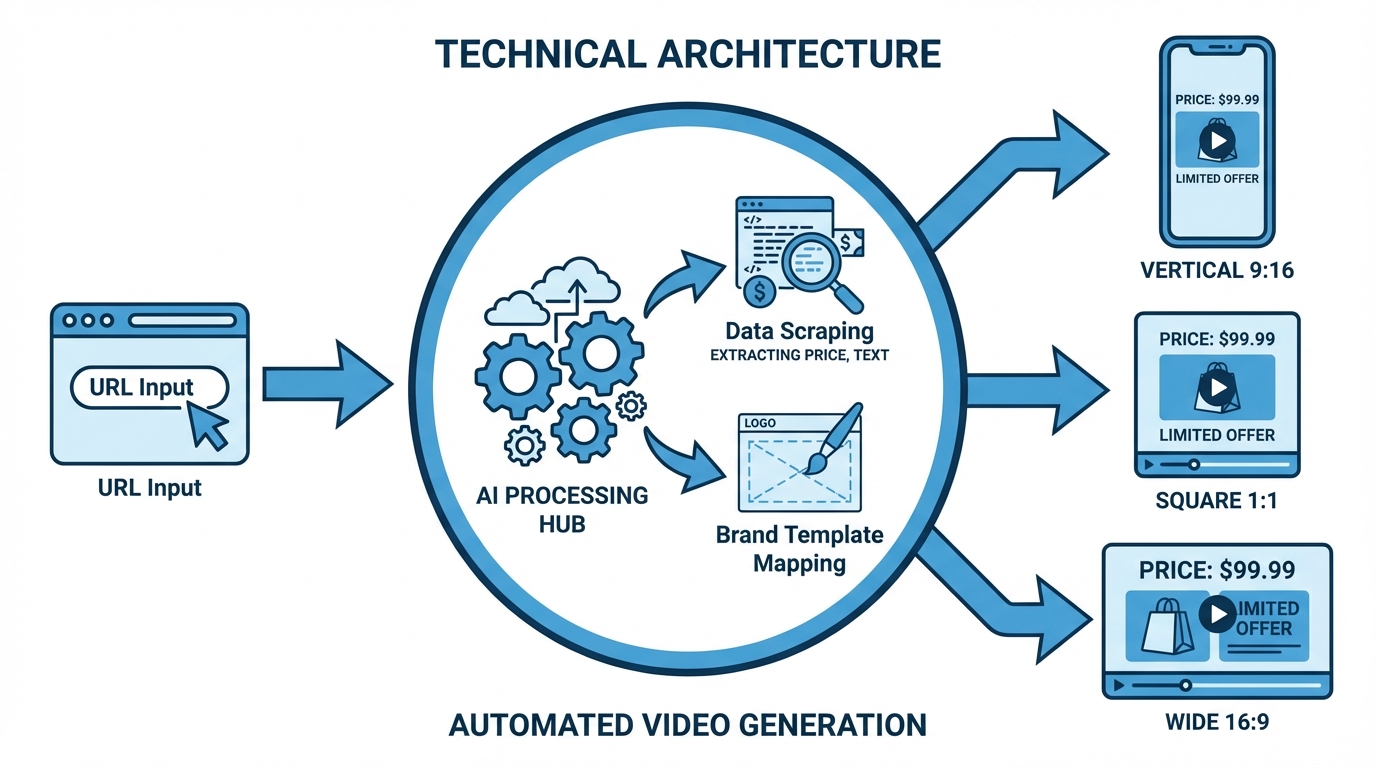
The core of a robust API-driven video creation workflow lies in its ingestion and parsing engine, which must handle diverse HTML structures and private authenticated URLs. Upon receiving a POST request, the system utilizes advanced scrapers to extract critical metadata such as product titles, current pricing, hero images, and customer ratings. This data is then normalized into a structured JSON format, ensuring that the subsequent rendering stages receive clean, predictable inputs regardless of the source page's complexity. For private or pre-launch pages, the API supports authenticated ingestion via signed headers or OAuth2 scopes, maintaining strict data privacy.
Once the data is ingested, it is mapped to a sophisticated templating system where brand governance is enforced through locked design tokens. These templates define the visual hierarchy, including font styles, color palettes, and logo placements, ensuring that every generated video adheres to the brand's identity guidelines. Dynamic placeholders within the template—such as {price}, {discount_percentage}, and {cta_text}—are populated in real-time, allowing for thousands of unique variations to be produced from a single master design. This level of control prevents the "hallucination" issues common in purely generative models, providing a brand-safe environment for enterprise-scale deployment.
The final stages of the pipeline involve neural text-to-speech (TTS) and high-speed rendering, where the video is optimized for specific distribution channels. Modern systems utilize locale-aware pronunciation engines to support 175+ languages, ensuring that voiceovers and burned-in captions are natural and accurate. The rendering engine is typically optimized for sub-30-second latency, producing various aspect ratios (9:16 for Reels, 1:1 for Instagram, 16:9 for YouTube) simultaneously. Observability is maintained through request ID propagation and signed webhooks, allowing developers to track the status of every render and receive automated callbacks upon completion.
Sources:
Product page to video converter: Optimizing Shopify and Amazon
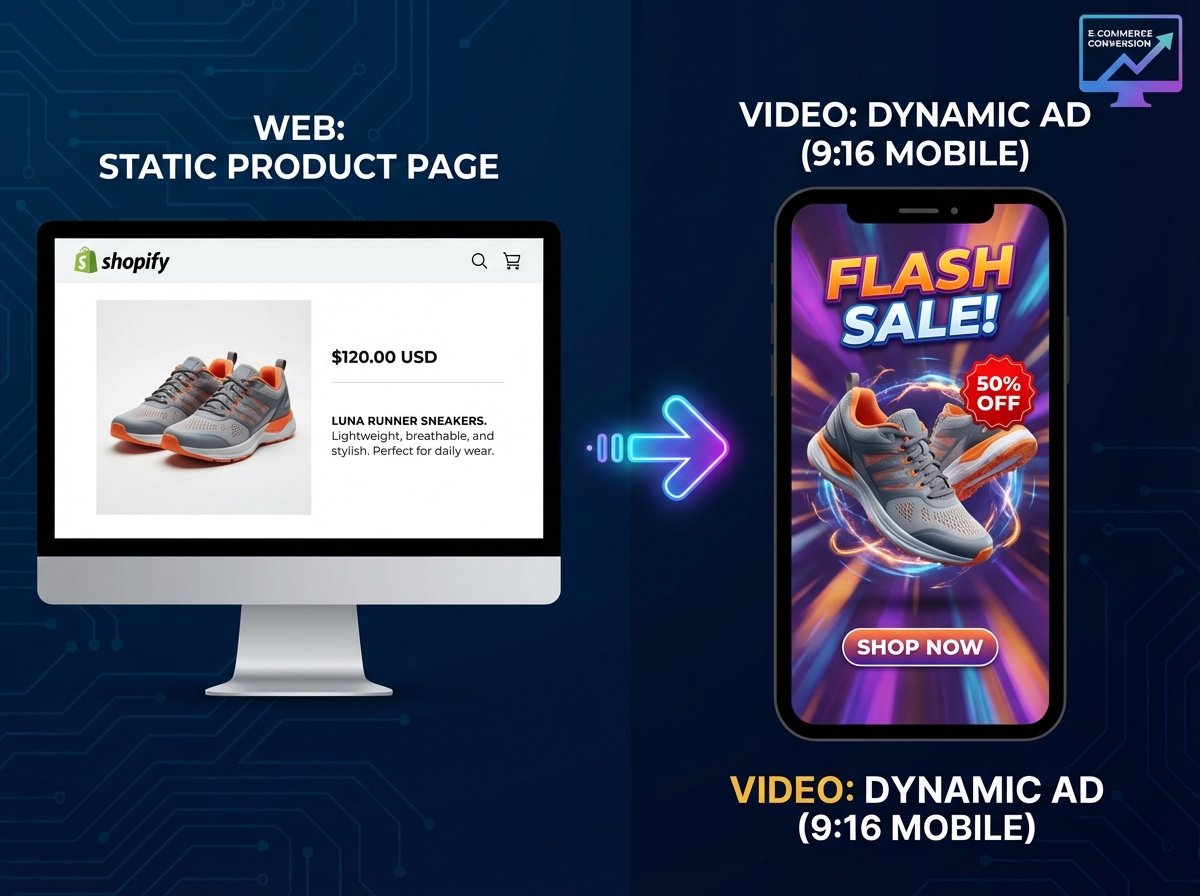
For ecommerce leaders, a product page to video converter is the ultimate tool for maintaining high-quality video coverage across massive SKU catalogs. On platforms like Shopify, the integration is typically handled via webhooks that trigger a video generation request whenever a product is created or updated. This ensures that the product media gallery is always populated with the latest promotional video, featuring current pricing and stock status. By automating this process, merchants can eliminate the manual effort of uploading videos for each individual SKU, which is particularly valuable for stores with thousands of items.
The Amazon India marketplace presents unique challenges that require a specialized approach to web content video automation for marketplace compliance. Amazon’s Seller Central has strict compliance guidelines regarding video duration, aspect ratios, and content claims, necessitating a generation pipeline that includes automated linting. A scalable API can render 30-45 second product highlight videos that specifically meet Amazon’s shoppable video requirements, including high-contrast captions and clear call-to-actions. Once generated, these assets can be programmatically submitted for approval, with the system tracking status updates and retrying renders if any compliance issues are flagged.
Beyond individual product pages, enterprises use these converters to scale their presence across social commerce and messaging apps. By converting a Shopify PDP into a 15-second vertical video, brands can instantly launch high-intent ads on platforms like Instagram and Moj. This "content repurposing" approach ensures that the investment made in web content is fully leveraged across all digital touchpoints. In 2026, the ability to maintain a 1:1 ratio between product listings and video assets is no longer a goal but a standard expectation for top-tier ecommerce players in the Indian market.
Sources:
- Amazon India Seller Central: Shoppable Video Guide
- Shopify India Blog: Video Marketing Strategy
- Amazon India: Add Product Images and Video Hub
CSV to video bulk generation and Advanced Personalization
When dealing with seasonal sales or festive campaigns, CSV to video bulk generation allows marketing teams to produce thousands of personalized assets in a single batch. By uploading a structured data file containing product URLs, customer names, and specific discount codes, the API can orchestrate a massive rendering job that runs in parallel across a GPU farm. This method was famously utilized by Zomato to generate over 354,000 unique videos in a single day, demonstrating the sheer throughput possible with modern AI pipelines. Such scale is physically impossible with traditional video editing, making bulk generation a cornerstone of modern performance marketing.
TrueFan AI's 175+ language support and Personalised Celebrity Videos provide the necessary localization depth for global market penetration. This capability allows brands to not only personalize the text and images but also the spokesperson and the language they speak. For example, a national brand in India can send a personalized video greeting to a customer in Tamil Nadu featuring a regional star speaking Tamil, while simultaneously sending a Hindi version to a customer in Delhi. This level of hyper-localization has been shown to increase engagement rates significantly, as seen in Goibibo’s 17% lift in WhatsApp read rates when using personalized video nudges.
The integration of REST API video personalization into CRM workflows enables lifecycle triggers that drive immediate action. For instance, a "cart abandonment" trigger can call the API to generate a video featuring the specific item left in the cart, along with a personalized discount for the user. These videos are then delivered via WhatsApp Business API or email, providing a much more compelling reason to return than a standard text reminder. As we move through 2026, the transition from static "Dear [Name]" emails to dynamic, celebrity-led video messages is becoming the new benchmark for customer experience and retention.
Sources:
Enterprise AI video API: Security, Compliance, and Governance
For large-scale organizations, selecting an enterprise AI video API with robust controls involves a rigorous evaluation of security posture and data governance. Compliance with international standards such as ISO 27001 and SOC 2 is non-negotiable, as these platforms often handle sensitive customer data and proprietary brand assets. Furthermore, the ethical use of AI, particularly concerning celebrity likeness and voice cloning, requires a consent-first model where every digital asset is legally cleared for use. Solutions like TrueFan AI demonstrate ROI through significant lifts in click-through rates and reduced production overhead while maintaining these strict ethical and security guardrails.
Governance within the API environment is managed through Role-Based Access Control (RBAC) and template locking mechanisms. This ensures that only authorized personnel can modify core brand templates, preventing accidental departures from visual identity guidelines. Additionally, automated content moderation filters are integrated into the rendering pipeline to detect and block any prohibited phrases or imagery before the video is finalized. This "safety-by-design" approach is critical for enterprises operating in regulated industries like finance or healthcare, where every piece of communication must meet legal and compliance standards.
Performance and reliability are equally important, with enterprises requiring clear SLOs for rendering times and API uptime. A high-performance 30-second rendering API built for scale must offer queue transparency and regional edge delivery to ensure that videos are available to end-users with minimal latency. Developers look for features like idempotency keys, which prevent duplicate renders in the event of network retries, and signed webhooks to verify the authenticity of the data received from the API. These technical safeguards allow enterprises to build mission-critical applications on top of AI video infrastructure with total confidence in the system's stability.
Sources:
30-second rendering API: Measuring ROI and Implementation
The implementation of a 30-second rendering API typically follows a structured roadmap designed to prove value within a short pilot window. In the first phase, engineering teams integrate the core POST /v1/videos/from-url endpoint to automate video creation for a subset of high-traffic landing pages. This allows the marketing team to A/B test AI-generated video against static images, providing immediate data on conversion rate lifts. By focusing on a "10x content velocity" scorecard, brands can measure the reduction in time-to-market for new campaigns and the increase in overall SKU coverage.
To maximize ROI, enterprises should track both production efficiency and performance metrics. Production efficiency is measured by the number of man-hours saved on editing and the decrease in cost-per-video, which often drops from thousands of rupees to a fraction of that cost. Performance metrics include the lift in Click-Through Rate (CTR) on PDPs and the increase in "Add to Cart" actions for users who viewed a personalized video. For example, Hero MotoCorp’s campaign saw tens of thousands of customers visit dealerships following a personalized video greeting, proving that digital automation can drive significant offline business outcomes.
As we look toward the remainder of 2026, the integration of content repurposing automation will become a standard part of the editorial and marketing workflow. Brands that can instantly turn a blog post or a customer review into a high-quality video will outpace those stuck in traditional production cycles. The goal is to create a seamless loop where every piece of web content automatically generates its video counterpart, ensuring a consistent and engaging presence across every digital channel. By adopting an API-first approach today, enterprises are future-proofing their marketing stack for the next decade of AI-driven engagement.
Sources:
Recommended Internal Links
- Enterprise AI Video Platform: Real-Time API for Scale
- Enterprise AI Video Platform: Secure, Scalable Solutions
- Enterprise AI Video Platform: Secure, Scalable, API-First
Frequently Asked Questions
What types of web pages can a URL-to-video AI generator process?
The generator is designed to ingest a wide variety of page types, including ecommerce product pages (PDPs), category listings, long-form blog posts, and custom landing pages. It can also handle authenticated or "behind-the-wall" pages by using signed headers or OAuth2 tokens provided in the API request. This flexibility allows enterprises to automate video creation for everything from public marketing sites to private loyalty portals.
How does REST API video personalization handle different languages?
The API utilizes neural text-to-speech and advanced translation models to support over 175 languages and regional dialects. When a request is made, the developer specifies the target locale, and the system automatically adjusts the voiceover, on-screen text, and subtitles to match. This ensures that the personalized content is linguistically accurate and culturally relevant for a global audience.
What are the typical rendering times for a 30-second rendering API?
Most enterprise-grade APIs target a P95 rendering time of under 30 seconds for a standard 15 to 30-second video. This low latency is achieved through high-performance GPU clusters and optimized rendering pipelines. For bulk jobs involving thousands of videos, the system uses parallel processing to maintain high throughput, ensuring that even massive campaigns are completed within hours.
Can I use CSV to video bulk generation for Amazon and Shopify listings?
Yes, bulk generation is the preferred method for updating large catalogs on marketplaces like Amazon and Shopify. By providing a CSV file with product IDs and URLs, you can trigger a batch job that generates compliant videos for every item in your store. These assets can then be programmatically uploaded to the respective platforms using their native APIs or management tools.
How does TrueFan AI ensure the security of my brand assets and customer data?
TrueFan AI maintains a robust security posture by adhering to ISO 27001 and SOC 2 standards, ensuring that all data is encrypted and handled with the highest level of care. The platform also features built-in content moderation and template governance to ensure that all generated videos are brand-safe and compliant with ethical AI standards. This makes it a trusted partner for enterprises that require both innovation and rigorous security.
Is it possible to integrate these videos into WhatsApp and Email campaigns?
Absolutely. The API provides direct asset URLs or hosted CDN links upon completion of a render, which can be easily embedded into WhatsApp Business API messages or HTML emails. Because the videos are generated in real-time based on user triggers, you can deliver a personalized video message to a customer exactly when they are most likely to engage, such as immediately after a purchase or a search.



